

CLICK HERE for the latest market quotes from the Iowa Agribusiness Network!
CLICK HERE for the latest market quotes from the Brownfield Ag News Network!


CLICK HERE for the latest market quotes from the Iowa Agribusiness Network!
CLICK HERE for the latest market quotes from the Brownfield Ag News Network!
BOONE, Iowa [KCCI] – A Boone family is recovering after a fire destroyed their barn and killed six show lambs over the weekend. The fire reportedly started on the west end of the barn and quickly spread to the entire building. The cause of the fire, which took place Saturday afternoon, was still under investigation.
Heath Oakes – who owns the barn – said he suspects a pile of manure may have self-combusted and ignited old corn stalks. The flames were fanned by strong winds. The flames spread across the field and down to the road, but firefighters managed to prevent damage to a neighbor’s field.
Oakes tried to save the lambs, but the flames were too intense. Despite the loss of livestock, Oakes expressed relief that his family was unharmed.
The family still has a few lambs in a nearby barn. They have set up a GoFundMe to assist with rebuilding efforts.
(Radio Iowa) – A ceremonial groundbreaking today in Boone for a plant that will produce Daisy Brand sour cream and cottage cheese. The 676 MILLION dollar project will eventually employ over 250 people. Ben Sokolsky is president of the family-owned company. “It is our most ambitious project yet,” Sokolsky said. Milk for the plant will come exclusively from Marshall Ridge Farms in nearby State Center, one of the largest dairy farms in Iowa. It will add seven-thousand cows to its milking operation by the time the Daisy plant in Boone opens in late 2028 or early 2029.
“Without milk, none of this would be possible,” Sokolsky said, “so that’s pretty important.” Sokolsky spoke at a luncheon in Boone today (Tuesday). Dan Culhane, president and C-E-O of the Ames Regional Alliance, was the host. “While economic development occurs every day in our communities, it doesn’t always come together to this magnitude,” Culhane said. “And so that’s what we’re really celebrating today.” Boone Mayor Elijah Stines says it’s a transformative project.
“One that will not only reshape the economic landscape of Boone, but the entire region,” Stines said. “…The future of Daisy Brands, the City of Boone and the State of Iowa is all brighter because of this investment.” Governor Kim Reynolds says many groups and individuals get credit for making the deal with Daisy possible — including local leaders, state agencies and the private sector. “This nearly $700 million investment isn’t just a number. It represents real opportunity. It means hundreds of new jobs, it means an expanded tax base, it means new momentum for local businesses, schools and family farms,” Reynolds says.

Ceremonial groundbreaking for Daisy Brand plant in Boone with Gov. Reynolds in center and Daisy Brand president Ben Sokolsky to the left of Reynolds. (RI photo)
“It simulates construction with plans for housing and hospitality projects already underway.” Daisy Brand currently has plants in Texas, Arizona and Ohio. State Agriculture Secretary Mike Naig says the project in Boone will boost Iowa’s dairy industry and create permanent, good paying jobs. “Today is a heaping dollop of good news and we can all be excited about that,” Naig said, prompting laughter from the crowd as he recited a line from a Daisy sour cream commercial.
Over one of every two cups of sour cream sold in the United States is Daisy Brand sour cream. Data shows overall sales of cottage cheese were up 16 percent last year and the company’s president says Daisy Brand hasn’t seen this kind of growth in cottage cheese sales since the 1970s.
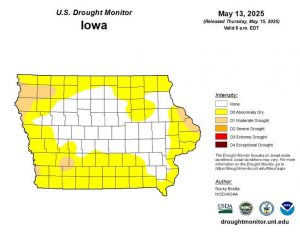
(Radio Iowa) – An Iowa State University weather and climate specialist says the rain we are getting is welcome for farmers across the state. Madelynn Wustenberg says improved soil moisture will support crops as they enter a critical part of the growing season. Most of the state is planted for corn and soybeans at this point and emergence is really starting to look good. So this is a really good time to have some of that rainfall so that we can, yeah, just get some moisture to those roots and get plants really popping up,” she says.
Wustenburg says the corn and soybeans should both benefit. “I would expect that we see some pretty decent growth in the next few days,” Wustenburg says. She says the rains this week will help the state catch up to get closer to normal for the month. “Climatologically what we would expect in mid-May is anywhere from around an inch to an inch and a quarter, maybe even an inch and half per week. So we’re definitely behind with the past couple of weeks being pretty dry across the state,” she says.
Wustenburg the soil moisture profile has been pretty similar to the same time last year prior to the latest rains.
Cass County: Corn $4.17 Beans $9.97
Adair County: Corn $4.14 Beans $10.00
Adams County: Corn $4.14 Beans $9.96
Audubon County: Corn $4.16 Beans $9.99
East Pottawattamie County: Corn $4.20 Beans $9.97
Guthrie County: Corn $4.19 Beans $10.01
Montgomery County: Corn $4.19 Beans $9.99
Shelby County: Corn $4.20 Beans $9.97
Oats: $2.97 (same in all counties)
(Radio Iowa) – Another dry week allowed farmers to spend a lot of time planting. The U-S-D-A report shows the corn planted jumped from 76 to 91 percent in the last week. That’s 12 days ahead of last year and four days ahead of the five-year average. The north-central region, with 97 percent, and the northwest, with 96 percent, lead the way in corn planting. Soybean planting moved from 64 to 84 percent complete, eight days ahead of last year and six days ahead of normal.
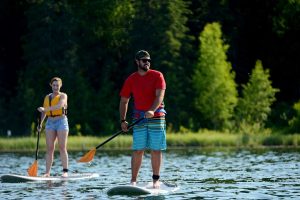
(Lewis, Iowa) – The warmer weather is giving people the itch to, get outside and have fun. The Cass County Conservation Department has several things you can do, to get back to nature. Naturalist Lora Kanning says their kayak and paddle-boarding programs this Memorial Day weekend, are one way you can get some fresh air and stay cool.
Paddle-boarding, she said, provides a core workout for your hips and thighs.
The Conservation Department will provide you with a life jacket for the 45-minutes you’ll be on the paddle-board, if you don’t have one. Since paddle-boarding is mostly done on calm water, if the wind is strong, the event may be canceled. Lora Kanning said registration for the paddle-boarding and kayak spots are done online, at mycountyparks.com. Kayaks are available in the sit-in or sit-on-top versions. The programs for both are designed to be introductory, for those who have never experienced paddle-boards or kayaks. Children must be 16-years-of-age or older, and paddlers must weight less than 250-pounds. For the kayaks, users must weigh less than 395-pounds.
Paddle Boarding
The Cass County Conservation Board is also hosting a “Movie in the Park” this Friday, and again the weekend of Labor Day, both at Cold Springs State Park.
The movie “Dog Man” is about when a dog and a police officer are injured together on the job, a life-saving surgery changes the course of history. Half dog, half man, Dog Man is sworn to protect and serve as he doggedly pursues his arch-nemesis: the feline supervillain Petey the Cat. The movies begin at dark, or generally around 9-p.m. You do not have to be a registered camper to attend the showing, and in the event of rain, the movie will be rescheduled.
For more information, call 712-769-2372.
Cass County: Corn $4.15 Beans $10.03
Adair County: Corn $4.12 Beans $10.06
Adams County: Corn $4.12 Beans $10.02
Audubon County: Corn $4.14 Beans $10.04
East Pottawattamie County: Corn $4.18 Beans $10.03
Guthrie County: Corn $4.17 Beans $10.07
Montgomery County: Corn $4.17 Beans $10.05
Shelby County: Corn $4.18 Beans $10.03
Oats: $2.93 (same in all counties)
(Iowa News Service) – Rural Iowans are asking lawmakers to be more aggressive in fighting for cleaner water in the state’s notoriously dirty rivers, lakes, and streams. Advocates from across the country gathered in Des Moines this month to exchange ideas on how to address the issue.
People from as far away as Maine and Arizona gathered at the Rural Policy Action Summit in Des Moines to address health care costs, a labor shortage in rural America, declining funding for public schools – and manure runoff from large ag operations polluting the state’s waterways.
Iowa Citizens for Community Improvement’s Executive Director Lisa Whelan said ag pollution keeps many lakes closed for recreation in the summer. “We need clean water,” said Whelan. “We are facing a real water crisis here – not only about quality, but also about quantity.”

Lake Okoboji is a popular Tourist Area known as the Great Lakes of Iowa
Corporate ag operators contend they consistently look for ways to be more environmentally conscious, but are often cited for ground and surface water pollution. Beyond clean and healthy water, Rural Democracy Initiative Communications Director Michael Chameides said there was also consensus at the summit on addressing concerns about worker safety, especially in Iowa’s rural towns.
“And so, we saw this concern for agricultural communities where there can be really harsh conditions for farm workers or for workers who are working in meat processing plants,” said Chameides, “but also other small factories, for people sort of needing a safe work environment.”
Chameides said people at the summit also expressed frustration about corporate consolidation and the undue influence of special interest groups in Washington, D.C. having an outsize influence on policies that affect rural Americans.
Iowa Drought Monitor graphic (5/15/25)
(Radio Iowa) – Groups representing corn growers and the ethanol industry are urging Governor Kim Reynolds to veto a bill that would put new restrictions on carbon pipelines. House Speaker Pat Grassley says House Republicans who’ve passed several pipeline-related bills over the past few years are extremely happy the Senate finally passed one this week.
Grassley, as House speaker, is required to sign each bill that passes the House. In a rare move, Grassley held bill signing ceremony with fellow House Republicans on Wednesday night.
Grassley said “…It’s something that we would really have a high expectation of the governor to sign.” Grassley made his comments during taping of “Iowa Press” which airs tonight (Friday) on Iowa P-B-S. The Iowa Renewable Fuels Association and the Iowa Corn Growers Association say the bill will effectively ban carbon pipelines in Iowa. Kelly Nieuwenhuis, a farmer from Primghar who’s a past president of the Iowa Corn Promotion Board, was at the Capitol this week to lobby against the bill.
About three miles of Summit’s pipeline route goes through Nieuwenhuis’s property. Nearly three years ago he signed a contract giving the company access to that section of his land.
Governor Reynolds has until mid-June to sign – or veto — all the bills that passed the legislature.


 Facebook
 Twitter
 YouTube
 RSS
RSS