

CLICK HERE for the latest market quotes from the Iowa Agribusiness Network!
CLICK HERE for the latest market quotes from the Brownfield Ag News Network!


CLICK HERE for the latest market quotes from the Iowa Agribusiness Network!
CLICK HERE for the latest market quotes from the Brownfield Ag News Network!
Cass County: Corn $4.13 Beans $10.09
Adair County: Corn $4.10 Beans $10.12
Adams County: Corn $4.10 Beans $10.08
Audubon County: Corn $4.12 Beans $10.11
East Pottawattamie County: Corn $4.16 Beans $10.09
Guthrie County: Corn $4.15 Beans $10.13
Montgomery County: Corn $4.15 Beans $10.11
Shelby County: Corn $4.16 Beans $10.09
Oats: $3.12 (same in all counties)
(Cedar Rapids, Iowa; by an FFA Reporter) – The Atlantic FFA Chapter competed in the annual Iowa FFA Horse Judging Career Development Event held at Kirkwood Community College on June 10, 2025. Atlantic FFA had a team and individual that participated in this year’s Career Development Event. Team members Kayedance Sturm, Clara Kennedy, Callie Rudy and Paislee Klever earned a silver medal.
The Horse Judging CDE is designed to provide the student an opportunity to display their agricultural knowledge and skills in the area of Equine Science. Each team member evaluated halter and performance classes. They also answered questions over the classes and gave oral reasons to explain their placings. A written examination was included along with a team problem solving competition.
In the Halter division, Kayedance placed second overall while the team placed 3rd overall. Sturm said, “Every year horse judging at Kirkwood College has been an amazing team building experience the night before going to eat, to going to the contest. I can’t wait to see what next year’s results hold for us.”
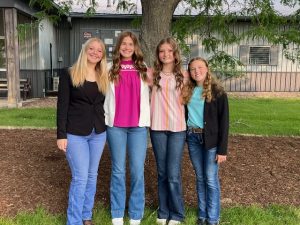
(From left-to-right): Kayedance Sturm, Clara Kennedy, Paislee Klever, Callie Rudy. (photo submitted)
Team member Clara Kennedy said “Aside from our pre judging nerves we have become more confident and grown as a team. We always make the most of our trip, from the night before, the drive there and back, to the actual reason we are there, for the contest. It will be exciting to see how our team continues to progress in the upcoming year.”
Callie Rudy said, “With the team being very young, it was a lot of fun. You can tell throughout the team that we have improved and that we genuinely love to do it. Always having fun the night before whether we go shopping or are hanging out in each other’s rooms it is always a blast with the team. The contest may be challenging, but it is a good experience for everyone.”
Paislee Klever said, Horse judging is a very fun experience I think everyone should try. The pre contest nerves are always the worst but not only the contest but being with your teammates, going shopping, having supper and just bonding was so fun. The contest might come across hard to others and it can be but that’s why we work for it, and we will get better as the years go on.”
The Iowa FFA Horse Career Development Event was made possible with support through the Iowa FFA Foundation Gold Standard Partners. The Horse Career Development Event was coordinated and held at the Iowa Equestrian Center in Cedar Rapids. Kirkwood Community College also provided lunch to all participants.
(Radio Iowa) – A few dozen tiny turtles were turned loose in a wetland in Guthrie County this month, the next important step in helping the rare creatures regain numbers in a state where they were once plentiful. Mick Klemesrud, a spokesman for the Iowa DNR, says many populations of Blanding’s turtles died out during a frigid, snowy spring about a decade ago. With the help of Blank Park Zoo in Des Moines, more than 50 were hatched and raised last year.
“We released 32 of them last week. Most of them had a transmitter on them, so we’re going to track their movements and try and get some information on these juveniles, what they do, search for habitat and where they move throughout the wetland,” Klemesrud says, “so we could maybe make some management decisions based on that to help these turtles survive.”
An adult Blanding’s turtle may grow to 10 inches in diameter, resembling an old-style army helmet, but each of these youngsters would fit in the palm of your hand. So how do you track them? Klemesrud says Iowa State University is also a part of this project.
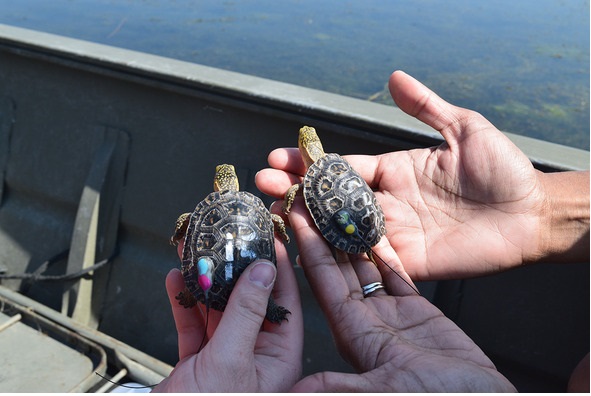
Two of the Blanding’s turtles (Iowa DNR photo)
“They have a student technician that’s going to be going out every day this summer with an aerial transmitter, and she’s going to be tracking these. There’s different frequencies associated with different transmitters,” Klemesrud says. “She’s going to be collecting some of this information just to see, where are they going? What are they using? What is their preferred habitat in the wild?”
Blanding’s turtles are a threatened species in Iowa and they’re being considered for federal listing. Besides the frigid weather, Klemesrud says the turtles face many other challenges in Iowa.
“The turtles will travel a long distance to lay their eggs and so they have to travel across a lot of roads and sometimes they get hit by vehicles. There’s a lot of nest predators that will just completely wipe out their nests,” Klemesrud says. “We have very little natural reproduction. It takes about 14 to 20 years for these turtles to become mature and to start laying eggs, the females, so it just takes a long time to get these back.”
In an agency statement, DNR director Kayla Lyon says: “In the wild, just hatching means these turtles beat the odds. Leaving the nest and finding the wetland is another major achievement, and making it to year one is like winning the lottery — which makes today all the more exciting.”
She says the restoration of wetlands and shallow lakes benefits Blanding’s turtles, in addition to many other wildlife species, including nesting trumpeter swans and sandhill cranes.
(Radio Iowa) – Dozens of landowners who would be impacted by the proposed Summit Carbon Solutions pipeline project held a conference call today (Thursday) to talk about the governor’s veto of the pipeline bill. Megan Sloma is the part owner of a Century farm in Sioux County says the governor chose the rights of the pipeline company over landowners, without any alternatives. “My dad told me growing up to never bring him a problem without also bringing him possible solutions, so I would ask Governor Reynolds what is your solution to help the land owners?,” Sloma says. Wright County land owner Julie Glade says she is “righteously angry” about the veto. ”
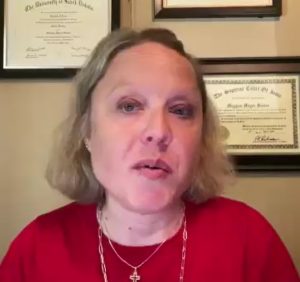
Megan Sloma. (Photo from Sierra Club video news conference)
Governor Reynolds, I’d like for you to tell me how modern life depends on the pumping of a waste product, highly pressurized and dangerous, through our very productive rich family farmland. I feel like she’s thrown us under the bus and sided with wealthy corporate interests in the state of Iowa,” Glade says.
Glade says people are paying attention like never before, and that will show when its election time. “My phone was exploding yesterday with messages from friends and family that heard the breaking news that governor Reynolds had vetoed our bill,” Glad says. “This is going to be a high priority election issue from here on out. We are going to make sure of it. We can do what South Dakota did and elect representatives that will reflect the will of the majority in Iowa, unlike Governor Reynolds and her minions in Senate leadership.” Bremer County Supervisor Cory Cerwinske says the veto is extremely disheartening, and says the governor’s reasoning is absolutely flawed from any and every angle. “This isn’t an agree to disagree circumstance, as we sometimes see ourselves varying over legislation. This veto is an outright attack on our inalienable rights that we, the people, are protected by both our U-S and Iowa Constitutions,” Cerwinske says. He supports the effort to override the veto, and also wants the governor removed from office.
“I suggest to speaker Grassley that in addition to an attempt to override, that our General Assembly addressed the glaring issue of the governor’s malfeasance by ignoring the Constitution to decimate our private property rights with her actions, by going forward and introducing articles of impeachment under the guidelines contained in Article three, Section 20 of the Iowa Constitution,” Cerwinske says. Republican Representative Steven Holt of Denison says impeachment is not the way to go. “Look, I understand everybody’s emotions on this, but a governor choosing to veto a piece of legislation in spite of what we feel about how it may violate the Constitution and those sorts of things probably doesn’t rise to the level of impeachment. So I doubt that that would get gained much traction,” Holt says.
Holt says that there would likely not be enough votes in the Senate for a special session to override the veto. He says the veto will be an issue for legislation the governor proposes in the next session, and they will continue to bring up legislation in the House to force the issue. “And the Senate is going to figure out. What they’re going. To do about, you know, they tried for over four years. They stopped the will of the people through their elected representatives to address this issue, they hid behind process and refuse to let legislation come to the floor and now the chickens have come home to roost in the Senate. They’ve got a civil war going on in the Senate, they’ve attack one another,” Holt says.
The bill the governor vetoed would have put limits on the use of eminent domain for pipelines. The governor says the bill was too broad and would impact other projects outside of carbon pipelines.
DES MOINES, June 11, 2025 – The Iowa Association of Business and Industry (ABI), in partnership with MidWestOne Bank, Wednesday, announced the winner of the 2025 Coolest Thing Made in Iowa competition: the CP770 cotton picker, manufactured by John Deere in Ankeny. The CP770 Cotton Picker was introduced in 2021 and is a leader in cotton harvesting technology. The picker is larger, faster, and more efficient than previous models. In addition, the model features smart tech that offers guidance to farmers in the fields.
Sixty-nine products were nominated for this year’s competition, representing manufacturers from 51 Iowa communities. After an initial public voting round and a head-to-head bracket-style tournament, four finalists emerged to compete for the title. More than 93,000 votes were cast throughout the contest, demonstrating the pride Iowans have in the products made in their state.
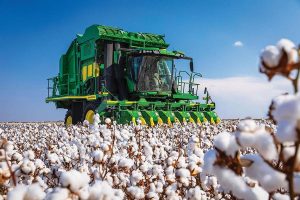
JD CP770 Cotton Picker
One of the products that made it into the Top Four, was The Moose Fireplace Grill – The Moose Fireplace Grill , which is manufactured in Red Oak.
This is the second year of the Coolest Thing Made in Iowa contest. The Vermeer ZR5-1200 self-propelled baler won during the first year in 2024. The Iowa Association of Business and Industry says the contest is successful and plans to bring it back next year.
(Radio Iowa) – Governor Kim Reynolds has vetoed a bill that would have made it harder for Summit Carbon Solutions to seize land along the pipeline route from unwilling property owners. Reynolds says she respects both sides in the debate over the use of that eminent domain authority, but Reynolds says the bill is too broad and affects other types of energy infrastructure. The ethanol industry and the Iowa Corn Growers Association have been urging Reynolds to reject the legislation. Monte Shaw is with the Iowa Renewable Fuels Association.
“The governor did a really good job explaining there’s a lot of problems with this bill,” Shaw said. Shaw says the bill would have diminished Iowa’s ethanol industry as well as prospects for Iowa corn farmers.”Carbon capture and sequestration is the key to unlocking almost all of the new markets for biofuels demand and for corn demand,” Shaw said. House Speaker Pat Grassley, the top Republican in the House, has called for a special session of the legislature, to override the governor’s veto. Representative Bobby Kaufmann, a Republican from Wilton, helped craft the bill.
“Kim Reynolds has failed the state of Iowa. Kim Reynolds has soiled her legacy,” Kaufmann said, “and her legacy is now spitting in the face of landowners and being Bruce Rastetter’s errand girl.”Bruce Rastetter is the founder of Summit Carbon Solutions. Kaufmann says Reynolds has been steadfast in her defense of constitutional rights over her tenure as governor, and he’d expected her to sign the bill into law. “Clearly she has chosen special interests and Bruce Rastetter over private property rights,” Kaufmann said. “I vow today to work against and kill every single bill she comes up with because I no longer trust her judgement.”
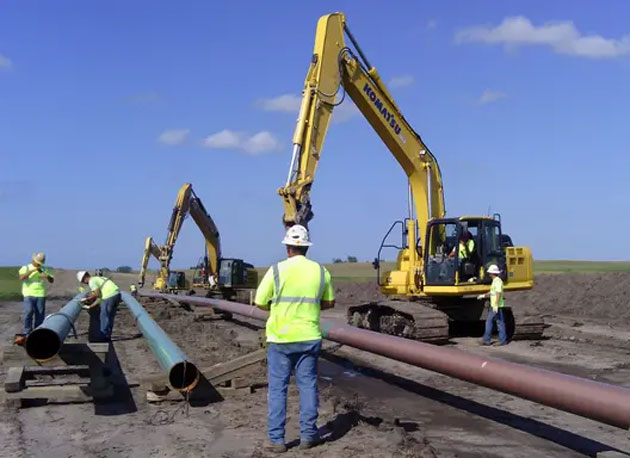
Pipeline construction (2023 file photo from Iowa Utilities Commission photo)
Representative Steven Holt, a Republican from Denison, led House debate on each piece of pipeline-related legislation over the past few years. “The governor had three years to weigh in on this,” Holt said. “The governor could have given us her suggestions. She continues to say she wants to protect landowner rights, but she’s done nothing in three years to do that. The landowners have pleaded to meet with her. She didn’t meet with them until recently. She’s had ample opportunity, like the Senate had, to weigh in and protect landowners and they didn’t, so I’m profoundly disappointed.”
Senate Republican Leader Jack Whitver says he supports the governor’s decision to veto the bill and he expects a majority of Senate Republicans would not be interested in any attempt to override her veto. Whitver says a significant majority of Senate Republicans support a better policy to protect landowner rights. Shaw, the Iowa Renewable Fuels Association’s executive director, says the industry is open to negotiations. “We stand ready to work with people who want to improve the system, but not kill the carbon capture project,” Shaw said, “and if people are wanting to do that, we stand ready.”
Reynolds says the debate has highlighted areas were real progress is possible. The governor says she wants to work with lawmakers to strengthen landowner protections, modernize permitting and respect private property.
(Atlantic, Iowa/FFA Advisor Eric Miller) – Each year the Southwest District and Iowa FFA officers plan and facilitate Chapter Officer Leadership Training (COLT) Conferences for FFA members in the Southwest district. Atlantic welcomed FFA chapters from all over the Southwest district on June 3, 2025. This year 196 members from 32 chapters from across Southwest Iowa participated in this unique leadership training experience.
While at Atlantic on Tuesday, district and state officers lead four interactive workshops for FFA Chapter leaders, many of which are officers, for the annual COLT Conference. The workshops facilitated were local FFA Chapter programs focused in the areas of advocating for the agriculture industry, connecting with stakeholders, recruiting for the local chapter, and working as a cohesive team. FFA leaders also received training relative to their specific officer duties within the local chapter.
Iowa FFA President, Chloe Zittergruen, stated, “COLT conference provides a chance for FFA members to learn more about their responsibility as a local leader and is a conference for members to meet and connect with state, district and other chapter officers.”
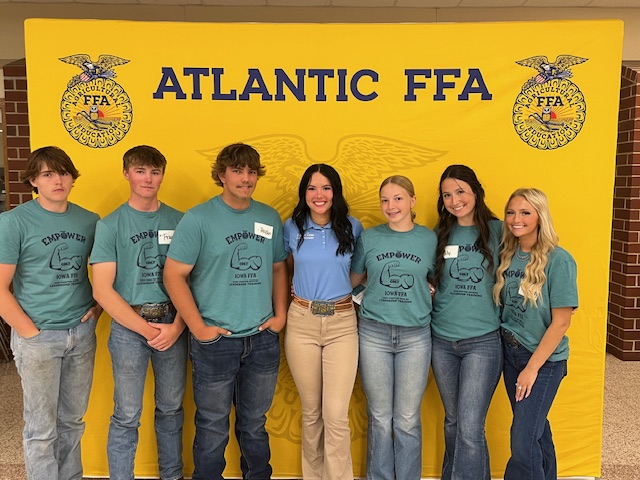
(Left-to-right: Keston Schmitt, Frank Freund, Hayden Kleen, Lauren Comes, Claire Schroder, Lily Johnson, Maddy Anderson. [photo submitted]
COLT conference is made possible with support from Farmers Mutual Hail Insurance of Iowa through the Iowa FFA Foundation. Atlantic Bottling provided drinks for all of the participants as well.
(Radio Iowa) – The volume of U.S. pork exports is down about 9% compared to this time a year ago and it’s not just trade tensions with China that caused the drop. “While China’s a major market that is significantly down, we’re fewer sales into Mexico, South Korea, Japan, Canada, Australia,” said Iowa State University agricultural economist Chad Hart. “We’re seeing losses sort of across the board.”
It’s happening at a time when American’s pork industry needs to sell as much pork as possible, according to Hart. “Pork production has continued to hedge higher and higher over the past few years, meaning that we have plenty of pork to work with here,” Hart said, “and while the domestic market has been very good for the pork industry, we need international growth as well in order to help balance out the pork market.”

Iowa State University agricultural economist Chad Hart (ISU photo)
Hart indicated the U.S. is facing export competition from countries, but worries about the global economy. “When people are worried about their incomes worldwide, what they tend to do is slow their consumption down,” Hart said, “and I think we’re definitely seeing that when it comes to our pork market.”
In 2024, the United States told 3 million metric tons of pork, followed by the European Union, which sold 2.9 million metric tons of pork products. Brazil is the world’s third leading exporter of pork.
(USDA Press Release, Washington, D.C., June 10, 2025) – U.S. Secretary of Agriculture Brooke L. Rollins, joined by Secretary of Health and Human Services Robert F. Kennedy Jr., today (Tuesday) signed three new food choice waivers to Make America Healthy Again. The signed waivers will amend the statutory definition of food for purchase for Supplemental Nutrition Assistance Programs (SNAP) in Arkansas, Idaho, and Utah, each commencing in 2026.
“The Trump Administration is unified in improving the health of our nation. America’s governors have proudly answered the call to innovate by improving nutrition programs, ensuring better choices while respecting the generosity of the American taxpayer. Each waiver submitted by the states and signed is yet another step closer to fulfilling President Trump’s promise to Make America Healthy Again,” said Secretary Rollins.
USDA photo 6-10-25 Ag Sec. Brooke Rollins
“Thank you to the governors of Indiana, Arkansas, Idaho, Utah, Iowa, and Nebraska for their bold leadership and unwavering commitment to Make America Healthy Again,” said Secretary Kennedy. “I call on every governor in the nation to submit a SNAP waiver to eliminate sugary drinks—taxpayer dollars should never bankroll products that fuel the chronic disease epidemic.”
Secretary Rollins and Secretary Kennedy were joined at the event by Governor of Arkansas Sarah Huckabee Sanders and Governor of Indiana Mike Braun.
“This approval sends a clear message: President Trump and his administration are tackling America’s chronic disease epidemic and Arkansas stands with him in that fight,” said Governor Sanders. “I am incredibly grateful for Secretary Rollins’ quick approval of our waiver. Arkansas leads the nation in getting unhealthy, ultra-processed foods off food stamps and helping our most vulnerable citizens lead healthier lives.”
“Indiana is proud to be a leader in the Make America Healthy Again initiative, and I’m proud to join Secretary Rollins, Secretary Kennedy, Congressman Baird, and my fellow Governor Sarah Huckabee Sanders today to discuss returning SNAP to its proper purpose of nutrition, and how my Make Indiana Healthy Again agenda supports Indiana agriculture and empowers Hoosiers to live longer, healthier lives,” said Governor Braun.
Prior to these waivers, SNAP recipients could buy anything except alcohol, tobacco, hot and prepared foods, and personal care products. This historic action expands the list of products excluded from SNAP purchases in Arkansas, Idaho, and Utah. Arkansas’ waiver excludes soda, low and no-calorie soda, fruit and vegetable drinks with less than 50% natural juice, other unhealthy drinks, and candy, and it will take effect July 1, 2026. The waiver for Idaho excludes soda and candy, and it will take effect January 1, 2026. The waiver for Utah excludes soft drinks, and it will take effect January 1, 2026. Secretary Rollins has previously signed waivers for Nebraska, Iowa, and Indiana.
“Idaho proudly welcomes the MAHA movement because it is all about looking for new ways to improve nutrition, increase exercise, and take better care of ourselves and one another, especially our children. We are excited to partner with the Trump administration in bringing common sense to the government’s food assistance program with the approval of our SNAP waiver,” said Governor Brad Little.
At the direction of President Trump, Secretary Rollins is ensuring programs work harder to encourage healthy eating and improved lifestyle habits while protecting taxpayer dollars. On Secretary Rollins’ first full day in office, she sent a letter to the nation’s governors (PDF, 88.8 KB), outlining her vision for the Department and inviting them to participate in a new “Laboratories of Innovation” initiative to create bold solutions to long-ignored challenges. Secretary Rollins and Health and Human Services (HHS) Secretary Robert F. Kennedy Jr. wrote an opinion piece in USA Today outlining their plan to Make America Healthy Again, including through SNAP waivers like the ones signed today.
DES MOINES, Iowa — The Iowa Department of Natural Resources is investigating a fish kill at Dean Lake in southeast Des Moines.
The DNR Field Office began receiving reports during the week of June 6 of dead fish at the lake, located off East Market Street. Officials observed dark-colored water and a strong, septic odor at the site.
Dean Lake drains into a series of City of Des Moines stormwater basins located between East Martin Luther King Jr. Parkway and Maury Street, where fish are now showing signs of stress. Water from these basins eventually flows into the Des Moines River. While dead fish are expected to appear in the connected basins, the incident is not expected to affect aquatic life in the river.
The DNR urges the public to avoid these areas, including fishing and wading. The investigation remains ongoing.


 Facebook
 Twitter
 YouTube
 RSS
RSS