

CLICK HERE for the latest market quotes from the Iowa Agribusiness Network!
CLICK HERE for the latest market quotes from the Brownfield Ag News Network!


CLICK HERE for the latest market quotes from the Iowa Agribusiness Network!
CLICK HERE for the latest market quotes from the Brownfield Ag News Network!
(Iowa DNR News) – Iowa woodlands, wildlands and waterways draw hundreds of thousands of tourists and recreational users each year. Much of the spread of invasive species comes from people simply enjoying nature. Uninvited guests can hitch a ride on outdoor gear, shoes and clothes, traveling hundreds of miles in a single day.
Take these easy steps to stop the spread of invasive species in your community.

*********
Is your newly planted tree thirsty? You may need to water trees planted in the spring or summer one to three times a week in the first few months after planting. Water early in the morning or evening so the tree roots have a chance to absorb most of the water and the sun can’t evaporate it away. Check the moisture level in the soil near the tree’s trunk (four to six inches below the surface) at least once a week, and more often during hot, dry weather. If the soil feels moist or damp you can hold off on watering, if it is dry you need to water your tree. The soil should be moist, but not saturated after watering.
Newly planted trees need regular and consistent watering for optimal growth and health. A gallon of water is equal to about one inch of rainfall.
*********
The popular Trees for Kids grant program is accepting applications through August 22 to plant trees in public areas of communities (park, community center, public school, etc.) this fall. Grantees can be awarded up to $2,500 to purchase trees and mulch. Youth are required to be engaged in the process, most often helping to plant the trees on site. Studies show trees planted around schools and in neighborhoods give youth increased levels of concentration, lower levels of aggression, lower levels of obesity and fewer symptoms of ADHD.
Cass County: Corn $4.20 Beans $10.14
Adair County: Corn $4.17 Beans $10.17
Adams County: Corn $4.17 Beans $10.13
Audubon County: Corn $4.19 Beans $10.16
East Pottawattamie County: Corn $4.23 Beans $10.14
Guthrie County: Corn $4.22 Beans $10.18
Montgomery County: Corn $4.22 Beans $10.16
Shelby County: Corn $4.23 Beans $10.14
Oats: $3.16 (same in all counties)
(Des Moines, Iowa) – Officials with the Iowa Department of Natural Resources, in their latest “Beach Monitoring” report, said visitors are free to swim at a popular Council Bluffs beach.
Last week, the Iowa Department of Natural Resources classified the beach at Lake Manawa State Park as “vulnerable” due to E. coli levels. That has now been updated to “ok for swimming,” with no indication of bacteria or Algal toxin.
There’s only one beach in the state where swimming is not recommended — Emmerson Bay State Recreation Area at West Okoboji Lake, because test results exceeds the single sample standard for E.Coli.
(Lewis, Iowa) – The Cass County Conservation Board held a youth fishing derby at Cold Springs Park on Saturday, June 14, 2025.
Prizes were awarded for the most overall weight: 1st Breken Amos; 2nd Cillia Shinkle; 3rd Waylon Carrigan. Awards also given for heaviest single fish and longest single fish: Breken Amos;, and shortest single fish Braxton Miller.
The CCCB thank the businesses that donated items for the event: Weirich Welding for the trophies; Cappel’s Ace Hardware, and Scheels for prizes.
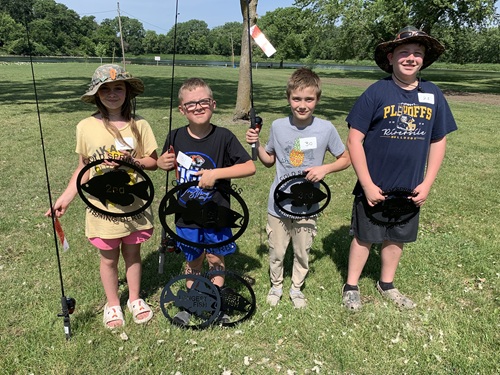
(From left to right): Cillia Shinkle; Breken Amos; Waylon Carrigan; Braxton Miller. (Photo courtesy Cass County Naturalist Lora Kanning).
SIDNEY, Iowa – Southwest Iowa area producers are invited to an evening pasture walk with Jake and Shane Smith on July 1 at the Fremont County Fairgrounds in Sidney. Experts from Iowa State University Extension and Outreach and the Natural Resources Conservation Service will cover a number of topics during the program. The event begins at 6 p.m. with supper served by the Fremont County Cattlemen, followed by the program at 6:30 p.m. The fairgrounds are located at 1004 Legion Rd, Sidney.
Speakers are ISU extension beef specialist Erika Lundy-Woolfolk, ISU extension field agronomist Aaron Saeugling, and NRCS district conservationist Lucas Forney. Their topics include pasture condition scoring, grazing management, weed control and pasture fertility, common forage insects, and USDA programs. The event will wrap up with a walk-through of the Smiths’ cattle pasture, located just west of the fairgrounds.
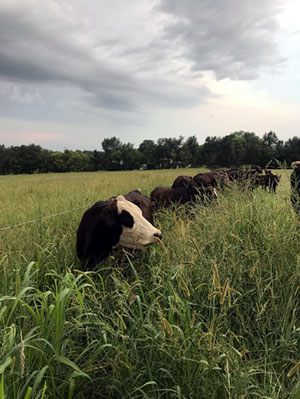
The Fremont County Pasture Walk takes place July 1st
Preregister by June 25 by calling 712-374-2351 or emailing xfremont@iastate.edu. Be sure to request any special accommodations, including dietary needs, when you preregister. This program is provided at no out-of-pocket cost to participants. Iowa State University Extension and Outreach educational programs are supported by federal, state, and county funds, as well as grants, contracts, user fees, and donations.
AMES, Iowa (6/13/25) – The Iowa State University Cash Rental Rates for Iowa 2025 Survey has been published, and the results make an interesting read for any land owner, tenant, or farm manager.
For the first time in six years, row crop rental rates decreased by almost 3%; however, rental rates on pasture and forage acres across the state remain steady to 3% higher for the ninth straight year. Record high beef prices, narrowing margins on forage acres, increasing competition for existing forage acres, and rising property taxes likely play a significant role in the strong forage rental rates faced by Iowa cattlemen and small ruminant producers.
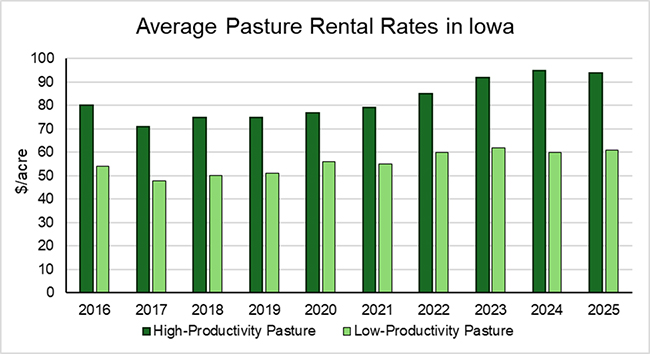
Rental rates on pastures in Iowa have increased almost 20% over the last decade. For high productivity pastures with an estimated stocking rate of 2.5 or less acres per pair for the summer and adequate fence and water, the state average rate reported was $94/acre in 2025. Over the last ten years, rental rates bottomed in 2017 at $71/acre and recently topped at $95/acre in 2024.
For low-productivity pastures defined as pasture requiring more than 2.5 acres per pair, the 2025 state average rate reported was $61/acre.
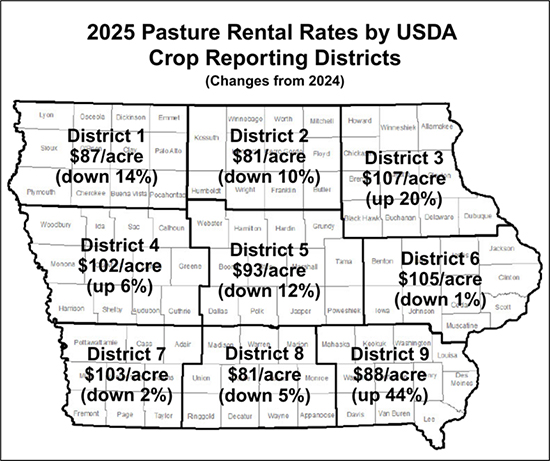
Highest pasture rental rates were reported in USDA Crop Reporting District 3 (Northeast at $107/acre), District 5 (East Central at $105/acre), District 7 (Southwest at $103/acre), and District 4 (West Central at $102/acre). Lowest rates reported fell in District 2 (North Central at $81/acre) and District 8 (South Central at $81/acre). District 5 (Central) saw the largest reduction in average prices at $26/acre from 2024 to 2025 while District 9 (Southeast) saw the largest increase at $27/acre from 2024 to 2025.
Despite high carryover numbers in stored hay this spring, cash rent prices for established alfalfa hay acres continues to remain strong at an average of $206/acre. This equates to a 25% increase from $165/acre in 2016 and is up $6/acre from the 2024 state average reported at $200/acre.
While established grass hay acres have followed a similar trend as alfalfa, rental rates on oat acres harvested for forage production came in at $187/acre, down $11/acre from the previous year.
Data generated from this annual survey carried out by the ISU extension farm management team is reported on a statewide basis as well as by crop reporting district levels for forages. Although response rate varies, the report holds value as a year-to-year comparison. It is important to note these are not recommendations for rental rates but rather intended to serve as a starting point for negotiating prices, as multiple factors go into establishing a rental rate for each unique farm including productivity, drainage capacity, longevity of the lease, fence and water availability, and services performed by parties. You can download the entire Cash Rental Rates for Iowa 2025 Survey (FM1851).
(Iowa Capital Dispatch) – The U.S. Environmental Protection Agency, Friday, released its renewable fuel standards draft rule which, if finalized, would set record high levels of biofuels to be blended into U.S. transportation fuels. Iowa Renewable Fuels Association Executive Director Monte Shaw said the draft rule, which proposes a total 24.02 billion gallon blending level in 2026, is a “very strong starting point for further discussions.” Shaw said the association will need time to evaluate the proposal, specifically as it relates to changes in credits for imported fuels and feedstocks.
According to the proposal, EPA is considering “several regulatory changes” to the RFS program that would reduce the number of Renewable Identification Numbers, or RINs which is the measuring unit for renewable fuel, for imported renewable fuels and renewable fuels produced from imported feedstocks.
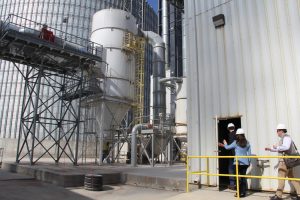
U.S. Secretary of Agriculture Brooke Rollins at the Elite Ethanol production facility in Atlantic. (Photo by Cecilia Lynch/USDA)
The U.S. Department of Agriculture reports imported biodiesel feedstocks, like used cooking oil, tallow and canola oil have all increased over the past several years due to the high cost of domestic feedstocks. According to the same report, in the 2023 and 2024 marketing year, the U.S. consumed nearly 30% of biofuel feedstocks exported globally.
The news to prioritize domestic feedstocks was welcomed by Iowa Soybean Association President Brent Swart, who said biomass-based diesel supports “roughly 10% of the price per bushel of soybeans.” U.S. Secretary of Agriculture Brooke Rollins said USDA and EPA have “never been more aligned” on the demand for domestically grown biofuels.
EPA will host a public hearing on the rules July 8.
Shaw said IRFA plans to work with EPA through the commenting period and to secure a final rule from the agency.
(Radio Iowa) – The Environmental Protection Agency is recommending a Renewable Fuels Standard for 2026 that would be a record amount — 24 billion gallons of biofuels produced for blending with petroleum based fuels. Iowa Renewable Fuels Association executive director Monte Shaw says it would continue corn-based ethanol production at 15 billion gallons next year — along with a big increase in renewable diesel and biomass-based diesel.
“The last Biden rule that they did for three years really underestimated the growth in biodiesel and renewable diesel, so it really hamstrung the growth in the industry from being what it could have been,” Shaw says. Soybean-based biodiesel is produced in Iowa. Renewable diesel is generally made by the petroleum industry. The public can now weigh in on the E-P-A’s recommended production levels for renewable fuels.
“We like most of what’s in here,” Shaw says, “but we will still be engaging in the public comment period.” Shaw says that’s because the final rule for biofuels production has been adjusted in the past based on public reaction. The Trump Administration’s proposal includes some provisions to limit bio-fuels imports.
Iowa is the nation’s top producer of ethanol and biodiesel. The proposed Renewable Fuels Standards for 2026 as well as 2027. Iowa elected officials are praising the proposal. Iowa Agriculture Secretary Mike Naig says the E-P-A’s announcement sends a welcome and optimistic growth signal to an important industry.
(Rural Cass County, IA) – A teen from rural Griswold has earned a position on the Iowa state/provincial National Junior High School Rodeo Team. McCoy H. Wicker, an 8th-grade student at the Oakland-Riverside School, will be traveling with fellow teammates to Des Moines (IA) June 22nd through the 28th, to compete at the 20th annual National Junior High Finals Rodeo (NJHFR) in Team Roping and Boys Goat Tying competitions. In addition, Wicker competed in the Iowa Junior High School Rodeo Association 2024-2025 season. He earned many achievements, culminating at the State Finals in Bloomfield, Iowa. Wicker concluded the Finals by achieving 1st in Boys Goat Tying, 2nd in Ribbon Roping, 5th in Chute Dogging. He also earned Rookie of the Year and received the Dalton H Baumann Exceptional Character Award.
Featuring roughly 1,200 contestants from 43 U.S. States, 5 Canadian Provinces, Australia, and Mexico, the NJHFR is the world’s largest junior high rodeo. In addition to competing for more than $80,000 in prizes, NJHFR contestants will also be competing for more than $200,000 in college scholarships and the chance to be named a National Junior High Finals Rodeo World Champion. To earn this title, contestants must finish in the top 20 – based on their combined times/scores in the first two go-rounds to advance to Saturday evening’s final round. World champions will then be determined based on their three go-round combined times/scores. Added money for the optional jackpot has increased to $100,000 and is available to everyone at finals who enters the jackpot in their event.
Again, this year, the Saturday championship performance will be televised nationally as a part of the Cinch High School Rodeo Tour telecast series on RFD-TV. Live broadcasts of all NJHFR performances will air on: https://www.cowboychannelplus.com/ . Performance times are 7 p.m. on June 22nd and 9 a.m. & 7 p.m. each day thereafter.
Along with great rodeo competition and the chance to meet new friends from around the world, NJHFR contestants have the opportunity to enjoy shooting sports, volleyball, contestant dances, family-oriented activities, church services sponsored by Golden Spur Ministries, and shopping at the NJHFR trade show, as well as visiting area attractions as Des Moines hosts the NJHFR this year. To follow your local favorites at the NJHFR, visit www.NHSRA.com daily for complete results.
For ticket information and reservations, go to: https://nhsra.com/juniorhighfinals/
 The change has been adopted by the following facilities:

 Facebook
 Twitter
 YouTube
 RSS
RSS