

CLICK HERE for the latest market quotes from the Iowa Agribusiness Network!
CLICK HERE for the latest market quotes from the Brownfield Ag News Network!


CLICK HERE for the latest market quotes from the Iowa Agribusiness Network!
CLICK HERE for the latest market quotes from the Brownfield Ag News Network!
(Radio Iowa) – None of the four Republicans who serve in the U.S. House crossed party lines this week to join Democrats in passing a resolution to override President Trump’s tariffs against Canada. Third District Congressman Zach Nunn of Ankeny says Trump’s trade reset with Canada is necessary. “Talking to a dairy farmer in western Iowa…when they tried to see dairy product to Canada, they were facing a 200% increased tariff are impacting,” Nunn says. “That was not only unfair to them, but it really goes to the point of what tariffs on both sides of the border are impacting so on this one, we feel very strongly that Canada needs to bring those down and make fair trade across the board a reality.”
Congresswoman Ashley Hinson of Marion says she voted against the resolution because Trump is the only one willing to even the playing field and reduce trade imbalances. Congresswoman Mariannette Miller-Meeks of Ottumwa says she appreciates Trump’s willingness to take on the egregious trade practices of foreign adversaries. Iowa Democrats say Trump’s tariffs are crushing farmers and hurting the overall economy. Nunn says Trump’s trade and tariff strategy is addressing a situation that’s been decades in the making.
“We have seen tariffs against the United States just really punish, particularly, our ag community,” Nunn said. “…When President Trump did tariffs on places like Vietnam and said: ‘Bring it to zero or you’re getting the same thing back,’ and they were at 95% against U.S. producers, in 24 hours we saw Vietnam drop it and so did the United States.” Nunn suggests, though, there could be a day when he’d vote to rescind tariffs imposed by a president. “I don’t want to see tariffs used viciously and I still believe that the first article in the Constitution says that congress should be leading this, but I do support the president in holding offenders accountable,” Nunn said. “Let’s bring trade tariffs down to zero.”
Nunn made his comments today (Friday) during taping of the “Iowa Press” program that airs tonight on Iowa P-B-S.
DES MOINES, Iowa (IOWA CAPITAL DISPATCH) – A House subcommittee advanced a bill Thursday that would allow landowners to renegotiate damage claims and file complaints with the Iowa Utilities Commission, or court, for damages and yield losses due to pipeline construction. Rep. David Young, R-Van Meter, sponsored the bill and said it was really about “the premise of you want to leave what you found … in the same condition if not better.”
Young specified that House Study Bill 691 was not related to any particular pipeline, but would provide “predictability” and “consistency” in the standards protecting landowners. The bill was supported by agricultural commodity groups including Iowa Corn Growers Association, Iowa Cattlemen’s Association, Iowa Soybean Association and the Iowa Farm Bureau Federation. Summit Carbon Solutions, a company seeking to build a carbon sequestration pipeline through Iowa, along with the Iowa Renewable Fuels Association, also registered in support of the bill.
Doug Struyk said some members of the Iowa Soybean Association, which he represented at the subcommittee meeting, are still dealing with yield losses from pipelines built close to a decade ago. The bill allows landowners to renegotiate damage claims for compensation with pipeline companies even if damages were apparent at the time of settlement, or it has been more than five years since a settlement was reached.
HSB 691 also allows landowners, rather than just county supervisors, to file complaints directly with the Iowa Utilities Commission. Landowners can also file claims in small claims or district courts for “violations of damage payment provisions” with the pipeline company.
Onnalee Gettler, a lobbyist for MidAmerican Energy Company, opposed the bill but offered an amendment to lawmakers that would “avoid unintended” legal outcomes of the bill text. Gettler said the ability for landowners to renegotiate claims past five years could lead to them reopening damage claims “in perpetuity,” and MidAmerican would like to see that language changed. She explained that part of the proposed amendment would also clarify the relationship between landowners and farm tenants to ensure a pipeline company is not required to compensate both landowners and tenants for the same parcel. Gettler said the utility company would support the bill if the amendment were adopted.
Rep. Charley Thomson, R-Charles City, chaired the subcommittee and said he intends to take a “closer look” at some of the language raised by MidAmerican. The Iowa Utility Association, American Petroleum Institute and Black Hills Energy were also registered against the bill, but did not speak at the hearing. Kevin Kuhle, speaking on behalf of the Iowa Farm Bureau Federation, said the language in the bill is supported by Farm Bureau policies set in 2022.
Under the bill, farmers could also seek compensation for things like lost or reduced yield, soil compaction, damage to irrigation systems and damage to soil or water conservation structures. Speakers and lawmakers on the committee noted that similar language has been brought up in the Legislature in the past, including in 2023 when a bill to restrict eminent domain for pipelines passed in the House.
The bill heads next to the House Commerce Committee.
(Atlantic) Officials with the Cass County Fair, Tuesday, reported on their social media page, that “Thanks to a national grant from Fairs.com, every fair board, volunteer team, and agricultural society across Iowa will receive fully funded training, tools, and support to strengthen the future of local fairs.”
Thanks to the grant, the Cass County Fair Board is able to host a “You make the difference” Fair workshop at the Cass County Community Center this Saturday, Feb. 14th, in Atlantic, beginning at 9-a.m. The Board invites anyone passionate about the future of the Cass County or other area fairs, to participate. That includes Fair board members, exhibition organizers, volunteers, community leaders, chamber members, county supervisors and superintendents, extension council members, sponsors, and anyone else who loves everything about their county fair. 
Attendees will learn:
The workshop will be led by Ian Hill, an award-winning advocate for ag societies and fairs.
The event is free to attend, but organizers request advance registration to ensure an accurate headcount.
To register, visit iowafairs.com, click on “Meetings,” then select “District Meetings.”
(Radio Iowa) – A bill ready for debate in a House Committee would shield Iowa farmers and renewable fuel producers from lawsuits or criminal charges related to the impact of greenhouse gas emissions like methane or carbon dioxide. The bill is supported by farm groups like the Iowa Corn Growers and Iowa Pork Producers. Kelli Klink is a lobbyist for the Iowa Cattlemen’s Association. “We recognize we need a safe, stable food supply,” Klink said, “and this bill prevents trivial lawsuits against the American farmer in providing food for all.” The bill allows exceptions that would allow farmers to be sued if there’s clear and convincing evidence they violated a government permit or regulation about emissions.
Representative Megan Srinivas, a Democrat from Des Moines, says the bill may be too vague. “We also aren’t differentiating between small farmers and larger bad actors,” Srinivas said, “and if we have no such differentiation, then we could just be having more accumulative problems, leading to worsening situations.”
The latest data from the Iowa Department of Natural Resources indicates agricultural production accounts for 29 percent of the state’s greenhouse gas emissions. Just over 80 percent of methane emissions come from farming operations.
(Des Moines, IA) – The Iowa Department of Natural Resources (DNR) will host a series of town hall-style meetings where local staff will provide updates on recently completed hunting and trapping seasons, discuss possible changes to hunting and trapping rules and regulations, and address other topics as requested. In the KJAN listening area, those meetings will be held:
The meetings are open to the public. Comments collected from these public meetings will be considered along with other related comments received by the Iowa DNR prior to proposing changes to hunting rules and regulations. Proposed rules will be presented to the Natural Resource Commission during a regular public meeting for consideration and additional public comment. Comments received during previous listening sessions have resulted in regulation changes, including modifying and removing areas closed to Canada goose hunting, establishing later goose season dates and increased bag limit, expanding the raccoon hunting and trapping season on private land, modifying Iowa’s antlerless deer quotas in north central and western Iowa, and extending the regular trapping season through the end of February.
Todd Bishop, chief of the Iowa DNR’s Wildlife Bureau, says “We want people to come out to these meetings, listen to the seasons reviews, ask questions and hear directly from our staff. Part of the meeting will be devoted to discussing potential rule changes and collecting feedback as we work through the rules process.”
Any person attending the public meeting that has special requirements, such as those related to mobility or hearing impairments, should contact the Iowa DNR or ADA Coordinator at 515-725-8200, Relay Iowa TTY Service 800-735-7942, or Webmaster@dnr.iowa.gov, and advise of specific needs.
Other meeting dates, times and locations include:
(An Iowa News Service report) – John Deere has recalled 245 workers in Iowa after mass layoffs. They’ll be back on the job this month and next. Prompted by weaker demand, a lagging agricultural economy and Trump administration tariffs on equipment, John Deere laid off workers across the Midwest last fall, including in Iowa.
Charlie Wishman, president of the Iowa AFL-CIO, said going back to work is a win for the workers, but also for the communities where they live. “When our communities here that are anchored by companies like John Deere, when those jobs, when those layoffs are announced,’ he said, “it doesn’t just throw the family, it throws an entire town into confusion and chaos and worry.” One hundred fifty of the recalled workers are going back to work at four Deere facilities in Waterloo.
Deere said the workers specialize in drive-train operations, tractor operations and engine works. Wishman said Deere weighed a handful of factors in deciding when to recall laid-off workers, adding that he believes the rehires will have a trickle-down effect. “To give these communities some stability, some insight and some understanding of what the future might look like for them,” he said, “it’s really, really good news.”
Some of the workers will return this month, and the rest will be back on the job in March.
(Radio Iowa) – With the temperatures rising in Iowa, the weekly ice fishing report from the Iowa Department of Natural Resources includes some warnings about ice fishing in areas of the state. The agency warns ice conditions are changing rapidly in north central Iowa and, in northeast Iowa, ice fishing on the Upper Iowa River is not recommended. However, opportunities in northwest Iowa the Iowa Great Lakes should be available for a few more weeks according to Andrew Carlson of the D-N-R’s Fisheries Bureau. He says it’s been a good season for ice fishing in the Okoboji region.
“Out on Spirit Lake, in particular, the yellow perch fishing has been really good this year, lots of reports of good sized perch and some small congregations of people out there enjoying the bite. We’ve also seen a lot of people fishing in recent weeks fishing West Okoboji and Smith’s Bay as well as parts of East Okoboji.”
he D-N-R says no ice is 100 percent safe and no one should go ice fishing alone. In February of 2024, a man cutting a new fishing hole on the ice of a Jackson County lake feel into the water when the ice buckled. A friend nearby grabbed the auger and helped the man stay afloat until another person arrived with a sled and helped pull the man out of the water.
Go to https://www.iowadnr.gov/things-do/fishing/fishing-tips-safety/ice-fishing for the DNR’s ice fishing report.
(Radio Iowa) – A new map from the U-S Drought Monitor shows almost half of Iowa is considered abnormally dry, while parts of three counties are now in moderate drought. Earlier this week, the state climatologist said Iowa’s in a snow drought, as January snowfall was about six inches below normal.
While months of dry weather triggered a drought resurgence in October, conditions in January improved slightly by comparison, as drought watches and moderate drought designations in eastern Iowa were removed. 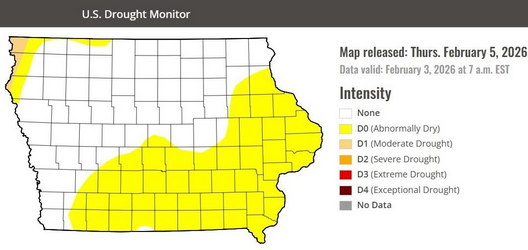 Still, there’s declining soil moisture, and January is typically Iowa’s driest month of the year.
The new drought map shows some 45-percent of the state’s abnormally dry, including much of eastern and southern Iowa along with a small patch in the northwest. That’s also where parts of Lyon, Sioux and Plymouth counties have fallen into moderate drought.
(Atlantic, IA) – The Cass County Extension office will be offering two opportunities for private pesticide applicators to attend their annual Private Pesticide Applicator Continuing Instruction Course (P-CIC), led by Extension Field Agronomist, Aaron Saeugling. The first session is scheduled for Thursday, February 12 at 1:30 PM. The course will be offered again on Thursday, March 19 at 6:30 PM. Preregistration is not required. Walk-ins are welcome on the day of the program.
The course will run for approximately 2 ½ hours, including check-in and breaks. The registration fee is $30. With questions or for additional information, contact the Cass County extension office at 712-243-1132 or email xcass@iastate.edu. The course will fulfill 2025-2026 recertification requirements for private pesticide applicators. Topics to be covered include:
To renew their certification, applicators must pass an exam every three years or attend an approved Private Continuing Instruction Course (P-CIC) between December 1 and April 15 each training period their certification card covers, including the year they passed the exam (if the certification is issued prior to October 1).
Applicators unable to attend in Cass County may take the training online or find another training location in a neighboring county. For more information on the Private Pesticide Applicator program or other upcoming CIC classes, please visit www.extension.iastate.edu/psep/.


 Facebook
 Twitter
 YouTube
 RSS
RSS