

CLICK HERE for the latest market quotes from the Iowa Agribusiness Network!
CLICK HERE for the latest market quotes from the Brownfield Ag News Network!


CLICK HERE for the latest market quotes from the Iowa Agribusiness Network!
CLICK HERE for the latest market quotes from the Brownfield Ag News Network!
Cass County: Corn $3.95 Beans $9.83
Adair County: Corn $3.92 Beans $9.86
Adams County: Corn $3.92 Beans $9.82
Audubon County: Corn $3.94 Beans $9.85
East Pottawattamie County: Corn $3.98 Beans $9.83
Guthrie County: Corn $3.97 Beans $9.87
Montgomery County: Corn $3.97 Beans $9.85
Shelby County: Corn $3.98 Beans $9.83
Oats: $3.32 (same in all counties)
(Iowa Capital Dispatch) – A press released Thursday from the U.S. Department of Agriculture, about the department’s response to the highly pathogenic avian influenza, shows the nation imported more than 26 million shell eggs, counted by the dozen, since January, which is more than 10 times the amount imported during the same period in 2024.
Increasing egg imports, enhancing biosecurity, researching vaccine options and providing financial relief to farmers were all elements of Agriculture Secretary Brooke Rollins’ plan to combat HPAI and lower the cost of eggs. Rollins said her five-pronged plan “has worked,” noting a 64% drop in wholesale egg prices and more than 900 completed biosecurity assessments at poultry farms across the country.
Rollins announced the $1 billion plan to combat the bird flu in February after three years of the H5N1 strain of the bird flu had eliminated nearly 170 million poultry birds and caused domestic egg prices to skyrocket.
From January 2024 to June 2024, the U.S. imported around 2.36 million shell eggs and just over 9.2 million egg products, according to an egg markets report from USDA. The USDA release said the U.S. had imported more than 26 million shell eggs, by the dozen, from Brazil, Honduras, Mexico, Turkey, and South Korea and imported an additional 14 million egg products, measured in dozen shell-egg equivalents since January 2025. The USDA press release said the efforts to increase imports have helped to “bolster domestic supply” and said by comparison, domestic egg production in 2024 totaled 109 billion eggs.
Iowa remains the top egg producing state in the country and to date has lost more than 29 million birds associated with commercial table egg production impacted by HPAI, according to data from the USDA’s Animal and Plant Health Inspection Service.
As part of Rollins’ plan, producers could have free biosecurity assessments at their facilities and receive USDA assistance for biosecurity improvements. According to the release from USDA, nearly 1,000 facilities have received the assessments, including 162 facilities in Iowa. Iowa ranked second on the list of states with the highest number of biosecurity assessments, behind Ohio at 214 assessments and above Pennsylvania at 144, Indiana at 129 and Missouri at 80 assessments. Of the assessments completed, 372 have looked at wildlife biosecurity according to APHIS.
The department also announced a grant challenge opportunity in March for research projects to support HPAI prevention, therapeutics, and potential vaccines. The Thursday release said the department received requests for more than $793 million in funding and the awards will be finalized in the fall.
(Radio Iowa) – Red Haw State Park is reopening its campground next week, more than three years after a powerful tornado tore through the southern Iowa park near Chariton.
Chad Kelchen, a district supervisor with the Iowa DNR’s Parks, Forests, and Preserves Bureau, says it’s been a challenging process to make repairs, and clean up and haul away the many hundreds of downed trees. Kelchen says campers and picnickers will notice some changes at the park.
“With the tornado coming through the campground like that, we were forced to rearrange the campground,” Kelchen says. “We’ve actually subtracted sites, making the sites a little larger and a little easier to get into. We have a few pull-through sites that overlook the lake now, and we have 52 sites in total, with the majority being electric sites.”

Red Haw State Park in 2025 (DNR photo)
The tornado struck on March 5th of 2022 and it was a whopper, rating as an EF-3 — with winds approaching 165 miles an hour — reducing wide sections of dense forest to an absolute mess.
“The tree damage was so severe that some of those trees were not safe to take down. We had to bring in specialized equipment, specialized labor forces to do that,” Kelchen says. “Then things like underground cables were ripped up by tree roots being pulled out of the ground by the winds. There was a lot of unforeseen damage that we found. The further we got into cleaning it up, the more that we found.”
Over the past three years, several events at the park have rallied dozens of volunteers to help remove debris and restore order.
“They were crucial,” he says. “That’s a small park with a single staff person in it, so bringing in those extra hands really helped us bring the debris out of the timbers and plant the new trees and all that we’ve done to bring the park back up and ready to go.”
While an untold number of trees were lost in the twister, Kelchen says they’ve planted many hundreds more since 2022, and they’ll continue doing so.
“I think we planted 1,000 trees in the timber, and then 50 or 60 in the campground to get us started,” Kelchen says. “Tree planting will be something that will occur each year in a smaller scale, just so we get a diverse year class and a diverse species we expect in the campground and in the area surrounding.”
The park features a 70-acre lake and more than four miles of grassy trails. The campground is slated to reopen July 1st.
(Radio Iowa) – Hormel Foods has named a long time manager at its Algona plant in a lawsuit accusing a competitor of trying to steal trade secrets.
The lawsuit claims that in 2023 Wisconsin-based Johnsonville hired Brett Sims, Hormel’s director of operations, and Sims began reaching out to several Hormel managers, inviting them to join Johnsonville. The suit alleges that Sims contacted Jeremy Rummel, the manager at Hormel’s Algona plant, soliciting information related to Hormel’s product formulas, processing procedures, acquisition targets, and marketing strategies. Hormel contends that Rummel accepted a job offer to work with Johnsonville and, before he left Hormel, the lawsuit alleges Rummel began to forward company information to his personal email account.
Hormel is seeking a judgement that will award damages from the breached agreements with its former employees, as well as a requirement that all disclosed trade secrets be retrieved, returned and/or destroyed.
Johnsonville has not released a statement on the lawsuit.
(Radio Iowa) – The latest Drought Monitor shows continued improvement in the state following more rain. The monitor shows 45 percent of the state has no drought conditions, that’s up from 31 percent last week. Just 20 percent of the state was without drought at the start of this year.
Around nine percent of the state has moderate drought, down from around 12 percent. Nearly 55 percent of the state is listed as abnormally dry, which is down from nearly 69 percent last week. The driest conditions are on the east and western edges of the state, with the southeast and south-central areas with the most counties with moderate or abnormally dry conditions.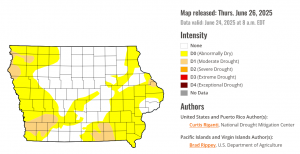
The data for the report is taken through Tuesday, and does not show the impact of the most recent rains.
Cass County: Corn $3.98 Beans $10.03
Adair County: Corn $3.95 Beans $10.06
Adams County: Corn $3.95 Beans $10.02
Audubon County: Corn $3.97 Beans $10.05
East Pottawattamie County: Corn $4.01 Beans $10.03
Guthrie County: Corn $4.00 Beans $10.07
Montgomery County: Corn $4.00 Beans $10.05
Shelby County: Corn $4.01 Beans $10.03
Oats: $3.10 (same in all counties)
CEDAR RAPIDS, Iowa (KCRG) – It’s county fair season. That means thousands of Iowa children in 4-H will be showing off their livestock, however disease like Avian Flu could still be a concern. Last summer some cows, specifically dairy cattle, required testing for Avian Flu before being allowed into into the fair. That’s because the disease infected 13 cows in Iowa. But the last cow in the state to have Bird Flu had it in July 2024, almost a whole year ago.
That’s why this year, cows aren’t required to be tested for it before coming to the fair. But a vet checks out each one before being allowed in, even though Bird flu has only impacted dairy cattle, not beef cattle.
(Onawa, Iowa; Iowa Capital Dispatch) – Years of drought conditions on Iowa’s western edge have lowered water levels at Blue Lake near Onawa, and impacted recreation at the lake. The Iowa Department of Natural Resources is hosting a public meeting Thursday in Onawa to discuss the low water levels and the department’s ongoing studies and lake restoration projects at Blue Lake. 200 years ago, when the Lewis and Clark expedition came through the region, the oxbow lake was an active channel of the Missouri River, but now it is fed by a small watershed off of the Missouri River, and is located in Lewis and Clark State Park just west of Onawa.
According to DNR’s annual lake restoration report, Blue Lake has a number of “aesthetically objectionable conditions” like algal blooms, and low water clarity that contributed to decreased recreational use. Since the early 2000s DNR has been working to restore the lake via chemical restoration, removal of “rough” fish and selective dredging. Water levels in the Missouri River have been “especially low” over the past five winters, which led to low groundwater levels in the region and impacted not only Blue Lake levels, but water in communities throughout western Iowa. The lake is currently about five feet below its crest elevation, or the fullest pool of the lake. Ben Wallace, a fisheries biologist who has worked on Blue Lake’s restoration projects said drop means the lake has about one third of its full-pool volume.
Wallace said the informational meeting Thursday will help address concerns within the community about the low lake levels and to explain DNR’s work at Blue Lake. According to the DNR report, the Lake Restoration Program spent about $10,000 on a dredging and fish barrier project at Blue Lake in the 2023-2024 fiscal year and allocated $265,000 in fiscal year 2025 for well and pump assessment, fish renovation and containment site improvements at the lake. Wallace said some folks in the community have questioned if the DNR’s dredging work contributed to the lake’s low levels, but he said lake restoration work is done very “systematically” with the “entire picture” in mind. Plus, Wallace said this isn’t the first time Blue Lake has had levels this low. He said historic maps of the region show levels just as low, if not lower in the 1930s. He said water levels in the lake are about on par with groundwater levels in the region. That type of drought takes more than just a good rain to replenish.
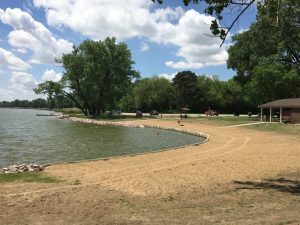
A beach area at Blue Lake in Lewis and Clark State Park. (Photo courtesy of Iowa DNR)
Restoration work at the lake has also addressed turbidity, or water clarity, by eliminating and blocking common carp from the lake. Wallace said these bottom-feeding fish continually stir up the sediment on the bottom of the lake which causes cloudy water, poor conditions for other fish and makes it easier for algae to bloom on the surface. Wallace said common carp are a problem at a lot of lakes in Iowa, but high densities in Blue Lake have impacted the water quality. DNR’s lake restoration efforts included the installation of fish barriers and aggressive carp angling in the lake to help reduce the common carp populations. In addition to the work to restore the lake, Lewis and Clark State Park Manager Nathan Fylstra said his team has been working hard to improve the state park with updates to the visitor’s center, improved drainage systems and a general clean up of ditches and fences.
The park is adjacent to the 250-acre Blue Lake, which typically hosts summer swimmers, boaters and anglers. Wallace encouraged anyone with an interest in Blue Lake to attend the informational meeting Thursday at the Onawa Community Center, 320 10th Street, at 5:30 p.m.
Cass County: Corn $4.01 Beans $10.11
Adair County: Corn $3.98 Beans $10.14
Adams County: Corn $3.98 Beans $10.10
Audubon County: Corn $4.00 Beans $10.13
East Pottawattamie County: Corn $4.04 Beans $10.11
Guthrie County: Corn $4.03 Beans $10.15
Montgomery County: Corn $4.03 Beans $10.13
Shelby County: Corn $4.04 Beans $10.11
Oats: $3.11 (same in all counties)
AVOCA – The Iowa Department of Natural Resources is investigating a petroleum release at the West Nishnabotna River near Avoca in Pottawattamie County. On June 24, staff from the DNR’s Atlantic Field Office observed a petroleum sheen entering the West Nishnabotna River, just north of the Avoca exit off Interstate 80.
The petroleum originated from the Eagles Landing Flying J Truckstop located just north of the City of Avoca. The facility is a registered leaking underground storage tank (LUST) site with the Iowa DNR, with a No Further Action classification since 2011.
This spring, a complaint was filed with the Iowa Department of Natural Resources (DNR) regarding potential petroleum contamination at the facility. During the investigation of the complaint, it was discovered that a petroleum product was being discharged into an on-site stormwater retention basin. The investigation found that the release did not reach any state water body. Eagles Landing has been cooperative in conducting cleanup activities following the discovery of the release.
Recent heavy rainfall in the area has impacted cleanup efforts at the facility, leading to an unknown amount of product reaching the West Nishnabotna River.
A contractor hired by the facility has added absorbent booms and sphag sorb to the river to prevent further downstream movement. The public is asked to avoid the area at this time. No dead fish have been observed, and the investigation is ongoing.
To report a release after hours, please call the DNR’s emergency spill line at (515) 725-8694. Quick reporting can help DNR staff identify the cause of an incident. The DNR website has more information about spill reporting requirements.


 Facebook
 Twitter
 YouTube
 RSS
RSS