

CLICK HERE for the latest market quotes from the Iowa Agribusiness Network!
CLICK HERE for the latest market quotes from the Brownfield Ag News Network!


CLICK HERE for the latest market quotes from the Iowa Agribusiness Network!
CLICK HERE for the latest market quotes from the Brownfield Ag News Network!
The Iowa Department of Natural Resources (DNR) is currently seeking public comment for the proposed rule making to implement Senate File 2389, passed by the Iowa Legislature in April 2018, allowing the DNR to establish rental fees at state parks and recreation areas. The change eliminates the need for the DNR to go through rule making under the authority of the Natural Resource Commission to establish, change and manage fees for camping, the use of rental facilities and other special privileges in state parks and recreation areas.
As part of the legislation, the DNR is required to establish and adopt rules for the purpose of setting forth the methodology to be used in establishing fees. To obtain a copy of the rule making documents, visit the Iowa DNR’s website at www.iowadnr.gov/parks The DNR is conducting six public hearings where the public may present their views verbally or in writing. All of the public hearings will be held on Feb. 7, 2019 from noon to 2 p.m. at the following area sites:
The public may also submit written comments no later than 4:30 p.m. on Feb. 7, 2019. Comments should be directed to:
Sherry Arntzen
Iowa Department of Natural Resources
Wallace State Office Building
502 East Ninth Street, Fourth Floor
Des Moines, Iowa 50319-0034
As many as five-thousand pork producers from across Iowa will be in Des Moines this week for the 47th annual Iowa Pork Congress. Greg Hora, of Fort Dodge, is president of the Iowa Pork Producers Association which is hosting the convention. While some events started Monday, the main draw is the industry trade show, which runs Wednesday and Thursday.
“What we really want to highlight is over 300 exhibitors that come in to over 500 exhibit booth spaces in Hy-Vee Hall,” Hora says. “These range from not just production and science and technology but new innovations and we’ll be showcasing over 30 new products and companies this year.”
Speakers and seminars will run the same days as the trade show, and one talk is focused on biosecurity and swine disease preparedness. “We have animal diseases out here that we’re well aware of over in China with the African Swine Fever right now,” Hora says. “We’re trying to make sure that type of disease never happens on the shores of the United States or in any of our Iowa pig farms.”
Last night (Monday night) was the Taste of Elegance cooking contest, featuring a dozen chefs from across Iowa who will be whipping up a variety of dishes using pork. The association’s business meeting is today (Tuesday), along with an auction to raise money for a youth scholarship program.
More at http://www.iowaporkcongress.org
The Atlantic Parks and Recreation Department’s Board of Directors are set to meet 5:15-p.m. Monday, in the Council’s Chambers at City Hall. Action items/New Business on their agenda includes:
In his report to the Board, Parks and Rec Director Seth Staashelm will talk about:
Harlan, IA – Six Shelby County residents were elected to the Iowa State University Extension and Outreach Shelby County Council in the Nov. 6 general election. They are: Elaine Baughman, Kirkman, Gwen Hansen, Kirkman, Renee Hansen, Harlan, Lorie Knudsen, Harlan, Jana Schmitz, Harlan and Klare Veath, Elk Horn. Current members of the county extension council who were re-elected to four-year terms are Baughman, R. Hansen and Knudsen. New members who joined the council in January are Schmitz and Veath. In addition to the four candidates elected to four-year terms, Gwen Hansen was elected to a two-year term to complete an unexpired term.
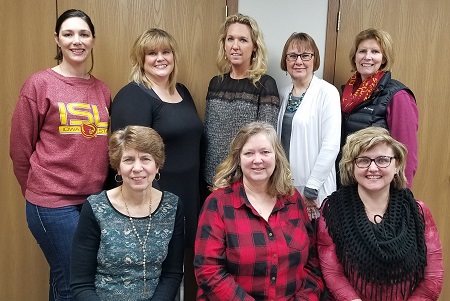
Photo: Front L-R: Elaine Baughman, Kathy Fara, Renee Hansen
Back L-R: Jana Schmitz, Julie Klein, Klare Veath, Lorie Knudsen, Gwen Hansen.
Carryover county extension council members whose terms expire at the end of 2020 are Kathy Fara, Irwin, Julie Klein, Harlan and Michele Monson, Irwin. The new members will replace Jo Kenkel, Defiance, Ellen Walsh-Rosmann, Westphalia, and Sheila Rhiner, Shelby.
Officer elections were held at the January 8th Extension Council meeting. Current officers are: Chairperson: Julie Klein Vice-Chairperson: Michele Monson Secretary: Lorie Knudsen Treasurer: Elaine Baughman. Other committee appointments: Regional Council: Julie Klein and Klare Veath, Iowa Extension Council Association Liason: Gwen Hansen.
The extension council is the county’s governing body of ISU Extension and Outreach. Extension council members hire county staff, manage the county extension budget and help determine programming, said Julie Klein ISU Extension and Outreach Shelby County council chairperson. The county extension office is located at 906 6th Street Harlan. Learn more at www.extension.iastate.edu/shelby.
Elected council members and offices in every county uniquely position ISU Extension and Outreach to move the state forward. Last year more than 1 million people directly benefited from ISU Extension and Outreach programs. These programs help citizens solve critical issues affecting their lives. ISU Extension and Outreach and county extension councils together are building a strong Iowa.
(Radio Iowa) — Despite a weak ag economy, 2018 was a good year for farm equipment sales, a big deal in Iowa where John Deere is the state’s largest manufacturing employer. A report shows tractor sales in the U-S rose seven-percent from the previous year, while combine sales jumped 18-percent. Curt Blades, with the Association of Equipment Manufacturers, mainly credits farmers replacing old equipment.
“You may’ve had a farmer that was typically on a three- or four-year replacement cycle who made the decision to stretch that out to four years or five years,” Blades says. “At some point, they just simply need to replace some equipment. That’s what we have found has been driving the market really for the last 18 months.”
Blades says 2018 started strong thanks to federal tax reform and a strong U-S economy helped all year, but then came the trade war with China and other drags on the farm economy. “If we’re talking about a farmer making a half-million dollar investment,” he says, “they’ve gotta’ feel good about the economy and they’ve got to feel like it’s something they want to do.”
Despite tariffs and the trade war, Blades expects farm income will go up a little this year. He also likes the new Farm Bill, but worries the partial federal government shutdown will delay its implementation.
OMAHA, Neb. (AP) — A monthly survey of rural bankers in parts of 10 Plains and Western states suggests banks are growing increasingly concerned about farm loan defaults in 2019. More than 4 of every 10 bankers questioned for the Rural Mainstreet survey for January said they expect farm loan defaults to be the year’s biggest challenge.
Creighton University economist Ernie Goss, who oversees the survey, says their outlook is being negatively influenced by tariffs, trade tensions, weak commodity prices and the partial federal government shutdown.
The survey’s overall index dropped to 51.5 from December’s 54.2. Any score above 50 suggests a growing economy in the months ahead, while a score below 50 indicates a shrinking economy.
Bankers from Colorado, Illinois, Iowa, Kansas, Minnesota, Missouri, Nebraska, North Dakota, South Dakota and Wyoming were surveyed.
Gov. Kim Reynolds has announced that the U.S. Department of Agriculture (USDA) has decided to temporarily reopen some Farm Service Agency (FSA) offices today (Thursday, Jan. 17) and Friday, Jan. 18, in addition to Tuesday, Jan. 22, during normal business hours.
A list of all FSA offices now open can be found here: https://www.farmers.gov/sites/default/files/documents/OpenFSAServiceCenters.pdf?utm_medium=email&utm_source=govdelivery
The USDA announced that they have recalled about 2,500 FSA employees to reopen these offices that closed during the ongoing government shutdown.
(Radio Iowa, w/thanks for Karla James in Omaha) — An alternative farmer in western Iowa who tends an apple orchard and raises peacocks and bees is appealing to state leaders to enact tighter restrictions on crop dusters who he claims destroyed much of his four-acre farm. Dennis Fett, of rural Minden, says the problem with drifting chemicals has been going on for decades but last year was the worst. Fett says, “We’ve been on our property since 1987 and starting in 1992, we’ve been pretty much violated by drifting of unwanted farm pesticides, fungicides, insecticides and herbicides.”
Fett says he built a tall fence, which kept out most of the ground-sprayed chemicals, but then neighboring farmers started hiring crop dusters. In July of 2018, he says his property was oversprayed three times. “It pretty well destroyed all our fruit in our fruit orchard, it destroyed our chemical-free garden, and one of them violated the Bee Rule, spraying insecticides within a mile of a registered bee hive — which ours are,” Fett says, “and it also caused neurological problems and death of some of our baby peacocks.”
Fett says he’s appealing to Iowa’s secretary of agriculture as well as to members of the legislature to look at the rules regulating crop dusters and overspraying. Fett says, “If they look at increasing the fine structure, if they’re given a civil penalty from $500 to $1,000 or maybe even $5,000 or more, that might discourage these crop dusters who come from out of state and are here six weeks or so and leave — and leave their dangerous chemical on off-target places, such as my place.” Fett says the state pesticide bureau has reported a 50-percent increase in overspraying cases during 2018. He says it’s baffling why more farmers aren’t raising a fuss about the problem. “The farmers are spending thousands of dollars to get their crops sprayed either for herbicides or insecticides, but when they’re drifting off target, like they have on my property, they’re not getting their money’s worth,” Fett says. “I’m proposing the farmers ask these people who overspray to give them all of their money back when they violate the law.”
Fett says he’s very concerned about the coming spring and the potential spraying around his acreage of the chemical dicamba, which may kill anything left on his farm.
(Oakland, IA)— The Loess Hills Missouri River Region is excited to share the accomplishments of 2018 with the public during a Year in Review Celebration at Uncle Buck’s Grill at Bass Pro Shops on Friday, March 8th from 4 to 5 PM. It has been nearly one year since Governor Reynolds, the Iowa Parks Foundation, and the Loess Hills Missouri River Region (LHMRR) Board and stakeholders gathered at the Field House in Council Bluffs to announce MidAmerican Energy Foundation’s $500,000 commitment to the Loess Hills Missouri River Region Parks to People Plan, and the board has been busy with regional priority projects ever since.
The Loess Hills Missouri River Region Parks to People Plan was created by a group of stakeholders from Harrison, Mills and Pottawattamie Counties and the Friends of Lake Manawa, who first assembled in 2014. The Plan, in partnership with the Iowa Parks Foundation, supports collaborative, regional projects to enhance economic development and tourism; public health and social vitality; natural resources, parks and trails; and overall regional vibrancy. This initiative intends to attract and retain young people interested in an active lifestyle, which will stimulate Iowa’s economy and promote business growth. A primary goal is to offer a fully connected 21st Century parks system, in time for the Iowa Parks Centennial in 2020.
In 2018, the LHMRR Board officially designated its first round of priority projects for funding from the MidAmerican Energy Foundation’s $500,000 challenge grant to the Parks to People Plan. $338,000 has been dedicated towards the following priority projects: Harrison County Conservation Board’s Willow Lake Nature Center and Overland Hiking Trail; Lake Manawa’s Dream Playground; Mills County Trails Board’s Glenwood Trail Project; Mills County Conservation Board’s Pony Creek Expansion; Lewis & Clark Today Route signage and the Green Hill Ranch conservation area. These projects represent over $10.6 million in planned recreational improvements to the tri-county region. To date, over $5 million of this has been secured or pledged towards implementation.
The LHMRR Board will hold its Annual Meeting and Year in Review Celebration on Friday, March 8th in Council Bluffs. The public is invited to attend the Year in Review Celebration from 4 to 5 PM, at Uncle Buck’s Grill (2901 Bass Pro Drive). At this celebration they will give a history of the initiative, outline the process for setting priority projects, overview progress on current priority projects and unveil the concept design for the new logo, branding and website. Project leaders will be available to answer questions and provide information about priority projects.
The LHMRR is coordinated by Golden Hills RC&D, a nonprofit organization with a mission “to develop and promote sustainable cultural and conservation projects that enhance the quality of life and preserve the assets of rural western Iowa.” More information about the Loess Hills Missouri River Region Parks to People Plan, Annual Meeting and Year in Review Celebration, visit goldenhillsrcd.org/lhmrr or facebook.com/loesshillsmissouririverregion.
The 2019 America’s Farmers campaign has kicked off with the Grow Rural Education program launch, which provides Iowa farmers with the opportunity to nominate local rural public schools for $10,000 and $25,000 grants designed to enhance STEM (science, technology, engineering and math) curriculums. Grow Rural Education, sponsored by the Monsanto Fund, a philanthropic arm of Bayer, will award more than $2.3 million to local rural school districts in 2019 – giving farmers the opportunity to make a difference in their community and contribute to local students’ success. Farmers can nominate their school district by visiting www.Americasfarmers.com or by calling 1-877-267-3332 toll-free.
Farmers can nominate their local public school district from January 1 to April 1, 2019. After the school district receives a nomination, the Monsanto Fund will notify the district and encourage administrators and teachers to design a grant that enhances STEM education for their students. Nominated school districts have until April 15, 2019 to submit a grant application describing their project. A panel of qualified teachers reviews the applications and narrows it down to the finalists. The program’s Farmer Advisory Council, consisting of approximately 30 farmer leaders from across the country, then select the winning school districts.
Later this year, the America’s Farmers programs continue with the Grow Communities program where farmers can enroll for the chance to direct a $2,500 donation to a local eligible nonprofit organization; and the Grow Ag Leaders program will begin accepting applications for $1,500 scholarships for students pursuing an education in agriculture-related fields.
Since Grow Rural Education began in 2011, it has awarded more than $16 million to more than 900 school districts in rural communities across the United States.

 Facebook
 Twitter
 YouTube
 RSS
RSS