

CLICK HERE for the latest market quotes from the Iowa Agribusiness Network!
CLICK HERE for the latest market quotes from the Brownfield Ag News Network!


CLICK HERE for the latest market quotes from the Iowa Agribusiness Network!
CLICK HERE for the latest market quotes from the Brownfield Ag News Network!
(Radio Iowa) – The Sioux City Honey Association unveiled more detailed plans Tuesday on its major expansion of processing operations. Association director of growth Aimee Sandman says the plan includes three phases in the next five years, starting with the renovation of a warehouse they purchased. “So we’ll be upgrading the warehouse with our new racking system that will accommodate our business and then update the corporate office. The warehouse will feature 200-thousand square feet of finished goods warehouse space for us and 26-thousand square feet of modern office,” she says..
The renovation will being in January of next year and is expected to be completed by the end of the year. The new warehouse will include six new jobs. The second phase is the construction of a new processing facility near the refurbished warehouse and then all employees will move to that location. The final phase adds more storage for increased production. “Phase three will include a new raw honey warehouse to support our continued membership growth. So this year we increased our membership by 15 percent which is about seven million additional pounds of U-S honey that will be coming into the Sioux City area for us to process,” Sandman says. The Sioux Honey Association has been in Sioux City since 1921.
Association president Kevin Hueser says other states tried to get them to relocate, but local and the state incentives were provided to keep them in Iowa. “At the end of the day, the existing warehouse gave Iowa a tremendous advantage, but also the city of Sioux City, state of Iowa stepped up,” he says. “Working with those communities as well as some of the local contractors that are willing to work with us on a on a build to suit and a lease back. I’m not really concerned. Our financing situation is in good shape and we’ve we’ve had a tremendous amount of support.”
The company currently employees 89 workers and expects to add 40 new jobs by the time the project is completed. Sioux Honey gets raw honey from around 200 beekeepers and produces 35 million pounds of honey annually, which is about 25 percent of the nation’s supply.
(Radio Iowa) – Iowa Congressman Randy Feenstra says a deal is near that would allow fuel with a blend of up to 15 percent ethanol and 85 percent gasoline to be sold year round. Feenstra is one of the leaders of the House Rural Domestic Energy Council that was set up in January when the year-round E-15 policy was stripped from a budget bill. The group met today (Wednesday).
“This is full on, year round E15 and we worked with the small, midsized and large refiners,” Feenstra says. “We worked with all the biofuels folks. We believe we’ve got something that works for all farmers…We’ve got to get it across the finish line.” House Republican leaders gave the group until February 25th to submit a bill for a vote on the House floor. E-P-A concerns about smog during the summer months have prevented the nationwide sale of E-15 from June 1st to September 15th, but the policy has been suspended in Iowa and other Midwest states.
National media outlets like Politico report the proposal that would end the long effort to authorize E-15 sales nationwide all year long would limit the number of ethanol blending exemptions granted to small oil refineries and prevent those operations from passing along the waiver to another refinery. Feenstra says President Trump’s statement — in Iowa last month — that he’d sign the year-round E-15 legislation was extremely helpful in negotiations.
“Agriculture’s the backbone of this state and we have to make sure we’re helping our farmers and that means opening new markets,” Feenstra said. “We don’t want handouts. We want new markets.” A majority of the fuel sold at U-S gas stations has 10 percent ethanol. The executive director of the Iowa Renewable Fuels Association says expanding E-15 sales would create brand new market demand for ethanol.
Cass County: Corn $4.04 Beans $10.79
Adair County: Corn $4.01 Beans $10.82
Adams County: Corn $4.01 Beans $10.78
Audubon County: Corn $4.03 Beans $10.81
East Pottawattamie County: Corn $4.07 Beans $10.79
Guthrie County: Corn $4.06 Beans $10.83
Montgomery County: Corn $4.06 Beans $10.81
Shelby County: Corn $4.07 Beans $10.79
Oats: $2.83 (same in all counties)
(Prices are per bushel; information is from the area Farm Service Agency [FSA] offices)
(Radio Iowa) – The Iowa Environmental Protection Commission is referring an alleged water pollution case to the Iowa Attorney General’s office. E-P-C Attorney Bradley Adams says Southwest Iowa Renewable Energy (SIRE) is illegally released sludge from its wastewater treatment facility near Council Bluffs into the Missouri River. He says they got a complaint August 25th of an orange sludge being released into the river. “On August 26th, Field Office 4 investigated the complaint and observed an orange wastewater discharging from the effluent pipe, orange coloration of the riverbank where the sludge deposits formed, and also orange sludge deposit buildup and the water beneath the effluent pipe,” he says. There was no fish kill found, but Adams says the sludge could harm wildlife. He says SIRE had been trucking the sludge away from the site.
“Beginning in March of 2025, SIRE began intentionally discharging the holding tank’s untreated clarifier sludge to Missouri River in violation of the facilities NPDES permit. According to Sire’s director of operations, approximately three-thousand of wastewater were discharged into Missouri every other day for a six-month period, beginning March of 2025 through August of 2025,” Adams says. Adams says SIRE sought to avoid the fees for trucking away the waste. “D-N-R estimates that sire avoided approximately 53-thousand dollars in disposal costs that other similarly situated businesses would pay. And, this is a clear and deliberate attempt to circumvent the law to save money,” he says. Adams says the D-N-R can only issue a penalty of up to ten-thousand dollars, and says by forwarding the case to the Attorney General, the state can seek a bigger penalty.
SIRE C-E-O Eric Fobes says they were trying to avoid the the truck traffic from hauling the material away. “It was never our intent to subvert a cost. We are not after cost savings of that magnitude at the plant. This is too small. It was more of an ease of execution not to haul it off site,” Fobes says. Fobes says his staff thought the discharge in the river was allowed. “Based on the permit as written, our team believed that sending backwash water to the permitted outfall was allowed. This was obviously a mistake. We now understand the department’s interpretation under the general water quality rule, and we respect that interpretation,” he says Fobes says they have made changes to do a better job of handling the requirements of the permit. He asked the Commission to not send the case to the Attorney General based on their response. “We acknowledge it happened. We are remorseful that it happened. I think we have learned a valuable lesson in that process. We’ve bolstered our internal compliance,” Fobes says.
The Commission voted to refer the case to the Attorney General with just two commissioners voting no.
(Statewide News) – The number of Iowa counties under a burn ban continues to grow due to an ongoing fire risk. As of Tuesday, Feb. 18th, 13 Iowa Counties were banning opening burning. Elsewhere, open burning and tossing of cigarettes or other means that may accidentally create fires, was strongly discouraged. Persons who previously had a controlled burn that was extinguished, were asked to keep a close eye on their property, because strong winds could cause those burn piles to rekindle. In southwest Iowa, Mills County was added to the list, that also includes Crawford, Shelby, Union and Ringgold, as of the latest information.
Aa burn ban goes into effect when fuels (such as tender vegetation, brush and timber) get less than 20% moisture and high temperatures, high winds, and low humidity start to develop.
Burn bans in February are rare, because there is usually enough snowpack on the ground, or at the very least heavy moisture in the ground, because the snow is starting to melt. In the last couple of months, though, Iowa has had significantly less snow than usual. Without that moisture in the ground, the risk of grass and field fires heightens.
Fire officials say what’s needed is a good soaking rain that saturates the soil, along with higher humidity in the range of 40%-50% or more, for a sustained period of time. Otherwise any moisture in the ground from rain can be dried out by the wind within 48-hours, which results in the same dry conditions.
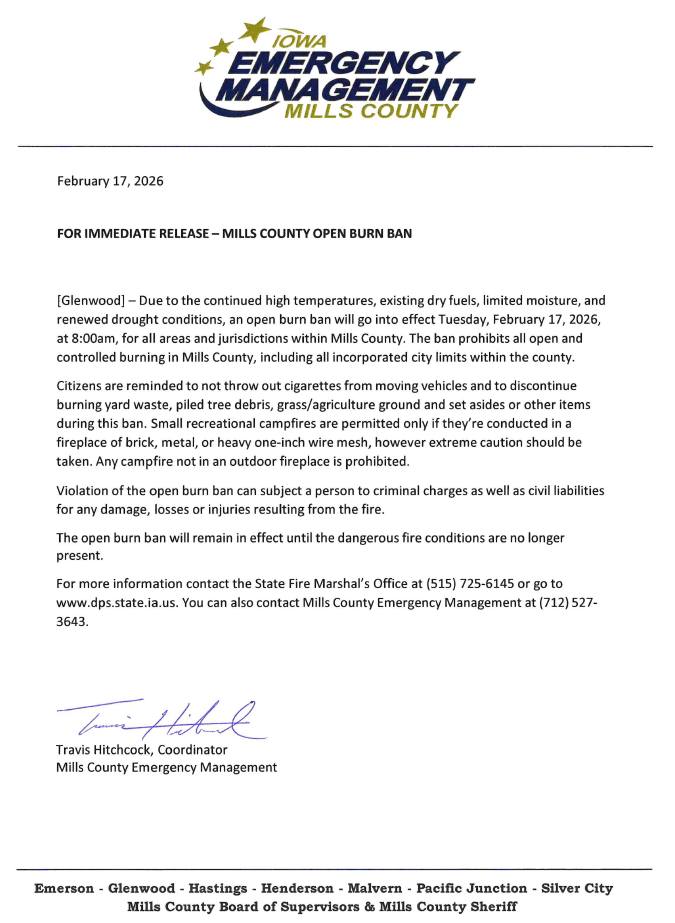
(Glenwood, IA) – The Mills County Emergency Management Agency reports a BURN BAN is now in effect, and until further notice. The ban is in-place due to the continued high temperatures, existing dry fuels, limited moisture, and renewed drought conditions. The BURN BAN is in effect for all areas and jurisdictions within Mills County. The ban prohibits ALL open and controlled burning in Mills County, including all incorporated city limits within the County. For more information, see the attached notification:
(Radio Iowa) – An Iowa State University horticulture professor is trying to find out how some plants are able to endure cold winter temperatures and start growing again in the spring. Professor Rajeev Arora says research is showing there’s not one single factor involved the hardening of plants to the cold. “Freezing tolerance or the acquiring of freezing tolerance is not a single factor phenomenon. In other words, several things are changing, and logistically they work together to put the plant in the hardest state,” he says. Arora says one thing he’s studied is a protein called dehydrin, which helps keep plants from losing water in a process called desiccation.”What happens is that when the ice forms inside these tissues, it is never inside the cells, but outside the cells between the cells,” he says.
Arora says ice in the cells causes plants to loose all their water, which leads to their deaths. “It is the desiccation part of the stress that plant actually ultimately succumbs to and gets injured. It is not so much the cold itself, but the desiccating effect of the freezing is what kills the plant,” Arora says. “And so these dehydrants, they prevent that desiccation or do not let all the water to be pulled out, maintain some hydration so that cells can survive.” Arora says he’s also studying the way some plants roll up their leaves to help them survive the cold in what is called “thermonasty.”
He says there’s no one clear process for plants to survive. “Many, many genes are involved, it’s not just one or two, and those have to collaboratively together also. So, it becomes very complicated,” Arora says, “these things have limits.” Arora says there has been some breeding of plants to better survive the cold, and he hopes his research will lead to more information on how to do just that.
Cass County: Corn $4.05 Beans $10.80
Adair County: Corn $4.02 Beans $10.83
Adams County: Corn $4.02 Beans $10.79
Audubon County: Corn $4.04 Beans $10.82
East Pottawattamie County: Corn $4.08 Beans $10.80
Guthrie County: Corn $4.07 Beans $10.84
Montgomery County: Corn $4.07 Beans $10.82
Shelby County: Corn $4.08 Beans $10.80
Oats: $2.81 (same in all counties)
(Prices are per bushel; information is from the area Farm Service Agency [FSA] offices)
(Radio Iowa) – A massive tree clearing project is planned for the Lewis and Clark State Park in Harrison County, near Mondamin. The D-N-R’s Sherry Arntzen says they closed the park on September 8th over safety concerns after noticing several dead trees. “The examination of 137 representative trees revealed that 99 percent of the park’s predominant species, eastern cottonwood, exhibit crown dieback with ten percent already standing dead,” she says. Arntzen says the trees range in diameter from 18 to 48 inches wide. “Mortality is attributed to over maturity and prolonged drought. Due to these harsh conditions, any tree with one-fourth or more canopy loss is unlikely to survive and classified as hazard,” Arntzen says.
The Natural Resources Commission approved a contract not to exceed one-point-seven million dollars for cutting down and removing the trees. Arntzen says they plan to remove the trees in two phases to improve the safety of the park. “Phase one involves felling approximately 610 mature trees in the campground and high use areas,” she says. “And phase two expands to clearing all hazardous timber within 150 feet of all hiking trails and roads covering approximately 98-point-five acres.” Arntzen says the first phase around the campground is expected to be completed by July. “The successful bidder anticipates being completed in that campground in time for RAGBRAI. So we had no idea that the RAGBRAI route was going to start in Onawa when all of this started back last fall,” she says. Getting rid of the wood from the felled trees is part of the contract.
“They’re going to fell the marked trees, they’re going to grind all the stumps, and they’re going to transport and dispose and burn of all woody debris and vegetation. We do have some brush piles established already that are out and away from our primary use areas,” she says. Arntzen says they have already planted a few trees and will look at the best way to replace trees that are removed. “And we will work with our foresters on appropriate trees to put back in our high use areas that is conducive to the soils that are there,” she says.
The work in the areas that are not high use could extend into March of 2028.
(Radio Iowa) – None of the four Republicans who serve in the U.S. House crossed party lines this week to join Democrats in passing a resolution to override President Trump’s tariffs against Canada. Third District Congressman Zach Nunn of Ankeny says Trump’s trade reset with Canada is necessary. “Talking to a dairy farmer in western Iowa…when they tried to see dairy product to Canada, they were facing a 200% increased tariff are impacting,” Nunn says. “That was not only unfair to them, but it really goes to the point of what tariffs on both sides of the border are impacting so on this one, we feel very strongly that Canada needs to bring those down and make fair trade across the board a reality.”
Congresswoman Ashley Hinson of Marion says she voted against the resolution because Trump is the only one willing to even the playing field and reduce trade imbalances. Congresswoman Mariannette Miller-Meeks of Ottumwa says she appreciates Trump’s willingness to take on the egregious trade practices of foreign adversaries. Iowa Democrats say Trump’s tariffs are crushing farmers and hurting the overall economy. Nunn says Trump’s trade and tariff strategy is addressing a situation that’s been decades in the making.
“We have seen tariffs against the United States just really punish, particularly, our ag community,” Nunn said. “…When President Trump did tariffs on places like Vietnam and said: ‘Bring it to zero or you’re getting the same thing back,’ and they were at 95% against U.S. producers, in 24 hours we saw Vietnam drop it and so did the United States.” Nunn suggests, though, there could be a day when he’d vote to rescind tariffs imposed by a president. “I don’t want to see tariffs used viciously and I still believe that the first article in the Constitution says that congress should be leading this, but I do support the president in holding offenders accountable,” Nunn said. “Let’s bring trade tariffs down to zero.”
Nunn made his comments today (Friday) during taping of the “Iowa Press” program that airs tonight on Iowa P-B-S.


 Facebook
 Twitter
 YouTube
 RSS
RSS