

CLICK HERE for the latest market quotes from the Iowa Agribusiness Network!
CLICK HERE for the latest market quotes from the Brownfield Ag News Network!


CLICK HERE for the latest market quotes from the Iowa Agribusiness Network!
CLICK HERE for the latest market quotes from the Brownfield Ag News Network!
(Radio Iowa) — A western Iowa farmer invited to speak when President Trump visited a Council Bluffs ethanol plant yesterday (Tuesday) used the moment to make a plea on behalf of “corn country.” “Mr. President, you delivered on E15, but we have more work to do,” he said. “EPA’s oil refinery waivers threaten to undo your good works. I ask that you listen again because the pain that the ethanol and biodiesel industries have endured is holding back a farm economy that has further capacity to produce clean air and clean liquid fuels for this country.”
Kevin Ross is a sixth generation farmer from Minden. Trump complemented Ross for his speech, but did not directly address the E-P-A waivers that let big oil companies avoid adding ethanol to gasoline. Trump told the crowd the deal recently struck on immigration with Mexico includes a pledge to buy more U.S. ag commodities. “Mexico’s going to be doing a lot of buying, a lot of buying,” Trump said, to applause. “Within a year and a half, would say, you’ll be in the best position that you’ve been in in 15 years as farmers and you deserve it.”
Trump signed an executive order at the event in Council Bluffs. It directs federal agencies to streamline regulations that deal with agricultural biotechnology.
DES MOINES, Iowa (AP) — The U.S. Department of Agriculture has lowered its estimate of this year’s corn crop to the lowest in four years, saying wet weather has delayed planting and reduced acres planted and the expected per-acre yield.
The expected production was cut in a monthly report released Tuesday by 1.4 billion bushels to 13.7 billion bushels, the lowest since 2015. While weather problems also have slowed soybean planting, the USDA didn’t change estimates since farmers have several more weeks to plant.
The USDA will release a report June 28 to provide updated farmer surveys more accurately reflecting the number of acres farmers planted. The USDA report also says disputes with China and other nations have reduced corn exports for the current-year crop by 100 million bushels and soybean exports by 75 million bushels.
GREENFIELD, Iowa – Officials with the Iowa DNR report the water level of Meadow Lake near Greenfield in Adair County will be lowered 3 feet starting June 14, to help improve the size of bluegills in the lake. The water will be released slowly over the next two weeks to avoid any downstream impacts.
A water level draw-down is a common fisheries management technique used to improve the size of panfish. Meadow Lake has an abundance of 6-inch bluegills that lack the quality anglers are looking for.
“Crowding the fish into a smaller area makes them more susceptible to predation by largemouth bass and reduces the number of small bluegills,” said Bryan Hayes, fisheries management biologist. The reduced number will improve growth in the coming year. “A draw-down in 2016 had this effect and we had good bluegill fishing in 2017 and 2018,” Hayes noted.
The draw-down is expected to have minimal effect on public access to Meadow Lake. The boat ramp will be usable and the lake will remain open during the draw-down. Meadow Lake will be allowed to refill starting in September.
Meadow Lake is a 34 acre lake in the middle of the 317 acre Meadow Lake Fish and Wildlife Area located in the north central part of Adair County. It has a maximum depth of 20 feet and an average depth of 7.3 feet.
DES MOINES, Iowa (AP) — A study shows Iowa leads the nation in the amount of human and animal waste it produces. Christopher Jones is a scientist at the University of Iowa. The Des Moines Register reports that Jones’ study shows the state of 3.2 million people and total livestock population of nearly 110 million produces as much manure as a human population of 168 million.
His study indicates pigs are responsible for driving the state to the top of the rankings. Jones writes in a blog on the university’s website that Iowa is home to at least 23 million pigs. In another study, Jones found that growth in the state’s livestock population has led to a doubling of nitrate levels in two western watersheds near the largest concentrations of pigs and cattle.
The Cass County Conservation Board held a youth fishing derby at Cold Springs Park on Saturday, June 8th. Prizes were awarded for the most overall weight: 1st place went to Tobin Juhl, 2nd place to Slade Sandbothe, and the 3rd place winner was Mason Daugherty. Awards also given for heaviest single fish: Slade Sandbothe; longest single fish: Carson Parks, and shortest single fish: Traven Thomas.
The CCCB wants to thank all those that donated items for the event: Weirich Welding for the trophies, Cappel’s Ace Hardware, Wal-Mart, Scheels, and Bass Pro Shops, for prizes. They also thank the Lewis Improvement Committee for making lunch available.
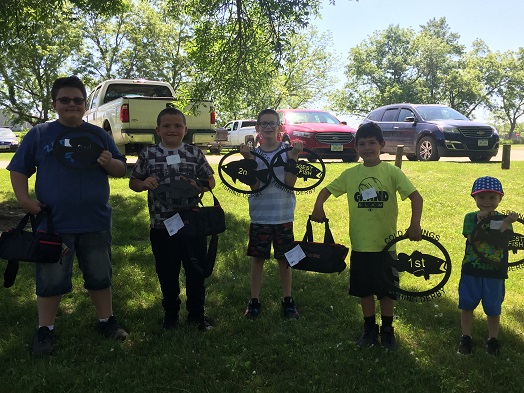
(Left) Mason Daugherty; Traven Thomas (1st from left); Slade Sandbothe (2nd from left); Tobin Juhl (3rd from left); Carson Parks (Right)
DES MOINES, Iowa (AP) — A seed developer from the Netherlands credited with introducing high quality disease-resistant vegetable seeds to more than 60 countries including the Philippines, Thailand and Indonesia is the 2019 recipient of the World Food Prize. Simon Groot, a sixth generation seedsman, began his search to create better vegetable seeds to help farmers in Southeast Asia in 1981. Groot’s award was announced Monday at the U.S. Department of State.
The foundation that awards the $250,000 World Food Prize is based in Des Moines, Iowa. Groot will receive the prize at an Oct. 17 award ceremony at the Iowa Capitol. The prize was created by Nobel Peace Prize laureate Norman Borlaug in 1986 to recognize scientists and others who have improved the quality and availability of food.
CHARLES CITY, Iowa (AP) — Officials at a chicken processing plant in northeastern Iowa announced the plant will close in August, taking 500 jobs with it. The Mason City Globe Gazette reports that the Simply Essentials chicken processing plant in Charles City closes on Aug. 5.
Employees were told Thursday in a letter that 479 plant workers, 22 administrators and 12 field operations workers would be laid off. The letter says the layoffs are expected to be permanent.
Simply Essentials has been in business since 2013, with a primary focus on health and wellness foods. It bought the Charles City plant in 2016. The Iowa Economic Development Authority Board awarded the company $1 million in investment tax credits and $66,000 through a refund of sales and other taxes paid during construction.
Just in time for the summer growing season, the Master Gardener Program with Iowa State University Extension and Outreach is planning three, one-hour-long educational webcasts. On the second Tuesday of the month, June- August, gardeners and plant enthusiasts will be able to learn about pollinators, perennial plant combinations and answers to frequently asked gardening questions at no cost. Susan DeBlieck, Master Gardener program coordinator with ISU Extension and Outreach, says “The webcasts are open to anybody who is interested in learning more about these topics. They’re not just for Master Gardener volunteers.”
The topics pertain to experienced and beginning gardeners, and provide insight into timely issues. Participating Master Gardener volunteers will gain three continuing education hours. The three one-hour webcasts will be shown at the Cass County Extension office from 7-8 PM on June 11, July 9, and August 13. No pre- registration is required, and there is no cost to attend. For more information call 712-243-1132 or email keolson@iastate.edu.
Webcast topics:
June 11, 2019 7-8 P.M. Give Your Garden Wings. Jessie Lowry, director of conservation and research at Blank Park Zoo, will share pollinator garden best practices. Participants will learn what to plant and will get to explore the monarch butterfly migration.
July 9, 2019 7-8 P.M. Gardening FAQ. From vegetables to flowers, explore the in-depth answers to frequently asked gardening questions with Aaron Steil, assistant director at Reiman Gardens.
August 13, 2019 7-8 P.M. Ecology Plus Diversity. Explore how to create plant communities that mimic nature with Grant Thompson, assistant professor of horticulture at Iowa State.
For more information, contact the Cass County Extension Office.
(Radio Iowa) — Iowa Agriculture Secretary Mike Naig says the long-awaited passage of a federal disaster relief bill is good news for Iowa farmers. President Trump on Thursday signed the 19-billion dollar package designed to assist victims of several recent disasters — including Iowa flooding. Naig says the bill helps Iowans in a couple of areas.
“It brings much needed support for our recovery efforts in the recovery area there in southwest Iowa,” Naig says, “whether it’s levee repair, or funds that farmers need to help remove the debris from their fields, or providing some compensation for damaged grain. We know that those are very, very important things for our producers as they recover and get back on their feet, and be productive again next year and in future years.”
Naig says the bill also provides for U-S-D-A assistance for farmers who are unable to plant crops this year because of swamped fields, though questions remain. “We don’t know what it looks like yet,” he said. “It certainly can apply to those areas that are flooded. But, we’re wondering — and asking — whether it can also apply to folks who have taken ‘prevent plant’ in other parts of the state, as well. So, those are some question marks, but it’s much needed support for our flood recovery efforts.”
Naig says statistics compiled by his office indicate the losses incurred by Iowa farmers during this spring’s record flooding are staggering. “You’ve got 100,000 acres that have been impacted in Pottawattamie, Fremont and Mills counties,” said Naig. “Then, we did an assessment of how much grain had been damaged. That number comes to right around 1.9 million bushels of corn, and about a half a million bushels of soybeans.”
An assessment was also done on how much grain in storage was impacted, and again, he says, it was millions of bushels ruined due to the floodwaters. The ag secretary says it all adds up to an economic disaster for producers. Naig also expresses concerns about lingering issues associated with the flooding.
“I keep saying this: you just lost your 2018 crop,” he said. “You’re not able to plant the 2019 crop, and really, your 2020 crop is in question, given how much water is still remaining. So, this is really, economically, a tough pill to swallow for folks.”
(Radio Iowa) — Forecasters say Iowa may have cooler-than-normal temperatures and much less rainfall throughout June. That may sound great, but not if you’re a farmer. Rains will diminish over the coming weeks and other signs of summer may be lacking. Meteorologist Dennis Todey, director of the U-S-D-A’s Midwest Climate Hub in Ames, says the rainy spell we’ve been enduring for months is over.
“For once in quite a while, most of our region is free of expected big rainfalls,” Todey says. Still, that doesn’t mean there won’t be rain on Iowans’ parades. Todey says there will be plenty of opportunities for showers, thunderstorms — and for more flooding. “Much of our region still has chances for storms,” Todey says. “They’re going to be spottier and less effective in the way of big precipitation. We don’t have a lot of capacity in much of our hydrologic system in the soils and the rivers, so even minor rainfall amounts can cause some problems.”
According to forecast models, Todey says much of the month ahead will be cooler than usual and may not bring Iowa’s acres of corn and soybeans the warmth they need to mature. “June is one time when above-average temperatures would help spur more development and accumulate some more ‘degree days’ without reaching those stressful mid-to-upper 80s on a regular basis,” Todey says.
“Instead of having above-average temperatures, we’re likely to have below-average temperatures throughout almost all of our region. It will be pleasant from a human standpoint and for livestock, but for our crops, it’s not good news.” Summer arrives two weeks from today. Todey says the effects of the ongoing El Nino pattern will be felt well into fall.

 Facebook
 Twitter
 YouTube
 RSS
RSS