

CLICK HERE for the latest market quotes from the Iowa Agribusiness Network!
CLICK HERE for the latest market quotes from the Brownfield Ag News Network!


CLICK HERE for the latest market quotes from the Iowa Agribusiness Network!
CLICK HERE for the latest market quotes from the Brownfield Ag News Network!
(Guthrie Center, Iowa) – The 2025 Guthrie County Fair gets today (Thursday), and continue through Labor Day Monday, Sept. 1st. Some activities began Wednesday, but the bulk of the activities begin today. View the complete schedule below, go to www.guthriecountyfair.com, or follow the Fair on Facebook.


Cass County: Corn $3.72 Beans $9.79
Adair County: Corn $3.69 Beans $9.82
Adams County: Corn $3.69 Beans $9.78
Audubon County: Corn $3.71 Beans $9.81
East Pottawattamie County: Corn $3.75 Beans $9.79
Guthrie County: Corn $3.74 Beans $9.83
Montgomery County: Corn $3.74 Beans $9.81
Shelby County: Corn $3.75 Beans $9.79
Oats: $2.78 (same in all counties)
(Prices are per bushel; information is from the area Farm Service Agency [FSA] offices)
(Radio Iowa) – Smoke from a fire at a chicken farm in southwest Iowa’s Taylor County could be seen for up to 30 miles last (Tuesday) night. The Taylor County Sheriff’s Office said on social media the fire had been brought under control thanks to at least two-dozen fire departments and their more than 100 personnel, who responded to the fire near Clearfield (1641 Yellowstone Ave.) at an egg production company called Daybreak Foods. Responding departments included Creston, Clearfield, Bedford, Blockton, Diagonal, Mount Ayr, Lenox, Corning, Prescott, Afton, Murray, New Market, Gravity, Woodburn, Villisca, Sharpsburg, Greenfield, Massena, Stanton, Clarinda, Union Township, and Worth County, with the last two coming from the Grant City, Missouri area.
In addition to the fire departments, the Taylor County Sheriff’s Office said four ambulance services, three county Sheriff’s Offices, the Taylor County EMA, Daybreak Foods employees “and countless community members” helped to combat the fire. A Facebook Post by the Taylor County Sheriff’s Office at around 7 p.m. Tuesday had asked residents to stay away from the area.
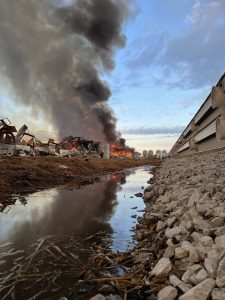
Creston Fire Dept. photo
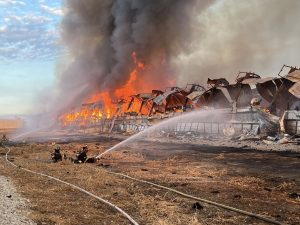
Creston Fire Dept. photo
According to information from the Iowa Area Economic Development Group, this is the second major fire at the site. In November 2021, when the facility was owned a company called Hen Haven, a fire destroyed the processing plant, biosecurity facilities and one of the barns for layer chickens. In February of 2022, in the midst of rebuilding, bird flu hit the site and the chickens had to be euthanized.
Daybreak Foods acquired the Clearfield chicken farm in 2023. Daybreak Foods is a family-owned, Wisconsin based company that employs 12-hundred people to manage 24 MILLION laying hens at its facilities in Iowa, Minnesota, Wisconsin and Ohio.

Taylor County Law Enforcement Facebook page photo
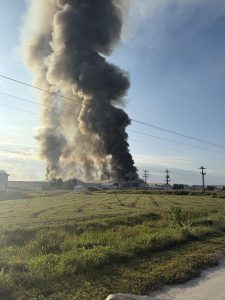
Taylor County Law Enforcement Facebook page photo
(Iowa DNR News) – Iowa’s mourning dove season begins Monday, Sept. 1st, and officials with the Department of Natural Resources say with the mild weather in the forecast and a later teal season, experts are predicting a busy opening day. “Anytime the opening day falls on a holiday weekend, we see higher participation, and with the weather forecast and teal not opening until Sept. 6, we expect a lot of hunters to be out,” said Todd Bogenschutz, upland wildlife biologist for the Iowa Department of Natural Resources (DNR).
Last year, hunter numbers increased an estimated 3 percent to 14,000, but dove harvest fell 27 percent, to 143,000. Mourning doves are the most abundant game bird in the country, with a population estimated at more than 345 million. Hunters are reminded that if they hunt mourning doves or other migratory game birds that they are required to register for HIP annually, either through the Go Outdoors Iowa app on their smartphone or through a link at www.iowadnr.gov/waterfowl. Migratory game birds include doves, ducks, geese, coots, woodcock and snipe.
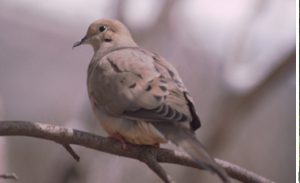
Mourning Dove
Doves are most often hunted in fields of mowed sunflowers, burned winter wheat, alfalfa or small grains and around farm ponds. “This is a good season to bring novice hunters along because there’s usually a good number of birds passing through, and a lot of action with mild temperatures,” he said. The Iowa DNR identifies state managed public areas with dove fields on its online hunting atlas with a pin on the nearest parking lot to the field.
As with all types of hunting, safety and communication is important. Know each hunter’s zone of fire, be aware of where everyone is and properly identify the dove before taking a shot. Be sure to pick up the spent shell casings – leaving them in the field is considered littering. Shooting hours begin one-half hour before sunrise until sunset.
(Iowa DNR News) – The Iowa Department of Natural Resources (DNR) has announced the first-ever collection of the federally endangered pallid sturgeon from the lower Des Moines River. The discovery of two pallid sturgeon this spring came a week a part during the Iowa DNR’s annual spring sturgeon sampling effort. The sampling has been conducted since 2014, but until this year, only shovelnose sturgeon, and an occasional lake sturgeon, have been collected. “To find a pallid sturgeon was a surprise, but to find a second one in nearly the same spot a week later was truly remarkable,” said Joe Larscheid, chief of the Iowa DNR’s Fisheries Bureau.
Pallid sturgeon are one of the rarest and most endangered species in North America. They were placed on the federal endangered species list in 1990 due to slow and continual declines in their populations throughout the Missouri and lower Mississippi River basins. The declines were due to limited natural recruitment often attributed to habitat loss and fragmentation caused by dams, which blocked migration routes for spawning adults and reduced or limited critical flow needed for larval development. While pallid sturgeon have been the focus of recovery efforts in the Missouri River, they have never been officially documented in the Des Moines River. “The presence of these wild, likely decades-old sturgeon, alongside other native sturgeon species preparing to spawn, reinforces the value of this river stretch,” Larscheid said.
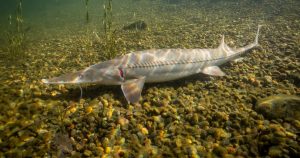
Pallid Sturgeon (U-S Fish & Wildlife photo)
While the discovery is monumental, Mark Flammang, fisheries biologist for the Iowa DNR, said the wild population remains critically small and is not self-sustaining. “Nearly nine out of ten pallid sturgeon collected from the Iowa section of the Missouri River were originally stocked from a hatchery. Finding two naturally reproduced individuals is a game changer for how the Iowa DNR and its partners manage the Des Moines River. This is a positive milestone, but does not mean the species has recovered,” Flammang said. Pallid sturgeon are slow-growing and late to mature, with females not spawning until they are 15-20 years old.
Anglers fishing in this stretch of the river who may incidentally catch a sturgeon will need to know how to identify the different species. The Iowa Fishing Regulations includes images identifying characteristics for the lake sturgeon, the pallid sturgeon, and the shovelnose sturgeon. Pallid sturgeon have a smooth belly; its outer barbels are twice as long as the inner barbels; and the base of barbels is “U” shaped, with inner two set out in front.
Of the three, only the shovelnose sturgeon may be kept – the lake and pallid sturgeon must be immediately released unharmed.
(Iowa Capital Dispatch) – Forty-five percent of Iowa corn acres have reached the dent stage and soybeans are just beginning to color, with nearly all, or 90%, of the crop already setting pods, according to the latest crop progress and condition report from the U.S. Department of Agriculture. Corn and soybean crops are a day or two behind the five year average schedule on several progression stages. Corn in the dough stage reached 88% which is three days behind the average for the Aug. 18 through Aug. 24 reporting period. Corn acres rated 84% good to excellent and soybean acres rated 79% good to excellent, a slight drop from the previous reporting period for both crops.
The report also noted disease pressure continued to rise in Iowa crops. Field agronomists with Iowa State University Extension and Outreach noted continued presence of southern corn rust and sudden death syndrome, along with a slew of other diseases and pests have been present across the state. Oat harvest is nearly finished in the state at 97% completion, and nearly 80% of alfalfa hay acres have had a third cutting.
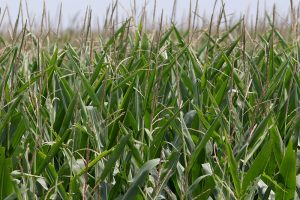
Corn growing in a western Iowa field in August 2023. (Photo by Jared Strong/Iowa Capital Dispatch)
Farmers had nearly 6 days suitable for field work this week and enjoyed high temperatures in the upper 70s and low 80s later in the week due to a cold front that pushed in. “Farmers across Iowa enjoyed a welcome break from the rain last week along with cooler temperatures and less humidity,” Iowa Secretary of Agriculture Mike Naig said in a statement. Naig said the cooler temperatures are forecast to hang around for the remainder of the month.
Despite the cool temperatures through the weekend, the average temperature for the reporting period was still 1.3 degrees above normal, according to State Climatologist Justin Glisan, who said temperatures were “unseasonably warm” for most of the period. Ames logged the highest temperature for the week, which at 97 degrees Fahrenheit was 16 degrees above the normal. Northeastern parts of the state had “unseasonably” high precipitation totals early in the week, with some areas logging as much as 6 inches of rain.
The average precipitation across the state was 0.87 inch, just slightly below the normal of 0.93 inch.
Cass County: Corn $3.72 Beans $9.79
Adair County: Corn $3.69 Beans $9.82
Adams County: Corn $3.69 Beans $9.78
Audubon County: Corn $3.71 Beans $9.81
East Pottawattamie County: Corn $3.75 Beans $9.79
Guthrie County: Corn $3.74 Beans $9.83
Montgomery County: Corn $3.74 Beans $9.81
Shelby County: Corn $3.75 Beans $9.79
Oats: $2.83 (same in all counties)
(Prices are per bushel; information is from the area Farm Service Agency [FSA] offices)
(Radio Iowa) – A soybean disease called sudden death syndrome – or S-D-S — is showing up in more fields this year due to a wet growing season. Iowa State University Extension plant pathologist Daren Mueller says a soil fungus causes S-D-S, largely by producing a toxin that’s absorbed into the soybean’s leaves, which turn yellow and die. “The more rain we get, the more toxin that’s going to be there and sort of hastens the death of the plant. But you still, it is a patchy disease and sometimes the fields are not 100 percent infected. So, it’s still good to have a few rains to finish out the crop that isn’t infected,” he says.
Mueller says treatment is not an option once S-D-S is detected, but farmers can consider different soybean varieties and seed treatments next year. He says planting later in affected acres can also decrease risks of the disease.“As farmers are planting earlier and earlier, that actually increases the risk of S-D-S, so maybe identify the fields that are worst, and try to put those toward the end of your list that you’re going to plant,” Mueller says.
Mueller made his comments on the Iowa Public Radio show “River to River.”
(Radio Iowa) – Bankers in Iowa and nine other states who responded to the latest “Rural Mainstreet” survey predict many Midwest grain farmers will have more expenses than profits this year. Creighton University economist Ernie Goss conducts the monthly survey. “It’s all about those two words that we always use: supply and demand. And I think in this case it’s too much supply for most of the grain products out there,” Goss says. “The bankers expect one-fifth of the grain farmers to experience negative cash flow — of course that’s not good, negative income.”
The U-S-D-A predicts Iowa farmers will harvest the largest ever corn crop this fall and that bumper crop means lower prices — projected to be around three-dollars-and-60 cents per bushel. Goss says there are other troublesome economic signals in the farm economy. “Farmland prices are down for the month and farm equipment sales down for the 24th straight month,” Goss said. “…Iowa and Nebraska had the worst economic performance from the fourth quarter of 2024 to the first quarter of 2025 — the worst in the nation — and that’s all about agriculture.”
Goss says urban areas are doing much better, but Midwest economies rely heavily on the performance of the ag sector. A weaker U.S. dollar may eventually boost overseas grain sales, according to Goss, and he says there may at least be a short term break for borrowers if the Federal Reserve cuts interest rates in September.
(Radio Iowa) – The first human case of a dangerous, flesh-eating parasite has been confirmed in the United States, in someone who recently traveled to El Salvador, and U.S. Agriculture Secretary Brooke Rollins warns the “New World Screwworm” could devastate cattle herds if it reaches the U.S. “The New World Screwworm is a real threat to America…The last time it really hit our shores was in the ’50s and ’60s. It took 30 years for our cattle industry to recover,” Rollins said at a press conference during the Iowa State Fair. The U.S. Department of Agriculture is building a facility in Texas, near the southern border, to produce and release hundreds of millions of sterile flies in hopes of eradicating the pest in Mexico before it reaches the U.S. “The last case of the screwworm that was an isolated case, but nevertheless a case, was found about 370 miles south of the Texas border,” Rollins said.
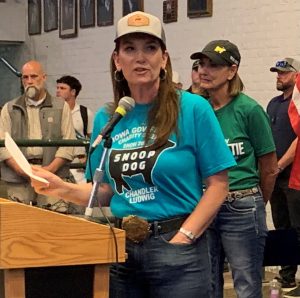
U.S. Agriculture Secretary Brooke Rollins spoke at a news conference before participating in the Governor’s Charity Steer Show at the 2025 Iowa State Fair. (RI photo)
In July, the Mexican government announced it was building a $51 million facility that will also produce and release sterile flies in hopes of pushing the screwworm population further south to the border between Panama and Colombia. Rollins said teams of USDA employees will be dispatched to Mexico, too. “We are staffing up in the hundreds to get down into Mexico so we can trust, but verify the data they’re giving us,” Rollins said. “That’s part of the problem. We’re relying on Mexico which has some significant cartel issues, significant funding issues, so we’re really grateful for their partnership, but we’re going to trust, but verify with our own teams down there.”
The U.S. government has stopped imports of live cattle from Mexico and the USDA is training dogs that will be able to detect screwworm infestations in animals at U.S. border crossings.


 Facebook
 Twitter
 YouTube
 RSS
RSS