

CLICK HERE for the latest market quotes from the Iowa Agribusiness Network!
CLICK HERE for the latest market quotes from the Brownfield Ag News Network!


CLICK HERE for the latest market quotes from the Iowa Agribusiness Network!
CLICK HERE for the latest market quotes from the Brownfield Ag News Network!
(Bedford, IA) – The Iowa Department of Natural Resources (DNR) will host a public meeting beginning at 6-p.m. on March 4th, at the Bedford Community School. The purpose of the meeting is to discuss an upcoming alum treatment to improve water quality at Lake of Three Fires, in Taylor County. The Iowa DNR will present an overview of the proposed treatments and how this treatment will help reduce the frequency and intensity of harmful algae blooms (or HABs) in the lake.
Alum (aluminum sulfate) is a nontoxic substance used in everything from cooking to treatment of drinking water, and is commonly used to reduce phosphorus concentrations in lakes. Phosphorus is a key nutrient for algae growth, and stems from runoff in the watershed. While much of the phosphorus that ends up in a lake is buried in the lake sediments, under the right environmental conditions, phosphorus can also be recycled within the lake, being released from the lake sediments when bottom waters have no oxygen.
These “internal releases” of phosphorus often fuel large algae blooms, especially in the late summer and early fall. When applied to a lake, alum binds with the phosphorus in the water and settles as a thin flocculant on the lake bottom, where it will continue to inactivate phosphorus being released from the sediments. This process can significantly reduce the likelihood of HABs, which can be harmful to the ecosystem and limit recreation.
Lake of Three Fires has experienced several significant HABs over the past few years and generally has poor water clarity. Several research efforts have shown that watershed inputs and internal phosphorus recycling are driving these blooms, and that a series of alum applications will likely help alleviate the frequency and duration of HABs.
The alum will be applied using specialized barges over a period of two weeks, depending on weather conditions, between April 1 and May 15. During this time, lake users may see boats, barges, heavy trucking equipment, and storage tanks around the park that are being utilized to complete the application. There should be minimal disruption to regular activities on the water and the application window was selected to minimize interference with spring fishing activities. DNR asks that you maintain a safe distance from the equipment to allow the crews to work efficiently and will have staff on hand to monitor the application. No swimming or boating restrictions are anticipated.
This treatment is one part of a broader effort to continue to improve water quality and recreational opportunities at Lake of Three Fires. An additional treatment is slated for this fall.
For more information, contact Michelle Balmer, Lake Restoration Program Coordinator, at michelle.balmer@dnr.iowa.gov, or 515-238-2458, or Andy Jansen, Fisheries Biologist, at andy.jansen@dnr.iowa.gov or 641-464-3108.
Cass County: Corn $4.01 Beans $10.84
Adair County: Corn $3.98 Beans $10.87
Adams County: Corn $3.98 Beans $10.83
Audubon County: Corn $4.00 Beans $10.86
East Pottawattamie County: Corn $4.04 Beans $10.84
Guthrie County: Corn $4.03 Beans $10.88
Montgomery County: Corn $4.03 Beans $10.86
Shelby County: Corn $4.04 Beans $10.84
Oats: $3.04 (same in all counties)
(Prices are per bushel; information is from the area Farm Service Agency [FSA] offices)
(Atlantic, IA) – The Cass County 4-H Endowment committee is hosting the annual 4-H Endowment Pancake Supper on Tuesday, March 3 from 4:30 p.m. – 7:30 p.m. at the Cass County Community Center in Atlantic. The Pancake Man will be dishing up fresh pancakes while 4-H members serve sausage, milk, juice, and coffee. The public is welcome can enjoy all you can eat pancakes, at a cost of $10/adult and $6/youth 10 & under.
There will also a silent auction going on throughout the evening. The local 4-H clubs in Cass County, as well as additional friends of 4-H and local business supporters can donate items. If a community business is interested in supporting the Pancake Supper with a Silent Auction donation, please contact the Extension Office.
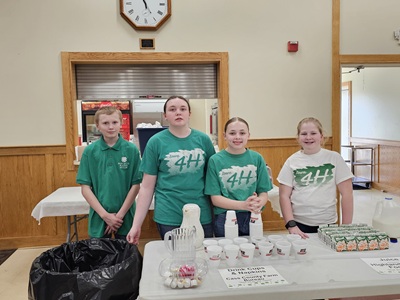
Cass County 4-H members help serve drinks at the 2025 Annual Cass County 4-H Endowment Pancake Supper. Left to Right: Hunter Kardell, Lynsie Kardell, Gentry Waters.
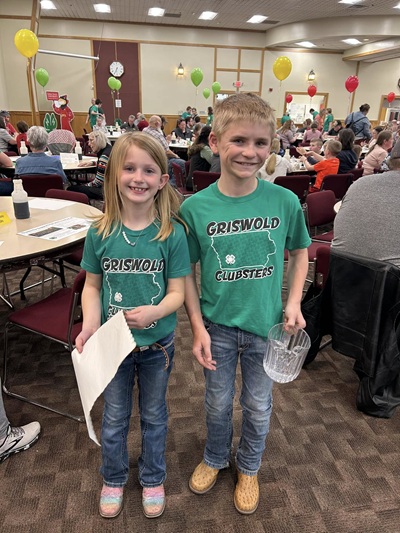
Members of Griswold Clubsters 4-H Club help clean tables, replace placemats, fill water and coffee cups along with refilling syrup bottles at the 2025 Annual Cass County 4-H Endowment Pancake Supper. Left to Right: Sawyer Chambers, Blaine Buffington.
“The silent auction is a fun added activity to the event. When we make final announcements about closing down bidding, people and pens really get to moving!” says Katie Bateman, Cass County Youth Coordinator. “We will be featuring the baskets on our Cass County 4-H and Extension social media pages ahead of the event. Be sure to check out the previews and make plans to bid on your favorites!”
Proceeds from the 4-H Pancake Supper directly benefit the Cass County 4-H Program. All funds raised go to the Cass County 4-H Endowment. Our committee then distributes money to cover the 4-H Program Development Fee for all Cass County 4-H and Clover Kid members, financial aid for out of county events, senior scholarships, and start-up dollars for innovative youth programs.
The 4-H Program Development Fee is $40 per youth each year to enroll. Instead of having individual 4-H’ers and families take on that expense, the Cass County Extension Council and the 4-H Endowment Committee pick up this cost for our members. It is free for youth to join 4-H in Cass County because of this. “We are very fortunate in Cass County that our 4-H Endowment covers this cost for all members. That would not be possible for us to continue without the outstanding support from our community.” stated Bateman.
For more information on the Pancake Supper, Cass County 4-H Endowment or how to join 4-H, contact Katie Bateman, Cass County Youth Coordinator, at 712-243-1132 or kbateman@iastate.edu.
(Radio Iowa) – During a visit to the Iowa Beef Expo this weekend, Republican Randy Feenstra repeated his promise to make Iowa the most ag-friendly state in the country if he’s elected governor.
Feenstra was at the Beef Expo to visit with junior high student Colton Griffin from Moville. Feenstra first met Colton five years ago after one of the boy’s eight-year-old classmates died. Colton led the entire second grade class in showing the girl’s calf at the Woodbury County Fair. “Ever since we get together when he’s showing and today he did great,” Feenstra said. “He got second in show.” Feenstra said he’ll start showing details of his own policy proposals for state government soon. “We’ll roll out more specific ideas,” Feenstra said. “…That’ll come out here in the next several months.”
In answer to a Radio Iowa question, Feenstra said as governor he would sign a bill to shield the makers of Roundup from lawsuits over the product’s safety if the label follows E-P-A guidelines. “I’m all about science and facts,” Feenstra said. President Trump issued an executive order last week that seeks to provide some legal immunity to Bayer’s — Roundup’s manufacturer — under the Defense Production Act and ensure an adequate U-S supply of Roundup’s main ingredient, glyphosate.
That’s sparked criticism from the Make American Healthy Again movement within the president’s Make America Great Again coalition. Feenstra says the focus should be on the facts about glyphosate. “I think it’s always good to have this great discussion of what is safe and what is reliable and what makes sense and that’s what I’ll do as governor,” Feenstra said. “I’ll make sure we look at all the facts and make the right decisions from there.” Feenstra, who will remain a member of the U-S House for the rest of the year, also responded to President Trump’s latest plan to impose 15 percent tariffs globally.
“I just believe that congress has to work with President Trump to hold countries accountable, but also make sure we that have more markets for our beef, soybeans, corn and things like that,” Feenstra said. “I sit on Ways and Means, I also sit on Agriculture — the only person who sits on both, and we understand how important it is not to get checks, but to get more open markets. We want more markets for our commodities.” Feenstra also indicated a bill that would resolve the dispute between the oil and ethanol industries will be released later today that would allow E-15 to be sold year-round.
Cass County: Corn $4.02 Beans $10.81
Adair County: Corn $3.99 Beans $10.84
Adams County: Corn $3.99 Beans $10.80
Audubon County: Corn $4.01 Beans $10.83
East Pottawattamie County: Corn $4.05 Beans $10.81
Guthrie County: Corn $4.04 Beans $10.85
Montgomery County: Corn $4.04 Beans $10.83
Shelby County: Corn $4.05 Beans $10.81
Oats: $2.91 (same in all counties)
(Prices are per bushel; information is from the area Farm Service Agency [FSA] offices)
(Radio Iowa) – Iowa’s ice anglers have been able to keep pulling in fish by moving north to the Great Lakes region, but the ice there is deteriorating now and the season is coming to a close. The D-N-R’s Mick Klemesrud says the lack of snow is the main culprit. “In a usual winter we’re going to have some snow cover that’ll act as insulation to protect it from these warm-ups in January and February, but this year we don’t have snow,” he says. Klemesrud says the lack of snow protection lets the other elements weaken the ice. “Between the warmer temperatures and the high winds, it really erodes the ice and causes a lot of unevenness. Most ice is uneven to begin with, but this makes it even more pronounced,” he says.
Klemesrud says the deterioration led to a U-T-V breaking through the ice on East Okoboji Lake, a pickup truck broke and a wheel house-style ice fishing shelter also broke through the ice on West Okoboji Lake. “Everything happened super fast. And so that makes it makes it weaker in places that were really, you know, pretty good ice quality a day or two before suddenly had deteriorated to the point where it couldn’t support the heavier ice shacks or vehicles,” Klemesrud says. “So you know, we’re telling people if they’re going to go out, they should be testing the ice frequently, bring your safety equipment with you.” Klemesrud says the cold weather that’s moving in now won’t provide enough continuously cold overnights to build the ice back up before it warms up again.
He says earlier subzero cold stretches this winter did create ice that was ten inches or more think across the state. “And so we did have a lot of thick ice. I mean, Twelve Mile (Lake) down in Union County, we had a lot of good reports, Three Mile (Lake), so those are southern Iowa lakes. And so we did get in a pretty good ice fishing season,” he says. “Now the fishing has still been really good up north, that’s what’s attracting a lot of these people up to the Great Lakes. But unfortunately, we’re just not going to have a normal ice year.”
Klemesrud says you are normally required require to get ice fishing shacks off the ice by February 27th, but most were pulled off recently as ice conditions deteriorated.
(Radio Iowa) – This week’s unseasonably warm weather in the 60s and 70s caused many trees across Iowa to start budding, and February is way too early for that, according to Tivon Feeley, the Iowa D-N-R’s forest health program leader. “The trees that we’re seeing leaf out a little bit right now are the red maples or the red maple hybrids that are pretty common, that you’d buy in the nursery,” Feeley says, “and those buds are just beginning to swell and kind of break open. There’s no leaf tissue hanging out.” The return to winter weather and temperatures in the 20s will spell trouble for those tiny, tender leaves.
“We know that leaf tissue that’s very fragile can freeze, and when that happens, it’ll cause damage to those leaves when they emerge,” Feeley says. “They may emerge green and look healthy, but as we get warmer in June, early July, that tissue will turn brown and fall out.” This condition is sometimes mistaken for insect feeding or disease, but Feeley says it’s simply a delayed response to cold injury that occurred earlier in the season. The leaf buds that are appearing now aren’t the only buds the trees will generate during spring, but leaves are vital to tree health and photosynthesis. Feeley was asked if the freezing of these early buds could cause us to lose any trees.
“We shouldn’t. The new growth that the trees put on won’t have this damage,” Feeley says. “Some of those will look kind of aesthetically unpleasing, but overall, there’s nothing we need to do about it. It’s just something to be aware of at the moment.” He says there should be -no- long-term threat to tree health. Homeowners are encouraged to monitor their trees, but there should not be a need for extra pruning, fertilization, or pesticides. Oh, and sorry, but he says it won’t likely mean any fewer leaves to rake in the fall.
(Radio Iowa) – Deere & Company, Iowa’s largest manufacturing employer, reports its first quarter income was down, but there’s optimism for the year ahead. Deere reports net income was 656 million in the first quarter compared with to 869 million dollars in the first quarter last year. Worldwide net sales and revenues increased 13 percent compared to the same quarter last year.
Deere C-E-O John May says in a statement that the global large agriculture industry continues to experience challenges, but they’re encouraged by the ongoing recovery in demand for construction and small agriculture. May says the positive developments reinforce their belief that 2026 represents the bottom of the current cycle and provides a strong foundation for accelerated growth going forward.
Cass County: Corn $4.03 Beans $10.80
Adair County: Corn $4.00 Beans $10.83
Adams County: Corn $4.00 Beans $10.79
Audubon County: Corn $4.02 Beans $10.82
East Pottawattamie County: Corn $4.06 Beans $10.80
Guthrie County: Corn $4.05 Beans $10.84
Montgomery County: Corn $4.05 Beans $10.82
Shelby County: Corn $4.06 Beans $10.80
Oats: $2.86 (same in all counties)
(Prices are per bushel; information is from the area Farm Service Agency [FSA] offices)

 Facebook
 Twitter
 YouTube
 RSS
RSS