

CLICK HERE for the latest market quotes from the Iowa Agribusiness Network!
CLICK HERE for the latest market quotes from the Brownfield Ag News Network!


CLICK HERE for the latest market quotes from the Iowa Agribusiness Network!
CLICK HERE for the latest market quotes from the Brownfield Ag News Network!
Cass County: Corn $3.70 Beans $9.73
Adair County: Corn $3.65 Beans $9.74
Adams County: Corn $3.65 Beans $9.70
Audubon County: Corn $3.67 Beans $9.73
East Pottawattamie County: Corn $3.71Beans $9.71
Guthrie County: Corn $3.70 Beans $9.75
Montgomery County: Corn $3.70 Beans $9.73
Shelby County: Corn $3.71 Beans $9.71
Oats: $2.95 (same in all counties)
(Prices are per bushel; information is from the area Farm Service Agency [FSA] offices)
(Radio Iowa) – County supervisors in Shelby and Story Counties have voted to seek U-S Supreme Court review of their ordinances for hazardous liquid pipelines, like the one Summit Carbon Solutions plans to build. Summit has argued both state and federal laws pre-empt local regulations and, in June, a federal appeals court ruled in Summit’s favor. Lisa Heddens is chair of the Story County Board of Supervisors.
Heddens and other officials in the two counties say their ordinances address safety issues by establishing no-go areas around homes, hospitals and other structures.
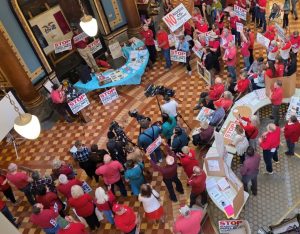
Property owners opposed to the Summit Carbon Solutions Pipeline rally at the Iowa Capitol in March. (RI file photo)
Former Shelby County Supervisor Steve Kenkel, who’s now the county’s liaison on pipeline issues, says economic development areas on the outskirts of Iowa towns for new homes and businesses need to be protected.
The ordinances set emergency response requirements if there’s a pipeline rupture.
And Kenkel says since the federal appeals court ruled a federal agency, not local governments, have jurisdiction over pipeline safety, the case could nullify state law.
The counties have hired a D-C law firm and Shelby County has capped its expenses at 60-thousand dollars. Shelby County’s insurance company is covering part of the costs and the rest is coming from what’s left in pandemic relief funds officials set aside three years ago to fight’s Summit’s legal challenge of Shelby County’s pipeline ordinance. Summit argues any county ordinance that attempts to control pipeline routes and regulate the construction or operation of the pipeline is pre-empted by state law.
Written by Andrea Welchans (ISU Extension & Outreach)
AMES, Iowa – Mandy Maher has accepted the position of regional director for Iowa State University Extension and Outreach serving Pottawattamie (east and west offices), Cass and Adair counties in western Iowa. She begins the position Sept. 29, 2025. As regional director, Maher will provide administrative leadership to county extension office staff and guidance to county extension councils.
 Maher has been the county director for ISU Extension and Outreach in Fremont County since 2012. In this role, Maher supervises county staff to cultivate a positive, high-performing work environment. She provides strategic guidance to the extension council, ensuring legal compliance while advancing personnel, financial and programmatic goals. She adheres to organizational policies and procedures and works closely with the regional director to manage the annual budget. She connects local audiences to research-based education, amplifying impact through targeted marketing and resource development. A civic engagement champion, she strengthens volunteer networks and delivers data-driven reports that highlight program outcomes and inform future initiatives. Her active representation of ISU Extension and Outreach in key local organizations reinforces the institution’s presence and deepens community trust.
“Mandy is an outstanding communicator. She excels at connecting people and fostering meaningful relationships with her staff and community networks making her an excellent fit for the role of a regional director,” said Andrea Welchans, assistant vice president for ISU Extension and Outreach. “We congratulate her and welcome her to her new position with Iowa State University Extension and Outreach.”
Maher received her bachelor’s degree in business administration and communications from Dakota Wesleyan University, Mitchell, S.D.
ISU Extension and Outreach is part of the federal Cooperative Extension Service—a network of more than 100 land-grant institutions, including Iowa State University, and the U.S. Department of Agriculture serving communities and counties across the United States. Every county in Iowa has an elected extension council that decides how to support ISU Extension and Outreach educational programs at the county level.
(Atlantic, Iowa) – Regardless of what Mother Nature throws at us temperature-wise, this week’s Produce in the Park in Atlantic will be “Cool as a Cucumber.” The event takes place this Thursday, August 21st, from 4:30-6:30 in the downtown Atlantic City Park. Food trucks on-hand include Lucky Wife Wine Slushies, the Teeny Weeny Weiner Wagon, and Karam’s Grill, a Mediterranean food truck selling a variety of dishes that include cucumbers–such as lamb gyro, chicken shawarma, and vegetarian falafel. Thanks to a music sponsorship from Rolling Hills Bank, Tyler Folkerts will be performing live.
This week, farmers market visitors will also find a free kids art activity hosted by Your Forte, a free bounce house thanks to the YMCA, and a Guest Chef handing out recipes and free samples of tzatziki, which of course features cucumbers. Farmers market vendors will be selling fresh produce such as cucumbers, tomatoes, zucchini, cabbages, onions, and peppers. Shoppers will also find local meat (lamb, chicken, pork, and beef), as well as farm-fresh eggs, honey, freeze-dried snacks (fruit, vegetables, and candy), and baked goods and desserts, including sourdough bread, cookies, and cupcakes. Multiple craft and other non-food vendors will be selling fresh-cut flowers, soaps, 3-D printed fidgets, leather wallets and purses, paintings, cut and polished rocks, compost, and more.

Tyler Folkerts

Tyler Folkerts is performing at Produce in the Park August 21
Various community organizations will be at the farmers market sharing information on community resources and events. Zion Integrated Behavioral Health Services, Healthy Cass County, the Atlantic Public Library, Cass County Tourism, and the Iowa National Guard are expected at the park August 21st.
Produce in the Park is held in the Atlantic City Park from 4:30–6:30 PM every Thursday from June through the end of September. All are welcome, and admission is free. The market accepts SNAP/EBT and Double Up Food Bucks for all qualifying food items. Produce in the Park continues to accept new vendors selling handmade or homegrown products throughout the farmers market season. For more information on vending at Produce in the Park visit www.produceintheparkatlanticiowa.com or email produceintheparkatlanticiowa@gmail.com.
Produce in the Park’s August farmers markets are made possible by support from Zion Integrated Behavioral Health Services, the City of Atlantic, First Whitney Bank & Trust, Gregg Young Chevrolet of Atlantic, Cass Health, Cass County Tourism, Atlantic Area Chamber of Commerce, and Nishna Valley Family YMCA.
For the latest market updates, follow Produce in the Park on Facebook at www.facebook.com/ProduceInThePark and Instagram at www.instagram.com/produceintheparkatlanticia/.
DES MOINES, Iowa — Governor Kim Reynolds today (Friday) welcomed the announcement that BioMADE, a Department of Defense Manufacturing Innovation Institute, has selected Iowa to establish a bioindustrial manufacturing scale-up facility at Iowa State University’s (ISU) BioCentury Research Farm in Boone, reinforcing Iowa’s leadership in bioscience innovation. A news release from the Iowa Economic Development Authority (IEDA) said the facility will feature 5,000-liter and 10,000-liter fermenters and downstream processing equipment, enabling companies to scale up fermentation-based technologies using Iowa’s abundant agricultural feedstocks. BioMADE will operate the facility in coordination with ISU Research Park. The announcement was made at IEDA’s board meeting.
“Iowa is proud to partner with the U.S. Department of Defense and BioMADE to build the infrastructure needed to lead in the next generation of biomanufacturing,” said Governor Reynolds. “This facility will unleash new value from our agricultural resources, create high-quality jobs, and ensure Iowa remains at the forefront of bioscience innovation and global competitiveness.”
Established in 2020, BioMADE leads a nationwide program to address a foundational gap in domestic pilot- and demonstration-scale bioindustrial manufacturing infrastructure. In 2024, BioMADE announced that Iowa was one of six states named as a finalist for potential project support—recognizing Iowa’s strategic assets in agriculture, renewable energy, and bioscience expertise.
“BioMADE is thrilled to be establishing this facility in Iowa,” said Dr. Douglas Friedman, Chief Executive Officer at BioMADE. “Iowa’s longstanding leadership in bioindustrial manufacturing makes it an ideal site for scale-up capacity. We’re excited to work with our partners at Iowa State University to establish this site, which will secure domestic supply chains for critical consumer and defense products – while also creating new markets for American-grown crops, re-shoring manufacturing jobs, and expanding rural development.”
At a total project value of $40 million, BioMADE has committed at least $20 million, which will be matched by up to $10 million in cost-share contributions from ISU and $10 million in funding from IEDA’s Strategic Infrastructure Program, approved today by the IEDA board over two fiscal years. The project will support workforce development, startup growth, and technology commercialization, while helping Iowa diversify beyond traditional biofuels and attract early-stage companies to establish permanent operations in the state.
“At ISU Research Park, we believe that the future of agriculture lies in bold partnerships and relentless innovation. Collaborations like the one with BioMADE, IEDA, ISU Research Park and Iowa State exemplify how these entities can come together to accelerate breakthroughs that will shape the next generation of sustainable, resilient ag technologies,” said Rick Sanders, president, ISU Research Park. “We’re proud to be part of a movement that has the potential to secure additional value and products from crops produced right here in Iowa and in turn, strengthen the bioeconomy.”
(Radio Iowa) – A fund drive is underway for a new building on the Iowa State Fairgrounds. Governor Kim Reynolds says the Agricultural Education Center won’t just be open during the State Fair. “We’re hoping kids will come there all throughout the year and really talk about ag and what it means to this state and to our economy and to the world,” Reynolds says. “As more and more kids get removed from the farm, we’ve got to do a better job of telling our story and having that interaction.” The center will focus on crop development, Iowa soils, farm equipment and jobs in agriculture.
The state budget plan Reynolds signed this spring includes five MILLION dollars for the building — about a third of estimated construction costs. The Agricultural Education Center will be built next to the “Little Hands on the Farm” exhibit during the State Fair that guides children through a garden, grain bin, tractor shed, apple orchard and livestock barns.
Reynolds says that will create a “kids zone” on the fairgrounds that’s focused on telling the story of Iowa agriculture.
AUDUBON, Iowa [KCCI] — U.S. Sen. Chuck Grassley said farmers are doing their part to help keep nitrates out of Iowans’ drinking water. His statement came during a visit to TNT Industries in Audubon Thursday afternoon. The Republican Senator from Iowa emphasized that farmers are already taking steps to prevent chemical runoff, which has been linked to high nitrate levels in water sources. Grassley told KCCI that he thinks farmers have done well by being more careful in their use of chemicals and fertilizers.
Grassley noted that Iowa was commended for its plan to protect and clean up its waterways in the last decade. He suggested that encouraging the use of grass waterways and establishing more wetlands could be another part of the solution.
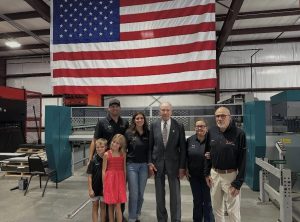
Sen. Grassley visits TNT Industries in Audubon, Aug. 14, 2025. (Photo from Grassley’s Facebook page)
The discussion comes after the metro was under a lawn watering ban for nearly two months because of high nitrate levels in the main water sources. A study by Polk County suggests farm pollution poses a risk to the water supply.
(Radio Iowa) – The 2025 Iowa State Fair doesn’t end until Sunday night, giving a few more politicians a chance to engage in what’s turned out to be common exercise for vote-seekers. Dana Wanken of Clarion was manning the state fair grills for the Iowa Pork Producers back in 2007 — the day presidential candidate Mitt Romney dropped a chop.
“Guess what happened? He flipped one high and it bounced on (the ground) and I was standing right behind him and his wife and he goes: ‘Oh, five second rule!’ And he picked it up and threw it back on the grill,” Wanken said. “I stuck my arm between him and his wife and grabbed that hot devil off of there and I said: ‘You can’t do that!'” Wanken has a piece of advice for the politicians volunteering to do a stint of flipping at the grill.
“Wear a glove ’cause it’s hot,” Wanken said, with a laugh. As temperatures soar during the State Fair’s August run, Governor Kim Reynolds says politicians still seem to wind up at the hottest spot on the fairgrounds. “They all want to do it because it’s iconic. You know, you can’t come here and not go, plus we’re the number one pork producer in the country,” Reynolds said, “so it really is an opportunity for us to get some time around the grill and make our case that we need markets.”
As an example, U-S Ag Secretary Brooke Rollins joined Reynolds at the grill a few days ago and visited with the real grill masters. Pork Producers from around the state come to grill pork loins and flip the chops and pork burgers that are sold to fair-goers. State Auditor Rob Sand grabbed a spatula and joined a group of grillers earlier this week. “I’m here every year, on Wednesday, with the Lee County guys,” Sand said. “I did that the first time, got to know them and it’s fun to come back and see them again.”
There is only one Wednesday during the State Fair’s annual 11-day run — but there was more than one politician at the Pork Producers’ grill this past Wednesday. Two state senators stopped by to flip and visit about half an hour before Sand arrived.
(Radio Iowa) – Deere and Company’s worldwide sales fell nine percent during the last three months. Josh Beal, director of Investor Relations for Deere, says an evolving global trade environment and ever-changing interest rate expectations are causing customers to be cautious about big-ticket purchases. Deere C-E-O John May says the company is able to manage its inventory to help production match retail demand.
Nearly two-thousand Deere workers at Iowa plants have been laid of since June of 2024 and the company has cut its North American inventory of large tractors by 45 percent and its combine inventory is down 25 percent.
Deere executives say the company paid 200 MILLION dollars in tariffs over the past three months and expects to pay 600 MILLION during its current fiscal year, which ends October 31st.
(Radio Iowa) – Every stall in the Horse Barn at this year’s Iowa State Fair has been occupied — and Clydesdale and Percheron draft horses have arrived as their National Shows get underway today (Thursday). Noah Levy is the Horse Barn Superintendent, which means he’s in charge of the two-acre, 12-aisle barn. “It’s about as big as we can get,” Levy says. “It’s about as many horses as we can put in the barn.” Levy started volunteering in the barn in 2017 to help out a friend — and this is his third year as superintendent. “You know, you want friends with boats, you may not want to own your own boat. I do this so I don’t have to own horses,” Levy says. “For me, it’s about the people and the horses are a bonus.” The Horse Barn is a MOSTLY tranquil place.
“The noise you’re going to hear is when one of them is hungry and has decided, even though it’s not technically meal time for them, they want it now and they’ll start banging on the stalls,” Levy said, “and especially with our drafts and you’ve got 2000 pound horses, their banging on the stalls sounds like thunder in this barn.” After the July deadline for entries in this year’s horse shows, there was a wait list. “When they enter for these classes, it’s difficult for us to know how many stalls they’re going to need versus what we had because we run a bunch of different breed shows and they overlap in the barn,” Levy says. “It’s not as simple as, ‘Oh, we’ve got 500 stalls in this barn. Once you sell out 500, you close it.” Levy says the wait list was eliminated, though, by laying out the puzzle pieces differently.
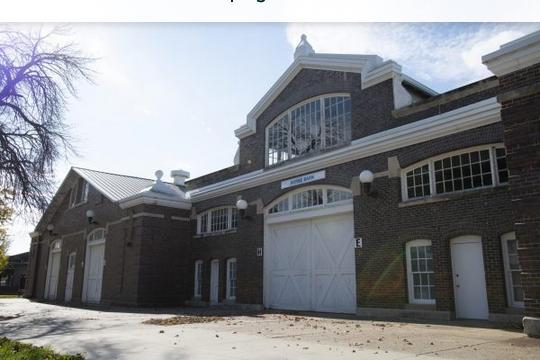
Horse Barn on the Iowa State Fairgounds
“A lot of credit for that goes to the team working on it and also our exhibitors themselves,” Levy says. “We called many of them and asked them: ‘What is the minimum number of stalls you need in order to show at the Iowa State Fair?’ And a lot of our long time exhibitors really came to the plate for us, gave back stalls, so that we could get exhibitors off the wait list so that everybody could get in and we cleared that wait list just a few days, I would say, less than a week before the Fair started.” Levy says all the horse shows are getting more popular based on the number of exhibitors — and the number spectators. There have been standing-room-only crowds for some of this year’s shows.
“If you’re popping in, especially to one of our evening shows with a six-horse hitch running in the ring, you’re generally hooked,” Levy said, “and your generally coming back and you’re bringing more friends with you.” The show ring in the Jacobsen Building on the Fairgrounds opened in 2010. Two years ago, state fair officials ended ticket sales for the Horse Shows and entry is now free. As soon as this year’s Fair is over, phase two of Horse Barn renovations will start. “New stalls on new flooring, new ventilation — that’s a big draw for some exhibitors,” Levy says. “These old barns are wonderful and historic and they’re really cool to walk through, but given their age they’re maybe not as nice to show in anymore, but the Fair has really stepped up and we’re looking at a very expensive renovation of this barn that should be completed before the Fair next year.”
Phase one of the project focused the outside of the building was completed before this year’s Fair. The Horse Barn was built in 1907, with additions in 1909, 1912 and 1929.

 Facebook
 Twitter
 YouTube
 RSS
RSS