

CLICK HERE for the latest market quotes from the Iowa Agribusiness Network!
CLICK HERE for the latest market quotes from the Brownfield Ag News Network!


CLICK HERE for the latest market quotes from the Iowa Agribusiness Network!
CLICK HERE for the latest market quotes from the Brownfield Ag News Network!
(Radio Iowa) – The Manchester City Council has approved the site plan for a proposed custom meat processing facility in the city’s industrial park. Todd Summers owns and operates a meat locker in Earlville, but Manchester City Manager Tim Vick says that facility needs some upgrades. “He’s looking at maybe just doing a much larger facility here in Manchester,” Vick says, “and so there are multiple phases that we are looking at.”
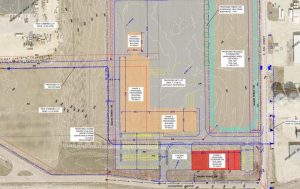
Site plan for proposed Manchester Locker (provided by City of Manchester)
Vick says phase one of the plan would be to develop 15 acres and build a 26-thousand square foot facility. “Animals would come in. They’ll be slaughtered, processed and out of the door,” Vick said. Vick says the business — which would be called The Manchester Locker — would also have retail space to sell meat directly to customers. Summers — who’s planning to operate a meat locker in Manchester — bought Dan’s Meat Locker in Earlville last year. It offers custom meat processing of beef, pork, lamb and deer and makes retail sales of everything from steaks to homemade sausage.
U-S-D-A records show there are nearly 150 licensed processing plants for meat and poultry in Iowa.
(Radio Iowa) – The corn and soybean harvest in Iowa is well underway — but since there’s a federal government shutdown, the U-S-D-A’s weekly report on Iowa crops wasn’t issued Monday. Iowa Agriculture Secretary Mike Naig says just driving through the countryside gives you a pretty good impression at the pace of the harvest. “Boy, if it’s fit, folks are really hitting it hard,” Naig said, “and I think we’re really taking a big chunk out of that soybean and corn harvest both.”
Naig says there appears to be variability in yields, as southern rust has appeared in parts of the state. “You’re hearing about some pretty dramatic yield reductions,” Naig said. “There are some areas of the state that were too wet. I’m hearing about some yield impact because of that as well and then I talk to folks that say it’s the best crop they’ve ever had.” Naig is hearing soybean yields are strong.
“Maybe the crop isn’t quite as good as we all thought it was going to be maybe in that mid-July time-frame, but we have a solid crop,” Naig said, “and, in fact, you have a lot of folks talking about: ‘Where are we going to store this crop?'” Iowa farmers typically have about two-thirds of soybeans and one-third of corn harvested by mid-October. Farmers worry the prices for corn and soybeans are being affected because buyers don’t have the weekly U-S-D-A information about harvest progress and conditions.
Naig says it also means the October payments farmers get for enrolling land in the Conservation Reserve Program aren’t going out. “In this tight economy if you’re waiting for a payment of some kind and you just can’t flat out access it because of a government shut down that’s wrong,” Naig said, “and it’s bringing instability…where we need certainty this time of year.”
With Farm Service Agency offices closed, farmers cannot submit the paperwork for operating loans that some might need to buy livestock, farm equipment, fuel or fertilizer. The loans may also be used to cover family living expenses.
ATLANTIC, IA (October 13, 2025) – Produce in the Park is hosting BOO-tique Market on Saturday, October 18, at the Nishna Valley YMCA from 10 AM to noon. BOO-tique Market is a new Halloween-themed farmers market. In addition to lots of fresh, local fall produce and other local foods and handmade crafts, the event will include lots of spooky, fall fun. Kids will be delighted to find hand-led horse rides, face painting, balloon animals, free bounce houses made possible by the YMCA, and a free spider plant craft activity hosted by Imagine at Zellmer Century Farm.There is no cost to enter the YMCA for the BOO-tique Market, and Halloween costumes are welcome. Trick-or-treating will be available throughout the market.
The BOO-tique Market will offer two food trucks: Tikka Talk Indian Food, and Liza’s Sushi and More. Tikka Talk Food Truck will be serving both vegetarian and non-vegetarian Indian food including butter chicken, lamb tikka masala, samosas, naan, rice pudding, mango lassis, hot Indian Chai tea, and more. Fresh, local produce at BOO-tique Market is expected to include peppers, cherry tomatoes, onions, garlic, sweet potatoes, zucchini, squash, and carrots. Other local foods will include local meat (beef, pork and chicken), farm-fresh eggs, local honey, and freeze-dried snacks (fruits, vegetables, and candy), along with baked goods and desserts including breads, muffins, cookies, and pastries.
Shoppers can expect to find craft products such as candles and wax melts, soaps, sugar scrubs, beard oils, greeting cards, potted plants, garden gifts, holiday decorations, and crocheted items such as stuffed animals, rugs, sweaters, hats, and gloves.
BOO-tique Market is the first of five markets in Produce in the Park’s Holiday Market Series. Additional farmers markets in the 2025-2026 series include Harvest Market (November 24), Christmas Market (December 20), Sweetheart Market (February 14, 2026), and Spring Celebration Market (April 4, 2026). All are welcome at Produce in the Park farmers markets, and admission is free. The market accepts SNAP/EBT and Double Up Food Bucks for all qualifying food items.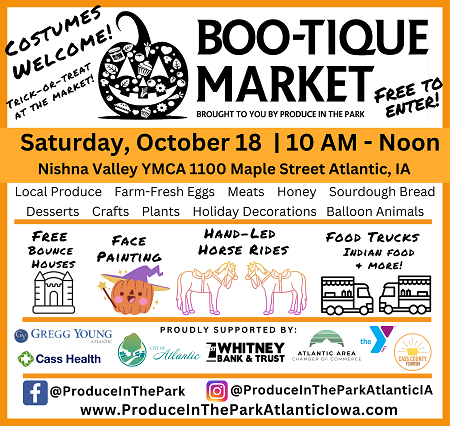
Produce in the Park continues to accept applications for vendors and sponsors for their 2025-2026 Holiday Market Series. For details and applications, see www.produceintheparkatlanticiowa.com.
Produce in the Park farmers markets are made possible by support from the City of Atlantic, First Whitney Bank & Trust, Gregg Young Chevrolet of Atlantic, Cass Health, Cass County Tourism, Atlantic Area Chamber of Commerce, and Nishna Valley Family YMCA.
For the latest market updates, follow Produce in the Park on Facebook at www.facebook.com/ProduceInThePark or Instagram at www.instagram.com/produceintheparkatlanticia/, or sign up for the Produce in the Park email newsletter at www.produceintheparkatlanticiowa.com.
(Radio Iowa) – Iowa has ended a nine-week run where the U-S Drought map showed no color for dryness of any kind. The D-N-R’s Jessica Reese McIntyre says the northwest, southern and eastern areas of the state are back to abnormally dry, with a slice of moderate drought. “It did have a small area, the equivalent of about one percent of the state, but still significant, along the Mississippi River in eastern Iowa,” she says. McIntyre says the rainfall slowed after what was the second wettest July on record. “It just progressively got worse through September because both August and September were drier than normal after having that really wet July,” she says.
McIntyre says there’s not a clear signal right now if the dry conditions will continue. “We don’t have the potential to see above normal precipitation for the next three months according to the National Weather Service forecast seasonal forecast,” she says. There’s just no real indication if we’ll go one way or the other and just kind of stay above average. So we will have to just kind of wait and see how that all pans out, how that forecast pans out, but it doesn’t look favorable to get above normal.” She says October could be warmer than normal, which could indicate we’ll stay dry. “One thing to kind of remember is that warm air tends to hold moisture, so it kind of kind of grabs it, right? So it can make these conditions worse, these dry conditions worse with warmer temperatures,” she says.
She says the drier conditions have helped farmers move quickly with the harvest, but also caused problems with dust and the potential for field fires.
(This article written by the Iowa Capital Dispatch. Read the entire version HERE) – Attorneys for Summit Carbon Solutions argued Friday in Polk County District Court that the company’s proposed amendment to its permit for a carbon sequestration pipeline through Iowa should be decided on before a legal case against the permit can move forward. The Iowa Utilities Commission approved a permit in June 2024 for Summit Carbon Solutions to build more than 600 miles of a carbon sequestration pipeline in Iowa, with the condition that the company gain permits in the Dakotas before beginning construction.
The Sierra Club Iowa Chapter, along with several counties and individual landowners, then filed a lawsuit in fall 2024, seeking to overturn the IUC’s permit approval. The lawsuit alleged the proceedings were unfair and that Summit did not meet the definition of a common carrier. Summit filed a petition with the IUC on Sept. 15 to amend its approved permit. The amendment would remove the condition that required approval in the Dakotas and add several route and pipe-size modifications to the permit. This action followed Summit’s second permit denial in South Dakota and the enactment of a law barring the use of eminent domain for carbon pipelines in the state.
Summit also requested the court remand the Sierra Club and landowners’ case to the IUC and stay any future actions on the case until the IUC decided on the filed amendment petition. This was the issue before Polk County District Court Judge Scott Beattie Friday morning. Summit’s attorney, Bret Dublinske of Fredrickson & Byron in Des Moines, argued the IUC needed to rule on the amendment petition before the case against the permit could proceed. He argued the facts in the case would be outdated once the IUC ruled on the amendment and the courts would be presented with either duplicative litigation or a scenario in which the ruling did not match the most recent version of the permit.
Wally Taylor, on behalf of the Sierra Club Iowa Chapter, argued Summit did not supply sufficient information as to how the amendment would change the nature of the lawsuit against the IUC’s decision. Taylor asked the court to deny the motion to remand the case to the IUC. Michelle Rabe, on behalf of the Iowa Utilities Commission, said while the IUC believes Summit’s request for remand is, “slightly outside” of how a remand is typically used, she believes there are three options forward, “none of which are ideal.”
Rabe said Beattie could deny the remand and allow the case to continue, in which case it would advance through the courts until eventually the Supreme Court issues what she said could be a “moot order” at that point because the permit might have changed via the IUC proceedings. The second option she presented was for the court to grant the remand and allow the IUC to rule on the amendment, in which case she predicted the parties would appeal the IUC’s decision and then the courts would be presented with potentially “parallel” cases. The third option, she said, would be for the court to stay the decision and allow the IUC proceedings to play out, so that when that decision is appealed, the two cases can be consolidated.
Summit’s amendment petition with the IUC, per Dublinske and the filing, does not seek to do away with the IUC’s protections against a “pipeline to nowhere.” Instead of listing North Dakota as the ending point, Summit asks the permit be changed to instead condition pipeline construction to the company’s securement of “access to one or more sequestration sites and permits or agreements to allow it to reach such storage.”
Opponents suggested the amendment means that Summit plans to change its original route, which would have ended in North Dakota where the CO2 could be pumped into an underground rock formation. A spokesperson for Summit said Friday the amendment “keeps open the option to transport CO2 west through Nebraska or north through South Dakota.”
Judge Beattie said he will work to issue an order as soon as possible, though he suspected it would be a “couple of weeks” before he able to issue a written order.
(Des Moines, Iowa) – Officials with the Iowa Department of Natural Resources (DNR), Thursday, said the DNR ordered Vision Atlantic, Inc., to pay an $8,000 administrative penalty associated with illegal discharges into state waters. The Consent Order required Vision Atlantic to cease all illegal discharges and to comply with all conditions of its National Pollutant Discharge Elimination System permit. The penalty was paid on Sept. 24th. (Read details about the Administrative Consent Order here: 2025WW19
A consent order is issued as an alternative to issuing an administrative order. A consent order indicates that the DNR has voluntarily entered into a legally enforceable agreement with the other party.
The DNR says its staff work with individuals, businesses and communities to help them protect our natural resources by complying with state and federal laws. The approach is very effective, they noted. In the few cases where compliance cannot be achieved, the DNR issues enforcement actions.
Find the entire, original orders on DNR’s website at www.iowadnr.gov/EnforcementActions

(A report from the Iowa Capital Dispatch) – A survey of the commercial horticulture food crops industry in Iowa showed direct specialty crop sales of more than $79 million in 2022 and even higher figures of economic output attributable to the industry. The Iowa Department of Agriculture and Land Stewardship announced the results of the 2023 survey, Wednesday, and said it shows the local produce industry is “diverse, growing, and making a significant contribution to Iowa’s economy and agricultural identity.” The survey was sent to Iowa specialty crop producers who grow edible crops like vegetables, fruits, berries, nuts, honey, maple syrup, herbs, mushrooms and pumpkins.
According to a news release from IDALS, this is the first “comprehensive look” at the industry since 2015. More than 850 specialty farmers participated in the survey, which found that a total of 11,650 acres of specialty crops were grown in 2023. Sales from these farms had a statewide economic output of $66.5 million in 2023 and supported $29.9 million in labor. Iowa Secretary of Agriculture Mike Naig said the survey “confirms the economic strength of specialty crop producers.” Most of those farms are small, grow multiple products and sell directly to consumers. These farmers skew young with nearly 50% of respondents below the age of 35. The survey found the average age of Iowa specialty crop producers was 57.2 years, which is lower than the national average, 58.1 years, of producers in the U.S. according to the latest Census of Agriculture.
The majority of specialty farm producers responded that they also work-off farm jobs and 37% responded they work full-time jobs off the farm in addition to running the farm. The average farm size for these edible crops was 7.8 acres, though many farms are quite a bit smaller considering the median farm size was just 2.8 acres. The survey also found that just 4% of farms had crop insurance. From 1989 to 2000, the number of specialty farms in Iowa declined from 1,400 farms to 938 farms, according to the survey results. The industry has since rebounded, with 1,680 farms counted in 2023. The results show the total number of sales of edible specialty crops increased by 73% from 2012 to 2022, with inflation-adjusted figures. The survey results show direct edible specialty crop sales amounted to $79 million in 2022.
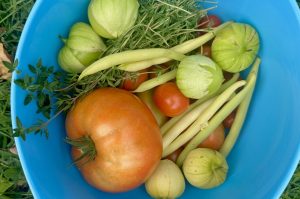
Locally grown produce. (Photo by Cami Koons/Iowa Capital Dispatch)
In addition to growing on average 3.8 distinct specialty crops, farmers also diversify their operations with on-farm activities. Nearly 60% of surveyed farms participate in some form of agritourism, which they reported generated $6.6 million in income. Farmers also increase their sales with value-added products, or products that have been processed in some way, like canned vegetables or wine. The survey results show edible specialty crop farms sold an estimated $11.3 million in value-added products in 2023. Naig said he believes the Iowa edible specialty crop industry will continue to grow, especially with the expansion of the department’s marketing service, Choose Iowa. Naig said these farmers also help connect Iowans to their food sources.
“With the continued expansion of the Choose Iowa program, I believe this sector is well-positioned for even greater growth in the years ahead,” Naig said. “Horticulture food crops bring opportunities not just for established farms but also for beginning farmers who are shaping the future of our industry.”
Honey, peppers, apples, tomatoes and lettuce were the top edible specialty crops grown in Iowa. According to survey results, the number of honey producers in the state has “dramatically increased” as there were fewer than 200 producers in 1997 and there were 1,229 in 2022. The other top crops had between 400 and 550 producers each in 2022. Producers who sold through Community Supported Agriculture programs or at farmers markets were more likely to grow a higher variety of crops.
According to the release from IDALS, the report, which was produced primarily by the department and staff from Iowa State University Extension and Outreach, will help lawmakers and department leaders to “better support specialty crop farmers and help them overcome challenges, seize new opportunities, and sustain growth.”
(Des Moines, Iowa) – Eighteen lakes across Iowa are gearing up to receive trout this fall. The Iowa Department of Natural Resources (DNR) says they will release between 1,000 to 2,000 rainbow trout at each location as part of its cool weather trout program that brings trout to areas that cannot support them during the summer months. The fall community trout stockings are a great place to take kids to catch their first fish. A small hook with a night crawler or corn under a small bobber or small simple spinners such as a panther martin or Mepps is all you need to get in on the fun.
Bringing trout to cities and towns offers a “close to home” option for Iowans who might not travel to northeast Iowa to discover trout fishing. A family-friendly event is often paired with the stocking to help anglers have success and fun while fishing. Check the Iowa DNR Community Trout Stocking Schedule website to see which lakes are having events.
The popular program is supported by the sales of the trout fee. Anglers need a valid fishing license and pay the trout fee to fish for or possess trout. The daily limit is five trout per licensed angler with a possession limit of 10. Children age 15 or younger can fish for trout with a properly licensed adult, but they must limit their catch to one daily limit. The child can purchase a trout fee which will allow them to keep their own limit.
2025 Fall Community Trout Stocking Schedule:
Oct. 23, Ottumwa Park Pond, Ottumwa, 11 a.m.
Oct. 24, Prairie Park Fishery, Cedar Rapids, 10 a.m.
Oct. 24, Liberty Centre Pond, North Liberty, 10:30 a.m.
Oct. 25, East Lake Park Pond, Mount Pleasant, 10 a.m.
Oct. 25, Wilson Lake, Donnellson, Noon
Oct. 25, Lake of the Hills, Davenport, 10 a.m.
Oct. 27, Triumph Park East & West, Waukee, Noon
Oct. 27, Terra Lake, Johnston, Noon
Oct. 29, Big Lake, Council Bluffs, 3 p.m.
Oct. 29, Moorland Pond, Fort Dodge, Noon
Oct. 29, Sand Lake, Marshalltown, Noon
Oct. 30, North Prairie Lake, Cedar Falls, 11:30 a.m.
Oct. 30, Heritage Pond, Dubuque, 11 a.m.
Oct. 31, Lake Petocka, Bondurant, Noon
Nov. 1, Stolley Pond, Spencer, 1 p.m.
Nov. 3, Ada Hayden Heritage Park Lake, Ames, Noon
Nov. 3, Bacon Creek, Sioux City, 1:30 p.m.
Nov. 26, Blue Pit, Mason City, 11 a.m.
Find more information about trout fishing in community lakes on the DNR trout fishing webpage.


 Facebook
 Twitter
 YouTube
 RSS
RSS