

CLICK HERE for the latest market quotes from the Iowa Agribusiness Network!
CLICK HERE for the latest market quotes from the Brownfield Ag News Network!


CLICK HERE for the latest market quotes from the Iowa Agribusiness Network!
CLICK HERE for the latest market quotes from the Brownfield Ag News Network!
AMES, Iowa— The Iowa 4-H Foundation and Cass County 4-H is launching its annual special 24-hour event, Iowa 4-H Giving Day (www.iowa4Hgivingday.org), on October 4th and 5th from Noon to Noon during National 4-H Week. Each year on Iowa 4-H Giving Day, supporters across the country come together to financially support Iowa’s largest youth organization, to ensure these opportunities continue to be available to youth across the state and at the county level.
Iowa 4-H Foundation Executive Director Emily Saveraid says “On Iowa 4-H Giving Day, we’re celebrating all that 4-H’ers have accomplished, how they’ve grown and how they support their communities. It’s great opportunity for 4-H supporters and alumni to give back and celebrate the program that is making a difference in every zip code in Iowa.”
Cass County 4-H supporters can go directly to the county giving day page to make a gift at https://www.iowa4hgivingday.org/organizations/cass-county-4-h-f319ebef-8748-431a-b9c5-133416766a9d simply scan the QR Code. 
Dollars raised on Iowa 4-H Giving Day go directly to the Cass County 4-H Program delivered by Iowa State University Extension and Outreach and to provide other opportunities– state recognition, national 4-H trips, college scholarships and special programs, which enhance the Iowa 4-H experience. Iowa 4-H Giving Day is proudly sponsored by Farm Bureau Financial Services.
The Iowa 4-H Foundation is a 501(c)3 nonprofit organization that provides private financial resources to develop and deliver quality 4-H youth programs to nearly 100,000 young people throughout the state of Iowa. These programs and opportunities help enhance 4-H’ers’ ability to use critical thinking, leadership, communication, and social skills.
For more information and to make a gift, visit www.iowa4Hgivingday.org. For the latest updates and stories on Iowa 4-H Giving Day, follow the Iowa 4-H Foundation on Facebook and Instagram.
(Radio Iowa) – A northwest Iowa judge has scheduled a hearing within two weeks on a couple’s request that a carbon pipeline developer be at least temporarily barred from conducting surveys on their Woodbury County land. Navigator has sued William and Vicki Hulse of Moville, accusing the couple of violating a state law that allows its agents to access to land along its proposed pipeline route. The Hulses have filed a counter claim, arguing the law is an unconstitutional taking of private land. Brian Rickert, an attorney for the pipeline developer, is urging the judge to expedite the case. “Farmers Almanac, I don’t know how accurate that is, you know they’re saying we’re going to have an early and heavy winter, so we really do need to get out on this parcel and get our surveying done,” Rickert said.
Brian Jorde, the couple’s attorney, told the judge there’s no legal deadline for completing the land surveys along the pipeline route. “There is no urgency other than the company’s own investor wish list to get this done,” Jorde said. “They haven’t filed for eminent domain rights. They have no permit application on file.” The judge who held a status hearing on the dispute let both attorneys present some initial arguments this (Wednesday) morning. Navigator’s attorney accused pipeline critics of using the court to try to slow down the project. “What we don’t want to have to deal with is tactics. We want to deal with what the law is. We’ve brought it to you. We think we’re right. We think they’re wrong. That is why we have judges to decide who wins in these situations,” Rickert said. “We need to move quickly.”
Jorde is the attorney for the couple refusing to let pipeline surveyors on their property. He told the judge he’ll be citing a recent Supreme Court opinion on property rights. “Once the constitutional right, the right to foreclose or prevent unwanted entry onto a property is destroyed, you can’t un-ring that bell,” he said. “You cannot go back.” Jorde has filed similar claims for landowners in Clay and Butler Counties. Navigator is suing a Sioux Rapids man and two Butler County property owners who have refused to allow the pipeline’s surveyors on their property.
(Radio Iowa) – Officials from Taiwan have agreed to buy two-point-six billion dollars worth of U.S. corn, soybeans and dried distillers grain. Representatives of Iowa commodity groups joined Taiwan officials at the Iowa Capitol for a signing ceremony. Johnson Chiang is director general of the country’s Economic and Cultural Office in Chicago.
“We want to have more cooperation with Iowa in addition to purchasing agriculture products, but also I think we enough areas in high technologies because of Taiwan is also one of the leading contributors to the high technology supply chain.” Taiwan, for example, is the world’s largest supplier of computer chips. Taiwan has signed letters of intent to purchase one-and-a-half million metric tons of U.S. corn and up to two-point-nine metric tons of U.S. soybeans as well as by-products of corn and beans over the next two years.
Iowa Agriculture Secretary Mike Naig says trade matters to Iowa. “As a leading exporter of food and agriculture products, we see great value in the type of commitment that you all signed today and that continues to build upon a relationship that we are maintaining and building throughout time.” Governor Kim Reynolds says Iowa exports to Taiwan have increased in the past five years and are on pace to be higher this year as well.
“Taiwan’s economic clout is substantial,” Reynolds says. “It’s the 12th largest purchaser of Iowa products, with a total of $304 million of (Iowa) goods sold in Taiwan last year.” The Taiwanese delegation is on a goodwill mission to the United States and has spent the past two days in Iowa. Chin-Chang Huang is the deputy minister of Taiwan’s Council of Agriculture. He was intrigued by Iowa State University programs on climate change and sustainable agriculture and plans to recommend his government establish agreements with I-S-U.
“And also send our people to study at Iowa State University,” he said. Taiwan’s first directly-elected president earned an agricultural economics degree from Iowa State in 1953. President Lee led Taiwan from 1988 until 2000.
(Radio Iowa) – The emerald ash borer (EAB) has now been discovered in all but six of Iowa’s 99 counties.
The Iowa Department of Agriculture has confirmed that Mitchell County is the 93rd county with an E-A-B infestation. Larvae were collected near Spring Park in rural Osage and federal identification confirmed them as the invasive insect. It is the ninth confirmed infestation this year.
The only counties now without an E-A-B infestation are Plymouth, Woodbury, Monona, Osceola, Emmett, and Palo Alto counties in western and northwest Iowa. The Ag Department says the invasive insect is a threat to native ash tree species — with the damage from the larva typically killing a tree within two to four years after infestation.
(Radio Iowa) – Northeast Iowa officials say a young farmer has died. A Farley man died in a farming accident on Saturday night. The Dubuque County Sheriff’s Office says it happened shortly before 9:30 north of Farley, at a residence there. Workers were unhooking a silage wagon when it started rolling backward. Twenty-five-year-old Austin Gaul got caught under the wheels and was run over.
(Radio Iowa) – A northwest Iowa woman has been offered a plea agreement in a case involving the deaths of over a thousand pigs at two hog confinements in Sac County in June. Thirty-four-year-old Elana Laber, of Early, was responsible for the care of the pigs. The company that owned the animals estimates it lost 150-thousand dollars due to the deaths of the pigs. Court records indicate Laber will plead guilty to one count of first-degree criminal mischief and one count of livestock neglect.
She faces up to 10 years in prison for the felony charge of criminal mischief charge. The sentence for animal neglect could be as long as a year. Her plea hearing is scheduled for next Monday, September 26.
ATLANTIC, IA – Produce in the Park in Atlantic is all about fall fun this Thursday, September 22. Market Manager Brigham Hoege says kids will be delighted to hear that the bounce house will be back, but there will also be pumpkin painting, face painting, and bracelet making. There will be lots of fall products at the park this week, including pumpkin bars, salted caramel
cupcakes, and caramel apple crisp cups from Frosting Inc., fall candles and soaps from Smudge in scents Pumpkin Spice and Salted Caramel, pumpkin kringle from Kringleman Pastries, and fall candles from Midwest Candles by Brit in Cashmere Cedar, Orange Spice, and Pumpkin Chai.
Hoege says September is a fabulous time for fresh produce at farmers markets, and this week market shoppers will find local fruits including grapes, watermelon, and elderberries, as well as vegetables including green beans, potatoes, sweet potatoes, tomatoes, a wide variety of peppers, onions, and eggplant. September is National Recovery Month, and as the Substance Abuse and Mental Health Services Administration explains, Recovery Month is a national observance held to “promote and support new evidence-based treatment and recovery practices, the nation’s strong and proud recovery community, and the dedication of service providers and communities who make recovery in all its forms possible.” 
Produce in the Park always hosts at least one community organization at the park every week, and this week the market is proud to celebrate Recovery Month by welcoming a number of local recovery supporting organizations. Many people are living in mental health or addiction recovery or know or love someone living in recovery. Visiting organizations at the park this week will include Zion Integrated Behavioral Health Services, National Alliance on Mental Illness Southwest Iowa (NAMI), Cass Health Senior Life Solutions, Southwest Iowa Narcotics Anonymous, Cass County Public Health, and more. These organizations will share resources as well as many of the fun fall activities mentioned above.
DETAILS: Produce in the Park September 22
Time: 4:30-6:30 PM
Location: Atlantic City Park (10 W. 7th St. Atlantic, IA 50022)
Iowa cattle producer and National Cattlemen’s Beef Association (NCBA) member Shayne Wiese, today (Tuesday) testified before the House Agriculture Committee regarding implementation of the conservation title of the 2018 Farm Bill. Weise said the “USDA’s voluntary conservation programs have been a great asset to cattle producers, and it is important that these programs are implemented in a practical, producer friendly, and voluntary manner for years to come to ensure that cattle producers will continue to have the ability to do what we do best: produce the world’s safest, most nutritious, abundant, and affordable protein while operating in the most environmentally friendly way possible.”
He shared his experiences utilizing the Conservation Reserve Program (CRP) and the Environmental Quality Incentives Program (EQIP). Additionally, Wiese highlighted his concerns with the staffing shortage at the U.S. Department of Agriculture (USDA) that has led to agency delays, additional paperwork burdens, and less time for local officials to meet with the agricultural producers they serve. “NCBA communicates with members of Congress and their staff every day but hearing directly from a cattle producer outside of Washington is extremely beneficial,” said NCBA Vice President of Government Affairs Ethan Lane. “We hope Congress carefully considers Shayne’s testimony as they evaluate the last Farm Bill and begin crafting the next one.” 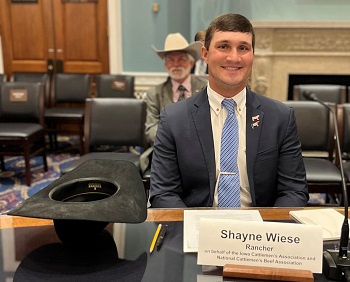
Shayne Wiese is a fifth-generation cattle producer, currently operating Wiese & Sons: Good Doin’ Bulls along with his older brother in West Central Iowa. Wiese & Sons are advocates for conservation and utilize cover crops, CRP, water filtration buffers, and erosion reduction practices as part of their comprehensive commitment to environmental stewardship. In addition to being a member of NCBA, Wiese is involved with the American Hereford Association, Iowa Beef Industry Council, Iowa Beef Breed’s Council, and Iowa Cattlemen’s Association.
“Producer feedback is vital to improving conservation programs outlined in the Farm Bill, and we appreciate Shayne for sharing his personal experiences,” said Bob Noble, president of the Iowa Cattlemen’s Association. “Livestock producers take pride in being stewards of the land and natural resources and would benefit from additional support from the U.S. Department of Agriculture. We seek to maximize the impact of programs like the Conservation Reserve Program and Environmental Quality Incentives Program to further achieve our conservation goals and solidify cattle as climate-smart solutions.”
(Atlantic, Iowa) – The Atlantic Parks and Recreation Department’s Board of Directors, Monday evening, selected a person to fill a vacancy on the Board, created by the resignation in August, of Ashley Hayes, who accepted a job with SWIPCO, in Atlantic. Parks Board Chair Jolene Smith said there were two applicants for the job.
The Board’s recommendation will be submitted to the City Council for their consideration and action, this Wednesday evening. Assuming the Council has no objections, Mayor Grace Garrett will swear-in Butler, along with Parks Board member Shirley Jensen, whose Oath of Office was done incorrectly, according to Smith.
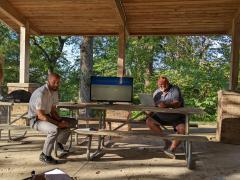
Atlantic Parks and Rec Director Bryant Rassmussen & Assistant Jeff Christensen at the Parks Board mtg., 9/19/22
In other business, the Parks and Rec Board discussed the Healthiest State Walk, which Parks Director Bryant Rasmussen said will be held 9:30-a.m. on October 5th, beginning in the north parking lot of the Nishna Valley YMCA. From there it will proceed to Harl Holt Park via the Bull Creek Pathway, and then back to the YMCA.
Ramussen spoke also, about the placement of a memorial flag pole on the ridge near the Rotary Shelter side, of the Schildberg Recreation Area. He said the request came from a woman whose husband has passed, and would be in honor of him. There is no cost to the Parks Department. The Kiwanis will install the flag pole and required lighting (for night-time illumination).
Rasmussen said the next Parks and Rec event, is the “Tour de Parks,” sponsored in conjunction with the Atlantic Area Chamber of Commerce. Tour de Parks on October 2nd at 2-p.m., is a free bicycle tour of Atlantic parks.
The ride will start and end at the Kiddie Korral at Sunny Side Park (1300 Sunnyside Lane). The Atlantic Kiwanis will be providing a free meal for riders when they finish the ride, and participating organizations and supporters will be giving away free prizes. The ride will be on both trails and streets to highlight area trails and the bike-ability of Atlantic. The ride and following celebration is expected to last until approximately 5:30.
For questions or to borrow a bike or helmet for the ride, contact Atlantic Parks & Recreation at 712-243-3542. Additional information will be forthcoming also, on a Scarecrow Contest. Follow Atlantic Parks and Recreation on Facebook, to see the latest.
(Radio Iowa) – Forecasters say Iowa will ride another weather rollercoaster this week with high temperatures tomorrow (Tuesday) climbing into the low to mid-90s, but then a cool front will arrive and knock highs by Thursday into the 60s, with lows in the 40s. Meteorologist Darren Clabo, who moderated the regional climate update for the National Weather Service, predicts another warm-up will soon follow with lesser chances of rain.
“Above-average temperatures are really expected over the next one to two weeks, combined with below-average precipitation,” Clabo says. “Kind of expecting more or less an upper level ridge to stick around, which should bring us warmer-than-average and drier-than-average conditions, which isn’t necessarily a bad thing going into the harvest season, folks will be able to get out in the fields.” He says that same pattern may continue right into October.
“There are some pretty strong signals that warmer-than-average conditions will persist over the central part of the United States combined with below-average precipitation,” Clabo says. “October is a drier month so below-average precipitation on a normally average to dryish month to begin with doesn’t bode well for filling stock ponds and allowing our stream flow to increase.”
Clabo says the climate outlooks show the La Nina pattern hanging on into winter, for the third year in a row, which -could- mean a warmer-than-normal winter ahead for Iowa.


 Facebook
 Twitter
 YouTube
 RSS
RSS