

CLICK HERE for the latest market quotes from the Iowa Agribusiness Network!
CLICK HERE for the latest market quotes from the Brownfield Ag News Network!


CLICK HERE for the latest market quotes from the Iowa Agribusiness Network!
CLICK HERE for the latest market quotes from the Brownfield Ag News Network!
AMES, Iowa – Nov. 12, 2025 – Today, the Iowa Transportation Commission approved $3,127,377 for nine State Recreational Trails Program projects. Among the projects and approved funding, was $285,000 for the Wabash Trace/Rapp Park Connector Trail (in Page County), and $500,000 for the Great American Rail Trail: Weston to Underwood (Pottawattamie County Conservation Board).
The State Recreational Trails Program was created in 1988 with the purpose of developing and maintaining recreational trails and trail-related facilities for both motorized and non-motorized trail users. This funding is available to cities, counties, state agencies, local governments, and nonprofit organizations through an annual application-based program.
The other projects and approved funding amounts are listed below.
(Ames, Iowa) – The Ames, Iowa-based Iowa Farmers Union (IFU) is hosting an upcoming community event in Clarinda next week. The IFU will hold a Farmers Union Community Happy Hour in Clarinda. The event takes place at The Ice House (1515 S 16th St.) on Tuesday, November 18th, from 6-until 7:30-p.m. Officials say “This is a relaxed gathering open to all Southwest Iowa residents – not just farmers or Clarinda residents. We are there to listen to local residents and there will be a short program (15 minutes or so) for folks to learn about IFU’s work across Iowa supporting family farms, local food systems, and rural communities.”
Enjoy drinks and appetizers – the first round is on the Iowa Farmers Union! More information is available at info@iowafarmersunion.org
Make your reservation to attend here: bit.ly/ClarindaHappyHour
ATLANTIC, IA – Produce in the Park in Atlantic is hosting Harvest Market November 24th, from 3-until 6-p.m., at the Cass County Community Center (805 W. 10th Street, Atlantic, IA 50022). Harvest Market is held just three days before Thanksgiving so shoppers can stock up on local foods, decorations, and gifts to enjoy at holiday celebrations. This year, Harvest Market is placing a special emphasis on ensuring everyone can enjoy good food this holiday season. Market visitors who show proof of SNAP or WIC participation will receive food coupons to spend at the Harvest Market. $25 in coupons will be distributed per qualifying individual (max $50 per family). Coupons can be spent on all food items (excluding food trucks) and will be distributed on a first-come, first-served basis while supplies last.
As of November 11th, Produce in the Park had received $1500 in funding for the Harvest Market food coupons initiative, with $500 contributions from three local organizations: Cass County Local Food Policy Council, Corn 4 a Cause, and Produce in the Park itself. Produce in the Park continues to welcome additional coupon sponsors. Organizations or individuals interested in sponsoring can contact Market Manager Ciara Hoegh at produceintheparkatlanticiowa@gmail.com.
In addition to distributing food coupons, Produce in the Park has invited various local organizations addressing food insecurity to join the market to share information about their programs and how community members can access and support them. As of November 11, participants include Cass County Grow Another Row, the Cass County Local Food Policy Council, Atlantic’s Free Community Thanksgiving, Atlantic’s new Gathering community dinner series, and Atlantic Food Pantry’s “Scrooge” contestants BJ Hart and Dave York.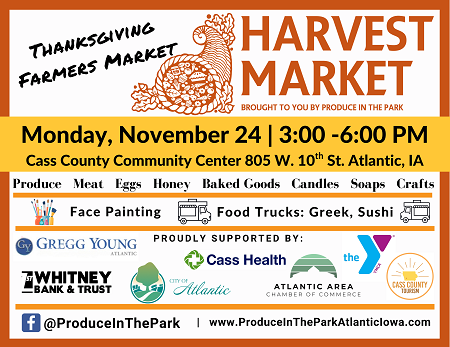
Harvest Market vendors will be selling a wide selection of local foods and handmade craft products. Fresh fall produce will include fresh greens (spinach, lettuce, kale, arugula), potatoes, sweet potatoes, butternut squash, onions, garlic, carrots, and bok choi. Other food offerings include local meats (chicken, pork, beef), farm-fresh eggs, honey, jellies, jams, salad and BBQ sauces, salsa, freeze-dried snacks, and baked goods like rolls, sourdough bread, cookies, cupcakes, kringle, and pies.
Craft vendors will be selling a variety of handmade goods such as candles and wax melts, holiday decorations, potted plants, jewelry, crocheted stuffed animals, and bath and body products such as soaps, sugar scrubs, and beard oils. Harvest Market will offer two food trucks: Karam’s Grill and Pho Wheels & Sushi. Karam’s Grill will serve Mediterranean food such as gyros, falafel, chicken shawarma, and baklava. Pho Wheels & Sushi will offer fresh sushi–preoders are highly recommended, and a link to preorder sushi is available in the Harvest Market Facebook event. And, kids can enjoy face painting and glitter tattoos.
All are welcome at Produce in the Park farmers markets, and admission is free. The market accepts SNAP/EBT and Double Up Food Bucks for all qualifying food items. Harvest Market is the second of five markets in Produce in the Park’s Holiday Market Series. Additional farmers markets in the 2025-2026 series include Christmas Market (December 20), Sweetheart Market (February 14, 2026), and Spring Celebration Market (April 4, 2026).
Produce in the Park farmers markets are made possible by support from the City of Atlantic, First Whitney Bank & Trust, Gregg Young Chevrolet of Atlantic, Cass Health, Cass County Tourism, Atlantic Area Chamber of Commerce, and Nishna Valley Family YMCA. Produce in the Park continues to accept applications for vendors and sponsors for their 2025-2026 Holiday Market Series. For details and applications, see www.produceintheparkatlanticiowa.com.
For the latest market updates, follow Produce in the Park on Facebook at www.facebook.com/ProduceInThePark or Instagram at www.instagram.com/produceintheparkatlanticia/, or sign up for the Produce in the Park email newsletter at www.produceintheparkatlanticiowa.com.
(An Iowa Capital Dispatch story) – A new report from the Iowa Food System Coalition shows that Iowa has 1,461 local food businesses spread across the state. Coalition staff said the report shows the economic viability of local food businesses across the levels of the food system. Bob Ferguson, who serves on the Farm and Food Business priority team with the coalition, said the report showed an increase in the number of on-farm stores, farm stands and local food businesses from previous estimations. “There’s more there than one would suspect,” he said. “There needs to be a lot more, but there’s already robust local infrastructure that interacts with itself to provide local goods and services.”
The businesses, which include food farmers, processors, food hubs and more, are spread across the state, with greater concentration around Iowa’s largest cities. The majority, or 1,074, of the businesses are farmers and food producers. Meat and food processors make up the next highest category, with 189 meat processors and 47 food processors in the state. The report identified between 10 and 26, per category, of local wineries, restaurants, retail stores, groceries and dairy manufacturers in Iowa. The remaining categories had fewer than 10 businesses each identified in the state: grade A dairies, breweries, coffee, food hubs, raw milk, uncategorized, grain mills, caterers, distributors and private chef services.
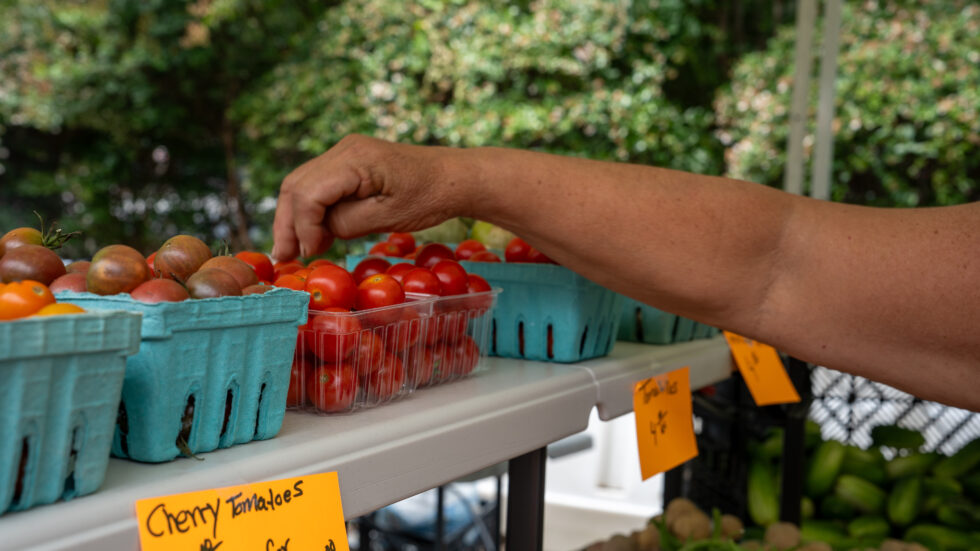
Farmers Market (USDA photo)
The report defined local food businesses as producers that sell direct to consumer, strategic supply chain partners and some large volume distribution services that make “substantial and effective efforts to produce or market source-identified local foods.” Ferguson said the food system has become heavy at the top level and at at the small-scale level, but has been “hollowed” in the middle. The report that shows the number and spread of local food businesses, he said, shows that “infrastructure at the middle is still there.” Ferguson predicts the number of businesses will only continue to grow in the state.
In addition to providing local food infrastructure and economic impact, Ferguson said these local business also provide a “powerful sense of placemaking” or the “coolness factor” that helps people “feel great about being where they are,” which he said is important for rural development. The report analyzed online directories, like the state’s Choose Iowa network, various food hubs, farmers market databases and registries for licensed dairy and meat processing plants. Because the report only makes use of regularly updated online lists, the coalition notes it is “likely an under-count” of local food businesses.
The coalition hopes future iterations of the report will also include business that don’t have an online presence.
(Radio Iowa) – There’s no U-S-D-A weekly crop report due to the government shutdown, but the state’s top ag official says the end of the harvest close. Iowa Ag Secretary Mike Naig says his travels around the state and conversations with farmers indicates the corn and bean harvest is nearly complete. That would fit with the five-year average that shows 98 percent of soybeans and 91 of the corn is usually harvest by mid-November. Naig says the weekend drop of temperatures into the teens and low 20s marked the official end of the growing season.
State Climatologist Justin Glisan wrote in his weekly weather summary that temperatures took a “nose-dive” late into the Nov. 3 through Nov. 9 reporting period. Several towns in northwest Iowa reported the weekly low temperature of 13 degrees Fahrenheit, which Glisan said was 14 degrees below normal. Despite the drop in temperatures toward the end of the week, the overall average temperature for the period was 47.2 degrees. The statewide average was 3.4 degrees above the climatological normal.
According to Glisan, more than 50 weather stations reported measurable snowfall during the reporting period. Pocahontas reported just slightly more than 5 inches of snow. The weekly precipitation average across the state was slightly under three-tenths of an inch, while the normal is 0.52 inch. The latest report from the U.S. Drought Monitor showed 81% of Iowa was in abnormally dry or drought conditions. About 15% of the state, mostly on the eastern edge, was in moderate drought conditions.
(Radio Iowa) – A Department of Natural Resources expert says they’re getting more data on a study of the decline of gray fox numbers. Furbearer biologist Vince Evelsizer says they’ve been putting collars on the elusive animals when they are found in live traps. “We’re up to three collared gray foxes since the start of this project two years ago. So, it’s a low and slow burn with this project, we knew it would be,” he says. “That’s why it started off as a pilot project.” He says it is encouraging that trappers and others have stepped up to help them collect data. “We’re getting more and more folks engaged with giving us reports of sightings. And so we’re going to continue trying to collar more gray foxes here this fall and winter,” he says.
Evelsizer says the tracking data and sightings are helping them track habitat and habits so they can get a picture of what is happening to the animals. “We have some pretty strong hypotheses or ideas about what may be leading to their decline, but we need to know what those are better. We need to , you know, have a better understanding of that,” Evelsizer says. He says they’ve enjoyed working with the animals. “The gray fox has been a really interesting animal to work with. They’re fairly small — adults weigh ten to12 pounds — so they generally are very easy to work with compared to some other species of wildlife,” he says.
Evelsizer says the public, trappers and partner groups such as the Iowa Wildlife Federation have also become really interested in finding out what is happening with the animals.
(Radio Iowa) – Mother Nature’s thrown Iowa a few curve balls this fall, making it difficult for people who love looking at the oranges, yellows and reds of autumn to know when and where to go. Chip Murrow, an urban forestry program specialist with the Iowa Department of Natural Resources, says some parts of Iowa have trees that are already bare, while others are still fully leafed out and mostly green. The wide weather swings share part of the blame.
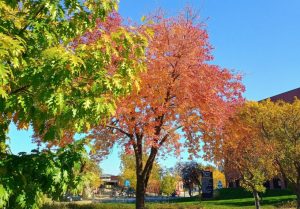
Radio Iowa photo
The amount of daylight may also play a role in the color show, plus, species like black walnuts might drop their leaves early, while oaks typically keep them well into winter. So, where can Iowans still go for the best fall color show?
While the recent weather has been unseasonably warm, the forecast calls for very cold temperatures and snow likely for this weekend. Murrow says that could spell the end of the fall color. Or not.
Typically, northern Iowa sees the leaves change color first, followed by central Iowa, then the south, although this year, parts of eastern Iowa have seen cold snaps that missed the rest of the state, prompting an earlier, faster fall in the east.
WASHINGTON (KCRG) – Iowa U.S. Senator Chuck Grassley says there will be a bailout to assist farmers dealing with the impacts of the government shutdown and Trump Administration tariffs. “There will be a bailout and there should be a bailout,” Grassley told reporters Wednesday. “The federal government ought to make up for what they’ve done negatively to hurt the family farmer.”
Senator Grassley said the bailout would likely range from $10 billion to $13 billion. This announcement follows President Donald Trump’s recent agreement with China to reduce tariffs and resume purchasing U.S. soybeans.
Grassley’s office was unable to provide further details on the plan.
(Radio Iowa) – Ground is being broken today (Thursday) at the state’s largest zoo on an 18-million dollar expansion called Wild Iowa, which will showcase various species that are all native to Iowa. Alex Payne, spokesman for Blank Park Zoo in Des Moines, says it’ll be their first installation for bobcats, and nearby they’ll build a new habitat for American bald eagles, which will include a place where the big birds can perch above visitors.
“There will be some enclosure there for them, but it will be a brighter area so they’ll be able to receive more sunlight than they have in their current habitat, and more room for them to be able to go out and explore around the area,” Payne says. Another section of the new exhibition will be dedicated to river otters, and it will offer visitors an up-close underwater view of the playful creatures. Payne says it’ll be a big improvement over the current otter habitat.

Otter Habitat (Blank Park Zoo image)
“We will move our otters over to the new Wild Iowa section, so the bald eagles and otters will be moving over there, and then next to that, we’ll also have our bobcat area that we’ll be adding, and then we’ll also have our Discovery Cabin and we’ll include some Blanding’s turtles, which are native to Iowa, and some other animals that are native to the Iowa area.” Today’s groundbreaking event also marks the launch of the zoo’s 60th anniversary, what Payne says will be a year-and-a-half-long celebration of the zoo’s past, and the exciting things that are still to come.
“We broke ground in May on our new lion habitat, so that will open next summer, and that’s part of our overall Expand the Impact campaign,” Payne says. “Then Wild Iowa, we’ll be breaking ground now and then that will probably be about a year, so we’re looking into probably spring of 2027 for Wild Iowa.” What was originally called the Des Moines Children’s Zoo opened in May of 1966. It now draws about a half-million visitors every year.
(Radio Iowa) – A northern Iowa organization called “Hunting with Heroes” is gearing up for an annual pheasant hunt later this week in Kossuth County. Bernie Becker, a spokesperson for the group, says six veterans from other states who’ve been wounded in combat will go hunting and four veterans who’ve been guests of the group before will be mentors. “We have probably about 1500 acres lined up that’s never been hunted just for these guys to hunt this year and we’re really looking forward to it,” Becker says. “We’ve got a great bunch of guys coming. We’ve talked to them and they’ve been chosen by people that have been here before and they are capable of doing the hunt because it’s kind of strenuous for combat wounded guys.”
Becker says they try to make sure the wounded vets are comfortable handling new shotguns. “The first day they come in we take them to a sporting club and get them used to shooting these new shotguns that we provide for them and we donate them to them to take home,” Becker said. “We try to hunt about two hours and then we take a break. Everybody has to catch their breath, even me, and then we go back at it again.”
The wounded veterans participating this year are flying in tomorrow (Thursday) and they’ll be hunting in Kossuth County this Friday, Saturday and Sunday. On Veterans Day, they’ll participate in an annual food distribution event in the small Kossuth County town of Lakota. Last year, the group provided over 500 complete Thanksgiving meals to area veterans and the widows of veterans. Becker says this year they’re planning on handing out over 600 meals for the upcoming holiday.

 Facebook
 Twitter
 YouTube
 RSS
RSS