

CLICK HERE for the latest market quotes from the Iowa Agribusiness Network!
CLICK HERE for the latest market quotes from the Brownfield Ag News Network!


CLICK HERE for the latest market quotes from the Iowa Agribusiness Network!
CLICK HERE for the latest market quotes from the Brownfield Ag News Network!
(Iowa DNR Water Summary Update) – Drought watches have been issued for northwest and southeast Iowa following a winter marked by a lack of rain and snow, according to the latest Water Summary Update from the Iowa Department of Natural Resources. Iowa experienced a notably dry winter, with worsening drought conditions expanding across much of the state through February. This deterioration has resulted in the northwest and southeast drought regions of Iowa being placed under a drought watch. While seasonal streamflows currently remain within normal ranges, soil moisture levels continue to decline statewide.
Iowa’s preliminary statewide February precipitation totaled 0.38 inches, or 0.79 inches below normal. Monthly totals ranged from no accumulation at several southern and northwestern stations to 1.26 inches in New Hampton, with southeastern Iowa experiencing the driest conditions as precipitation measured between 0.75 and 1.75 inches. The preliminary statewide average temperature for February was 31.3 degrees, which is 7.2 degrees above normal.
The U.S. Drought Monitor (USDM) currently shows that most of Iowa is abnormally dry or experiencing drought conditions, with portions of southeast Iowa carrying a severe drought designation. According to Iowa’s Drought Plan, all drought regions saw conditions deteriorate in February as soil moisture remained critically dry due to growing moisture deficits and the resurgence of drought. 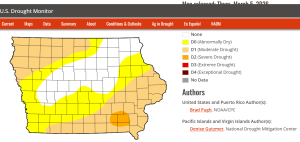
The National Weather Service’s Climate Prediction Center’s March outlook indicates above-average precipitation across the entire state, and an increased likelihood of above-average temperatures. The seasonal outlook suggests continued drought in far northwestern Iowa, and a drought-free or drought removal is likely for the remainder of the state.
“Following a winter of persistent moisture deficits, Drought Regions in northwest and southeastern Iowa are now under a drought watch. The lack of both precipitation and a significant snowpack has led to substantial soil drying across the state. While the seasonal outlook predicts drought will persist in far Northwest Iowa through May, the rest of the state shows a favorable trend for improvement,” said Jessica Reese McIntyre, DNR Environmental Specialist.
The report is prepared by technical staff from Iowa DNR, the Iowa Department of Agriculture and Land Stewardship, IIHR—Hydroscience and Engineering, and the U.S. Geological Survey, in collaboration with Iowa Homeland Security and Emergency Management Department.
Cass County: Corn $4.17 Beans $11.26
Adair County: Corn $4.14 Beans $11.29
Adams County: Corn $4.14 Beans $11.25
Audubon County: Corn $4.16 Beans $11.28
East Pottawattamie County: $4.20 Beans $11.26
Guthrie County: Corn $4.19 Beans $11.30
Montgomery County: Corn $4.19 Beans $11.26
Shelby County: Corn $4.20 Beans $11.26
Oats: $ 2.89 (same in all counties)
(Prices are per bushel; information is from the area Farm Service Agency [FSA] offices)
(An IOWA CAPITAL DISPATCH report) – In southwest Iowa, the fields can be dry, sloped or have rough soil that is poor for growing corn or soybeans and is prone to erosion and runoff. A state-led program is helping farmers, like Bailie Walters, convert those less-than-desirable crop lands into pasture. This helps with soil and nutrient conservation on those acres and it gives farmers more places to graze cattle.
Walters, who farms and raises cattle with her father in Taylor County, has used the state Cattle and Conservation Working Lands Program to convert crop land to pasture and to add fencing and water sources to different parts of the farm to facilitate additional grazing opportunities. Walters said she’s not sure these conservation measures would have happened if it weren’t for the state program, which offers cost-share funding and technical support to producers in select counties.
The program began as a pilot project in 2016, administered by the Iowa Department of Agriculture and Land Stewardship, and now serves farmers in eight counties: Adams, Carroll, Cherokee, Guthrie, Ida, Page, Taylor, and Woodbury. IDALS recently announced it was extending the program for an additional three years and renewing agreements in Taylor, Page, Carroll, Cherokee, Guthrie and Ida counties. The program will persist in the other counties, but they have a separate grant timeline.
The goal of the project, according to IDALS, is to “convert non-productive land to productive land while also providing water quality benefits to the state of Iowa.” According to a news release from IDALS, the program has facilitated the conversion of more than 16,000 acres of land from less-productive row crops fields to pasture and grazing systems. IDALS also said producers in the program have established more than 195,000 acres of cover crops, which can also be used as pasture for livestock. Secretary of Agriculture Mike Naig said the project shows that “conservation does not require taking land out of production.”
“Farmers take their responsibility to be good stewards of the land very seriously because clean water is non-negotiable,” Naig said in the news release. Naig said the project encourages farmers to evaluate their land and “determine what makes sense to farm and what makes sense to hay or graze.” Underperforming or highly erodible acres are areas targeted for conversion. Walters said she has seen the impacts of the program on her family land as areas that were prone to erosion are now stabilized and more fields get seeded with cover crops.
She said seeding a marginal field to pasture was the “best thing” the family could do for that ground, which she said had poor soil and was in a rough and hilly area. The program also allowed them to grade stabilize a ditch at the back of the property and put in a couple of cattle ponds, both of which have made it easier to move the cattle to different paddocks and have reduced the amount of soil that runs off the land.
Walters said her father and grandfather implemented traditional conservation measures, like terraces, but were harder to convince on things like cover crops. Walters, as the younger generation on the farm, said it has been easier to get her family to try out different conservation methods under the program, since it has some funding attached. Ultimately, the program has allowed the Walters’ operation to rotate cattle between different areas on the farm. Walters said this has been especially helpful toward the end of the summer — when the pasture starts to singe, she still has areas to move the cattle.
A total of $15 million has been invested in the program, according to IDALS, and $11.7 million of that has come directly from the state. Funding for the recent extension of the program comes from the state’s Water Quality Initiative. The Water Quality Initiative funds many projects across the state, in addition to the cattle and conservation program. According to a fiscal year 2027 budget recommendation, the initiative received $8.2 million in both 2025 and 2026 from the state’s Rebuild Iowa Infrastructure Fund.
Naig, speaking to lawmakers in a House appropriations subcommittee March 2, said the project could be a model for the federal Farm Bill because it promotes conservation without taking land out of production. Plus, he said it gives the younger generation on the farm, like Walters, some assistance to add or build up a cattle herd if they want to diversify the family operation. Pallin Turner is another of the more than 1,100 producers in the state who have participated in the project. She runs about 300 head of cow-calf pairs and farms around 1,500 acres in Taylor and Page counties.
Turner said the program has allowed her operation to put cover crops on all of their farmed row crop acres, and even hay some of the rye they use as cover crops. Like Walters, she has also used the program to add fencing and ponds that make it easier to move cattle to different areas. She said there is a lot of pasture in southwest Iowa that was converted to crop land when row crops were more profitable than grazing cattle.
Those sloping or less productive lands are key targets of the program, which also partners with local Soil and Water Conservation Districts and the U.S. Department of Agriculture’s Natural Resources Conservation Service. Turner said the funding and implementation of cattle-specific conservation practices come at a time when the “pendulum” in the ag economy is swinging from row crops over to cattle. The U.S. cattle herd is at a historic low, while row crop producers have faced several years of low crop prices and high yields.
Applications for the program, according to IDALS, are considered on a first-come, first served basis. Interested producers can reach out to their USDA service centers for application information in the applicable counties.
(Des Moines, IA) – The Iowa Department of Natural Resources is accepting public comment on a proposed increase to the price of resident and nonresident hunting, fishing and trapping licenses, tags and fees. If approved, the new prices will go into effect on Dec. 15, for the 2027 recreation year.
The proposed price of a resident hunting and resident fishing license would increase by $1, resident deer license by $1.50, resident trout fee by $0.50, and resident lifetime hunting and lifetime fishing by $2.50. The increase will apply to all licenses and fees.
This is the first license fee increase since 2019.
Comments may be emailed to wildlife@dnr.iowa.gov, given verbally by calling 515-201-3376, or in person at 1 p.m., March 24, at 6200 Park Avenue, Suite 200, in Wildcat Den conference room, in Des Moines. Public comments will be accepted through March 24. The fee increase was approved at the February meeting of the Natural Resource Commission.
(Radio Iowa) – A sixty-five acre tract of land in southwest Iowa near the Missouri border is being donated to Taylor County, providing a natural space that will be preserved and turned into a public use area for future generations to enjoy. County Conservation Director Zoie Lecy says life-long county resident Jim Gamel is one of the last members of his family who still lives in the area.
“Twenty-seven acres of that has been in his family since 1973, so he’s had this in his family for a long time,” Lecy says. “He just wants to pass down something from his family and let the families of Taylor County and the residents of Taylor County and the surrounding counties have an opportunity to have something that they’ll enjoy and think back on his family legacy for a long time.”
The land is located in the Ross Township and is part of the larger Gamel farm of about 100 acres. Lecy says plans are in the works for what will be called the Gamel Recreation Area. While row crops were grown on the land at one time, Lecy says it has been mostly used for pasture, with some timber that could also present future hunting opportunities.
“In the middle of that property is a pretty decent sized ditch that we would like to utilize into a smaller lake, probably like a 3.5 acre lake,” Lecy says. “We’d also like to bring in camping and there’s an opportunity for hunting and we’ll bring in some trail systems and stuff like that.” Lecy says contractors have begun scoping out the area for the lake and dam development, with seasonal crews expected to come in later this year to tackle tree removal and create more space for trails.
She adds they also hope to have a variety of aquatic life in the lake, including bluegill, bass, catfish, and crappies. Lecy says the project is a once-in-a-lifetime opportunity for the county to expand its parks and recreational areas. “A lot of people don’t have the opportunity or the money or the means to be able to donate something like this to the county,” Lecy says. “This opens up a whole new world for conservation as we get to start a park that’s fresh to do what we think would be best for the people of Taylor County and the communities around it.”
She says the gift is very important to Gamel, “to be able to give back to those families and people of this county and community that’s been a part of his whole life.”
(IOWA CAPITAL DISPATCH) – Bills to prohibit cloud seeding in Iowa, raise the punishment for animal torture and require state prioritization of vehicles with biodiesel fuel capacities were sent to the Senate following House approval Thursday. House File 2640 would prohibit the intentional emission of air contaminants for the purpose of “affecting the temperature, weather, climate or intensity of sunlight.” The bill would prohibit geoengineering practices, or methods to reduce the impacts of climate change by releasing certain properties into the atmosphere. One form of geoengineering, called cloud seeding, involves the release of silver iodide crystals into certain types of clouds to trigger rain or snow.
The U.S. Government Accountability Office holds that while several states utilize cloud seeding technology, its benefits are “unproven.” A similar bill has also advanced in the Senate, though the bills are not identical. The House adopted an amendment that struck the first portion of the bill, which would have required public airports to submit regular reports on aircraft at the terminals with equipment that could emit weather-changing particles into the atmosphere. The amendment also specified that the aerial application of agricultural inputs, like pesticides or fertilizers, would not be affected by the bill.The bill passed with a vote of 59-26 along party lines.
The House voted unanimously Thursday to pass House File 2348, which would elevate animal torture from an aggravated misdemeanor to a class “D” felony in Iowa. The bill alters code to specify that someone is guilty of animal torture if they perform actions that intentionally crush, burn, drown, suffocate, impale or subject an animal to serious injury or death. Class “D” felonies are punishable with up to five years confinement and fines of $1,025 to $10,245, according to the bill
Another bill, passed from the House Thursday, would require that diesel engine passenger vehicles leased by the state be manufactured with the capacity to run high blends of biodiesel fuel.House File 2671 provides that diesel engine vehicles rented or leased by the state must be capable of running on B-20, a blend with 20% biodiesel fuel, or higher blends. This brings biodiesel requirements for leased and rented vehicles in line with state requirements for purchasing diesel engine vehicles.
An amendment was added to the bill and adopted by the House to stop the Iowa Department of Administrative Services from limiting the number of events held at the state Capitol complex to one event. HF 2671 passed with a vote of 85-1 with Rep. Mark Cisneros, R-Muscatine, as the sole no.
Cass County: Corn $4.10 Beans $11.07
Adair County: Corn $4.07 Beans $11.10
Adams County: Corn $4.07 Beans $11.06
Audubon County: Corn $4.09 Beans $11.09
East Pottawattamie County: $4.13 Beans $11.07
Guthrie County: Corn $4.12 Beans $11.11
Montgomery County: Corn $4.12 Beans $11.09
Shelby County: Corn $4.13 Beans $11.07
Oats: $ 2.76 (same in all counties)
(Prices are per bushel; information is from the area Farm Service Agency [FSA] offices)
Cass County: Corn $4.10 Beans $11.03
Adair County: Corn $4.07 Beans $11.06
Adams County: Corn $4.07 Beans $11.02
Audubon County: Corn $4.09 Beans $11.05
East Pottawattamie County: Corn $4.13 Beans $11.03
Guthrie County: Corn $4.12 Beans $11.07
Montgomery County: Corn $4.12 Beans $11.05
Shelby County: Corn $4.13 Beans $11.03
Oats: $2.73 (same in all counties)
(Prices are per bushel; information is from the area Farm Service Agency [FSA] offices)
DES MOINES – The Iowa Department of Natural Resources (DNR) is offering workshops around the state to teach the skills needed to hunt, field dress and cook wild turkey to participants who have little to no wild turkey hunting experience. The workshops will be offered in Council Bluffs, Indianola, Massena, Marble Rock, Sioux City, Solon and Vinton from mid-March through early April. Workshops are designed using hands-on techniques to teach basic wild turkey hunting strategies, such as proper equipment, where to hunt, safe shooting practices, and how to field dress, butcher and cook the bird.
“For those interested in the challenge of wild turkey hunting as a means of sourcing their own protein, this program provides the opportunity to learn the skills and knowledge it takes to do it all yourself,” said Jamie Cook, Hunter Education coordinator with the Iowa DNR. For information on cost, workshop time and location, and to begin the registration process, go to https://servicedesk.gooutdoorsiowa.com/EventManager/EventsHome.aspx
Early registration is encouraged as space is limited. Programs are provided through a partnership with the Iowa DNR, the Iowa Hunter Education Instructor Association, the National Wild Turkey Federation and other local partners. It is part of a national effort to recruit, retain and reactivate hunters due to the overall decline in hunting and outdoor recreation.


 Facebook
 Twitter
 YouTube
 RSS
RSS