

CLICK HERE for the latest market quotes from the Iowa Agribusiness Network!
CLICK HERE for the latest market quotes from the Brownfield Ag News Network!


CLICK HERE for the latest market quotes from the Iowa Agribusiness Network!
CLICK HERE for the latest market quotes from the Brownfield Ag News Network!
(Radio Iowa) – A key member of the Iowa House backs a bill to prohibit lawsuits accusing pesticide companies of failing to warn the product could cause cancer, as long as the product’s label meets federal guidelines. The bill does not name glyphosate, the main ingredient in Roundup — but House Majority Leader Bobby Kaufmann, a Republican who farms near Wilton, suggests Bayer’s factory in Muscatine that makes Roundup could close if Iowa lawmakers don’t take action.
“I can tell you what will happen if we don’t get this bill done. What will happen is we’ll be buying glyphosate from China. We just got done seeing what China can do if they choose to squeeze us — whether it’s soybeans, whether it’s (computer) chips — China can put its grip around our throat and particularly around our farmers’ throats,” Kaufmann said during an interview with Radio Iowa. About 70 percent of the glyphosate sold in the North America is made at the Bayer plant in Muscatine.
“Do you want an Iowa company with all of the Iowa guardrails, with all of the Iowa accountability…making a product our farmers have to have,” Kaufmann asks, “or do you trust China?” Kaufmann says while Bayer’s Muscatine plant is just outside of his House district, he represents many of the 400 people who work there. “It’s 15 miles from me,” Kaufmann said. “It’s five miles from my district.”
The Iowa Senate narrowly approved this bill this past May, but it did not come up for a vote in the House. Kaufmann isn’t guaranteeing a vote in the House next year. Kaufmann says he’ll talk with House Republicans to see if there are the 51 votes necessary to pass the bill in 2026 — and he knows there are some House Republicans who are strongly against it. “Some of my closest friends are not for that bill in my (House Republican) caucus and their views are based on real stories and heart-tug stories,” Kaufmann said, “and their views are very, very valid.”
Opponents of the bill say it prioritizes profits over the health and lives of Iowans who’ve been affected by RoundUp and some accuse the company of covering up information about the product’s harmful effects. Tens of thousands of lawsuits have been filed in the U.S. with claims that the weedkiller causes cancer. Bayer has spent over 10 BILLION dollars on litigation and jury awards to plaintiffs. New laws in North Dakota and Georgia give Bayer new liability protection from lawsuits over product labeling and Iowa’s governor has signaled she would support of a similar law here.
(From an FFA reporter) – On Wednesday December 10th members of the Atlantic FFA participated in the Iowa Cattlemen’s Foundation Beef Extravaganza. Team members Lauren Comes, Hayden Kleen and Frank Freund placed 5th overall. The three members of the Beef Extravaganza team thank Chad Comes, Kevin Freund for helping with the team’s preparation, and Cass County Cattlemen for paying the entry fee for the team’s contest. Atlantic FFA member Lauren Comes commented, “Overall this is a very difficult contest and I feel like I learned a lot. I know this will help me in the future as I continue to work in the cattle industry.”
The Beef Scholarship Extravaganza is a unique contest open to high school juniors and seniors that focuses on the student’s knowledge and skills in ten different areas of the beef industry. Teams worked through ten 30-minute stations with 10-minute breaks between each station. In station one, Health and Handling, Team members were tested on effective stockmanship for handling of cattle and proper health related practices included, but not limited to, proper vaccination procedures and protocols, dose administration and equipment selection, parasite control, castration procedures and other health related practices essential for the beef industry and animal welfare.

Pictured from left to right: Frank Freund, Hayden Kleen, Lauren Comes. (Photo courtesy Eric Miller)
During station two, Nutrition, team members evaluated the body condition score of four cows and then assisted the station judge in balancing a feed ration for a real-life scenario. To prepare, students learned about body condition scoring, cattle nutrient requirements, the nutrient values of feedstuffs, and how to use that information to determine what diet will be the best for the exercise. Station three focused on Marketing. The station required contestants to calculate yield and quality grades for carcasses, determine the value of a carcass, and determine values for lots of cattle. Team members should know the degrees of marbling necessary to achieve a final quality grade, assuming that all marbling calls are derived from A maturity carcasses. Students must also be able to use adjusted fat thicknesses, ribeye areas (sq. in.), hot carcass weights, and KPH% to calculate final yield grades. Team member Frank Freund said, “I really enjoy the marketing section. It’s a complex math problem that has real world applications. I will be able to use this information in the future when I work for the family business.”
Station four was the Seedstock Merchandising station. Team members demonstrated how to incorporate performance information, pedigrees, and phenotypes into a private treaty sales situation. Judges acted as buyers and team members had to identify the buyer’s needs, concerns, and goals in order to “sell” the bull or bulls. Atlantic FFA member Lauren Comes commented, “My favorite part of the contest is the Seedstock Station. I like talking about the genetics of cattle and how to use that information to predict the future of a cattle herd.“ Station five was the Keep-Cull Replacement Heifer station. During the first part of this station team members evaluated expected progeny differences (EPDs) and visually appraised live cattle in order to choose four out of eight heifers to keep that would best fit the production scenario given to contestants. The scenario addressed the objectives and marketing scheme of the operation along with other management information. In the second component teams answered questions about the set of heifers and their EPDs as well as their phenotypical features.
At station six, Job Interview, each student prepared a cover letter and resume and participated in a mock interview with an industry professional. By participating in this station, young people had the opportunity to explore career choices in the cattle industry. Station seven, Beef Industry Issues and Advocacy, gave team members the opportunity to give a presentation shedding a positive light on an area of the beef industry. Subjects may have included Modern Beef Production, Animal Care, Beef Safety, Beef Nutrition, Environmental Stewardship, and The Beef Checkoff. The Reproduction station is often considered the most difficult station of the contest. Students were tested on their knowledge of calving management practices such as pre-calving preparation, process of parturition, dystocia, equipment involved in reproductive practices, synchronization techniques, artificial insemination, embryo transfer and other technologies in this field.
In the Credit and Finance station team members were provided with the experience of organizing, preparing, and participating in a mock loan request. Teams met with financial officers and presented a description of a project along with completed financial data in support of the loan request. The project consisted of selecting one of three scenarios: purchasing 150 head of yearling steers to feed out, purchasing 15 bred cows to start a cow/calf business, or purchasing 75 head of heifer or steer calves. Atlantic FFA member Hayden Kleen commented, “My favorite station is the Credit and Finance scenario. This station will give me confidence when its time for me to get a loan to continue into the agriculture world after graduation“
The final station was the Beef Management Challenge. This station allowed students to tie information gained from the other stations of this competition together. This station was an informal discussion between team members and a judge, who assumed the role of a manager who needed advice about his or her cattle operation. The team members assumed a role of a hired consultant to provide advice for the fictitious beef enterprise.
Atlantic FFA Advisor Eric Miller said, “Overall I was extremely happy with how the team performed. This contest is basically taking ten college sophomore level tests in a row. This contest is very demanding and takes a lot of practice. Thank you to all the parents that helped and a special shout out to the Cass County Cattlemen for funding our team for the past 13 years”
(Oakland, IA) — An Iowa conservation organization based in Pottawattamie County is asking for landowners’ help in improving water quality and reducing soil erosion. Golden Hills RC&D received funding from the Regional Conservation Partnership Program for the West Nishnabotna Water Quality and Infrastructure Partnership. The project aims to improve water quality, increase flood resiliency, and protect local infrastructure across a 681,000-acre project area in southwestern Iowa.
The project will complement similar activity on private lands in service of making the landscape more resilient in the face of increasing catastrophic flooding events. The partnership will report project outcomes through monitoring and modeling of soil and nutrient loss reductions.
Golden Hills RC&D has released a survey for rural property owners in Southwest Iowa. The brief questionnaire asks about conservation practices and related initiatives.
The organization says the goal is to better understand how familiar landowners are with these practices. The survey is also issued as part of the Regional Conservation Partnership Program and the Underserved Farmer to Farmer program. Golden Hills also says it will improve outreach efforts about cost-sharing programs.
For more information, or to fill-out the survey, go to:
https://www.goldenhillsrcd.org/rcpp.html
(Atlantic, IA) – Atlantic FFA Advisor Eric Miller says three Atlantic FFA members traveled to Ankeny last weekend, to attend the State Officer Selection Process workshop and Amplify FFA Leadership Conferences. Making the journey to Ankeny on Dec. 6th, was Lauren Comes, Tenley Cappel and Tiegan Daniel. FFA members from all over Iowa attended the conference, which taught them about leadership and student development.
Lauren Comes attended the State Officer Selection Process workshop (SOSP) in preparation for her potential run for an Iowa FFA State Officer position later this spring. The SOSP workshop focuses on the areas that all State Officer Candidates must prepare for. To start the process, each candidate must first complete an application. The first interview is a one-on-twelve interview where the candidates should capitalize on this time by making their first impression a lasting impression. Next is the Multiple Choice Test of key issues related to agriculture. Then the Round Robin 1 interview where State officer candidates will engage in a conversation with a knowledge area expert. The One-on-One interview is focused on two objectives. First, this is an opportunity for individual nominating committee members to develop rapport and get to know the candidates in a one-on-one setting.
On day two the candidates will start with a Writing Exercise 1 by completing an in-depth written essay. The written essay will be on a topic relevant to the theme of agriculture, FFA or the American agricultural education system. The next interview is called Stand and Deliver. State officers must consistently be knowledgeable and be able to verbally convey a message in front of a group or crowd. Candidates will have 20 minutes in a private room to prepare for delivering a 3-minute speech. The final interview is another Personal interview. The purpose of this interview is to ask a final set of questions developed by the committee to address competencies such as character, passion for success and influence.
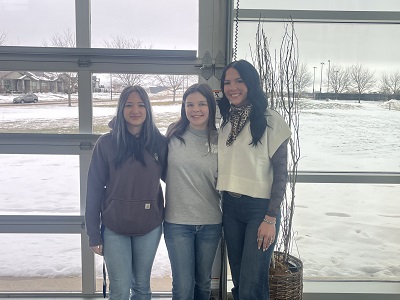
Left to right
Tiegan Daniel, Tenley Cappel and Lauren Comes (Photo submitted with this story)
The AMPLIFY Conference focuses on student development. This year the conference focused on Purpose: Connect. Care. Create. Establishing a purpose as a daily practice and draft a leader purpose statement. Discovering how people are connected to purpose and identify their talents. Members also learned to discover what it means to live to serve as a leader and examine methods for serving others while pursuing purpose. All of this while Identifying the value in practicing practical self-care as a leader and discovering the difference between living with purpose and completing action items. To wrap up the conference, each member drafted a personal purpose team and identified how to live out a purpose plan at home.
FFA Advisor Eric Miller said, “These conferences are important to help develop the kind of leaders that we need in our school and community. I am glad the Iowa FFA provides us with the opportunity and the students are so willing to give their time to become better leaders.”
Cass County: Corn $4.14 Beans $10.50
Adair County: Corn $4.11 Beans $10.53
Adams County: Corn $4.11 Beans $10.49
Audubon County: Corn $4.13 Beans $10.52
East Pottawattamie County: Corn $4.17 Beans $10.50
Guthrie County: Corn $4.16 Beans $10.54
Montgomery County: Corn $4.16 Beans $10.52
Shelby County: Corn $4.17 Beans $10.50
Oats: $2.44 (same in all counties)
(Prices are per bushel; information is from the area Farm Service Agency [FSA] offices)
(Radio Iowa) – The annual Iowa State University Extension farmland survey shows land values statewide increase by point- seven percent an acre. I-S-U’s Rabail Chandio oversees the survey. “This minor increase is the sixth increase in the last seven years. The only exception to that was last year when we experienced a decline, again a minor one,” Chandio says. The increase brings the statewide average this year for an acre of farmland to 11-thousand-549. She says when you consider inflation, land values are holding steady. “In inflation adjusted terms, we actually see a decline. Overall. I would really classify this change as about stability in the land market rather than growth rather than broad based growth,” she says.
Six of the nine crop districts reported increases in land values. “The highest increases are observed in the northeast corner and the east-central corner and the northwest corner. These are the top three districts reporting highest increases in land values,” Chandio says. “And these are also the areas that are more prone to livestock activity, animal operations within Iowa.” The crop district in the northeast corner of the state saw a land value increase of four-point-one percent. Chandio says the money made from cattle was better than for crops. “The most respondents reported more difficult situations within the crop sector, while the dairy farmers or the cattle sector experienced better gains or better prices this year,” she says. Chandio says the lack of available farmland for purchase helped keep prices up.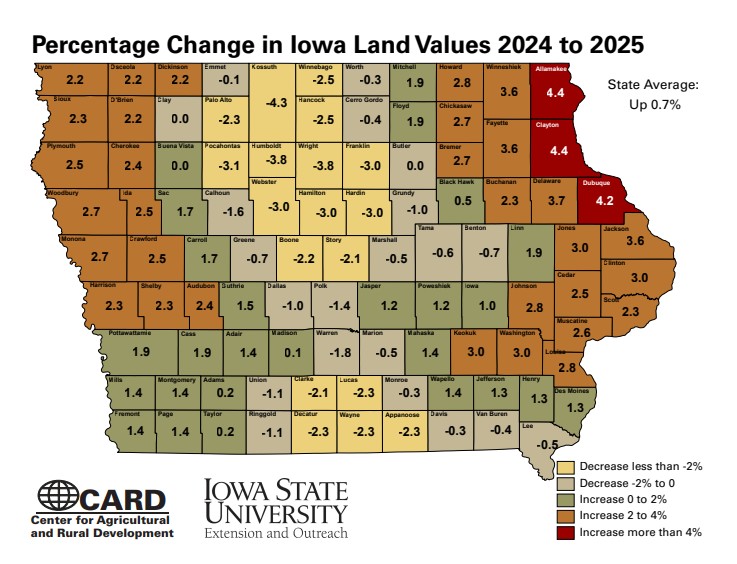
“The most positive influence on the land markets again this year was a limited supply of land. Cited as a major positive factor by 21 percent of the responses,” she says. The top negative factor in the value of farmland are the continued low commodity prices. “This factor was cited by 32 percent in our responses…followed by high interest rates, higher input costs, uncertainty around trades and tariffs, as well as the struggles with depleting cash and credit reserves,” she says.
O’Brien County once again has the highest county-level land values at 16-thousand-269 dollars an acre. And the lowest land values are again reported in Appanoose County that stand at six-thousand-679 dollars an acre.
(Radio Iowa) – Iowa Senator Chuck Grassley says the 12-billion dollar farmer bailout program President Trump announced Monday is much-needed and he predicts a great many farmers in Iowa will qualify for it. Grassley says this is quite similar to the help the president offered farmers in 2020 when trade trouble with China impacted U-S agricultural markets. Grassley keeps a very close eye on the daily movements of commodity markets. “Yesterday’s prices in Shell Rock, Iowa, were about $4.11 for corn, still losing money on corn,” Grassley says. “The price of soybeans was down yesterday, I think about 12-cents, and at 10-something, farmers are still losing probably a dollar-and-a-half, a dollar-75.”
Grassley’s son, Robin, raises corn, soybeans and livestock on the family farmstead in New Hartford. The Republican says they had a good crop in Butler County this season, but input costs were up 25-percent, so they’re in the same financial boat as most other farmers. “The last two years, I haven’t been farming with Robin 50-50, like you might call crop share,” Grassley says. “He pays me cash rent, so whether he applies for this aid or not, that’s his business. I’m not going to say anything about that.” Grassley says the program is for farmers who are facing severe losses due to high input costs, falling commodity prices, and international trade troubles.
“The president ran on a platform of tariffs, and for the most part, his tariff programs are working out pretty good for the economy, generally,” Grassley says, “but when you have programs that are working out, sometimes they have harmful effects and these tariffs are having a harmful effect on farmers’ income.” The Farmer Bridge Assistance Program will make payments available to farmers who raise 20 different crops, including corn and soybeans, with the checks expected in late February. Applications need to be in to U-S-D-A by December 19th.
Cass County: Corn $4.12 Beans $10.56
Adair County: Corn $4.09 Beans $10.59
Adams County: Corn $4.09 Beans $10.55
Audubon County: Corn $4.11 Beans $10.58
East Pottawattamie County: Corn $4.15 Beans $10.56
Guthrie County: Corn $4.14 Beans $10.60
Montgomery County: Corn $4.14 Beans $10.58
Shelby County: Corn $4.15 Beans $10.56
Oats: $2.44 (same in all counties)
(Prices are per bushel; information is from the area Farm Service Agency [FSA] offices)
(Radio Iowa) – President Trump says the federal government will provide up to 12 BILLION dollars in one-time payments to farmers being pinched by higher production costs and lower commodity prices. “This relief will provide much needed certainty to farmers as they get this year’s harvest to market and look ahead to next year’s crops,” Trump said, “and it’ll help them continue their efforts to lower food prices for American families.”
Trump made the announcement yesterday (Monday) during an event at the White House. Cordt Holub, a 4th generation farmer who raises corn, soybeans and cattle in Tama County, sat next to Trump. “It’s Christmas early for farmers,” Holub said. “…With this bridge payment, we’ll be able to farm another year…It gets in your blood to farm and what you’re doing here in D.C. is working. You have a backbone to stand up to other countries.”
U-S Agriculture Secretary Brooke Rollins says the payments will be based on 2025 acreage reports that eligible farmers file with the U-S-D-A by December 19th. “So as you are going with your lender, as you are working to ensure and understand what you can plant for next year, you will have that number in hand,” Rollins said. The checks should be distributed by the end of February.
Iowa Farm Bureau President Brent Johnson says farmers are facing severe financial stress driven by high input costs and declining crop prices — compounded by a lack of global trade opportunities. He says the payments will be critical support for farmers while broader trade discussions continue.
Farmers who raise 20 different crops, including corn, soybeans and oats, will get 11 BILLION dollars under the “Farmer Bridge Assistance Program.” The U-S-D-A will use the remaining BILLION dollars to help farmers who grow specialty crops and sugarcane.
(Radio Iowa) – The Iowa D-N-R recently released a series of informational updates on chronic-wasting disease that’s found in deer. State deer biologist Jace Elliott says they want to get information out to update everyone as the deer season is underway. “C-W-D has always been a hot topic. It’s controversial, and it’s important for hunters and the public to understand, you know, there, there’s a lot of information out there and we just want to help provide maybe sort of a biological, scientific and deer management focus,” he says. If you haven’t seen any of the information, you can find it online.
“Our deer hunting website, which is just iowadnr.gov/deer, has a lot of different helpful resources,” Elliott says. “We have a a sub website in there called deer health. You can find a lot of information about C-W-D, including our our interactive C-W-D dashboard.” He says there’s also information on other diseases that impact deer.
” You can also see. our E-H-D and blue tongue reporting tool and dashboard, So, for anybody who hasn’t visited that website, there’s a wealth of information for folks who are interested in in how and why we manage deer in Iowa,” Elliott says.
The D-N-R collects samples from hunters throughout the deer season to test for C-W-D to help track its spread in the state.


 Facebook
 Twitter
 YouTube
 RSS
RSS