

CLICK HERE for the latest market quotes from the Iowa Agribusiness Network!
CLICK HERE for the latest market quotes from the Brownfield Ag News Network!


CLICK HERE for the latest market quotes from the Iowa Agribusiness Network!
CLICK HERE for the latest market quotes from the Brownfield Ag News Network!
DES MOINES, Iowa — Late-night TV icons with Iowa ties will be immortalized in butter at next month’s Iowa State Fair. Johnny Carson, who was born in Corning, and Des Moines native Steve Higgins will be in the Agriculture Building’s cooler next to the wildly popular butter cow and another special guest — “The Tonight Show” host Jimmy Fallon. State Fair butter sculptor Sarah Pratt and her team will also make a butter version of the sky glider to celebrate its 50th year.
Fallon, known for his on-air impressions, will get his own impression in butter at the 2024 Iowa State Fair. Fallon will be sculpted alongside the Tonight Show’s announcer, producer and Des Moines, Iowa, native Steve Higgins in celebration of 10 years with Jimmy Fallon as the host of the show.
Another Iowa native will also be featured in butter – longtime Tonight Show host Johnny Carson. Johnny Carson lived in Corning, Avoca and Red Oak as a child. Carson took over the Tonight Show in 1962 for a run that lasted three decades.
The butter cow, along with butter versions of Higgins, Carson and Fallon, will be featured alongside an iconic sky glider chair as the main Sky Glider celebrates 50 years in 2024. All of the sculptures will be on display in the John Deere Agriculture Building 9 a.m. to 8 p.m., during the Fair, August 8-18.
The butter cow has been an annual attraction at the State Fair since 1911. Sarah Pratt of West Des Moines was named the fair’s fifth butter sculptor in 2006 after 15 years as an apprentice to Duffy Lyon. Companion sculptures of the butter cow have been a tradition since at least 1996 when Grant Wood’s famous “American Gothic” painting was immortalized. Last year’s fair featured iconic Iowa athletes Jack Trice, Kurt Warner and Caitlin Clark.
The 2024 Iowa State Fair annual parade kicks things off Aug. 7 in downtown Des Moines.
(Radio Iowa) – The latest Drought Monitor report for Iowa is dramatically different than it was one year ago. One year ago 100 percent of Iowa was either in drought or abnormally dry conditions. The latest Drought Monitor map shows just Scott County and a small part of Clinton County now show abnormally dry conditions. That amounts to less than one percent of the state. 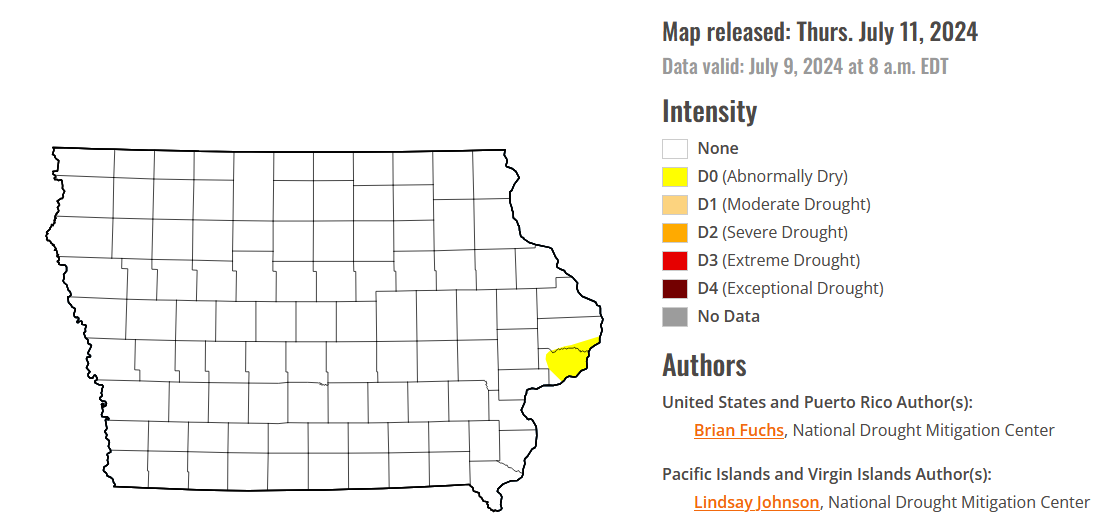
State Climatologist Justin Glisan says the last time Iowa had no abnormally dry areas was in early May of 2020. The state has been free of actual drought conditions since late May of this year – which stopped four-years of drought conditions.
(Ames, Iowa) – The Iowa Department of Natural Resources says the City of Audubon has agreed to pay an $8,000 fine for repeatedly expelling too much ammonia nitrogen in its wastewater that flows to the East Nishnabotna River. The Iowa Capital Dispatch reports, according to a recent DNR order, Audubon violated its ammonia limits in nearly every month of 2021 and 2022 and in several months of 2023.
Elevated levels of ammonia can be toxic to fish and other aquatic life and can deplete oxygen in water. The city has said its pollution woes were the result of large amounts of contaminants from a truck stop that pipes its wastewater to the city’s treatment facility. Waspy’s Truck Stop opened about six years ago and has a truck wash that is used to clean the insides of animal trailers. That debris was believed to be the source of the excessive ammonia levels in Audubon’s treated wastewater. The DNR also fined Waspy’s $8,000 this year and said it had violated its pollutant limits — for ammonia nitrogen, waste solids, oil and grease — more than 500 times.
The truck stop has installed barriers to collect the manure and help prevent it from being discharged to the treatment facility. Audubon’s public works director was not immediately available to comment for this article, but he has said the situation was improving. The DNR order noted that Audubon was warned multiple times that it was exceeding its contaminant limits but that it failed to expeditiously remedy the problem.
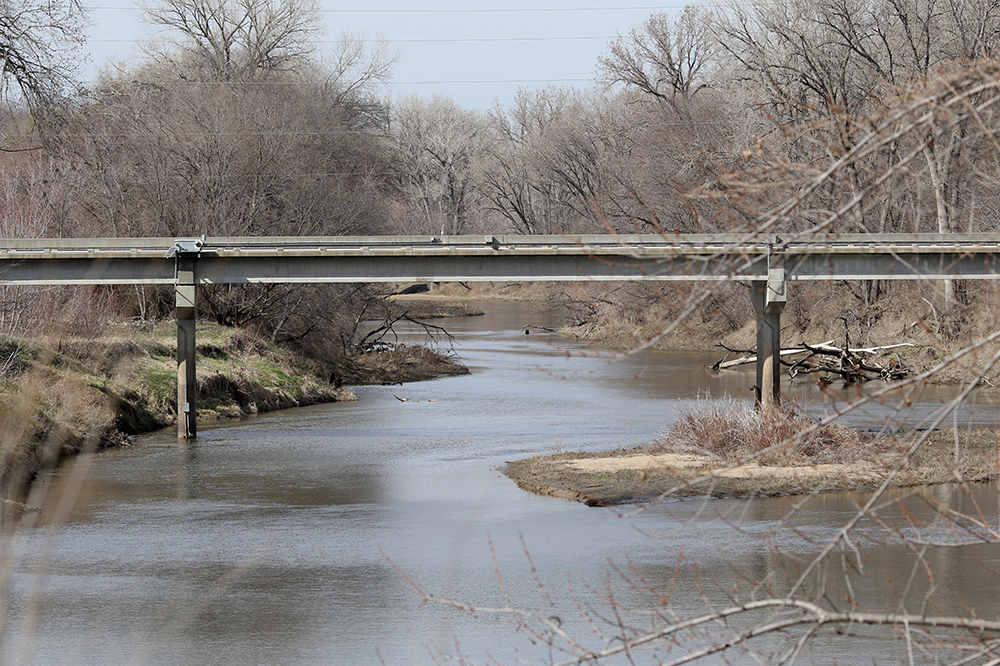
Wastewater from Audubon flows into a creek that goes to the East Nishnabotna River. (Photo by Jared Strong/Iowa Capital Dispatch)
Treated wastewater from the city flows through a creek to the East Nishnabotna, which was polluted downstream in March by a large fertilizer spill near Red Oak. The spill killed nearly all the fish and other aquatic life in about 60 miles of the East Nishnabotna and Nishnabotna rivers.
Oats: $2.93 (same in all counties)
(Radio Iowa) – It’s been almost four years since a powerful derecho blasted across Iowa, causing some 11-billion dollars damage, and the rebuilding of our landscapes is still far from complete. The storm’s winds of up to 140-miles an hour wiped out millions of trees and a grant program is offering funds to help communities recover and replant. Ellie Jones is the Iowa D-N-R’s community disaster recovery coordinator, and she’s partnering with Trees Forever. “We lost a lot more trees than we can replace within a couple of years,” Jones says. “Between urban and non-urban areas, we lost over seven-million trees. We’ve had this grant program going on pretty much since the year after the derecho happened, but unfortunately, with the amount of funds that we have available and the sheer amount of recovery that needs to be done, it’s probably going to – hopefully – continue for the next 10 years as well.”
The Community Forestry Grant Program offers grants of between 500 and 10-thousand dollars to purchase and plant trees suitable to Iowa. “This is a grant that’s for public landowners,” Jones says. “Unfortunately, we’re not able to work with private landowners, especially with this grant, but if you are a public entity or work on behalf of a city, you can apply and you have to be in one of the 27 counties that were in the governor’s proclamation of disaster.” Unlike with previous grants, she says matching funds are -not- required from communities with this effort. Cedar Rapids was one of the worst-hit communities, losing more than half of its tree canopy to the derecho’s winds on August 10th of 2020. Jones says trees help to purify our waterways, and they filter out carbon and other harmful pollutants from the air. Trees also help to offset what’s known as the urban heat island effect.
“In cities, because there’s so little green space, they tend to be a lot hotter. Since we have these really high temperatures in our cities,” Jones says, “people are more prone to heat-borne illnesses and things of that nature. When we lost a lot of these trees in our urban areas, you’re making that problem worse and we’re not getting the benefits that those trees provided.” The deadline to apply is August 26th.
To apply, visit www.iowadnr.gov/urbanforestry
(Des Moines, Iowa) – State regulators have taken action against three men they say share responsibility for illegal fires that torched 10 large chicken confinement buildings last year near Villisca. The Iowa Capital Dispatch reports one of the men, Tyson Means of Villisca, has agreed to pay a $10,000 fine, according to a recent Iowa Department of Natural Resources order. Two others, Shawn Gohlinghorst and Darrel Schipansky, were issued violation notices, but no orders regarding them have been publicly released.
State law generally prohibits the deliberate burning of buildings and requires their debris be taken to a landfill, but there are exceptions for agricultural buildings. In this case, Villisca had annexed the property, and burning the buildings had additional requirements, such as gaining approval from the local fire chief. That didn’t happen, according to the DNR. The building fires were ignited simultaneously about 3 p.m. on June 29, and they burned for hours. Each building was 50 feet wide and 728 feet long. Iowa DNR Senior environmental Specialist Kristi Burg said “There’s no way you would have had enough fire departments and water nearby if it got out of control.” The Villisca fire chief became aware of the fires about seven hours after they began and decided “it was too big to be put out,” the DNR order said.
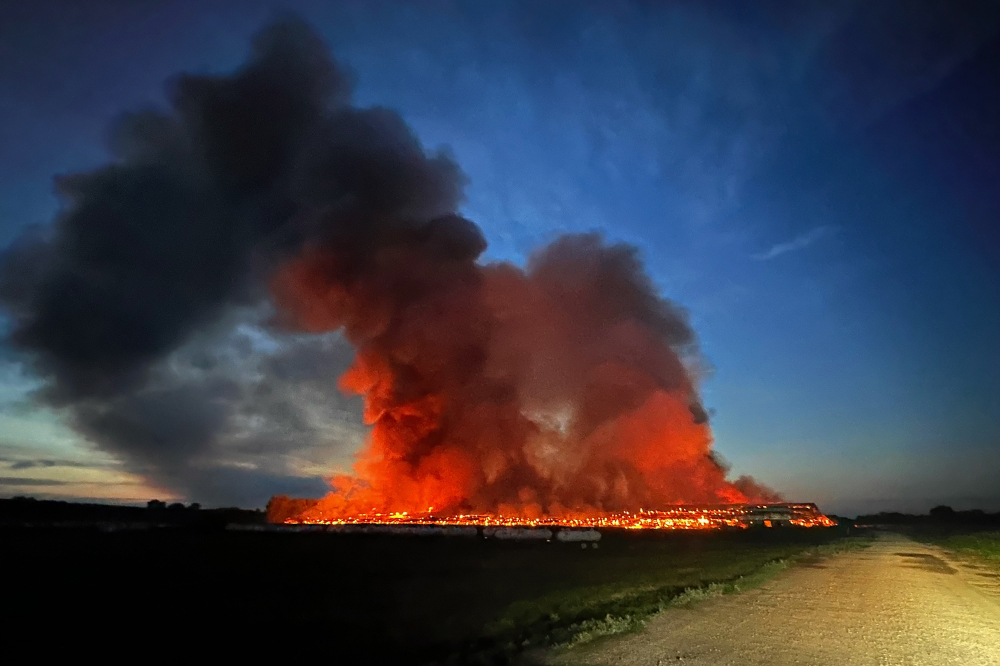
Fires burned 10 former chicken confinement buildings near Villisca in June 2023. (Photo by Brian Hamman/courtesy of Iowa DNR)
Several rural homes are located nearby, along with a site for storing and distributing liquid fertilizer. The property lies about a mile west of residences and businesses in town. Montgomery County Emergency Management Coordinator Brian Hamman said the smoke and glow from the fire was visible for miles, and residents in four different counties made emergency calls to report it. Hamman said the men burned the buildings after recent rainfall, and that the fires did not stray. “From my point of view, there was nothing dangerous,” he said.
Schipansky owned the property, and Gohlinghorst and Means later bought it on contract. They razed the site with the intention of growing crops on the land. The men had also neglected to inspect the site for asbestos. The DNR tested samples of the debris and found no asbestos, but “a thorough asbestos sampling could not have been conducted since the buildings had been completely burned,” the department’s order said.
Gohlinghorst and Means rid the property of the remaining building debris in September and October 2023 and disposed of it at a landfill, the order said.
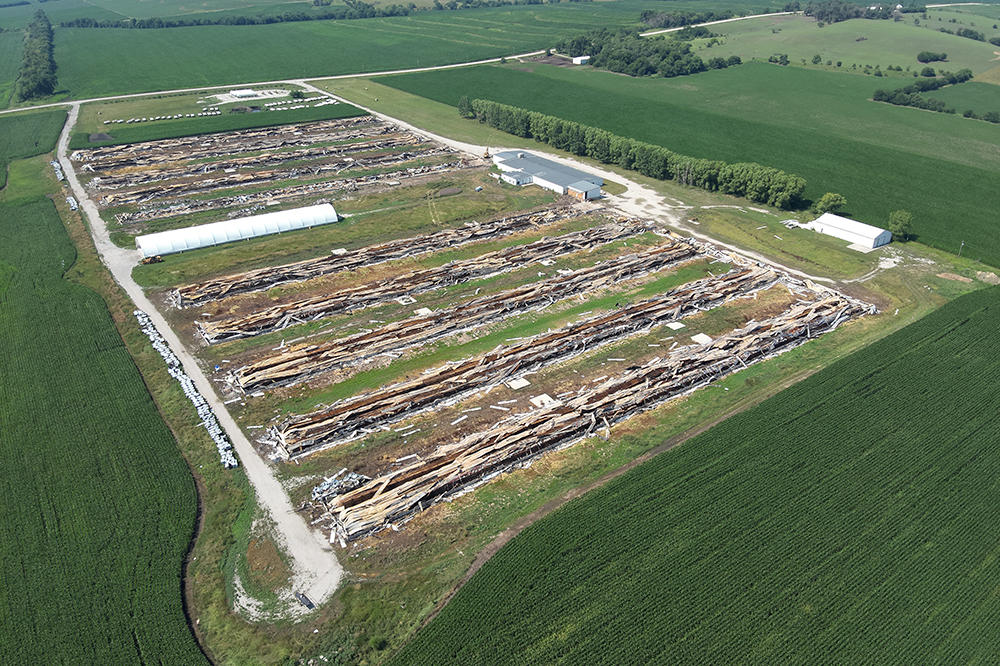
Debris from the confinement buildings were later taken to a landfill. (Photo by Brian Hamman/courtesy of Iowa DNR)
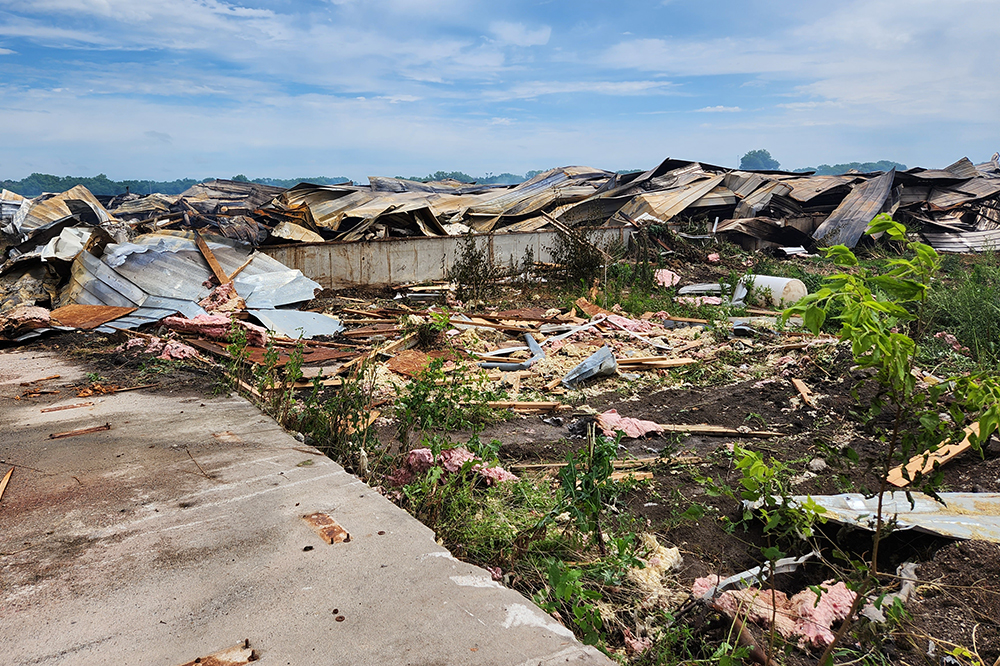
The Iowa Department of Natural Resources surveyed the burn site the day after the fires were ignited. (Photo by Brian Hamman/courtesy of Iowa DNR)
(Ames, Iowa) – July is here, and summer is in full swing. Young beef farmers are diligently preparing their 4-H projects for the county fair, kids are cooling off by the pool and the irresistible aroma of beef sizzling on the grill fills the air. The Iowa Beef Industry Council (IBIC) says as a parent navigating summer vacation, you might be searching for fun and engaging activities for your child. Look no further! The Council has announced a coloring contest that will spark creativity and provide entertainment.
Participation is easy and hassle-free. Simply download the coloring page from our website and let your child’s imagination run wild with crayons, colored pencils and markers. Once your child has created their masterpiece, upload a high-quality photo of their artwork using the form provided on our site. Children will be grouped into four categories: ages 2-3, 4-5, 6-7, and 8-9. The winning artwork in each category will receive a $50 beef certificate and a summer grilling swag item perfect for their age.
Entries must be submitted by July 28, 2024 at 5 PM CST. 
Looking for a delicious way to keep your kids energized and satisfied this summer? Look not further than beef, a fantastic source of high-quality protein that fuels endless summer fun. If you’re tired of the same old meals, shake things up with these kid-friendly recipes. For an extra dash of excitement, invite your little ones into the kitchen for some hands-on cooking adventures.
Cooking and coloring: fun for the whole family!
(Des Moines, Iowa) – You’ll have no shortage of food – favorites and new additions – to pig out on, during the 2o24 Iowa State Fair. Officials today (Tuesday), announced 84 new food selections for you to indulge in, including some out-of-the-box Iowa eats such as a BLT on a stick and bacon cheeseburger egg roll. The 2024 fair begins Aug. 8th.
The full list is available HERE. A food judging contest is scheduled for 1 p.m. July 16. Last year’s “Best new food” contest winner was What’s Your Cheez – Deep-Fried Bacon Brisket Mac-n-Cheese Grilled Cheese.
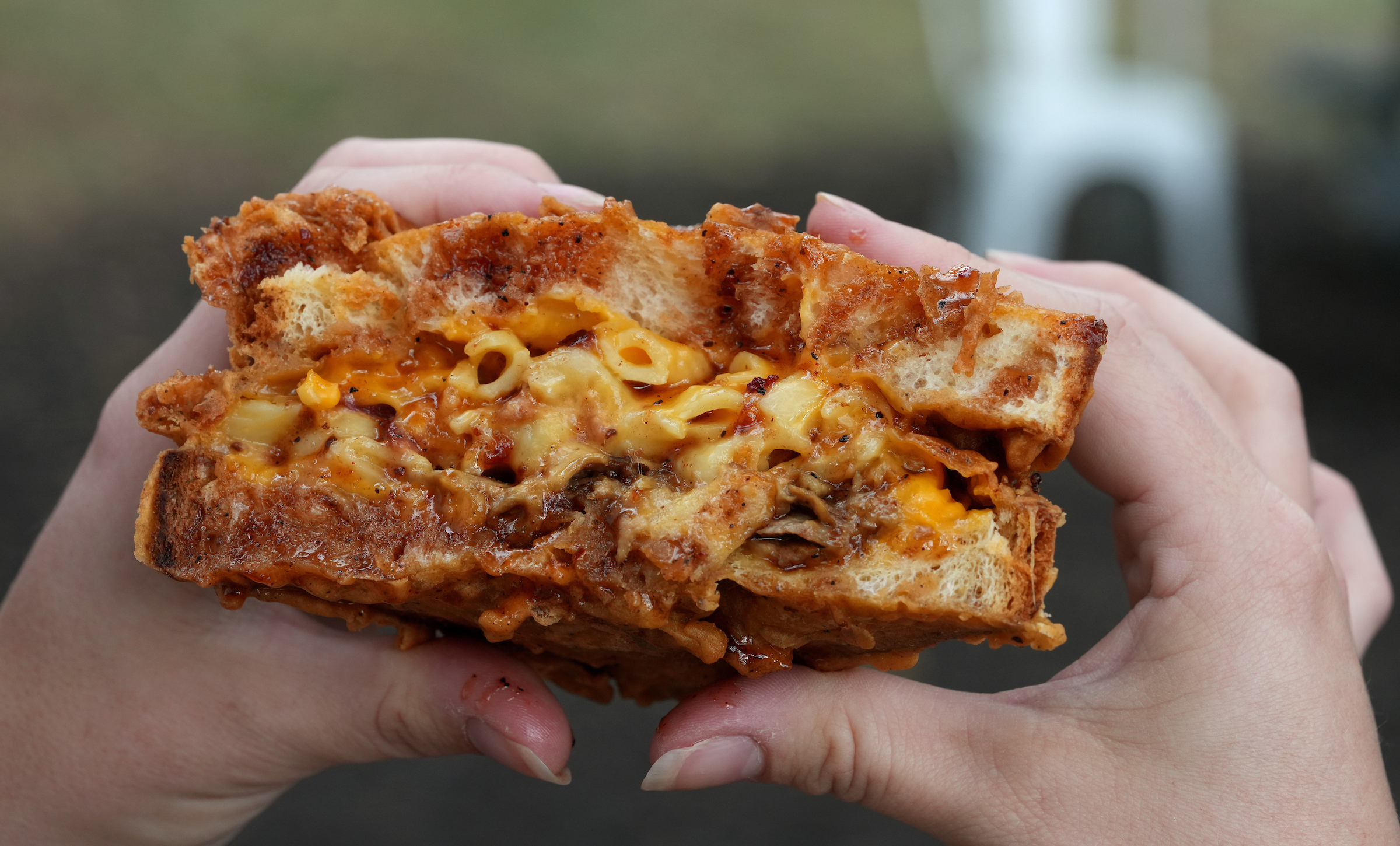
What’s Your Cheez – Deep-Fried Bacon Brisket Mac-n-Cheese Grilled Cheese
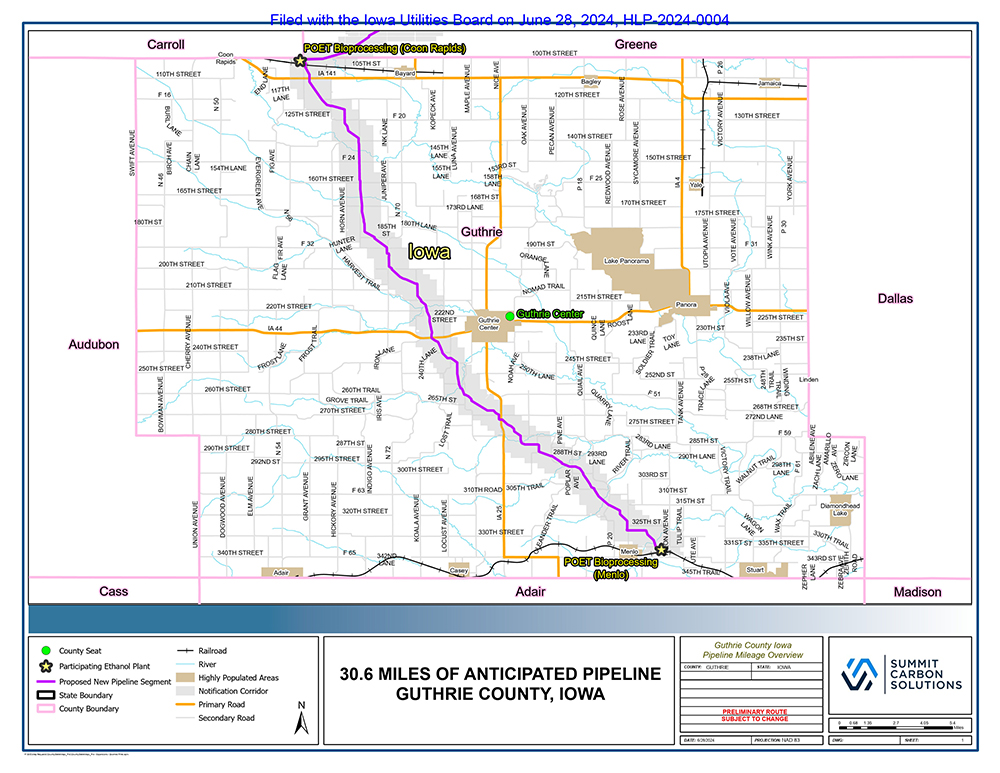
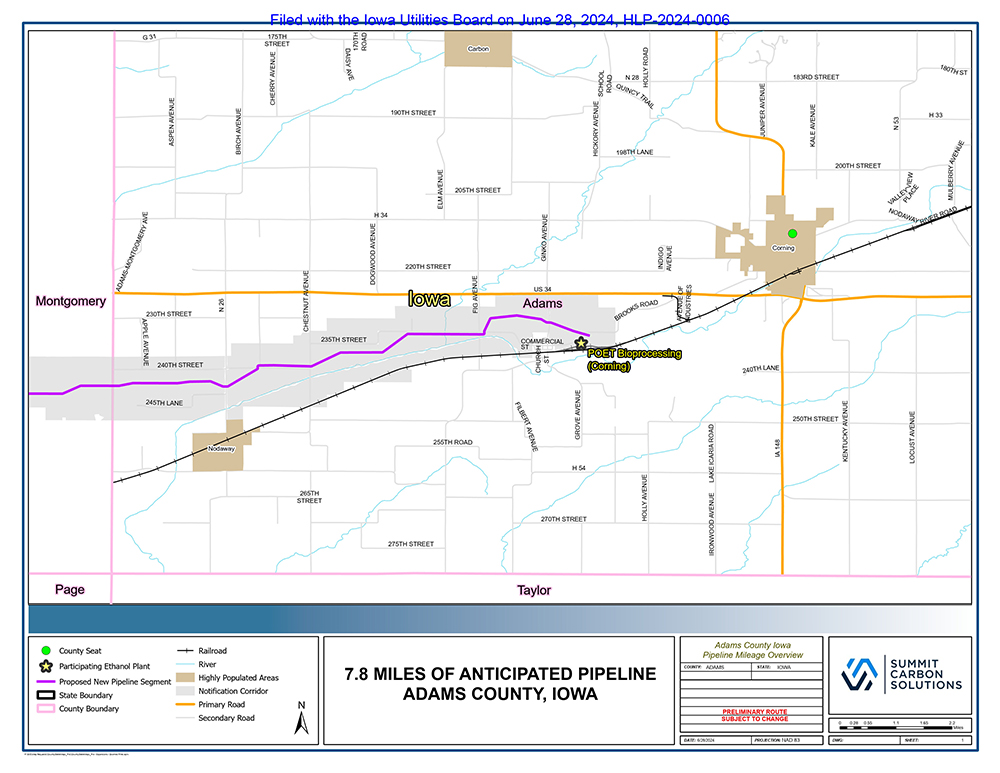
(Des Moines, Iowa/Iowa Capital Dispatch) – State utility regulators have approved a public meeting schedule starting in late August, in which Summit Carbon Solutions will present its significant proposed expansion for its carbon dioxide pipeline system. The company’s initial network of pipe in the state — which runs a total of about 690 miles — was recently approved by the Iowa Utilities Commission, although Summit is barred from starting construction until it has permission to build the system in North and South Dakota. The system might capture carbon dioxide at ethanol plants in five states and transport it to North Dakota for underground storage.
The expansion in Iowa includes about 340 miles of pipe to connect to more ethanol plants. It is the result of Summit inking new agreements with more ethanol producers after another company, Navigator CO2, abandoned its plans for a similar project. Summit has said it has agreements with 30 of the state’s 42 ethanol plants.
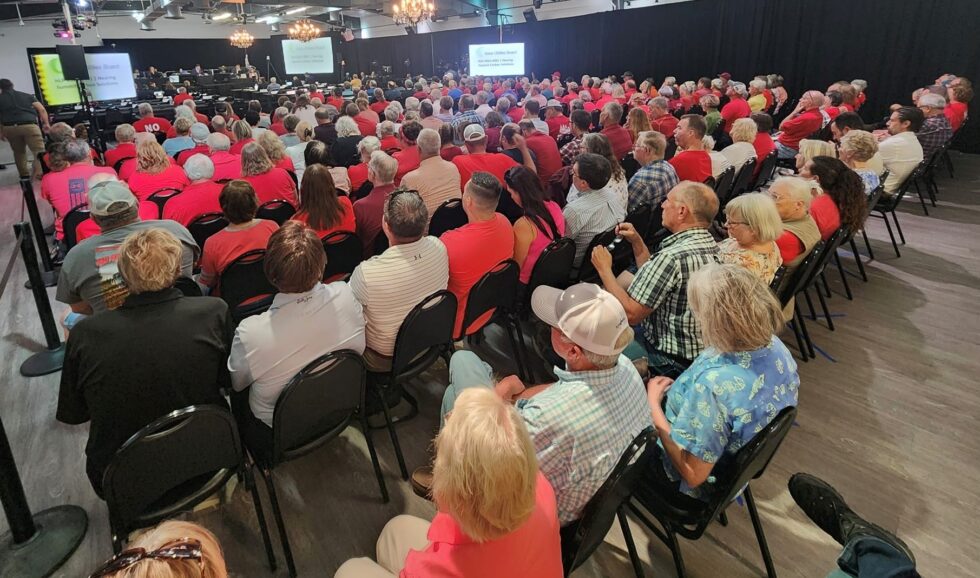
Crowd in Fort Dodge for Summit’s hearing before the Iowa Utilities Board (now known as the Iowa Utilities Commission). (RI photo)
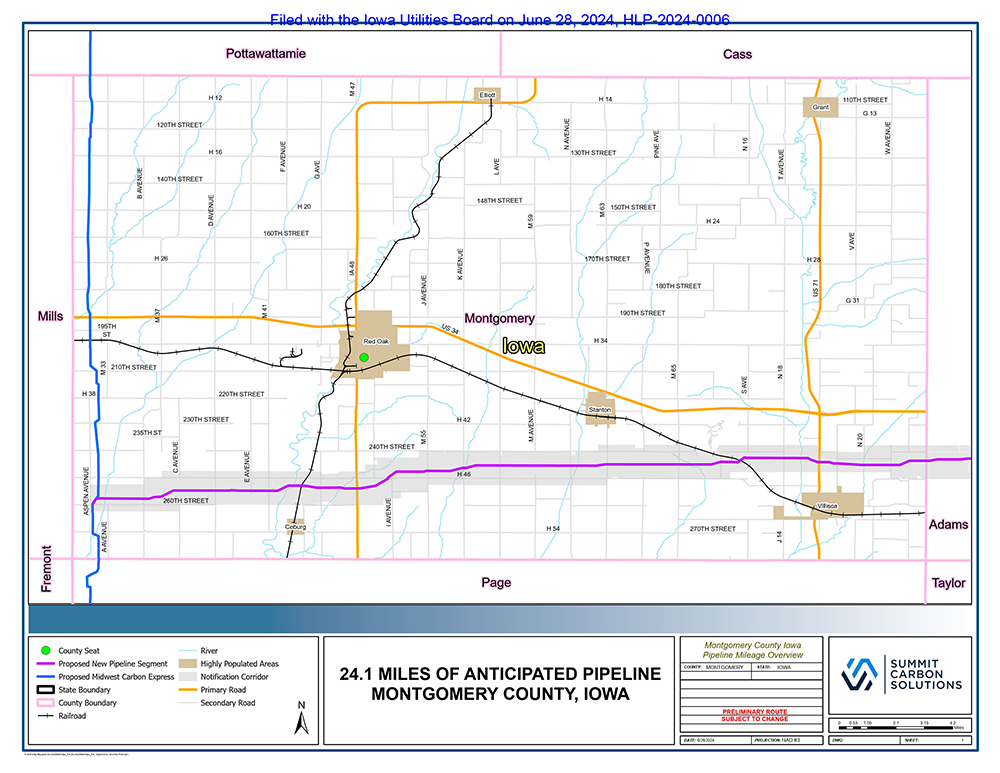
The public meetings for the expansions are set to be held in 23 counties, after which Summit can negotiate for land easements and petition for pipeline permits. In southwest Iowa, pipeline expansion meetings will be held :
— Aug. 26th at 6 p.m. in Adams County: Corning Opera House Cultural Center, 800 Davis Ave., Corning
— Aug. 27th at noon in Montgomery County: Red Coach Inn, 1200 Senate Ave., Red Oak
— Aug. 27th at 6 p.m. in Guthrie County: Guthrie County Activity Center, 209 State St., Guthrie Center
Proposed pipeline expansion routes:
(Radio Iowa) – The Iowa Food System Coalition wants to make locally-produced food the norm, not the exception, and is releasing a 250-page plan to get there in the next decade. One priority in the plan is to make it easier to get food from the farm to the table. That means supporting more local and regional infrastructure, like small-scale processing for specialty crops, grains, dairy and livestock. Coalition executive director Chris Schwartz says more than 40 partners across Iowa helped shape the plan.
“Which details all the things that we think we need to do in the state of Iowa to have a food system that is more local, that is more nutritious, that is more environmentally sustainable, and is more just for people doing the work.” Strategies include improving farmers’ access to land and expanding incentives to adopt practices that protect Iowa’s soil, water and air. Giselle Bruskewitz is the senior program director at Iowa Valley Resource Conservation and Development.
“We’re talking about small grain processing, rural grocery stores getting the infrastructure that they need,” Bruskewitz says, “vegetables that can be processed at scale so that schools and other institutions can buy them.” She says the coalition also wants to invest in more refrigerated trucks and food hubs, which aggregate and distribute local products.
Iowa’s network of food hubs serves nearly 70% of the state’s counties.


 Facebook
 Twitter
 YouTube
 RSS
RSS