

CLICK HERE for the latest market quotes from the Iowa Agribusiness Network!
CLICK HERE for the latest market quotes from the Brownfield Ag News Network!


CLICK HERE for the latest market quotes from the Iowa Agribusiness Network!
CLICK HERE for the latest market quotes from the Brownfield Ag News Network!
Cass County: Corn $4.14 Beans $10.12
Adair County: Corn $4.11 Beans $10.15
Adams County: Corn $4.11 Beans $10.11
Audubon County: Corn $4.13 Beans $10.14
East Pottawattamie County: Corn $4.17 Beans $10.12
Guthrie County: Corn $4.16 Beans $10.16
Montgomery County: Corn $4.16 Beans $10.14
Shelby County: Corn $4.17 Beans $10.12
Oats: $2.59 (same in all counties)
(Prices are per bushel; information is from the area Farm Service Agency [FSA] offices)
DES MOINES, Iowa [KCCI-TV] — The U.S. Supreme Court has denied a request by Shelby and Story counties to hear their case. That’s according to a report by KCCI-TV, and it’s the latest turn in a years-long legal battle. The counties say they want to decide where a pipeline goes. They have said their ordinances are to protect residents’ public health.
Summit Carbon Solutions has proposed a multi-state pipeline to carry carbon dioxide. The company has argued in previous court filings that federal law preempts the counties’ ordinances. KCCI confirmed the decision with the counties’ Washington, D.C., attorney.
Officials in Shelby County issued the following statement in response to the Supreme Court’s decision:
“Shelby County was surprised and very disappointed by the denial by the US Supreme Court to hear an important case addressing local control authority and protections. The Shelby County Board of Supervisors will be consulting with its legal counsel in the near future and weighing its options moving forward.”
Cass County: Corn $4.19 Beans $10.16
Adair County: Corn $4.16 Beans $10.19
Adams County: Corn $4.16 Beans $10.15
Audubon County: Corn $4.18 Beans $10.18
East Pottawattamie County: Corn $4.22 Beans $10.16
Guthrie County: Corn $4.21 Beans $10.20
Montgomery County: Corn $4.21 Beans $10.18
Shelby County: Corn $4.22 Beans $10.16
Oats: $2.62 (same in all counties)
(Prices are per bushel; information is from the area Farm Service Agency [FSA] offices)
DES MOINES, Iowa (KCCI-TV) – High nitrates levels are back in the Des Moines and Raccoon Rivers, prompting Central Iowa Water Works officials to turn-on their nitrate removal facility again. KCCI reports the facility turned on three of their eight nitrate removal vessels last week, which is a rarity for January. Plant officials, however, said all the water the facility produces is below the EPA safe drinking water standard of 10 milligrams of nitrates per liter that public water systems are required to meet that.
Former University of Iowa researcher Chris Jones tells KCCI the recent weather is worth considering as a reason for the rise in nitrate levels. According to Jones, the warm weather we’ve had kept the ground from freezing, and with no frost below four-feet, it remains thawed down where the field tiles, the agricultural field tiles are found.
When rain comes, it washes the nitrates out. Jones said the high numbers aren’t just hitting central Iowa. He noted the Cedar River on Thursday was almost 10 milligrams per liter.
In spring and summer 2025, the nitrate removal facility ran in part of fully for 112 days. A wet July drove nitrates out of farm field drainage tiles and into lakes and rivers. That all led to an unprecedented lawn watering ban in central Iowa last summer. The nitrate removal facility, located in Des Moines but operated by Central Iowa Water Works, has been in used since the 1990s. This is the fourth time in the facility that it has run in the winter.
(Iowa DNR News) – The final deer seasons are the two January antlerless deer only seasons – the Population Management January Antlerless Season and the Excess Tag January Antlerless Season. Both seasons run from Jan. 11-25, but there are differences between the two.
The Population Management January Antlerless Season is available only in Allamakee, Appanoose, Decatur, Lucas, Monroe, Wayne and Winneshiek counties if there are more than 100 antlerless tags available in that county on Dec. 22. Since all seven counties met that requirement, all seven will be open. Hunters participating in the population management January antlerless season may use bows, muzzleloaders, handguns, shotguns, crossbows, or rifles .223 caliber and larger, as a method of take.
The Excess Tag January Antlerless-deer-only season will be available in all counties with unsold county antlerless tags at midnight on January 11.
Currently, counties with unsold antlerless tags include Adair, Allamakee, Appanoose, Clarke, Clayton, Dallas, Davis, Decatur, Fayette, Guthrie, Jefferson, Lee, Lucas, Madison, Monroe, Taylor, Union, Van Buren, Wapello, Warren, Wayne, and Winneshiek.
County specific license quota information is available in real time online and can be found here: (select 5 – Resident Antlerless Deer By County) https://gooutdoorsiowa.com/RealTimeQuotas.aspx?_gl=1*t0k6x8*_gcl_au*ODkwNTQ1MjUxLjE3MzQzNzEzMjA.
Licenses will be available beginning January 11 until quotas are filled. The season is open through January 25, 2026. Due to the compressed timeline, these licenses will not be available online. Only antlerless deer may be taken during the Excess Tag January Antlerless-only season. Hunters participating in the excess tag January antlerless season may only use rifles from .223 caliber to .500 caliber as a method of take.
Hunters are reminded that their 2025 licenses expire on January 10. Hunters will need a valid 2026 license and habitat fee to hunt beginning January 11.
If a county meets the qualifying criteria for a January Antlerless-only season, then Landowner / Tenant (LOT) tags will also be available for registered landowners / tenants for use on qualifying property within those counties. When / if the county antlerless quota runs out in any of these counties, LOT January tags will still remain available. LOT January Season tags will be available for purchase only from vendors in open January Season counties.
(Clarinda, IA) – Officials with Page County ISU Extension are inviting crop producers to attend an informal, question and answer session next Wednesday, January 14th, at the Ice House, in Clarinda (1515 S. 16th St.), beginning at 6-p.m. The Q&A session is designed to help you make the most out of every dollar you invest in your operation. Tim Christensen, Farm Management Specialist, and Aaron Saeugling, Agronomy Specialist, with Iowa State University Extension and Outreach will lead the informative session.
Topics covered include:
· 2026 Cost of Production
· Marketing Strategies
· Market Update
· Planning Resources
· Soil Fertility & Lime
· Keeping more of your Profits
Dinner is sponsored by Iowa Corn. The cost for the session and dinner is $20 per person. To register, please call the Page County Extension Office at 712-542-5171.
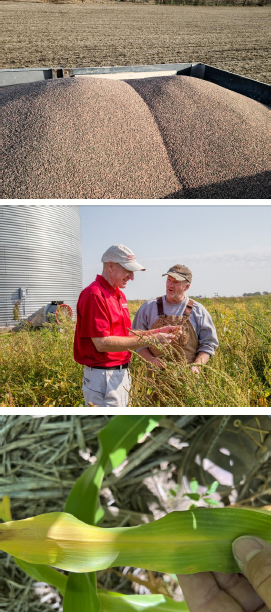
Photos via Page County ISU Extension
The fees for service will be used to off-set direct expenses and to support the Agricultural and Natural Resources County Extension Program. This institution is an equal opportunity provider. For the full
non-discrimination statement or accommodation inquiries, go to www.extension.iastate.edu/legal.
Cass County: Corn $4.15 Beans $10.12
Adair County: Corn $4.12 Beans $10.15
Adams County: Corn $4.12 Beans $10.11
Audubon County: Corn $4.14 Beans $10.14
East Pottawattamie County: Corn $4.18 Beans $10.12
Guthrie County: Corn $4.17 Beans $10.16
Montgomery County: Corn $4.17 Beans $10.14
Shelby County: Corn $4.18 Beans $10.12
Oats: $2.67 (same in all counties)
(Prices are per bushel; information is from the area Farm Service Agency [FSA] offices)
(Radio Iowa) – Iowa Secretary of Agriculture Mike Naig is proposing the first-ever “Iowa Farm Act” that includes a wide ranging of proposals, from targeted tax relief to promotion of agritourism.
“It’s something that you can actually think of as being akin to a Farm Bill like we would see at the national level. There are some other states across the country that have done similar things,” Naig said. “…I think it brings a focus on the farm economy, on farmers, on agriculture and it also represents kind of the broad range, the diversity of our agriculture.” Naig says the bill was developed after discussions with different groups about their priorities.
“We’ve got provisions in here that affect beekeepers and specialty crop producers, row crop producers, livestock and biosecurity and ag businesses as well,” Naig said. “We bring together that diverse array of ag interests in the form of the Iowa Farm Act.” Naig describes one section of the bill as an attempt to modernize zoning exemptions. For example, if an apple grower decides they want to start making apple cider or hard cider on site, Naig says it would be good to clarify whether that’s still a farming operation or a commercial operation.
“We’re trying to increase those types of operations where we’re seeing farmers able to process and sell director to consumers and do more of that activity on their farms. We think now’s an opportunity to kind of clear the way and provide some clarity around what is a farm operation — what’s included and what isn’t,” Naig said. “And it’s not that we’re looking for a new type of exemption for farms, we’re just looking to clarify some of the activities that you may not have previously thought of, like processing.” The bill includes some “agricultural experience” definitions, in order to boost agritourism.
“Meaning events being held on farms, maybe even being able to stay overnight in a cabin or something on a farm,” Naig said. “And how do we continue to clear the way for that, bring clarity, protect consumers and yet allow for this opportunity expand in the state of Iowa?”
The Iowa Farm Act includes a few tax proposals, too, like expanding a tax break for retired farmers and exempting honey bee purchases from the state sales tax. Naig says there’s no sales tax on livestock sales, but beekeepers have to charge the sales tax on the queen bees they raise and sell to clients, many of whom are in other states.
(Radio Iowa) – The forecast calls for parts of southwest Iowa to have high temperatures this (Wednesday) afternoon in the low 60s, but water temperatures will be much colder, so an expert says to leave your canoe or kayak in the shed, for now. Todd Robertson, the Iowa D-N-R’s river programs water trails coordinator, says it’s easy to be fooled by the sunny, unseasonably warm weather and he reminds, it may feel like April, but it’s still January.
“There’s no way the water’s going to be heating up to a safe level,” Robertson says. “If you don’t have a dry suit, if you’re not experienced in winter paddling, being out there on really cold water in a cold environment, it’s not a good time to go. I know it’s real tempting and you’ve been cooped up all winter, but we just need to wait a little bit longer.” Most Iowa lakes, rivers and streams are still registering water temperatures in the 30s, and seasoned paddlers know to plan for the worst case — which means getting wet.
“When the water temperature is below 60°, that puts you at automatic risk for hypothermia or worse,” Robertson says. “We know it’s really cold. It’s deceiving because you feel like you want to go out there without a jacket and just think you can paddle, but as soon as you hit that water, you’re going to feel cold water shock and it’s going to be a big problem.” The D-N-R offers a series of paddling courses during the warm weather months, and Robertson says they’ll touch on cold weather precautions, but the best way to learn is from another expert.
He says there are plenty of veteran winter kayakers around Iowa who are willing to share their knowledge. “If you can find those groups, whether it be social media or through local paddling clubs, get hooked up with the right people, because you don’t want to paddle alone anyway, you want to go out with three or four really experienced people,” Robertson says. “Just get out there, put your feelers out on social media, you’ll come across some people.” He recommends paddlers always wear a life jacket, let a friend or loved one know where you’re going and when you’ll be back, and bring a dry bag with extra clothing to change into should you get wet.
Find the DNR’s interactive paddling map HERE:
https://www.iowadnr.gov/things-do/paddling-river-recreation/where-paddle
Cass County: Corn $4.11 Beans $10.05
Adair County: Corn $4.08 Beans $10.08
Adams County: Corn $4.08 Beans $10.04
Audubon County: Corn $4.10 Beans $10.07
East Pottawattamie County: Corn $4.14 Beans $10.05
Guthrie County: Corn $4.13 Beans $10.09
Montgomery County: Corn $4.13 Beans $10.07
Shelby County: Corn $4.14 Beans $10.05
Oats: $2.67 (same in all counties)
(Prices are per bushel; information is from the area Farm Service Agency [FSA] offices)


 Facebook
 Twitter
 YouTube
 RSS
RSS