

CLICK HERE for the latest market quotes from the Iowa Agribusiness Network!
CLICK HERE for the latest market quotes from the Brownfield Ag News Network!


CLICK HERE for the latest market quotes from the Iowa Agribusiness Network!
CLICK HERE for the latest market quotes from the Brownfield Ag News Network!
(Des Moines, Iowa) – This year (2024) marks a milestone for the Cattlemen’s Beef Quarters with the celebration of its 40th anniversary grilling at the Iowa State Fair! Iowa Beef Industry Council (IBIC) officials says, since 1984, the Cattlemen’s Beef Quarters has became a beloved destination for fairgoers, offering high-quality beef dishes and a welcoming atmosphere. The Cattlemen’s Beef Quarters began its 40-year journey at the fair serving as an advocate for Iowa cattlemen and women and promoting the beef they raise. Comprised of 68 county cattlemen association and FFA groups bringing more than 1,600 volunteers each year, these passionate individuals are crucial in creating a memorable dining experience for fairgoers. These loyal cattle farmers serve nearly 90,000 customers annually and prepare roughly 28,000 lbs. of beef during the 11-day event.
For four decades, Cattlemen’s Beef Quarters has been dedicated to promoting and showcasing the best of Iowa’s beef industry. Commitment to quality and tradition has made them a staple at the Iowa State Fair. CBQ Manager Wayne Baumhover, says “One detail that makes us special is that we have something for everyone on our menu from the casual, on-the-go diner, to those interested in a true sit-down meal. Our menu has expanded and changed through the years, but one thing remains constant – it’s always about the beef.”
The Cattlemen’s Beef Quarters all-beef menu includes such favorites as Prime Rib, Taco Salad, Ribeye Steak Sandwich and the Hot Beef Sundae. Serving up mouthwatering meals is well-known amongst fairgoers, and their breakfast offerings are no exception. You can enjoy a hearty start to your day with their classic breakfast menu, featuring biscuits and gravy, brisket breakfast burrito, salt beef bagel and more. It’s the perfect way to fuel up for a day of fair fun. 
Iowa cattlemen and women invite you to visit them at the Iowa State Fair to celebrate this special milestone. Whether you’re a longtime fan or a first-time visitor, there’s something for everyone at the Cattlemen’s Beef Quarters. Enjoy a delicious meal, learn more about the beef industry, and be a part of the 40th anniversary celebration. Visit the CBQ’s iconic location August 8 through August 18, 2024. Located north of the Horse Barn and east of the Walnut Center, look for the black steer on the roof.
Hours of operation are 6:30 AM to 9:30 PM. Breakfast is served daily until 10 AM. Learn more about the Cattlemen’s Beef Quarters and find a full menu at www.cattlemensbeefquarters.com.
(Radio Iowa) – Looking for fresh-picked sweet corn or ripe strawberries right out of the patch? Iowa has more than 220 certified farmers markets and many of us know they’re a great place to find a wide variety of produce, to interact with local growers, and to support the community. U-S-D-A Undersecretary Jenny Lester Moffitt says farmers markets offer Iowa’s small producers what’s known as a low-barrier entry point, where it’s affordable to sell directly to consumers. “It’s really important because when we have direct sales, right now in mainstream supply chains, anywhere from 14 to 15 cents of that consumer dollar, our food dollar, goes directly to farmers,” Moffitt says, “but at farmer’s markets, that price is seven times that.”
This is National Farmers Market Week and Moffitt says communities in Iowa and across the country are celebrating the role farmers markets play in supporting local agriculture. “Farmers are able to capture and keep a lot more money of the consumer dollars in their own pockets, which means they’re reinvesting in their farms, they’re reinvesting in local jobs in their communities,” Moffitt says. “Really importantly, they’re able to get healthy food that’s grown in their region to the members in their communities as well.” She says Iowans who are on SNAP or other nutritional programs can use their benefits at many farmers markets. The markets are also known for offerings like local honey, giant heirloom tomatoes, and fresh-baked pies and pastries.
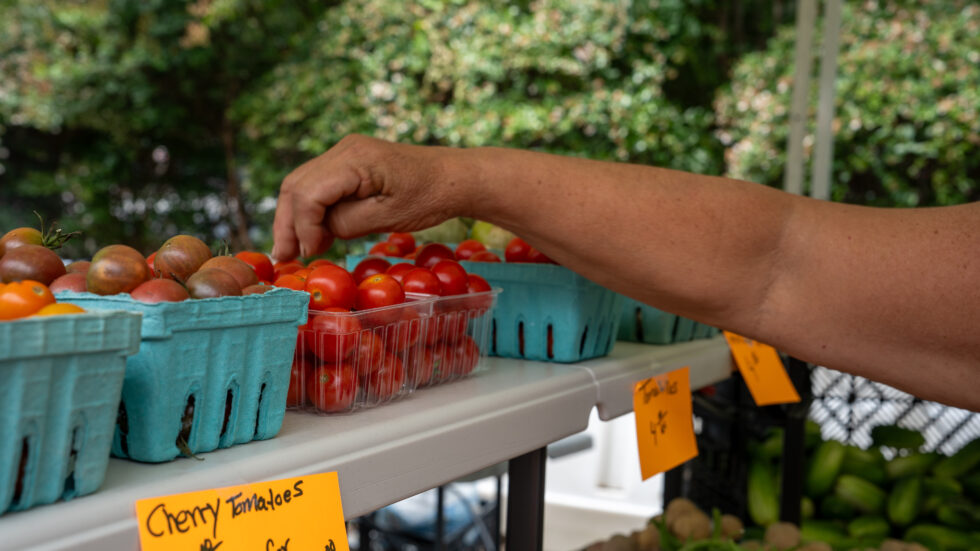
Farmers Market (USDA photo)
“What’s really great is you can find products that you normally can’t find on store shelves, whether that is locally-grown produce or other types of grains,” Moffitt says. “Also, it’s a really great opportunity to be able to buy things from other local producers, whether that is jams and jellies, and other value-added products, or craft products as well.” Even in an agricultural state like Iowa, people can forget where their food comes from, so farmers markets are a perfect way to rediscover our roots. “It’s also just a really great place to engage with farmers, to talk about how the food is grown, to be able to have that personal connection,” Moffitt says. “I know we all really love and thrive when we’re talking with producers that are growing the food that we’re enjoying.”
You can find a farmers market near you by visiting the USDA’s Local Food Directory (https://www.usdalocalfoodportal.com). Before entering the government sector, Moffitt raised organic walnuts on a family farm in California. She’s now the U-S-D-A’s Under Secretary for Marketing and Regulatory Programs, the first woman to hold the post.
(Radio Iowa) – Volunteers are needed in north-central Iowa this weekend to help clean up a stretch of the Boone River. In years past, they’ve hauled out everything from water heaters to wagon wheels. They’ll be clearing out debris from the waterway on Saturday as a group, according to Brian Stroner, with the city of Webster City, who’s organizing the Boone River Clean-up.
“We’re going to be on the river for about four to five hours,” Stroner says. “We’re going to provide food and drink, some T-shirts. We’re also offering a self-guided clean-up to where people can go at their own pace. We’ll have dumpsters available at the 7-B canoe access, also at Briggs Woods.”
Hamilton County Conservation naturalist John Laird said since the first clean up of the river in 2007, volunteers have collected a range of interesting items. “We’ve found all kinds of things,” Laird says. “We’ve found couches, washing machines, washers, dryers, cars, car parts, old safes.”

Hamilton County Conservation Board photo
They had planned to clean a stretch of the Des Moines River in Fort Dodge this weekend, but the plans were called off due to the high water levels. The Boone is one of Iowa’s most scenic rivers.
Learn more about the weekend cleanup at the Hamilton County Conservation Facebook page. Volunteers are to meet at Briggs Woods Shelter #1 at 7:30 AM on Saturday.
(Radio Iowa) – There’s been a dramatic decline in the total number of barns in Iowa over the past century and it’s estimated fewer than 75 in the extremely rare round design remain. Wayne Frost of the Iowa Barn Foundation says most of the round barns in the country were built between 1900 and 1920. “There was some work in early 1900, some of it at Iowa State and other universities that linked a round barn to maybe being more efficient and less expensive to build,” Frost says.
By 1925, though, Iowa State Extension warned against round barn construction due to the expense of materials and how difficult it was to find carpenters with the skills needed to complete the complicated designs. “If you look across our landscape, every barn we have is different,” Frost says. “Even every round barn is different. Oftentimes they would have a silo in the center of it.”
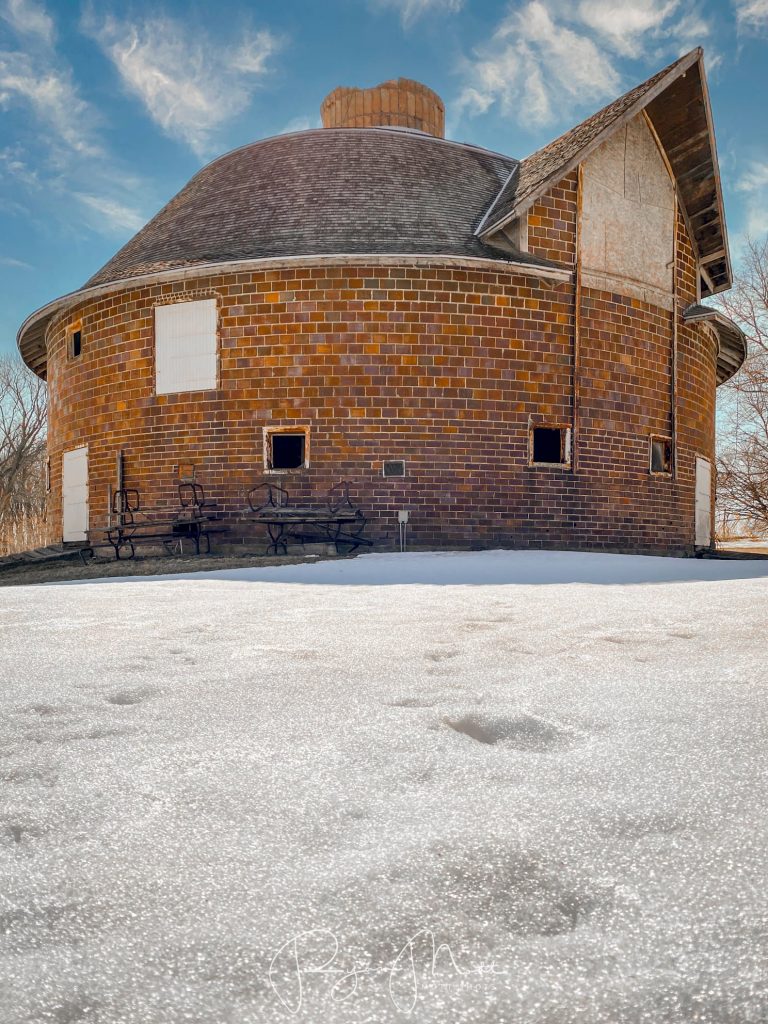
2021 photo of a Hardin County Round Barn (Iowa Barn Foundation Facebook post)
Round barns are so rare now that dozens are listed on the National Register of Historic Places. There’s a 94-year-old round barn on the Plymouth County Fairgrounds in Le Mars. At this month’s State Fair, the Iowa Barn Foundation is building a small barn inside the Agriculture Building on the fairgrounds to promote their work. The group raises money and awards grants to people who are working to preserve barns on their property.
AMES, Iowa – The Iowa State Fair is quickly approaching and the anticipation of the annual Governor’s Charity Steer Show is building. The Iowa beef cattle industry is again partnering with the governor in this fundraising event to raise money for the Ronald McDonald House Charities of Iowa. Hundreds of fairgoers will attend the August 10 event, featuring youth, industry supporters, local celebrities, and of course, steers. Each steer is exhibited by a local youth representative and a guest celebrity selected by the sponsor of the steer. Twenty-four steers will be shown this year. Along with Gov. Kim Reynolds, we have other notable celebrities showing this year ranging from industry favorites to college. The Governor’s Charity Steer Show is sponsored by the Iowa Cattlemen’s Association (ICA) and the Iowa Beef Industry Council (IBIC).
Exhibitors from western Iowa include Claire Pellett from Atlantic, and her steer “Magic.” They are sponsored by the Iowa Veterinary Medical Association and ISU College of Veterinary Medicine. The animal will be shown by Celebrity hosts Dr. Dan Grooms & Dr. Stephen G. Juelsgaard, Dean of Veterinary Medicine at ISU. And, Ryan Brenner of Mapleton, and his steer “McEars” will appear during the event. They are sponsored by the Iowa Corn Promotion Board. The animal will be shown by celebrity host Stan Nelson, ICPB President. 
“The Iowa Governor’s Charity Steer Show showcases the good that can be done by one industry when producers, industry supporters, and community namesakes collaborate,” said Jenna Smith, ICA member services and Governor’s Charity Steer Show co-chair. “The cattle industry is full of people that care and it is an honor to work with the Ronald McDonald House Charities of Iowa, who provide a crucial service to families in need.”
The Iowa Governor’s Charity Steer Show has been held since 1983 and has raised over $5.1 million for the Ronald McDonald House Charities of Iowa since the show’s inception. Last year the show raised more than $500,000, the third year in a row that the fundraising record has been broken. Funds are raised through online donations, sponsorships, and an auction of steers following the show. All money raised benefits the three independent Ronald McDonald House Charities of Iowa, located in Des Moines, Iowa City, and Sioux City. These three houses have served over 55,000 families from all 50 states and 62 foreign countries. Families from all 99 counties in Iowa have benefited from the Ronald McDonald Houses of Iowa too.
If you are interested in supporting the Governor’s Charity Steer Show, consider donating online or attending the show/auction to contribute. The Governor’s Charity Steer Show is being held in Pioneer Pavilion at the Iowa State Fair on Saturday, August 10 at 4:30 p.m. For additional information about the Governor’s Charity Steer Show or to donate, visit www.iowagovernorscharitysteershow.com.
2024 Iowa Governor’s Charity Steer Show Participants
(Radio Iowa) – D-N-R Hydrologist Tim Hall says it looks like July will end up slightly wetter than normal once the final numbers are in. He says it continues the string of normal or above normal months that has pulled Iowa out of the drought. “The challenge that we’ve seen in the most recent month is although the rainfall is about average a lot of it came in the last week or ten days of the month,” he says. “And anytime you get a month’s worth of rain in a couple of weeks period of time it can be very, very challenging.” The latest map from the National Drought Monitor shows a clear map with no drought areas. Hall says while the colors indicating drought areas quickly washed off the map, the process was slow and steady. “While we’ve had a pretty rapid turnaround in drought conditions, this trend toward wetter weather and sort of giving us our side of the drought started almost ten months ago in October of last year,” Hall says.
Hall says water flows are back to normal on most waterways. “Last year there was a record number of irrigation permits that were in danger of being cut off because of low flow. If the stream flows too low, we don’t allow irrigators to withdraw water to irrigate under their permits. This year, no irrigation permits are even under any pressure,” he says. The drought had cities putting water use restrictions in place and Osceola has been looking at a plan to recycle wastewater. Hall says we’d be wise to not stop thinking about water use plans. “We would caution and advise any utility that’s sometimes struggling with water supply to think about where they were a year ago and keep working on some proactive solutions,” Hall says, “because droughts gonna come back. Maybe not this year, maybe not next year, maybe not for several years.”
He says the drought will come back sometime and it’s best to be prepared and take steps that can help minimize the impact when it does.
KNOXVILLE, Iowa — Swimming is not recommended at Lake Red Rock’s North Overlook Beach due to elevated levels of bacteria. The U.S. Army Corps of Engineers works with Iowa State University to test the water weekly. They say the “swimming not recommended” signs will stay up until testing shows lower bacteria counts. The Iowa Department of Natural Resources reports there are currently 13 state beaches that also have dangerously high bacteria count.
Swimming is not recommended at the following state beaches:
(Radio Iowa) – A southern Iowa man has grown a piece of fruit that’s destined to set a world record. A state official has verified that Dave Bennett of Davis County grew an eggplant that weighs eight-point-33 pounds. “I’ve been growing eggplants for probably five years now,” Bennett says. “Two years ago I set the state record at 5.6 pounds.” Bennett picked up the hobby from his second cousin, a past winner of the Big Pumpkin competition at the Iowa State Fair.
After growing pumpkins and watermelons, Bennett got intrigued with the purple fruit after meeting a Minnesotan who’d grown a four pound eggplant — and the rest will be history. Bennett has been assured by a representative of Guinness World Records that his paperwork is in order. “Eventually I will have a plaque that says I grew the world’s largest eggplant,” Bennett says. Right now, the world’s largest eggplant is in Bennett’s refrigerator, in hopes of entering it in the Iowa State Fair.
“I’m going to see what it looks like next week and I might arrangements about bringing it up. I don’t know yet,” Bennett said. “It might start wrinkling up and spoiling, I don’t know.” An inspector with the Iowa Department of Agriculture’s Weights and Measures Bureau went to Davis County to weigh the eggplant this week. Bennett used greenhouse grade fabric to create a shade over the plant during its final days outside before it was measured.
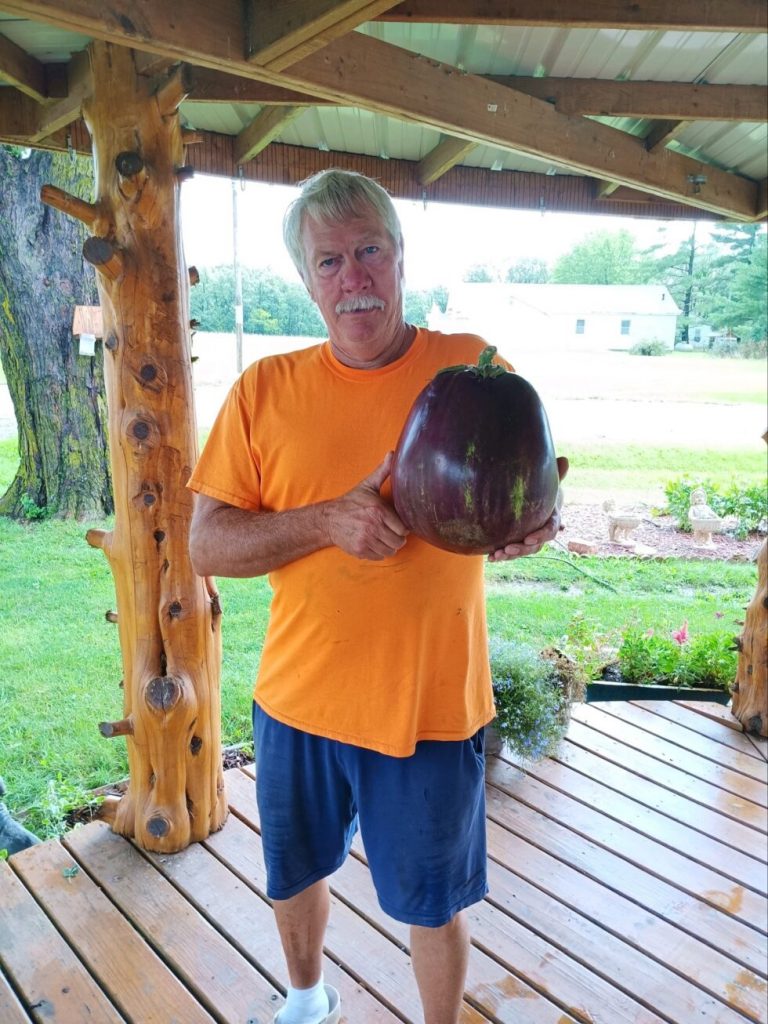
Dave Bennett with his 8.33 eggplant. (Photo courtesy of Iowa Dept. of Agriculture and Land Stewardship)
Bennett says you start the growing season by planting “giant variety” seeds, then trim down the vine so it’s supporting just one eggplant. “You just keep fertilizing and stuff like that and hope for the best,” he says.
Eggplant is often treated like a vegetable on the dinner table, but it’s actually a berry, so it’s a fruit. Bennett has never eaten eggplant and ordered it at a restaurant recently, but had to pay his bill and leave to make it to a concert before the dish was served.
DES MOINES, Iowa [KCCI/Iowa State Fair]— The Iowa State Fair’s list of Iowans of the Day was released, today (Thursday). The Iowan of the Day program was created by the Iowa State Fair Blue Ribbon Foundation in 1997 to honor outstanding Iowans who have made a difference all across the state, according to a news release from the foundation.
Winners, selected by a committee after a nomination process, are awarded a day of recognition at the Iowa State Fair. Each day at noon on the Anne and Bill Riley Stage they will be recognized and presented as an Iowan of the Day. They also receive four State Fair admission tickets, four Grandstand concert tickets, use of a golf cart, VIP parking, accommodations at the Des Moines Marriott Downtown and $200 cash.
Two western Iowa residents are among those who will be recognized:
Saturday, Aug. 10: Roxanne Cogil of Jamaica
Roxanne’s volunteer work spans far and wide, positively impacting those around her. She is an active member of several community organizations, including the Yale Community Club, where she participates in organizing meals, fundraisers, the 4th of July Celebration, and the Steak Supper. Roxanne also contributes to the Jamaica Lions Club, where she has been fundraising for a bike repair station on the Raccoon River Valley Trail. Roxanne also serves on the County Council, supports Habitat for Humanity, and serves as a National Weather Service Weather Spotter for Guthrie County.
Additionally, Roxanne is a large supporter of community youth and youth in agriculture, volunteering with the Guthrie County Fair, serving as the Vice President of the Panorama FFA Alumni Chapter, leading local 4-H groups, and assisting her local Boy Scouts troop. At Calvary Chapel, she is a youth group leader and participates in various service projects, mission trips, and the Operation Christmas Child Shoeboxes initiative. She also volunteers at Panorama High School events, including prom and the concessions stand.
Furthermore, Roxanne is an advocate for those with disabilities as she serves as the Executive Director of Regional Teams for the Epilepsy Foundation and is a member of the Executive Committee of the Iowa Developmental Disabilities Council, the Brain Injury Alliance of Iowa, and the Department of Human Services Case Management Advisory Board. Previously, Roxanne served as the President of the Autism Society of Iowa Board of Directors and organized an Autism Awareness team for RAGBRAI. 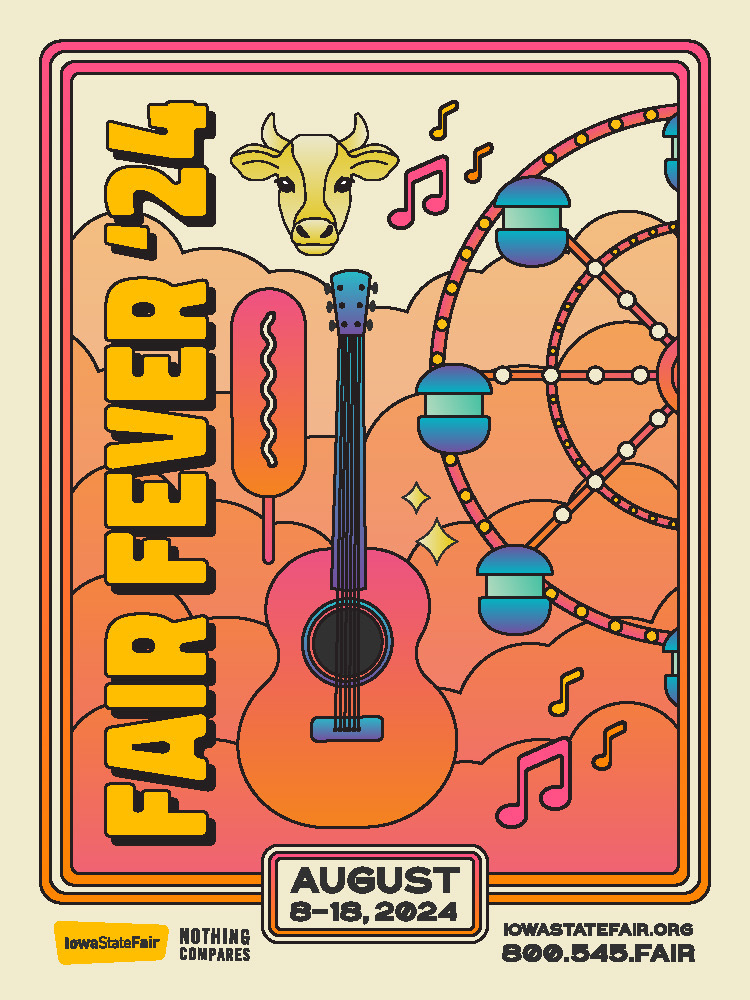
Monday, Aug. 12: John Klein of Treynor
John sees a need in his community, develops a solution, and makes it a reality. His dedication is particularly evident in his efforts with the youth through the Treynor Optimist Club and other community organizations.
He has written grants for numerous community projects, including a new playground for East City Park. John also organized swim lesson sign-ups and provided round-trip bus transportation from Treynor to Council Bluffs, making this essential skill more accessible to local families. He supports the Treynor Community Can Kennel, which benefits various youth groups and has raised over $246,000 to date. John also created the Mulch Madness event on Arbor Day, where 5th graders and volunteers plant new trees and mulch existing ones on the school campus and in city parks. Furthermore, he contributes to the Watch DOGS mentoring program and volunteers for the Cardinal Combine youth football activities.
Beyond his work with the youth, John is active in various community initiatives. He has helped organize City Block Parties, a thank-you banquet for Treynor Fire and Rescue Volunteers, and the Pottawattamie County Sheriff’s Department. He also established a community volunteer organization called Cardinal Core.
Other honorees include:
Thursday, Aug. 8: Marilyn Sokol, of Belle Plaine
Friday, Aug. 9: Pat Burch, of Norwalk
Sunday, Aug. 11: Nelson Klavitter, of Dubuque
Tuesday, Aug. 13: Crystal James, of Ottumwa
Wednesday, Aug. 14: Tate Giesemann, of Bellevue
Thursday, Aug. 15: Rodd Holtkamp, of Primghar
Friday, Aug. 16: Elaine Graham Estes, of Des Moines
Saturday, Aug. 17: Kendall Pals, of Algona.
(Radio Iowa) – A dairy specialist with I-S-U Extension says the number of dairy entries at county fairs has been down in areas of northwest Iowa due to bird flu outbreaks. Fred Hall says entries in Sioux County, for example, fell 30 percent. “Absolutely, it’s a concern. Probably the biggest reason is it can go from a bird to a cow to a human. Now, fortunately, cows get sick, and they go off production, but they don’t die. You don’t have to euthanize them,” he says. Every competitor must show proof of a negative test to allow their cow in. “If they’re coming from a premise where there are lactating cows, has to have a bulk tank test and has to then have a sick pin test, and they all have to be negative,” he says.
Hall also stresses that pasteurized milk is safe to drink. “The high-path virus is not very durable. So, once it’s been exposed to the traditional pasteurization temperatures, it’s dead,” Hall says. “You may find particles and pieces, but there’s no virus that can cause the contamination to spread.”
The Iowa State Fair is one week away and Hall says officials with the Fair also expect fewer dairy cow competitors due to the bird flu.
(By Sheila Brummer, Iowa Public Radio)


 Facebook
 Twitter
 YouTube
 RSS
RSS