

CLICK HERE for the latest market quotes from the Iowa Agribusiness Network!
CLICK HERE for the latest market quotes from the Brownfield Ag News Network!


CLICK HERE for the latest market quotes from the Iowa Agribusiness Network!
CLICK HERE for the latest market quotes from the Brownfield Ag News Network!
(Radio Iowa) – The new Farm Bill that has been delayed multiple times is one of the key topics of discussion at the Iowa Farm Progress Show that’s going on in Boone.
U.S. Ag Secretary Tom Vilsack says he still feels it can get done yet this year. “Here’s what I’m optimistic about. I’m optimistic about the people who are involved in this process understanding the importance of it, of getting it done, certainly before the end of the year,” Vilsack says. “That’s important, because if it doesn’t get done before the end of the year, or if there’s not an extension before the end of the year, then there’s some ramifications that are pretty dire.”
The former Iowa Governor says both sides have to take the same approach. “To get it done, I think everyone in the process needs to be practical. And by that, I mean you have to take a look at what actual resources are indeed available for any new programs or expansions of existing programs, and try to fit whatever you’re proposing within the real cost,” he says.
Iowa Fourth District Congressman Randy Feenstra says increasing prices paid under crop insurance is a key reason to get the bill done this year. “You’ve got corn at three-dollars and 60 cents, you got soybeans at nine dollars and 40 or 50 cents, whatever it might be. I mean, it’s the killer,” he says. “We’ve got to increase those revenue prices, and we got to make sure that crop insurance is there and available, because we know it’s going to be used this year.”

Ag Secretary Tom Vilsack (photo from Ag Secretary’s office)
House Ag Committee Chairman Glenn “GT” Thompson of Pennsylvania also discussed the Farm Bill in Boone. “I think it’s urgent that we do that this year. I to me, I have an urgency. I want to do it before the election. I think would that that’s really important. It’s important for our farm families,” Thompson says. He says the bill is being held up in the Senate. “Well, part of it is, you know, the Senate just has 90 pages of ideas. Some of them are great ideas, and they dovetail nicely with what we pass. Some of them are not so good ideas,” Thompson says. He says with only ideas, the lead senator is unsure if there are 60 votes to bring the bill forward.
(Thanks to Brent Barnett of the Brownfield Network.)
(Des Moines, Iowa via the Iowa Capital Dispatch) – The Iowa Utilities Commission, Wednesday, issued a construction permit for Summit Carbon Solutions’ proposed hazardous liquid pipeline across Iowa. The commission’s decision was not unexpected, given a June 25 order in which the panel issued a final decision approving the project while requiring Summit Carbon to submit numerous filings demonstrating compliance with regulatory requirements before a construction permit would be issued.
The commission also required the company to secure and maintain a $100 million insurance policy, and agree to compensate landowners for any damages that result from the pipeline’s construction. On August 5, Summit Carbon submitted the required compliance filings, clearing the way for the permit to be issued.
The commission issued the permit without modifying the previously imposed conditions Summit Carbon must meet in order to begin construction – the most significant of which is that the project must be approved by regulators in North Dakota and South Dakota. The company hopes to begin construction next year with the goal of making the pipeline operational in 2026. The pipeline, which would be the largest of its kind anywhere in the world, would carry liquefied carbon dioxide from ethanol plants in Iowa and surrounding states to a site in North Dakota, where the company still hopes for approval of a previously denied permit.
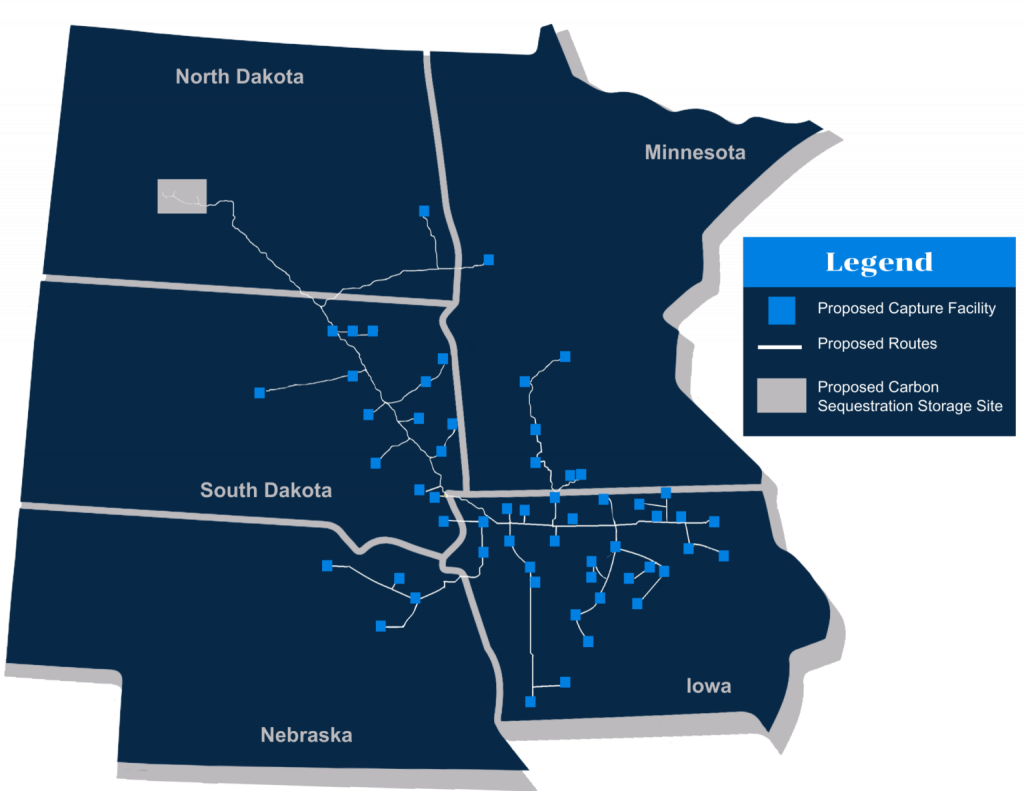
Summit Carbon Solutions wants to sequester the carbon dioxide of more than 50 ethanol producers in five states. (Courtesy of Summit Carbon Solutions)
The pipeline would cross more than 2,000 miles across five states, including nearly 700 miles in Iowa. In planning the pipeline, Summit has partnered with 57 ethanol plants and the company says it has signed voluntary easement agreements with 75% of the Iowa route’s landowners. In giving its approval to the project, the Iowa Utilities Commission has stated that Summit will be able to use eminent domain in Iowa to force the sale of land from property owners who are opposed to the use of the property for the project.
The Iowa House approved legislation the past two sessions that would have given landowners more leverage over pipeline negotiations. In 2023, the House passed a bill requiring pipeline companies to obtain voluntary easements for 90% of their routes before they could use eminent domain for the rest.
This year, the House voted to allow landowners who are subject to eminent domain requests by carbon dioxide pipeline companies to challenge the legitimacy of those requests in court earlier in the permit proceedings. Neither bill advanced in the Senate.
The proposed pipeline has been the focus of intense public debate over the past 30 months, with farmers, environmentalists and pipeline safety advocates voicing their opposition. In August 2023, Summit was denied permits in North Dakota, and one month later it was denied permits in South Dakota.
In the two and half years since the Iowa Utilities Commission first began weighing Summit’s permit application, the panel has filed tens of thousands of pages of testimony and exhibits, heard testimony from more than 200 witnesses, and considered 4,180 comments, objections, and letters of support for the project.
(Des Moines, Iowa) – Officials with Landus, an Iowa-based agriculture solutions company, Wednesday, announced the purchase of Wickman Chemical in Atlantic, an independent Iowa-based agricultural chemicals provider, to expand its chemical products and services offerings. A press release said Landus’ acquisition of the company represents its continued commitment to delivering innovation to the farm and empowering our farmers with the tools they need to succeed.
Wickman Chemical, founded by Erich and Tammy Wickman in 1998 grew into one of the region’s prominent agricultural chemical suppliers. Landis and Conduit President and CEO Matt Carstens said “Our purchase of Wickman Chemical reinforces our business strategy to bring the tools and innovation farmer-owners need to thrive.” He complimented the Wickman’s on the growth of their operation and dedications to their farmer customers. Carstens added, “We welcome both their team and customers from across Iowa and Kansas to Landus and look forward to building upon the great reputation of service Erich and Tammy established.”
The purchase agreement is in effect as of October 1, 2024, with Erich Wickman remaining with the company as a Chemical Marketing Specialist. Tammy Wickman will exit to focus on family and the farm. Wickman Chemical employees will remain in their roles to continue providing premium service to farmers, only now as Landus employees. The company will experience no major operational changes other than Wickman Chemical customers having access to all services provided by Landus.
(Sioux City, Iowa) – The Board of Supervisors in one northwest Iowa county are looking to the future when it comes to the proposed carbon capture pipeline potentially going through the county. KTIV-TV in Sioux City reports during their meeting Tuesday evening, Woodbury County Supervisors Jeremy Taylor and Mark Nelson proposed the county create a decommission plan requirement for the pipelines proposed by Summit Carbon Solutions. The plan would require Summit Carbon Solutions to prepare a decommissioning plan to restore the thousands of acres of land affected by its pipeline, once the pipelines are no longer in use.
The county board is still against the idea of carbon pipelines coming in at all, but Tuesday night they voted unanimously to require Summit Carbon Solutions to have a plan in place before they break ground. The county’s planning and zoning commission, along with the board of adjustment, will now begin work to draft an ordinance to put that plan into action.
(Radio Iowa) – The Iowa State Fair just wrapped up ten days ago, but Iowa State Fair C-E-O Jeremy Parsons says plans for next year are well underway. One concern — for the first time ever, the fair ran out of parking spaces on August 10th — the first Saturday of this year’s fair. “The largest single day in fair history, just less than 130,000 that first Saturday, obviously taxes our property and the same thing happened on that second Saturday as well,” Parsons says. ”
As the Iowa State Fair continues to grow and expand, we just have keep getting ready for bigger and bigger crowds.” The bus system in Des Moines operates a shuttle to the fairgrounds for people who park three miles away at the Iowa Capitol Complex. A record 270-thousand people took advantage of that service for this year’s State Fair.
CRESTON – Lake water levels at Three Mile Lake in Union County will be lowered an additional three feet as a part of an ongoing lake restoration project.
Managers will maintain the lake at approximately eleven feet below normal pool to expose additional areas of the lake bed and shoreline for construction. Water released through the lake’s outlet structure to lower the lake level will be released slowly to avoid downstream impacts.
Construction activities began in the fall of 2023 and will be completed in the spring of 2025, when managers will allow the lake to refill. An effort will be made to maintain recreation throughout the project and access to the lake for boating via the main boat ramp. Boaters should use caution throughout the lake as tree stumps, cedar tree brush piles, and underwater reefs may be at or near the water’s surface with the lower water levels.
The restoration project will improve and protect water quality in Three Mile Lake and provide new recreational opportunities for this popular destination. Planned activities include stabilizing the shoreline, improving the jetties, installing fish habitat and modifying the existing in-lake silt basin.
(Radio Iowa) – Students in the Morningside University’s Applied Agriculture and Food Studies program put their work to good use by donating food from their on-campus garden Monday to the Food Bank of Siouxland. Food Bank associated executive director, Valerie Petersen, says it’s a great way to receive fresh food. “We can’t get any fresher in this can we? So we’ve worked with Morningside University for a long time now. We’ve worked with their applied Ag department for a long time, and we just kept working together, and eventually they said, ‘Hey, we have all this produce that’s going to be coming out. We would love to donate it to you.’ And we said, that’s great,” Petersen says.
Associate Ag professor, Dan Witten is also a board member of the Food Bank. “We’ve, as a faculty and as a department, have donated to a couple of the Food Bank’s outlets, but this was the first year we made an intentional effort to directly raise product for the food bank, and we hope it’s many to come,” he says. Witten says students did most of the work to raise the vegetables “Our students are responsible for an experiential learning activity known as May term on campus. While spring term was wrapping up and we were rolling into May and June term, students actually planted 90 percent of what you see growing out here, if not 95 percent of it,” Witten says. “And now, over the summer, we had multiple student interns help manage the crop. Now we’re using students to help harvest it.”
The students also donated food to local pantries, including 100 pounds of cucumbers donated to the United Methodist Church, which is located next to the Sioux City campus.
DES MOINES – The Iowa Department of Natural Resources is investigating a bright blue liquid observed near the West Branch of the East Nishnabotna River near Oakland, in Pottawattamie County.
On August 22, the DNR Field Office in Atlantic received reports of a blue liquid in an inlet area on the east bank of the East Nishnabotna River in Oakland. According to information provided anonymously to the DNR, the blue liquid was first observed around August 11th.
By the time DNR officials were notified, the blue liquid was found in the recessed area near the river and not in the river. Soil staining in the area shows the blue liquid likely reached the East Nishnabotna River before the DNR was notified.
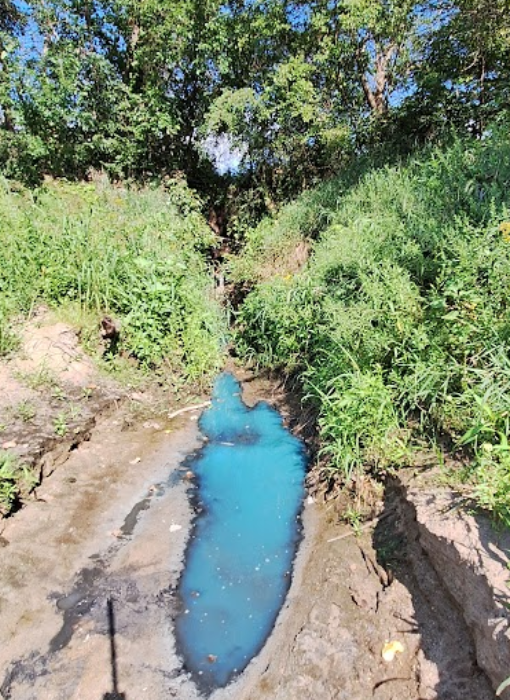
A bright blue pool of unidentified liquid near the East Nishnabotna River in Oakland
A large storm sewer outlet was identified directly above the pooled water. Oakland city officials were notified, and assisted DNR with placing booms and absorbent pads to avoid further release into the river.
Water samples were collected and submitted to the State Hygienic Lab for analysis. No dead fish were observed.
If anybody has any information on the incident, please contact the DNR Field Office in Atlantic at (712) 243-1934.
To report a release after hours, please call the DNR’s emergency spill line at (515) 725-8694. Quick reporting can help DNR staff identify the cause of an incident. The DNR website has more information about spill reporting requirements.
MONONA COUNTY – The Iowa Department of Natural Resources is investigating a diesel spill in a tributary of Willow Creek in Monona County. On August 25, the DNR Atlantic Field Office was notified by the Monona County Sheriff’s Department of a pickup truck running off the road into Pumpkin Run, a small tributary that travels east to Willow Creek, northwest of Mapleton.
Officials say the truck was carrying a 50 gallon drum of red diesel when the driver, Christopher Kreger, lost control near the intersection of Highway 141 and Plum Avenue. The tank’s contents emptied upon the pickup truck entering Pumpkin Run, in addition to a small amount of oil.
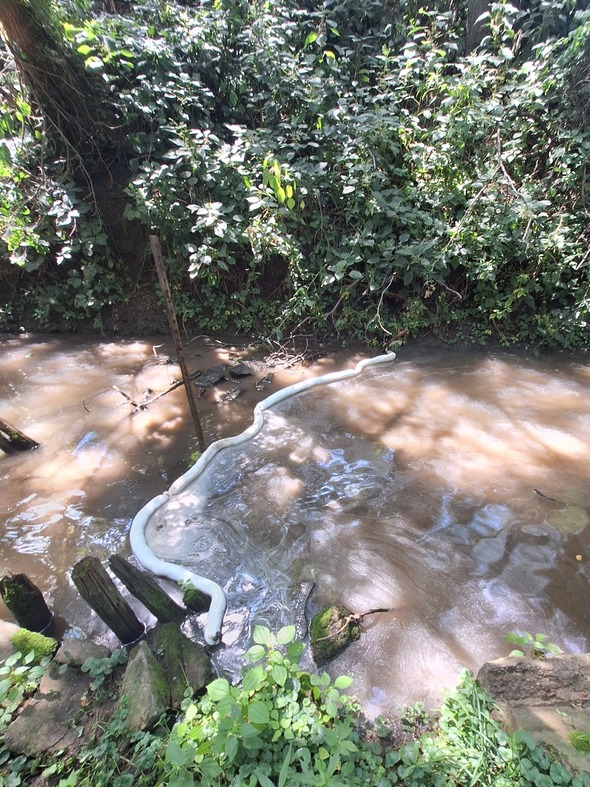
Willow Creek with booms
Red diesel fuel flowed downstream reaching Willow Creek. Booms were placed in Pumpkin Run and downstream in Willow Creek south of the 120th Street and Hwy 141 intersection. DNR Staff did not observe diesel fuel or any odors downstream of Simmons Creek. The driver is cooperating with the DNR and local sheriff to clean-up the diesel fuel. No injuries were reported and no dead fish were observed. The investigation is ongoing.
To report a release after hours, please call the DNR’s emergency spill line at (515) 725-8694. Quick reporting can help DNR staff identify the cause of an incident. The DNR website has more information about spill reporting requirements.

 Facebook
 Twitter
 YouTube
 RSS
RSS