

CLICK HERE for the latest market quotes from the Iowa Agribusiness Network!
CLICK HERE for the latest market quotes from the Brownfield Ag News Network!


CLICK HERE for the latest market quotes from the Iowa Agribusiness Network!
CLICK HERE for the latest market quotes from the Brownfield Ag News Network!
(State News/Iowa Capital Dispatch) – Crop conditions for corn, soybeans and pasture are far better than conditions from this time last year, with over 75% of corn and soybeans and 63% of pasture rated as good or excellent, according to the U.S. Department of Agriculture’s weekly crop progress and condition report for the state. Only 44-46% of corn and soybeans and 15% of pasture cropland rated good or excellent this time last year. Nearly all corn has reached the dough stage or beyond. The percentage of mature corn in the state doubled from 10% last week, setting it four days behind last year, but only one day behind the five-year average.
Soybeans are similarly maturing, with 95% setting pods and nearly 9% dropping leaves. Like this year’s corn, soybeans lag four days behind last year’s crops. A report from USDA in August forecasted corn yields for the state would be up eight bushels per acre from last year, soybean yields would improve by three bushels per acre. In preparation for harvest season, Gov. Kim Reynolds issued a proclamation on Monday waiving the need for a permit on overweight trucks bearing agricultural products.
More than 40% of the state, primarily in northern and western Iowa, is in abnormally dry conditions according to the U.S. Drought Monitor, but the state’s crop progress report shows that around 70% of topsoil and subsoil moisture is adequate. Statewide average temperatures the past week were 6.3 degrees below normal, with north eastern regions of the state seeing some overnight lows in the upper 30s, according to State Climatologist Justin Glisan.
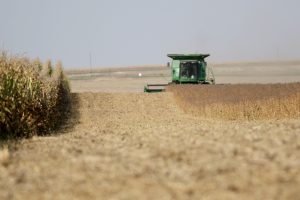
A farmer harvests soybeans in western Iowa in early October 2023. (Photo by Jared Strong/Iowa Capital Dispatch)
The lower temperatures also gave farmers 6.4 suitable days for field work such as cutting hay and chopping corn silage.
(Crawford County, Iowa) – The Iowa Department of Natural Resources is investigating a wastewater bypass at the City of Denison in Crawford County. Officials at the Iowa DNR Field Office in Atlantic received a call today (Monday) from Denison Municipal Utilities (DMU) regarding a wastewater bypass due to a lateral service line that had become plugged.
The discharge was discovered around 7:40 a.m. at the Denison Country Store located at 1108 4th Avenue S. in Denison. It is estimated that up to 300 gallons of sewage flowed onto the ground and a portion of it flowed into a storm sewer which outlets to the Boyer River. DMU staff were able to remove the blockage and officials say the discharge has stopped.
Cleanup efforts have begun. Residents are advised to avoid the area. Water samples have been collected for testing. No dead fish have been observed at this time. The Iowa DNR will follow up with the city for further assessment.
To report a release after hours, please call the DNR’s emergency spill line at (515) 725-8694. Quick reporting can help DNR staff identify the cause of an incident. The DNR website has more information about spill reporting requirements.
(Radio Iowa) – A group of northern Iowans, including landowners along the Summit Carbon Solutions pipeline route, plan to host a meeting tomorrow (Tuesday) in Titonka. Bud Jermeland of Forest City says they’ll discuss the options people have when they’re contacted by Summit.
“To know what’s currently happening with the pipeline, to know legal wise what they need to know — if they need to seek legal counsel,” Jermeland says, “questions they need to have answered, options as far as letting their land go to eminent domain and what that process entails.”
In late August, Summit began holding informational meetings in areas where the original pipeline route would be expanded if regulators approve extending the route. Summit will host a meeting in Kossuth County next Monday and in Hancock County this Friday. “It’s an individual choice,” Jermeland says, “but we just want them to know there are options out there.”
Summit will host an informational meeting tonight (Monday) in Buchanan County. Meetings are scheduled for Tuesday in Fayette and Bremer Counties. On Wednesday, Summit’s information meetings will be in Butler and Floyd Counties.
Summit’s project would be the largest carbon capture and storage project in the world and the company’s executives say the pipeline will expand economic opportunities for ethanol producers and for corn farmers.
(Here’s the link to when and where Summit’s informational meetings are being held: https://summitcarbonsolutions.com/iowa-utilities-commission-approves-public-information-meeting-dates-for-summit-carbon-solutions-expansion-counties/)
(Lewis, Iowa) – The Cass County Conservation Board held a youth fishing derby at Cold Springs Park on Saturday, September 7th 2024. Prizes were awarded for the most overall weight: 1st Addyson Freerksen, 2nd : Gavin Dougherty, 3rd : Sabyr Johnson.
Awards also given for heaviest single fish and longest single fish: Cillia Shinkle, and shortest single fish: River Peterson. The Conservation Department thanks all those that donated items for the event: Weirich Welding for the trophies, Cappel’s Ace Hardware, and Scheels for prizes.
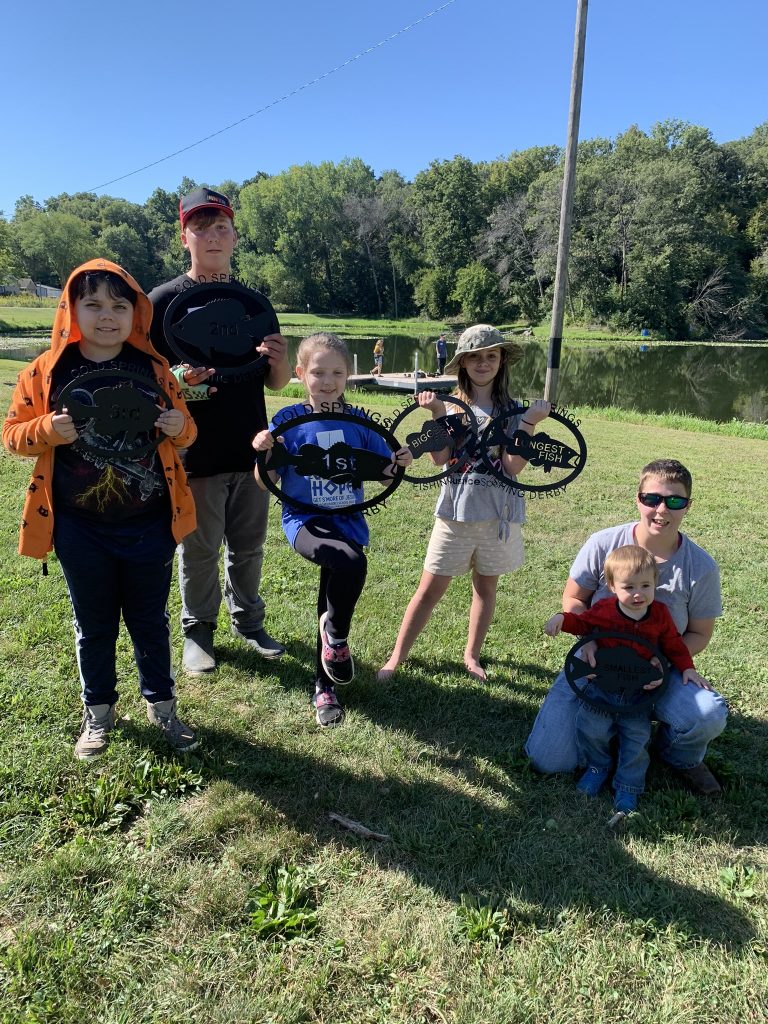
From left to right: Sayber Johnson; Gavin Dougherty; Addyson Freerksen; Cillia Shinkle, and River Peterson.
(Radio Iowa) – Kossuth County officials are advancing a temporary moratorium on permits for construction of solar farms. Kyle Stecker, chairman of the Kossuth County Board of Supervisors, read the resolution during a board meeting this week. “Kossuth County has recently been approached by several entities interested in constructing several large-scale solar energy systems in the county,” he said. In early August, the Kossuth County Planning and Zoning Commission recommended the no permits be issued for large scale commercial solar arrays in the county for nine months, to give officials time to consider the impact of solar farms would have in the county.
The resolution Kossuth County supervisors have initially approved notes large arrays of solar panels require above and below ground transmission lines. “The installation of said systems necessarily impacts the county’s infrastructure, including roads and drainage facilities,” Stecker said as he read from the document. The supervisors voted for the moratorium this week, but a second and third round of voting is required before the moratorium would take effect. Luke Seaberg of Iowa State University Extension and Outreach met with Kossuth County officials in August to discuss his federally-funded research to explore the benefits and drawbacks of large scale solar at the county level. He was part of a public hearing this week before the Kossuth County Board of Supervisors voted on the ordinance.
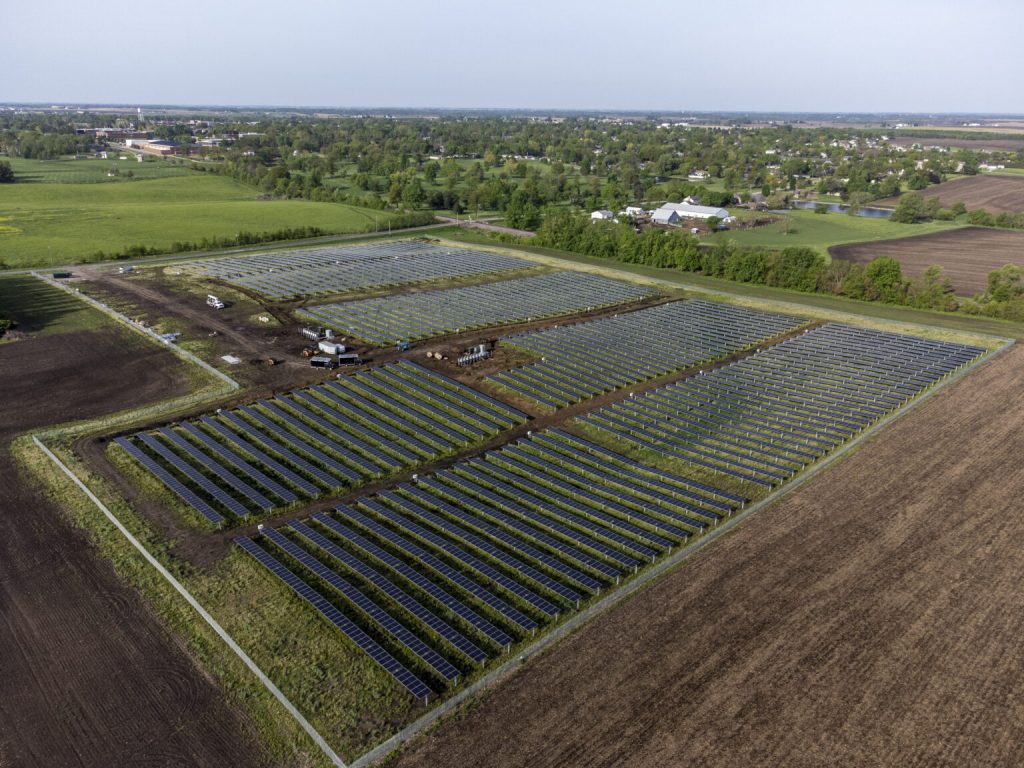
The Grinnell College Solar farm, the largest privately owed solar farm in the state of Iowa May 19, 2022.
(Photo by Justin Hayworth/Grinnell College)
“The goal of the project is to help communities make more informed decisions regarding solar energy planning and ensure that if any projects do get built in your community that those projects reflect those communities’ values,” Seaberg says. Other counties are considering or have adopted rules for solar farms. In February, Pottawattamie County’s Board of Supervisors adopted an updated set of regulations for both wind and solar projects in the county.
A couple of years ago Linn County officials debated and ultimately approved a permit for a large scale solar farm at site of a former nuclear power plant near Palo. A nine-thousand panel solar array in Grinnell generates about a third of the electricity used on the Grinnell College campus.
(Iowa Agribusiness Radio Network; Riley Smith) – There’s not much time left until harvest season will be upon us in Iowa, and the crops in the southwest part of the state are still looking great. SW Iowa Beck’s Agronomist Nate Meyer said he’s expecting a bumper crop for both corn and soybeans this year.
Meyer said now is the time to do some final crop scouting and think strategically about which fields to harvest first.
While some areas of the state are concerned about pod fill in soybeans, Meyer said the fields in his region have looked very full and healthy.
On top of practicing proper machine maintenance and safety habits, Meyer said it’s important for farmers to maintain their own bodies and get plenty of rest during harvest.
For more information, visit beckshybrids.com.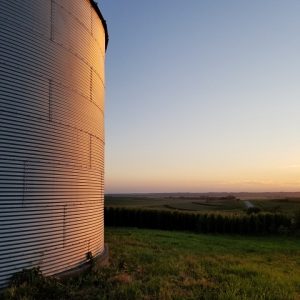
(Atlantic, Iowa) – The shorter days and more moderate temperatures make this fall a great time for gardening projects. The Cass County Master Gardeners invite you to their annual Fall Plant Sale, set for Saturday morning, September 14, at the Cass County Community Center, 805 W 10th Street on the Fairgrounds in Atlantic. The sale will be open to the public to purchase divided perennials suitable for fall planting.
Plants expected to be on the sale include iris, rudbeckia, clematis, Siberian iris, perennial geranium, grape hyacinth bulbs. peonies, daylilies, hosta, dahlias, salvia, sedum, houseplants and more! There will also be a large collection of gently used garden decor, pots, books, and tools for shoppers to explore.
The sale begins at 8 AM, and will be held in the front parking lot of the Cass County Community Center on the fairgrounds in Atlantic. Interested gardeners are encouraged to arrive early for best plant selection, as high-demand plants occasionally sell out before 10 AM.
The Master Gardeners will bring perennials dug and divided from their own gardens to the fall plant sale. Community residents are also welcome to donate plants, and members may even help you dig! Please call in advance and make arrangements to drop off donated plants before the date of the plant sale. All funds raised from the sale support local Master Gardener projects such as community garden spaces, grants and educational activities across Cass County.
Many perennials work well for fall dividing and transplanting, including daylilies, peonies, garden phlox, bleeding heart, coneflowers, speedwell, and more. Iris and hosta can also be transplanted successfully in early fall. By dividing the plant when it is not flowering, all the energy it produces can be directed to root and foliage growth, so plants overwinter in place and come back strong in the spring. Additionally, the cooler weather is easier on the plants (and the gardener!), and the plants generally do not use as much water as in spring and summer. 
Plants should be placed in the ground as early in fall as possible, but most can be successfully planted up until the ground freezes. The plants should also be adequately watered until the ground freezes, and some may benefit from a layer of mulch to help control moisture loss and help with root establishment. If you have questions about dividing and caring for plants, stop by the Extension Office or visit the online Extension Store to pick up a free publication on dividing and caring for perennial plants in the garden!
To donate items, or for more information about these events and other Master Gardener activities in Cass County, please call the Cass County Extension Office at 712-243-1132, stop by the office at 805 West 10th street in Atlantic, email Cass County Extension Director and Master Gardener Coordinator Kate Olson at keolson@iastate.edu or visit www.extension.iastate.edu/cass. You are also invited to follow the Cass County Master Gardeners Facebook page at www.facebook.com/CassCoMG to keep up with local events and tips for gardening!
(Radio Iowa) – The developer of a new beef processing plant near Council Bluffs says they are moving into the third round of selling units to the Co-op which will supply the cattle. Chad Tentinger says he hopes they will be able to start construction next year.
“We are waiting to see that heifers are being retained, so we know that our herd is being built back,” he says. “So right now it looks like we’re starting to see that heifer retention, and as we see more and more that we’ll be able to make a business decision come next spring to break ground or not.” The Co-op will supply the beef for the Cattlemen’s Heritage processing plant using a different model than what is used now by the major processors.
“And we sell them based on the board of trade. The C-M-E (Chicago Mercantile Exchange). The problem with it is, over the last decade, the C-M-E has gotten further and further away from the fundamentals, and today it doesn’t trade on fundamentals. It trades on computer algorithms. It trades with no people in the pits anymore,” Tentinger says. Cattlemen’s Heritage will pay for cattle based on what’s called the Boxed Beef Cutout pricing model, which he says will provide and opportunity for a share of profits to go back to the cattle producer.
Tentinger says he isn’t trying to put the big processing plants out of business, he just wants to provide cattle producers like himself more options. “That’s my belief system. I think we need more options, more regional with producer involvement, so that we can get a better deal and receive more value,” Tentinger says. “But the only way we can receive more value for our product, is take ownership in the plant.” Tentinger says it’s a new way to bring more of the profit to the producers.
“The Co-op will own 20 percent give or take, but 20 percent of Cattlemen’s Heritage true ownership. So when somebody buys, for example, somebody buys a thousand shares, they have to deliver a thousand cattle every year,” he explains. He expects to have three rounds where they sell units, and the cost rises for each round.
The processing plant will source cattle from Iowa, Kansas, Minnesota, Missouri, Nebraska and South Dakota and is designed to process two-thousand cattle daily for an annual total of 525-thousand. Tentinger says it not only supports family cattle producers, but will also stimulate the local economy by creating 800 direct jobs and 34-hundred indirect jobs.
(Atlantic, Iowa) – Cass County’s next mobile food pantry distribution will be held on September 11, 2024. Atlantic’s Mobile Food Pantry distribution will be at the Cass County Fairgrounds. Massena’s Mobile Food Pantry will be on the East Side of Massena’s City Park. The mobile pantries are hosted by community partners across Cass County.
A mobile pantry is a traveling food pantry that delivers food directly to families in need for a one-day distribution. People from surrounding towns and communities are welcome. Mobile food pantries are available free of charge. Anyone in need is welcome, and no documentation is required. Each car can take food for up to two households at a time. For any additional information or questions please contact Grace McAfee, Community Wellness Coordinator, at (712) 250-8170 or by email at mcage@casshealth.org.
Additional mobile food pantries have been scheduled for Atlantic, Anita, Griswold, and Massena. (See below for details)
Atlantic 2024 Mobile Food Pantries
Where: Cass County Fairgrounds (1000 Fair Ave. Atlantic, IA 50022)
2024 Dates: September 11, October 9
Time: 4:00 pm – 6:00 pm
Anita 2024 Mobile Food Pantries
Where: Anita Food Pantry (208 Chestnut St. Anita, IA 50020)
2024 Dates: October 16
Time: 4:00 pm – 5:30 pm
Griswold 2024 Mobile Food Pantries
Where: Central Church of Christ (51 Harrison St. Griswold, IA 51535)
2024 Dates: November 2
Time: 10:00 am – 11:30 am
Massena 2024 Mobile Food Pantries
Where: East Side of Massena’s City Park (500 5th St, Massena, IA 50853)
Dates: September 11, October 9
Time: 4:30 pm – 5:00 pm
Mobile pantry dates, times, and locations are subject to change. For the latest information on mobile pantries in the county, visit https://foodbankheartland.org/food-resources/find-food/. For information on local food, farmers markets, and food access, follow the Cass County Local Food Policy Council’s Facebook page @CassCountyLocalFood.


 Facebook
 Twitter
 YouTube
 RSS
RSS