

CLICK HERE for the latest market quotes from the Iowa Agribusiness Network!
CLICK HERE for the latest market quotes from the Brownfield Ag News Network!


CLICK HERE for the latest market quotes from the Iowa Agribusiness Network!
CLICK HERE for the latest market quotes from the Brownfield Ag News Network!
(Des Moines, Iowa) – Officials in charge of Iowa’s state parks invite you to lend a hand this Saturday, Sept. 28 for Statewide Volunteer Day. Several state parks and forests will host events that include picking up litter, trail maintenance, prairie seed gathering and more. No experience is necessary. The Iowa Department of Natural Resources (DNR) invites you to come out and enjoy the outdoors! The list of state parks and forests where volunteer help is needed can be found HERE.
In southwest Iowa, that includes: Lake Anita State Park, in Anita; Springbrook State Park, in Guthrie Center, and Waubonsie State Park, in Hamburg. 
You can learn more about specific events, on the DNR’s Volunteer webpage
(Iowa News Service) – Advocates for a fair, sustainable and healthy food system have released a report showing that nearly all of the corn seed in Iowa is controlled by just four companies. Economists say concentrations that large can lead to market manipulation. Farm Action’s report shows nearly 90-percent of the corn seed in Iowa is controlled by Corteva and Bayer. AgReliant and Syngenta control the rest. Farm Action President Angela Huffman says that kind of control and concentration is happening all the way from seeds to the consumer’s plate, and she warns it makes market conditions ripe for abuse.
The same type of consolidation is happening in ag operations where livestock are raised in large confinements, and manure runoff is known to damage the air, ground and surface water in rural Iowa.

SALO, FINLAND – AUGUST 22, 2015: Line up of four John Deere agricultural tractors, 6115R and 7340 on the left, at Puontin Peltopaivat Agricultural Harvesting and Cultivating Show.
Operators have said they’re always looking for more efficient and environmentally friendly ways to raise livestock.
Huffman argues that monopolies like this can lead to collusion, price fixing and other types of market manipulation. She and other advocates have called on lawmakers in Congress to address the issue in the pending Farm Bill.
The current Farm Bill, which was supposed to expire in September of last year, has been extended – but debate still hasn’t started on a new version.
(Radio Iowa) – Iowa’s bumper crop of buzzing cicadas this year may lead to a population boom in another, much-smaller insect known as the oak leaf itch mite. St. Louis-area entomologist Tad Yankoski says the mites are tiny, but there are many, many millions of them emerging in Missouri, and Iowa could be next.
Unlike mosquitoes, these weensy mites don’t seek people out, but he says if they find you, you’ll know it.
Those mite bites can leave annoying welts that might persist for days or even weeks.
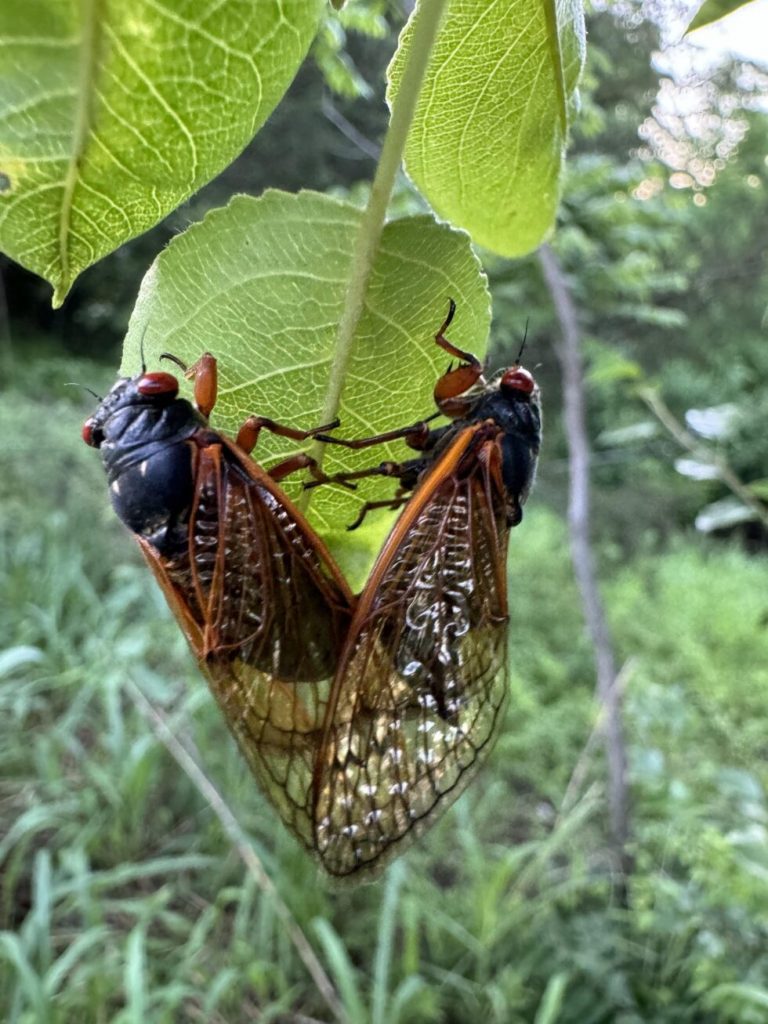
Cicadas (Photo by Ginny Mitchell at Iowa State University’s Insect Zoo)
Cicadas can grow one to two inches in length, and they’re insect giants compared to these mites.
Iowa saw emergence’s of both the 13- and 17-year cicada broods this spring, with large populations in both northeast and southeast Iowa.
(Radio Iowa) – The final public meeting on the expansion of the Summit Carbon Solutions carbon capture pipeline expansion project is today (Friday). Farmer Dave Balder (bald-er) plans to attend the meeting in Buena Vista County and opposes the project. “This is a dangerous, profit-driven project, and I see that it will be obsolete before it even gets completed.” Balder, who lives a mile north of the Valero Renewable Fuels plant in Albert City already granted easements on his property for two natural gas pipelines. He says those pipelines are projects that benefit the public, but the carbon pipeline is not.
“I do not agree with someone coming in and with eminent domain and taking over, especially since this is a private situation,” Balder says. Summit Carbon Solutions scheduled public meetings in 23 counties as required by the Iowa Utilities Commission as it seeks to increase its nearly 700-mile carbon capture pipeline by 340 miles.
Several property owners, lawmakers, and the Sierra Club have filed lawsuits opposing the use of eminent domain to build the pipeline connecting about 60 ethanol plants across five states.
(Anita, Iowa) – Nishna Valley Trails, Cass County Conservation, and Healthy Cass County’s “Tour de Lake Anita” free, community group bicycle ride is set to take place 2-p.m. October 6, 2024, beginning at the Lake Anita Shelter number 5. Freewill donations will be collected for the Cass County Coalition on Mental Wellness.
Tour de Lake Anita is a guided, leisurely five-mile group ride around Lake Anita that will make stops along the trail where various community groups and organizations will greet riders and provide information on activities and organizations involved in the Anita community. Participating organizations include Anita Sesquicentennial, Anita Health and Wellness Center, Friends of Lake Anita, Anita Town & Country, and Iowa Bluebird Conservationists.
The ride will start and end at Lake Anita State Park shelter 5 (55111 750th St. Anita IA 50020). When cyclists finish their ride, singer Sarah Selders will be performing and the Nishna Valley Trails will be sponsoring a free-will donation snack bar for participants; all donations will go to the Cass County Coalition for Mental Wellness.
Tour de Lake Anita participants can expect to ride on hard-surfaced trails and roads around Lake Anita. The route will be guided by Dave Chase, Bruce Henderson, and Jon Jordan. ‘Tour de Lake Anita’ is a play on the name of the famous bike race, the Tour de France, but unlike the famous event, this bike ride is not a race. Registration for the event is preferred by September 29 to ensure that participating organizations bring enough supplies and food. Cyclists can register with Grace McAfee by calling 712-250-8170 or emailing mcage@casshealth.org. Registration for this event is preferred by September 29 to ensure that participating organizations bring enough supplies and food.
Nishna Valley Trails is a tax-exempt local nonprofit that promotes the development of recreational trails and cycling. People who support these causes are welcome to join the group. For more information on Nishna Valley Trails or to join the organization, contact President Dave Chase at 712-249-3059.
(Radio Iowa) – The latest Iowa Drought Monitor shows moderate drought conditions have returned to about four and a half percent of the state, with the rest of Iowa rated as abnormally dry. Just over half of Fremont County in southwest Iowa is considered to be in moderate drought, along with five counties in the northeast corner of the state. All of Clayton County and most of Fayette County is in moderate drought, along with the northern tip of Dubuque County and southern areas of Winneshiek and Allamakee Counties.
Through Wednesday, rainfall in Iowa was about four percent of what’s normal for September. If the dry weather persists, this month would rank as the second driest September in Iowa since weather records have been kept.
The Iowa Drought Monitor is released weekly, on Thursdays, using weather data collected through 8 a.m. Tuesday morning. Already today (Thursday), rain HAS fallen in areas of Iowa mainly north of Interstate 80. Forecasters say a line of storms stretching from Minnesota, through Iowa and down to Missouri will develop tonight (Thursday) that could be capable of producing large hail. There is the potential for isolated tornadoes as well.
(Lewis, Iowa) – Cass County Conservation is hosting their 8th Biennial Lighted Halloween Campground on Saturday October 19th, at Cold Springs Park in Lewis. The event takes place from 7-until 9-p.m. It’s intended to be a non-scary, Family Friendly, FREE drive into the night.
Prizes will be for the top 3 voted sites, and for some special categories. Sign up to decorate a site in the Lighted Halloween Campground. Deadline for decorating a site sign up is October 11th and the groups will have Saturday(19th) from Noon on to decorate. Please help make the event a success! Decorating participants receive Saturday night camping for FREE. (if you choose to camp- not required). 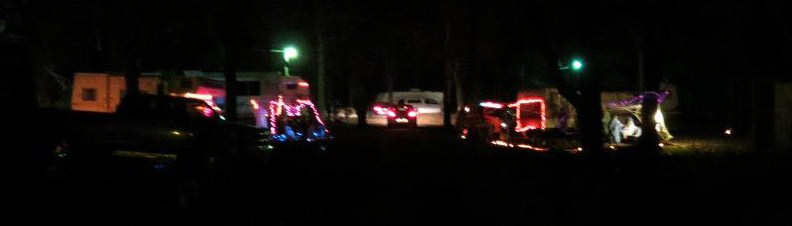
You DO NOT have to have a camper. Message, call, or email the Cass County Conservation Department. Include your name, email and phone number. Call the Cass County Conservation Office to get involved, at 712-769-2372.
The event will be cancelled if there is inclement weather. https://www.facebook.com/share/UNFJZZm1EBqbUsBj/
(Radio Iowa) – Iowa’s deputy secretary of agriculture says there are frustrating and confusing inequities in federal programs meant to support farmers trying to recover from natural disasters. Grant Menke testified yesterday (Wednesday) before the U-S Senate Small Business Committee.
“In addition to the overall complexity of these programs, one of the most significant issues Iowans have faced is the disparity in accessibility and eligibility between USDA and SBA disaster programs,” Menke says. Farming operations are not eligible for Small Business Administration loans and Menke says the historic flooding and a record number of tornadoes have created significant challenges for Iowa farmers.
“In many cases, these folks lost nearly everything,” Menke said, “not just farm buildings and equipment, but also their homes.” Menke says S-B-A disaster loans offer lower interest rates and a longer repayment period than the disaster loans farmers have access to through the U-S-D-A. “SBA disaster loans also offer deferral of the first payment and no interest accrual for the first 12 months – features that are not available with USDA disaster loans. These discrepancies place an undue burden on farmers and farm businesses who already operate on thin margins, especially during the softening ag economy.”
Menke says another frustration is the U-S-D-A’s disaster loans have an upper limit that’s less than the maximum loan amount available through the S-B-A.
(Radio Iowa) – A spokesman for the D-N-R says more than 12-hundred fish died after a water main break Monday that allowed chlorinated water into Iowa’s only urban trout stream in Cedar Rapids. D-N-R fisheries technician Chris Mack talked with K-C-R-G T-V about the fish kill at McLoud Run.
“It is a big deal. I mean, our hatchery spent money and time raising these fish, and we spend time hauling them and stocking them,” Mack says. D-N-R records show there have been seven other kill at McLoud Run since 2012. Mack says the last fish kill happened earlier this year, and the cause was also chlorinated water.
‘It’s fairly frequent occurrence being an urban situation,” Mack says. He says the D-N-R assess the value of the dead fish, then the city of Cedar Rapids has to pay the fine. In spring 2023 that was around 22-thousand dollars, and another fish kill in 2017 cost around 20-thousand dollars.
Mack was asked by K-C-R-G T-V, if mass fish kills have become the norm for this area, when do they get to the point where they don’t restock McCloud Run. He says it provides a unique opportunity for anglers. “It’s just these urban settings are closer to people and the majority of our anglers don’t want to travel that far,” he says.
Iowa’s other trout streams are in Northern Iowa. The Cedar Rapids Gazette reports in the wake of these kills, the city of Cedar Rapids has purchased seven sensors that would alert city staff when a water main break occurs so that it can be stopped sooner.
(Radio Iowa) – The Iowa D-N-R says a broken water main will likely to lead to dead fish in the only state trout stream near a major urban area. The D-N-R says the break allowed chlorinated water into McLoud Run in Cedar Rapids Wednesday. D-N-R staff reported seeing stressed fish in the stream after the water flowed in, and it is expected that dead fish may be observed over the next few days.
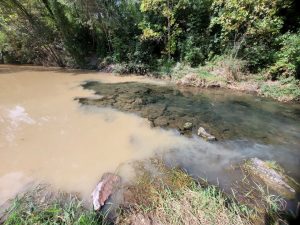
Chlorinated water from a main break leaked into McLoud Run trout stream in Cedar Rapids. (Photo courtesy of Iowa DNR)
Murky stream conditions hampered efforts to count any dead fish, but the D-N-R says they will be surveying the area when the water clears.

 Facebook
 Twitter
 YouTube
 RSS
RSS