

CLICK HERE for the latest market quotes from the Iowa Agribusiness Network!
CLICK HERE for the latest market quotes from the Brownfield Ag News Network!


CLICK HERE for the latest market quotes from the Iowa Agribusiness Network!
CLICK HERE for the latest market quotes from the Brownfield Ag News Network!
(State Newss) – Iowa farmers have harvested 27% of soybean crops in the state after yet another, hot and dry week caused pasture conditions to decline and topsoil and subsoil moisture levels to slip. Precipitation totals for the state were less than 20% of normal totals for this time of year, which State Climatologist Justin Glisan said made this one of the driest Septembers in 152 years.
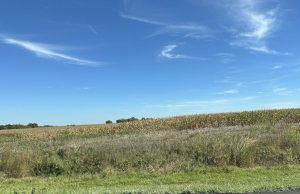
Corn crops along Interstate 35 in southern Iowa on Sept. 28, 2024. (Photo by Cami Koons/Iowa Capital Dispatch)
The National Weather Service forecasted no precipitation in Iowa over the next week, and above average temperatures. Iowa Secretary of Agriculture Mike Naig said in his weekly press release, that “Although suitable for harvest, these warm and dry conditions, paired with low humidity and gusty winds, also produce an environment that can lead to field fires. I encourage everyone to be prepared, have a plan, and keep safety top of mind as you are in the field, on the road and around the farm.”
Monday evening, firefighters from around Cass and Audubon Counties responded to a break-out of grass and field fires in the northern part of the Cass County. The fires erupted about one-mile south of Interstate 80, near the intersection of Olive Street and Boston Road, at around 5:45-p.m. Separate grass/field fires occurred along Interstate 80 eastbound between mile markers 59 and 60. Crews from Atlantic, Marne, Wiota, Anita and Exira were among the many crews battling the flames. The last crews reported the Olive Street fire was out at around 8-p.m. It’s not clear how those fires started.
The crop progress and condition report for the week of Sept. 30 through Oct. 6, said some producers have started hauling water to cattle as the majority of pastureland now rates fair or worse condition. Corn harvest reached 11% this week, up from 5% last week. All but 3% of corn acreage has reached the dent stage or beyond, and 95% of soybeans have colored or begun dropping leaves. Both crops rated 77% good or excellent.
(Information for this report was obtained from the Iowa Capital Dispatch and KJAN News Director Ric Hanson)
(Radio Iowa) – Rainfall in the spring and early summer briefly relieved drought in the Corn Belt but it also contributed to elevated nitrate concentrations in many of the region’s waterways. During dry years, nitrates from soil microbes and farm fertilizers can accumulate in fields until it rains and a lot of it flushes into rivers, lakes and sources of drinking water. America’s Watershed Initiative executive director Kim Lutz works across 31 states.
Steve Kalkhoff is a hydrologist with the U-S Geological Survey, which collects a lot of this data.
Lutz says this pollution is a problem for habitats in and around affected waterways… and it’s hurting industries like fishing and tourism. It’s also costing communities a lot of money to treat drinking water. But Lutz says new federal funding and conservation practices like cover crops can help.
(Radio Iowa) – Congress has failed for a second year to pass a new Farm Bill. The one-year extension of the legislation expired yesterday (Monday) and the temporary spending package congress approved last week to keep the government operating through December 20th did not include even a temporary continuation of Farm Bill policies. Congressman Zach Nunn, a Republican who represents Iowa’s third district, had hoped the U.S. House would vote on a version of the Farm Bill that won bipartisan approval in the House Ag Committee four months ago.
Congress is now on recess through November 12th. Nunn says even if the House had taken action, the Senate Ag Committee hasn’t developed its version of the five-year Farm Bill.
Nunn acknowledges congress won’t revisit Farm Bill negotiations until after the election.
Lanon Baccam is the Democrat who’s running against Nunn in this year’s election. Congressman Randy Feenstra, the Republican who represents Iowa’s fourth district, is also a member of the House Ag Committee. Feenstra says it’s been nearly 130 days since that committee passed its version of the Farm Bill. Feenstra says given low commodity prices and declining farm income, congress needs to approve a new Farm Bill to deliver certainty and relief for Iowa agriculture. Ryan Melton, the Democrat who’s running against Feenstra, says Feenstra is serving in the least productive U.S. House in modern history and the Farm Bill is long overdue.
Today: Sunny with a high near 70. North wind 5 to 10 mph.
Tonight: Mostly clear with a low around 42.
Wednesday: Sunny with a high near 80. Breezy, with a south southwest wind 10 to 20 mph, with gusts as high as 25 mph.
Thursday: Sunny with a high near 81
Friday: Sunny with a high near 76.
Saturday: Sunny with a high near 85. Breezy.
(Radio Iowa) – Governor Kim Reynolds spent about a third of the month of September on a trade mission in India. Reynolds says the groundwork for her meetings was laid decades ago by the Iowa native who won the 1970 Nobel Peace Prize for his research that improved wheat and rice yields.
Borlaug took a wheat variety he’d developed to India in the mid-1960s and increased wheat production there by 60 percent.*
Reynolds met with India’s Secretary of Agriculture as well as the country’s Minister for Food Processing and Minister of Commerce. Iowa Corn Growers President Stu Swanson says a memorandum of agreement was signed to promote discussions between Iowa’s and India’s feed sectors.
An Iowa-based start-up company called “Power Pollen” also signed a letter of agreement with an India company called V-R-N Seed that does business in the Middle East, Africa and Southeast Asia. Power Pollen, which is based in Ames, has developed a process for collecting pollen, storing it and then applying it to fields to increase production of rice, wheat and corn seeds.
(Radio Iowa) – An analysis from the group Food & Water Watch says Iowa is the top-ranking state for producing manure from livestock feeding operations at 109 billion pounds annually. Amanda Starbuck is the nonprofit organization’s research director.
Starbuck says there is a difference between the two types of waste.
While manure can add nutrients and organic matter to farm fields, Starbuck says the sheer amount of waste is too much for the land to handle.
Food & Water Watch used the latest data from the U-S Census of Ag and the E-P-A’s definition of medium-sized concentrated animal feeding operations to develop state rankings and create interactive maps. The 20-year trends across the U-S show fewer farms but larger livestock operations.
The massive hurricane that blew into Florida and the southern U-S won’t be felt directly in Iowa, but it will have an indirect impact. Iowa D-N-R hydrologist Tim Hall says the forecast shows the weather system will keep things dry here.
Hall says the impact could keep rain away for up to seven days. The storm could have a positive impact as it brings rain to southeast Ohio.
The Mississippi River carries barges full of Iowa grain and the lower Mississippi River water levels have been down due to drought in the Ohio River valley.
Hall says we won’t get the rain, but can be glad it is going to fall somewhere that will benefit Iowa farmers.
The Iowa D-O-T keeps track of barge traffic on the Mississippi and has recently said barges would have to carry less grain with lower water levels, and that can increase grain transportation costs.
Today: Sunny with a high near 85. Light and variable wind becoming south southwest 5 to 10 mph in the morning.
Tonight: Mostly clear with a low around 48. Breezy, with a north wind 15 to 20 mph, with gusts as high as 25 mph.
Tuesday: Sunny with a high near 68. North wind at 10 mph, with gusts as high as 20 mph.
Wednesday: Sunny with a high near 78. Breezy, with a south southwest wind 10 to 20 mph, with gusts as high as 25 mph.
Thursday: Sunny with a high near 79.
Friday: Sunny with a high near 74.
(Atlantic, Iowa [Story by Atlantic FFA reporter Maddy Anderson]) – The Atlantic FFA chapter competed in the Southwest Iowa District Soils Judging Contest at the Armstrong Research Farm in Lewis, on Wednesday, September 25th. Atlantic FFA had 6 individuals compete in 2 teams. One team that place 9th, consisted of Lily Johnson, Frank Freund, and Hayden Kleen. Members of Team 2, consisting of Jarrett Hansen, Jacquie Freund and Rylie Vandevanter, placed 25th out of 47 teams.
The Soils Judging Career Development Event is designed towards motivating students to gain knowledge on surface features, the soil profile, land capability and productivity, evaluation of land use and management practices, and suitability of soils for non-agricultural uses. Students also develop the ability to observe selected soil properties, and use these observations to interpret and evaluate these properties for recommendations for land use.
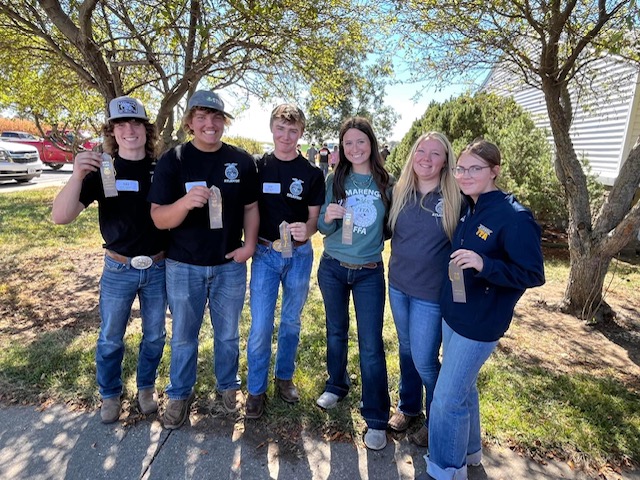
Team members from left to right are: Jarett Hansen, Hayden Kleen, Frank Freund, Lily Johnson, Rylie Vandevanter, Jaquie Freund. (photo submitted)
After the contest took place, Lily Johnson said, “I enjoyed getting the opportunity to go study soil and learn about the different things that contribute to soils judging and was very pleased with how our team placed!”
(Radio Iowa) – The latest report from the U-S Drought Monitor showed a slight improvement with six percent of the state showing no dry conditions. D-N-R hydrologist Tim Hall says the majority of the state is listed as “abnormally dry,” or just before the drought level. “That’s either a precursor to or remnants of coming out of drought. So in the conditions we’re in where we’re kind of on the edge of being in drought and not being in drought,” Hall says. There are some areas in western Iowa and far northeast that have moderate drought. Hall says the dry weather can be an asset to farmers right now.
“From an ag producer perspective, being dry is great because it doesn’t cause any problems with getting into the field. You get really good grain dry down. Those are all good,” he says. Hall says it would not be good to go much longer without some rainfall. “Thinking forward to the next crop year, we need to be adding some moisture into the soil profile,” Hall says. “So it’s not good when we have a September like we’re in. This is likely to end up being the driest September ever on record for the state of Iowa.” Hall says when you look outside of agriculture needs, the state’s water systems are okay. 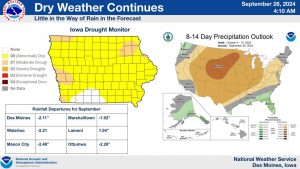
“Fortunately for the state of Iowa, we had some wetter than normal months for most of the last 12 months, going back to October of last year. So coming out of some pretty decent wet months this spring and early this summer, we’re in much better shape than we would be had we not had that rain,” he says. Hall says rain naturally drops off as we head through fall and into winter, so making up the gap from the dry September may not be easy.


 Facebook
 Twitter
 YouTube
 RSS
RSS