

CLICK HERE for the latest market quotes from the Iowa Agribusiness Network!
CLICK HERE for the latest market quotes from the Brownfield Ag News Network!


CLICK HERE for the latest market quotes from the Iowa Agribusiness Network!
CLICK HERE for the latest market quotes from the Brownfield Ag News Network!
Cass County Farm Bureau & East Pottawattamie County are recognizing Pork Month this October.
Livestock plays a vital role in the local economy, accounting for 11% of jobs in both Cass County and Pottawattamie County. Jobs that support pig farmers like trucking, animal nutrition and veterinary services strengthen communities and contribute to economic growth.
Thanks to cutting-edge research, farmer-led changes and advancements in technology, today’s pork is more sustainable and nutritious than ever before. Since the 1990s, U.S. pork production has increased by an impressive 76% while emissions per pound of pork have decreased by 23%.
Not only is pork sustainably raised, it remains a staple of a healthy diet.
Pork is an excellent source of nutrients and vitamins that regulate metabolism, strengthen bones, promote energy and aid in red blood cell formation. Health-conscious consumers can enjoy pork tenderloin and pork sirloin roast, both of which meet the American Heart Association’s Heart-Check certification for containing low levels of fat, saturated fat and sodium.
To learn more about how farmers raise pigs, follow the Cass County Farm Bureau & East Pottawattamie County on Facebook.
(Radio Iowa) – A farmer who’s a spokesman for South Dakota landowners who oppose the Summit Carbon Solutions pipeline says his state is the firewall that could stop the project. Ed Fishbach spoke at a rally at the Iowa Capitol this week. “Summit has nothing in South Dakota at this point in time that they can claim a victory for,” Fishbach said, “not one thing.”
The Iowa Utilities Commission has granted a permit to Summit, but with the requirement that North and South Dakota regulators approve the pipeline before construction may begin in Iowa. Fishbach lives near the small town of Mellette, about 25 miles south of Aberdeen, South Dakota. “I live in Spink County,” he said, “and by the way, my county in Spink County has the most miles of this Summit pipeline in South Dakota.”
South Dakota’s Public Utilities Commission has denied Summit’s permit application and South Dakota’s Supreme Court has ruled Summit has yet to prove the pipeline is a service to the general public. That limits the company’s ability to do surveys along its proposed pipeline route in South Dakota without landowner permission. “That’s a landmark decision,” Fishbach said, “and I hope your supreme court is listening to what our supreme court said about Summit because it is damning.”
This November, South Dakota voters will decide a ballot question seeking repeal of a law South Dakota’s legislature and governor approved last winter. Supporters say the law is a compromise that provides protections to landowners, while preserving a path for pipeline projects. Fishbach says the law gives state officials authority to overrule county ordinances that regulate where pipelines may be routed. “There will be nothing to stop Summit from putting that pipeline anywhere they want,” Fishbach said. “…This is what we’re up against, folks.”
Summit and pipeline advocates say the 25-hundred mile pipeline will drive job growth in the Midwest and provide a substantial boost to the ethanol industry and the U-S farm sector by making ethanol carbon neutral. Summit’s proposed pipeline route goes through five states and would connect to 57 ethanol plants, including 30 in Iowa.
(Lewis, Iowa) – The Cass County Conservation Department is hosting their 8th Biennial Lighted Halloween Campground, on Saturday, October 19th, at Cold Springs Park in Lewis. The event takes place from 7-until 9-p.m., and is intended to be fun, non-scary and FREE family friendly drive into the night.
Prizes will be for the top three voted sites, and for some special categories. Prizes are donated by event sponsor, Cappel’s Ace Hardware. The Lighted Halloween Campground event will be cancelled if there is inclement weather.
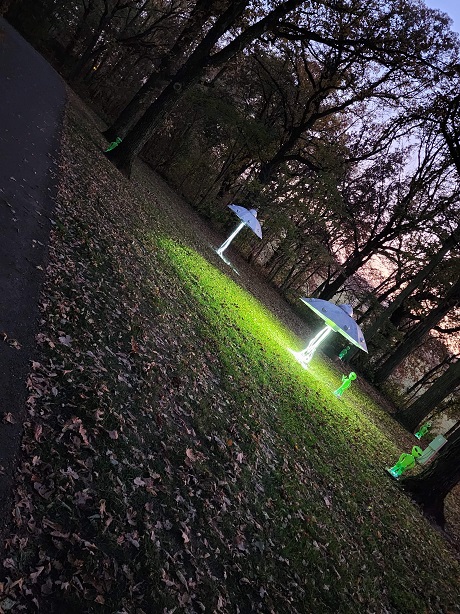
2022 Lighted Halloween Campground winner, the Dougherty family with the Alien décor. (Photo submitted)
(Lewis, Iowa) – Each year at about this time, the Cass County Conservation Board asks residents of the County when they think the first Trumpeter Swan will arrive at the Schildberg Quarry, in Atlantic. Trumpeter Swans have visited the Schildberg Quarry for, at least, 25 out of the last 26 winters. 
Arrival and departure dates of the swans have been as follows:
1997/1998 December 18 – January 2
1998/1999 Nothing on record
1999/2000 December 25 – February 15
2000/2001 November 23 – March 6
2001/2002 December 25 – February 24
2002/2003 November 23 – March 15
2003/2004 November 26 – March 21
2004/2005 November 25 – March 18
2005/2006 November 17 – March 5
2006/2007 October 30 – March 9
2007/2008 November 22- February 14
2008/2009 November 18- March 12
2009-2010 November 19 – January 5
2010-2011 November 5 – February 10
2011/2012 November 17 – February 21
2012/2013 November 24– March 4
2013/2014 November 12- April 7
2014/2015 November 11- April 6
2015/2016 November 22- March 24
2016/2017 November 19- March 9
2017/2018 November 9- March 20
2018/2019 November 11- January 23
2019/2020 November 8- March 3
2020/2021 November 30- February 13
2021/2022 November 22- February 28
2022/2023 November 22- February 22
2023/2024 December 2- January 30
Please call in your prediction (by November 10th) to the Conservation Board at 712-769-2372, leave a message and return phone number if Conservation staff are not in. Duplicate dates will not be allowed. For example, if a caller predicts November 25th, no one else will be allowed to predict that arrival date. So, call anytime until November 10th to make your prediction! One prediction per family, please. The sponsors of this contest will determine the official arrival of more than 6 trumpeter swans to Lake 4, and if they arrive before Nov. 10th no more dates will be taken. The winner will receive a Trumpeter Swan Prize from the Cass County Conservation Board. Sorry, this contest is only for residents of Cass County.
(Radio Iowa) – Attorneys for a Hardin County landowner and for the company seeking to build a carbon pipeline argued the case before the Iowa Supreme Court last (Tuesday) night. A district court judge ruled Kent Kasischke did not have the right to refuse to let surveyors for Summit Carbon Solutions on his property. Brian Jorde — Kasischke’s attorney — says it’s a violation of the constitution to grant a private company access to Kasischke’s land before the project has been approved by state regulators.
“This is an extreme right to give a private company the right to invade someone’s property against their will for the mere convenience of looking around,” Jorde said. Ryan Koopmans, the attorney representing Summit, says surveyors for private companies plotting out projects have had the right to survey Iowa land since 1851. “To go onto the property…to make sure that easement they’re going to seek is where they say it is,” Koopmans said. “That’s about as simple as it can be.” Koopmans says if the justices rule in the landowner’s favor, it would prevent utilities and other private companies, as well as state and local governments, from surveying property.
“Either we all get survey access,” Koopmans said, “or none of us do.” Jorde urged the justices to limit their decision to a section of state law that deals with hazardous liquid pipelines. “The sky will not fall if you go with landowners on this particular case,” Jorde said. A pipeline opponent sued by the company that’s no longer planning to build the Navigator carbon pipeline were among those who spoke at a rally on the statehouse steps just before last (Tuesday) night’s hearing.
Vicki Hulse of Moville was sued by Navigator for access to her land, but a district court dismissed the lawsuit last year. “If we can stop Navigator’s surveys, we can stop Summit’s,” Hulse said. “We have to keep fighting. We have to stand together and today we stand with Kent.” Kim Junker of New Hartford, an opponent of Navigator’s pipeline, noted the Iowa Utilities Commission has fined Summit for buying the voluntary easements Navigator before the required public hearings were held. “Summit knows the law, but they are arrogant enough to break the law anyways. Well this time Summit is going to be held accountable…well, sort of,” Junker said. “$10,000 is chump change for a billion dollar company.”
Summit issued a written statement, saying the company believed it was in compliance with state regulations and cited the commission’s statement, which called the violation minimal.
(Washington, D-C) – Officials with the U-S Food and Drug Administration (FDA) have updated an egg recall issued early last month (September), due to include additional eggs affected in a salmonella outbreak. The FDA warns eggs distributed by Milo’s Poultry Farms, LLC, in Bonduel, Wisconsin, may cause “serious adverse health consequences or death.” The recall pertains to all eggs branded “Milo’s Poultry Farms” and “Tony’s Fresh Market” with all expiration dates.
The Food and Drug Administration (FDA) upgraded the recall status to Class I, which the agency defines as “situation[s] in which there is a reasonable probability that the use of, or exposure to, a violative product will cause serious adverse health consequences or death.” Anyone in possession should immediately throw them away. 
According to the FDA’s website, the recall impacts 345,417 dozen cartons of eggs – equaling more than four million eggs in total. The eggs were sold in Iowa, Wisconsin, Illinois and Michigan over the summer. The Centers for Disease Control and Prevention (CDC) says 65 consumers fell ill from the eggs and 24 others were hospitalized, but there have been no deaths. Sicknesses were reported in Virginia, Iowa (2 cases), Wisconsin (42 cases), Minnesota, Colorado, Utah and California.
Health officials cautioned that the true number of cases related to the outbreak is likely much higher and potentially includes additional states, as people who recover without being tested aren’t counted. It takes roughly 3 to 4 weeks to determine if an infection in a sick person is related to an outbreak, according to the CDC. Symptoms include abdominal pain, diarrhea, fever, and vomiting, which can last several days.
The recall began after the FDA found out the eggs tested positive for salmonella.
(Des Moines, Iowa) – Eighteen lakes across Iowa are gearing up to receive trout this fall. The Iowa Department of Natural Resources (DNR) will release between 1,000 to 2,000 rainbow trout at each location as part of its cool weather trout program that brings trout to areas that cannot support them during the summer months. The fall community trout stockings are a great place to take kids to catch their first fish. A small hook with a night crawler or corn under a small bobber or small simple spinners, such as a Panther Martin or Mepps, is all you need to get in on the fun.
Bringing trout to cities and towns offers a “close to home” option for Iowans who might not travel to northeast Iowa to discover trout fishing. A family-friendly event is often paired with the stocking to help anglers have success and fun while fishing. Check the Iowa DNR Trout Fishing website to see which lakes are having events. The popular program is supported by the sales of the trout fee. Anglers need a valid fishing license and pay the trout fee to fish for or possess trout. The daily limit is five trout per licensed angler with a possession limit of 10.
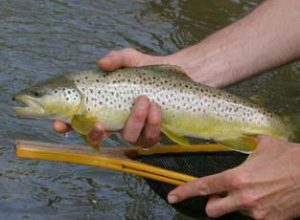
Trout stocking (DNR file photo)
Children age 15 or younger can fish for trout with a properly licensed adult, but they must limit their catch to one daily limit. The child can purchase a trout fee which will allow them to catch their own limit.
2024 Fall Community Trout Stocking Schedule (in western/southwest Iowa) includes:
Oct. 18, Big Lake, Council Bluffs, 3 p.m.
Nov. 5, Bacon Creek, Sioux City, 1:30 p.m.
Find more information about trout fishing in community lakes on the DNR trout fishing webpage.
(Des Moines, Iowa) – More than half of Iowa soybeans and nearly a quarter of the state’s corn have been harvested as of Monday’s crop report. The warm and dry weather from September persisted into October and led to increased drought and burn bans across the state. The Iowa Capital Dispatch says the crop report shows Iowa farmers harvested 31% of the state’s soybeans acreage during the reporting period of Sept. 30 through Oct. 6, bringing the total acres harvested to 58%. Harvest percentages for corn harvested for grain doubled from last week, with 22% of the crop harvested and 90% reaching maturity.
The state climatologist report for the same period said the Iowa saw a high temperature of 96 degrees Fahrenheit (reported in Atlantic) and a statewide average rainfall of 0.10 inches, or 0.64 inches below normal. The majority of topsoil and subsoil moisture rated short or very short, and a persistent decline in pasture conditions gave producers concern about water for livestock.
A small portion of west central Iowa moved from moderate drought to severe drought conditions over the span of a week, and more than 90% of the state remains in abnormally dry or worse conditions, according to the U.S. Drought Monitor. These conditions increased the likelihood of fires, especially on combines and other field equipment as it gets hot. The crop progress and condition report for the week said several combine and equipment fires were reported.
State Fire Marshal Dan Wood said he didn’t have a report of the number of equipment fires from the past week, but said 46 Iowa counties are in a burn ban. He urged Iowans, and farmers, to be cautious around things that could start a fire. “Make sure that farmers are trying to keep their combines and tractors cleaned off of debris and stuff, especially the parts that get hot,” Wood said.
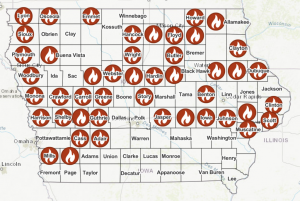
Iowa has 46 active burn bans, represented by a flame icon on the map, as of Monday. (Map courtesy of Iowa State Fire Marshal)
He said folks should take care to properly dispose of cigarettes during these dry, windy conditions, and call in anything they see smoking on the side of the road.
(Radio Iowa) – Efforts to reach an agreement on a new contract to end the strike at a Cargill corn processing plant in Cedar Rapids have failed to make any headway. The business agent for the local Teamsters chapter at the Cedar Rapids plant, Scott Punteney, says the company is busing in workers from other plants to continue production and has not responded to the union’s request to negotiate.
“We haven’t heard from them, and we’ve reached out through a federal mediator to try to resume talks. So we’re willing to talk whenever we were willing to talk the very next day after the strike happened,” he says.
The union’s three-year contract with Cargill expired last week. Punteney said workers are seeking a wage increase of more than three dollars an hour and are prepared to strike until the company meets their demands. He said striking workers are paid from a union fund to cover basic living expenses. Cargill has not responded to requests for comment. Punteney made his comments on the Iowa Public Radio Program, River to River.


 Facebook
 Twitter
 YouTube
 RSS
RSS