

CLICK HERE for the latest market quotes from the Iowa Agribusiness Network!
CLICK HERE for the latest market quotes from the Brownfield Ag News Network!


CLICK HERE for the latest market quotes from the Iowa Agribusiness Network!
CLICK HERE for the latest market quotes from the Brownfield Ag News Network!
(Des Moines, Iowa) – Iowa snowmobilers are no longer required to purchase and display an annual trail user permit, according to a new law that went into effect July 1, 2024. The Iowa Department of Natural Resources (SNR) says the law folded the trail user permit into the annual snowmobile registration fee, which will now be $30 plus administration fees. The previous price for each type was $15.
Registration and permit fees for snowmobiles are placed in a dedicated account for snowmobile programs in Iowa, including the Iowa Snowmobile Trail Grant Program, which is administered through the Iowa State Snowmobile Association. The grant program supports snowmobile trail development and grooming; equipment purchases and maintenance; and trail signage in cooperation with snowmobile clubs all across Iowa.
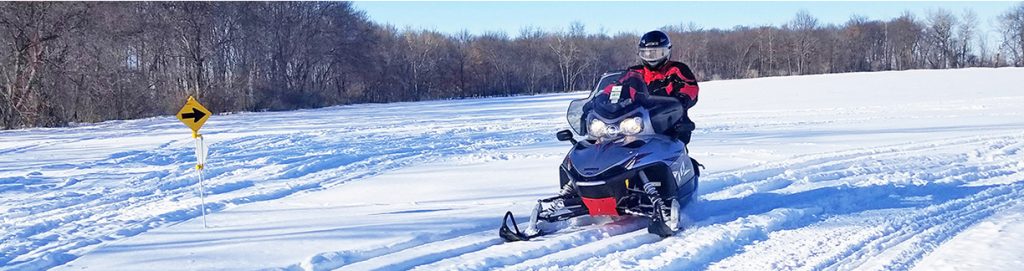
Iowa Snowmobile Association photo
Snowmobilers who own a new machine or have not yet entered the snowmobile into the state registration system need to go to the County Recorder’s office in their county of residence to start the registration process. To renew an existing registration, visit the County Recorder or go online to www.gooutdoorsiowa.com
Nonresident snowmobilers will still need to purchase and display the trail user permit, which are available at any County Recorder’s Office, through retailers that sell hunting and fishing licenses, or online at www.gooutdoorsiowa.com .
Learn more about Iowa’s snowmobile programs at: https://www.iowadnr.gov/things-to-do/snowmobiles
(Johnston, Iowa) – USDA Deputy Secretary Torres Small announced Tuesday, that the U.S. Department of Agriculture is awarding $39 million of Higher Blends Infrastructure Incentive Program (HBIIP) grants across 18 states to help retailers upgrade infrastructure such as storage tanks, dispensers and fuel pumps. This will allow 9 Iowa fueling locations, who received nearly $3 million, the ability to offer consumers higher blends of biofuels like E15 and B20 across the state.
Iowa Renewable Fuels Association (IRFA) Executive Director Monte Shaw says “Consumers in Iowa come out winning when Iowa retailers choose to provide a homegrown, cleaner fuel option that leaves extra dollars in their pockets. With Iowa’s cutting edge E15 Access Standard taking effect on January 1, 2026, there is plenty of time and resources to help Iowa retailers meet the deadline. The momentum for the USDA grants is rolling and USDA should not hit the brakes now. As congressional funding for HBIIP has run out, IRFA encourages the USDA to use discretionary funds to keep the grant awards going until Congress can refund HBIIP in the next Farm Bill.”
HBIIP provides cost-share grants to retailers who are working to expand access to biofuel blends, aiming to significantly increase the sales and use of ethanol and biodiesel. On average each grant dollar has leveraged four dollars in private investment. Iowa retailers can also apply to the Iowa Renewable Fuels Infrastructure Program for cost-share grants to offer higher ethanol and biodiesel blends.
###
The Iowa Renewable Fuels Association represents the state’s liquid renewable fuels industry and works to foster its growth. Iowa is the nation’s leader in renewable fuels production with 42 ethanol refineries capable of producing 4.7 billion gallons annually – including 34 million gallons of annual cellulosic ethanol production capacity – and 10 biodiesel facilities with the capacity to produce 416 million gallons annually. For more information, visit the Iowa Renewable Fuels Association website at: www.IowaRFA.org.
(DES MOINES, Iowa) – U.S. Department of Agriculture (USDA) Rural Development State Director in Iowa Theresa Greenfield, Tuesday, announced that USDA is awarding $3,143,693 in grant funding for six projects in Iowa to increase the availability of domestic biofuels that will give Iowans cleaner, more affordable fuel options.
The Department will also make $200 million available through the new Biobased Market Access and Development Grants made possible by Commodity Credit Corporation (CCC) funds. USDA will use previously transferred CCC funds to create the Biobased Product Market Development and Access Grant program to support innovative biobased technologies and bridge the gap between pilot-scale demonstrations and commercial viability. The funding will be available to applicants who have been accepted into the Biorefinery, Renewable Chemical and Biobased Product Manufacturing Assistance Program (Section 9003), which is administered by Rural Development. The $200 million program is being funded through the reallocation of unobligated CCC funds from 2020.
All six Iowa projects are funded through the Higher Blends Infrastructure Incentives Program (HBIIP) and are part of a larger nationwide announcement. Recipients are:
–Kardes Inc. received a $930,000 grant to create infrastructure to expand the sales and use of renewable fuels. Kardes Inc. is the owner of 10 or fewer fueling stations. This project will install eight E15 dispensers, eight E85 dispensers, eight B20 dispensers, two ethanol storage tanks, and two biodiesel storage tanks at two fueling stations, located in Iowa. Two stations in Monticello in Jones County are impacted by this funding. This project is expected to increase the amount of biofuel sold by 1,710,115 gallons per year. The purpose of this funding program is to assist owners of transportation fueling and fuel distribution facilities in activities designed to expand the sales and use of ethanol and biodiesel.
–SNK Gas & Food LLC received a $624,750 grant to create infrastructure to expand the sales and use of renewable fuels. SNK Gas & Food LLC is the owner of 10 or fewer fueling stations. This project will install three E15 dispensers, five B20 dispensers, one ethanol storage tank, and one biodiesel storage tank at one fueling station in Zwingle in Jackson County. This project is expected to increase the amount of biofuel sold by 410,732 gallons per year. The purpose of this funding program is to assist owners of transportation fueling and fuel distribution facilities in activities designed to expand the sales and use of ethanol and biodiesel.
–H&A Mini Mart Corp. received a $1,009,943 grant to create infrastructure to expand the sales and use of renewable fuels. H&A Mini Mart Corp. is the owner of 10 or fewer fueling stations. This project will install eleven E15 dispensers, three B20 dispensers, three ethanol storage tanks, and one biodiesel storage tank at three fueling stations—two in Des Moines in Polk County, and one in Ames in Story County. This project is expected to increase the amount of biofuel sold by 404,554 gallons per year. The purpose of this funding program is to assist owners of transportation fueling and fuel distribution facilities in activities designed to expand the sales and use of ethanol and biodiesel.
–Stratford Country Store LLC received a $229,500 grant to create infrastructure to expand the sales and use of renewable fuels. Stratford Country Store LLC is the owner of 10 or fewer fueling stations. This project will install two E15 dispensers, one B20 dispenser, one ethanol storage tank, and one biodiesel storage tank at one fueling station in Stratford in Hamilton County. This project is expected to increase the amount of biofuel sold by 204,659 gallons per year. The purpose of this funding program is to assist owners of transportation fueling and fuel distribution facilities in activities designed to expand the sales and use of ethanol and biodiesel.
–Libertyville Gas & Goodies received $248,250 to create infrastructure to expand the sales and use of renewable fuels. Libertyville Gas & Goodies is the owner of 10 or fewer fueling stations. This project will install two E15 dispensers, one B20 dispenser, and one ethanol storage tank at one fueling station in Libertyville in Jefferson County. This project is expected to increase the amount of biofuel sold by 136,002 gallons per year. The purpose of this funding program is to assist owners of transportation fueling and fuel distribution facilities in activities designed to expand the sales and use of ethanol and biodiesel.
–GA Combine LLC received a $101,250 grant to create infrastructure to expand the sales and use of renewable fuels. GA Combine LLC is the owner of 10 or fewer fueling stations. This project will install three E15 dispensers and two E85 dispensers at two fueling stations in Fort Dodge in Webster County. This project is expected to increase the amount of ethanol sold by 165,637 gallons per year. The purpose of this funding program is to assist owners of transportation fueling and fuel distribution facilities in activities designed to expand the sales and use of ethanol and biodiesel.
(Radio Iowa) – Researchers, business executives and government officials from around the globe are in Iowa this week for the World Food Prize symposium. It’s an annual gathering to discuss food security and innovation. Geoffrey Hawtin and Cary Fowler are this year’s World Food Prize laureates. They were instrumental in establishing the Svalbard Global Seed Vault in Norway two decades ago. Fowler says it’s a backup for seedbanks that could be hit by natural disasters, wars or a loss of funding. “In a world of changes, we are all in this together,” Fowler said, “and a loss in any seed bank around the world is a loss for all of us.” Fowler is the current U-S Special Envoy for Global Food Security.
Hawtin, the other World Food Prize laureate for 2024, says the preservation of seeds is crucial to protect the diversity and resilience of crops. “We think of genebank as being a safe haven, but it’s only a safe haven as long as you can continue to pay for the electricity. If you can’t afford to pay for the electricity, and you have to switch it off, you risk losing your entire of collection,” he says. “That could be decades of work and thousands of samples.”
Hawtin and Fowler spoke last (Monday) night at Iowa State University. The Des Moines-based World Food Prize is hosting three days of events, culminating with a banquet and closing ceremony in the Iowa Capitol.
(Radio Iowa) – Iowa’s two U-S senators are questioning why Pure Prairie Poultry, which recently declared bankruptcy, was given tens of millions of federal dollars. Senator Chuck Grassley says two years ago, the U-S-D-A handed the Minnesota-based company a near-seven-million dollar grant along with guaranteed loans of almost 39-million. “We all know it’s very important for the USDA to support the farm economy, especially in today’s tough market,” Grassley says, “but companies don’t just fail out of the blue.” When the company’s plant in Charles City closed this month, it left around 50 farmers in Iowa, Wisconsin and Minnesota without processing capacity or feed for more than two-million chickens. Plus, another 100 Iowans lost their jobs.
Grassley questions when it became apparent the company was going to fail. “This proposition raises questions about how well the Department of Agriculture is overseeing the federal funding it administers,” Grassley says. “For example, does the USDA have a process for vetting companies before it gives away taxpayer dollars? More importantly, are there other companies in a similar financial situation right now?” Senator Joni Ernst says “Pure Prairie Poultry’s abrupt closure shows the importance of proper vetting and oversight at USDA,” and says those funds need to help producers, “rather than being flushed down the drain and harming entire rural communities.” Grassley agrees.
Senator Grassley (file)
“Taxpayers have a right to know how the government is spending their money,” Grassley says. “We need to assist the workers and the farmers, and I’ll keep pushing for full enforcement of the Packers and Stockyards Act to create a better environment for small processors.” Grassley was asked if he thinks the owners or managers of Pure Prairie Poultry did something wrong, or whether they should pay the U-S-D-A back. “I don’t have any evidence they did anything illegally, but obviously bad management, I think without a doubt, you can say that,” Grassley says. “In the situation they’re in, they have no ability to pay the money back. If they did, I would expect them to, if there’s $1 left over, that ought to be paid back.”
Grassley says it’s the U-S-D-A that’s “responsible for keeping tabs on the taxpayer-funded grants it administers, but it clearly dropped the ball with Pure Prairie.” He’s asking the agency to explain to Congress and the public “what went wrong to help prevent a repeat scenario.”
(Radio Iowa) – The number of active burn bans in Iowa has dropped down to 57 counties (as of 5:30-p.m. Monday). State Fire Marshal Dan Wood says five counties ended their bans thanks to recent storms. “We’ve experienced a little bit of rain, but, you know, we’ve got a lot, lot of rain to go to catch up, to get everything, you know, sufficiently moist, where it’s not going to catch on fire as easy.” he says. Bremer County reported a grass fire along Highway 218 near Janesville Monday morning that was believed to be caused by a discarded cigarette. Wood says the dry conditions make a fire possible almost anywhere in counties with bans. A grass fire was also reported Monday afternoon near mile marker 51 off westbound I-80 in Cass County. Marne and Atlantic Fire responded and quickly had the flames extinguished.
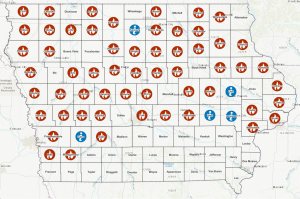
Counties w/an active burn ban are shown with a flame. Recently rescinded burn bans are shown in blue.
“With this being a rural state, and you know, our crops dry out at this time of year, every year, so that doesn’t help any either. And getting those out gives a lot of relief, but we still got to be mindful of there’s a lot of dry grass, a lot of dry crops and stubble out there. So everybody needs to be careful,” Wood says. He thinks most people have been avoiding open burning in the counties under a ban. “I think so. Haven’t heard too much of people, you know, going against the bans, a few here and there, but not much. I think people are pretty mindful once they get put on,” Wood says.
Johnson, Linn, Iowa, Hancock and Cass County recently lifted their burn bans after some rain.
(State News) – The Iowa corn harvest reached 84% this week, up from 68% last week, and soybean harvest is nearly complete, at 96%, as the state nears the end of one of its driest Octobers. According to the Iowa Capital Dispatch, the crop progress and condition report for Oct. 21 through Oct. 27 showed a continued decline in soil moisture conditions. Topsoil rated 75% short to very short, and subsoil moisture condition rated 80% short to very short.
The state climatologist Justin Glisan reported precipitation totals for the week were higher than the past four weeks combined, yet still below the state’s average for this time of year.
Eastern and central counties saw storms this week, with Johnson County logging almost two inches of rain and 30 monitoring locations with totals above one inch.
The National Weather service forecasts more precipitation for the state next week and normal precipitation through November.
“Continued warm temperatures and dry conditions last week allowed for harvest to push forward at a brisk pace,” Iowa Secretary of Agriculture Mike Naig said in a statement about the crop condition report. “Following what is likely to be one of the driest Octobers on record, weather outlooks for early November are indicating more chances for rainfall.”
A crop update report from Iowa State University Extension and Outreach noted the dry conditions have caused “excessively dry grain,” difficulty with tillage and an inability to apply anhydrous ammonia to fields.
DES MOINES, Iowa [KCCI — Lovers of the Iowa State Fair can bid on hundreds of state fair surplus items through Nov. 7. Daugherty Auction & Real Estate Services is handling the auction, which includes various items from used vehicles, machinery and lawnmowers, signage and advertising, benches, bricks and other pavers, artwork, antiques, lumber and much more.
As of the latest check, an 8-by-20-foot enclosed trailer has the highest bid at $1,800. A Bobcat skid loader is next at $2,800.
Bidding closes at 7 p.m. Thursday, Nov. 7, and winning bidders can pick up their items between 10 a.m. and 5 p.m. Friday, Nov. 8, and Saturday, Nov. 9.
The 2024 state fair was the biggest ever, drawing a record 1,182,682 people through the gates over its 11 days.
Officials last month announced “Fair Sweet Fair” as the theme for the 2025 state fair, which is scheduled to run Aug. 7-17.
(Radio Iowa) – The pheasant season is underway amidst a resurgence in the number of birds available and success by hunters. D-N-R wildlife biologist Todd Bogenschutz says habitat is a key for bird numbers and the Conservation Reserve Program (CRP) is the main component. “You know, Iowa as a state is doing pretty well with C-R-P. We probably have more than any of the states are joining us, Minnesota, South Dakota, Nebraska, Illinois,” he says. ” But that being said, we are down from our historic enrollments like back in the mid 90s.” The C-R-P program pays farmers to take some land out of regular crop production and it is planted with grasses and other cover crops. Weather is another factor in pheasant populations.
“We had a pretty uh significant turn of weather for about five years there in the late 2000s. That really drove our populations down, but since then we’ve come back to kind of more normal Mother Nature, since about 2013,” he says. He says you can see the direct impact on the pheasant population since the change in weather. “Counts have generally showed a steady increase since then. And you know, that’s why, we’ve gotten a lot more notoriety, I guess, let’s say in the last four years or so, because our counts have come back up,” Bogenschutz says. “I mean, we’re not back to million bird harvest or anything like that. But, you know, half a million still a very respectable number. Half million plus.”
Bogenschutz says increasing pheasant harvest would take a change in the farm policy. ” You know, if we have farm policy, that would push C-R-P back to what we saw in the mid 90s. I absolutely think we could, we could harvest a million birds,” he says. The D-N-R will celebrate the 100th pheasant next fall.
(Salt Lake City, UT) – A handful of states, including Iowa, are throwing their support behind Utah’s lawsuit that questions whether the Bureau of Land Management can hold onto nearly 18.5 million acres of public land within the state’s borders. Filed with the U.S. Supreme Court in August, Utah’s lawsuit argues that the BLM can’t indefinitely hold onto land without giving it a designation, like a national monument, national forest or wilderness area. Those 18.5 million acres are what the state calls “unappropriated land” — they’re still leased for grazing, recreation and mineral extraction, but have no designation. Now, 12 states and a few state legislatures are supporting Utah’s effort, signing amicus briefs with the nation’s high court.
An amicus brief, also called a “friend of the court” brief, is filed by organizations or individuals who are not named in the lawsuit, but have an interest in the case or would like to support a particular side. In total, 11 briefs have been filed with the Supreme Court by various groups, states and politicians, all of them supporting Utah’s effort. The Iowa Capital Dispatch says the states filing briefs include Iowa, which spearheaded a brief signed by attorneys general from Alabama, Arkansas, Mississippi, Nebraska, North Dakota, South Carolina, South Dakota and Texas.
The brief spearheaded by Idaho Attorney General Raul Labrador argues the federal government’s control of unappropriated land curtails state sovereignty. In the filing, attorneys argue that the state’s inability to control that land causes a host of problems. There’s a different criminal code; the land cannot be taxed by the state and results in tax hikes; the state cannot exercise eminent domain; and the state can’t generate revenue from grazing fees, mineral leases or timber sales, the brief claims.
The brief led by Iowa and signed by eight other attorneys general focuses more on whether the Supreme Court should take up the case, and less on the merits of Utah’s lawsuit. Utah is invoking original jurisdiction, which allows states to petition directly to the Supreme Court rather than starting in a lower court and then going through the appeals process. To invoke original jurisdiction, the issue needs to be between a state and the federal government. Iowa Attorney General Brenna Bird said in a news release, “States have a right to sue the federal government, and the citizens of those States have the right to have their interests heard in court.” Bird says she is “Calling on the Supreme Court to let Utah make its case for control over its own lands.”
Most of the cases considered by the high court are appeals — in Iowa’s brief, attorneys ask the justices to consider Utah’s complaint. “Few issues are as fundamentally important to a State as control of its land,” the brief reads. “The Amici States respectfully ask this Court to take this case out of respect for the sovereign dignity inherent in a State’s dispute against the United States.”


 Facebook
 Twitter
 YouTube
 RSS
RSS