

CLICK HERE for the latest market quotes from the Iowa Agribusiness Network!
CLICK HERE for the latest market quotes from the Brownfield Ag News Network!


CLICK HERE for the latest market quotes from the Iowa Agribusiness Network!
CLICK HERE for the latest market quotes from the Brownfield Ag News Network!
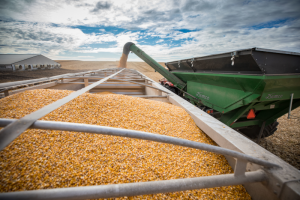
Photo credit: Iowa Corn Growers Associatoon
The proclamation applies to loads transported on all highways within Iowa (excluding the interstate system) and those which do not exceed a maximum of 90,000 pounds gross weight, do not exceed the maximum axle weight limit determined under the non-primary highway maximum gross weight table in Iowa Code § 321.463 (6) (b), by more than 12.5 percent, do not exceed the legal maximum axle weight limit of 20,000 pounds, and comply with posted limits on roads and bridges.
DES MOINES – The Iowa Department of Natural Resources (DNR) Lake Restoration Program is accepting public comments on the newly released draft 2024 Lake Restoration Report and 2025 Plan, now through Dec. 18th. The report is available for review at: https://www.iowadnr.gov/Environmental-Protection/Water-Quality/Lake-Restoration. It highlights restoration projects completed around the state in State Fiscal Year 2024 and outlines plans for upcoming restoration projects.
The Lake Restoration Program works with communities and stakeholders across Iowa to improve water quality and recreational opportunities at publicly-owned lakes. Since the program’s creation in 2006, the Iowa legislature has invested more than $166 million in the lake restoration program. To date, DNR and project partners have invested in lake improvement projects at 72 lakes in 54 counties. Since 2006, 40 shallow lake/wetlands projects have also been completed, improving over 14,000 wetland acres. The program maintains a list of publicly-owned lakes and shallow lakes/wetlands prioritized for restoration.
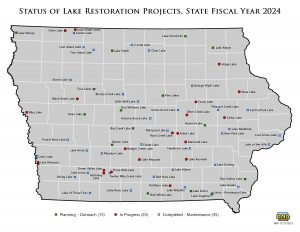 Major projects completed in 2024 include a $2.92 million investment in Casey Lake, located within Hickory Hills Park (Black Hawk County), a $3.52 million investment at Three Mile Lake (Union County) and a $1.2 million program investment at Rock Creek Lake (Jasper County) to stabilize eroded shorelines. Major projects planned for 2025 include watershed and in-lake restoration work at Lake Keomah (Mahaska County), Diamond Lake (Poweshiek County), and McKinley Lake (Union County).
Additionally, several large-scale shallow lake/wetland restoration projects are underway, including projects at Pleasant Lake, and Lily Lake (both in Dickinson County) and East Twin Lake (Hancock County). Once again, the DNR is accepting comments through Dec. 18th. Comments may be submitted via email to michelle.balmer@dnr.iowa.gov or sent via mail to Michelle Balmer, Iowa Department of Natural Resources, 6200 Park Avenue, Suite 200, Des Moines, Iowa 50321.
(Des Moines, Iowa) – Iowa anglers can buy the Missouri and Big Sioux River paddlefish license and tags from Dec. 15th through Jan. 7th. The Iowa Department of Natural Resources says you can buy your special paddlefish license and tags on the Iowa DNR online licenses sales website at https://gooutdoorsiowa.com. A resident license sells for $25.50 and a nonresident license is $49. Anglers must also have a valid Iowa fishing license.
A limited number of paddlefish licenses are available – 950 resident, and 50 nonresident. Anglers may buy up to two tags – one between Dec. 15 and 31; and an additional tag between Jan. 1 and 7, or two tags if you didn’t buy one in December. The license, harvest tag(s), and regulations will be mailed to purchasers in mid-January. Purchasers will be asked to complete an electronic survey to help the Iowa DNR evaluate the success of the paddlefish season. Please complete the survey whether you harvested a paddlefish or not. The Iowa DNR is always working to improve the paddlefish season for anglers; any input provided is considered and is greatly appreciated.
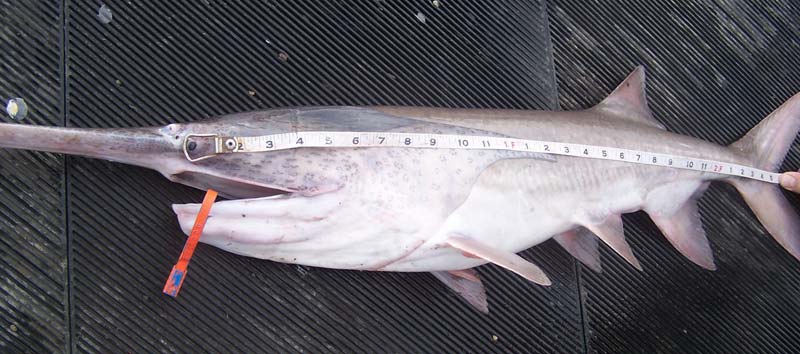
Paddlefish-DNR photo
The Missouri and Big Sioux River paddlefish season opens Feb. 1 and runs through April 30. For more information about Iowa’s special paddlefish season, visit the Iowa DNR website at www.iowadnr.gov/paddlefish – click on Missouri River Paddlefish Season and Regulations.
(Radio Iowa) – Wetlands in Iowa help prevent nearly 500-million dollars in flood damage every year, according to a new report from the Union of Concerned Scientists. Report author Stacy Woods says wetlands are natural floodwater barriers that absorb and slow down rushing water like a sponge. Federal data shows a decline in the number of wetlands, especially in the Prairie Pothole region, Great Lakes and southeast. Woods fears the trend could accelerate, as a U.S. Supreme Court decision last year stripped away federal protections in the Clean Water Act for many wetlands.
Woods says, “It’s critically important that we really step up to protect the wetlands that remain, because we’re going to need them as our flooding frequency increases with this warming climate.” The report’s findings build on peer-reviewed research, which estimates one acre of wetlands provides 745-dollars of flood mitigation benefits to residential homes. “We know that flooding is a significant issue,” she says. “It’s expensive, and it’s getting worse as the climate warms.”
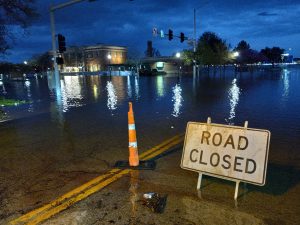
Radio Iowa file photo
Along with flood mitigation, the report says wetlands provide habitat and food for roughly half of the endangered species in the U.S. They also act as natural pollution filters for drinking water. In the last two decades, Iowa has had six flood disasters with losses exceeding one-billion dollars. “In our report, we were only looking at how wetlands benefit communities by mitigating flood damage,” Woods says, “but of course, wetlands bring so many benefits to communities.”
The report recommends boosting conservation programs that help restore and protect these habitats.
(Radio Iowa) – With Thanksgiving over, many people are now searching for a live Christmas tree. Northeast Iowa grower Robert Moulds says the wet spring was a relief this year after battling the drought. “This year, our trees around the state got plenty of moisture, and so the growing was much better than it has been the last two years,” he says. Moulds is a member of the Iowa Christmas Tree Growers Association and says traveling to his farm near Fairbank or others is a tradition for many. “You can go out in the field and select the tree and cut it, so you know exactly what you’re getting.,” Moulds says. “There’s, there’s about 70 Iowa Christmas tree farms in Iowa, Iowa Christmas Tree Association member farms, plus, we think probably about that many more again. So roughly 100 to 140 tree farms in Iowa.” Moulds has been in the business more than 40 years. 
“Planted my first trees in 1980 and sold our first trees just a few in 1986,” he says. “and we’ve been selling trees since then. We sell, we sell around 2000 trees a year.” Muolds says the key to keeping a live tree fresh is the care you give it. “Have a good stand that holds plenty of water. Never let it run dry, always use hot water to help dissolve the resins that accumulate on the tree. That is the biggest thing, and a good fresh cut tree will stay well into January,” he says.
You can find out more about a Christmas tree farm in your area, by visiting iowachristmastrees.com.
CEDAR RAPIDS, Iowa (KCRG) – One of the nation’s largest food and agriculture companies, with ties to eastern Iowa, is cutting its workforce. Cargill announced plans to layoff five percent of its employees worldwide. According to the company’s website, it employs around 160,000 employees.
The Minnesota based company has made a profit after the pandemic with rising inflation. But says falling numbers of U.S. cattle and grocery prices are hitting them the hardest. The company has not said if the layoffs will impact the multiple Cargill plants across eastern Iowa. 
The Minnesota company did release a statement to the ABC affiliate in Minneapolis saying, “To strengthen Cargill’s impact, we must realign our talent and resources to align with our strategy. This difficult decision was not made lightly.”
WATERLOO, Iowa (KCRG)—More than 100 John Deere workers in Waterloo were told Tuesday (Dec. 4, 2024) morning that they will be without a job after the holiday season. It comes two weeks after Deere announced a net income of seven billion dollars last year. That’s a 16% decrease from the year before. Over 1,700 John Deere employees across Iowa have been laid off since the beginning of 2024. Waterloo has taken the brunt of the layoffs. Tuesday morning 112 employees at John Deere Waterloo Works were told their last day would be January 3. This brings the total layoffs in Waterloo alone to more than 1,000.
KCRG reports that in Davenport, 80 workers will also be losing their jobs after the new year. Those layoffs were announced back in October and will take effect on January 3rd. A John Deere plant in Des Moines laid off 166 employees earlier this year and Deere in Dubuque has lost 133. The company said it has seen declining demand for its products because of challenging market conditions. It cited the USDA expecting falling commodity prices for things like corn and soybeans.
John Deere gave the following reasons for why orders are down:
The company also says its construction division is impacted by fewer new homes being built. The company said:
Laid off employees will receive monetary and health care benefits for a period after their end date.
Farm income is forecasted to have decreased in 2024 by 4% from 2023, largely because of a decrease in cash receipts, or the gross income, from the sale of commodity crops, according to the December update of the U.S. Department of Agriculture’s farm income forecast. The Iowa Capital Dispatch reports Carrie Litkowski, the farm income team leader with USDA Economic Research Service, presented the latest update in a webinar Tuesday, and said the forecast was very similar to its previous September iteration.
“But somehow it feels a little more important, as we near the end of the year, to evaluate the current state of the farm economy as a starting point for considering what challenges and opportunities may lie ahead for U.S. agriculture,” Litkowski said.
Net cash farm income for 2024 is projected to be $158.8 billion, which in inflation-adjusted figures is 3.5% lower than net cash farm income in 2023. The forecast shows the 2024 figure, however, is 9.8% above the 20-year average for net cash farm income, and represents a less gradual decline than that of 2022 to 2023. Net cash farm income is the income minus expenses of the farm, including government payments, but excluding things like changes in inventories or economic depreciations, which are reflected in the “net farm income” figures. 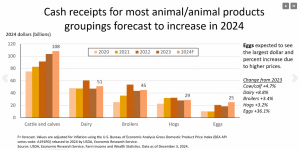
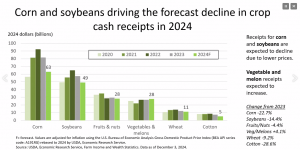
The sale of agricultural commodities is projected to decrease by less than 1 percent overall as an over 8% increase in animal and animal product receipts nearly offsets the over 9% decrease in forecasted crop receipts. Because of this, net cash income for all farm businesses specializing in crops is forecasted to be lower this year than last, but all farm businesses specializing in animal or animal products are expect to have higher net cash farm income than they did in 2023.
This could mean lower net cash income for the farming sector in Iowa for 2024, as the majority of cash receipts on Iowa farms in 2023 were for corn and soybeans, which are projected to decrease, nationally, by 23% and 14% respectively in 2024.
The data used in the USDA ERS forecasts represents the entire farming sector of nearly 2 million farms and ranches. Litkowski said the reports are used to inform policy makers and lenders, and in determining the ag sector’s contributions to the U.S. economy. It’s forecasted that farmers in 2024 will have a decreased need of supplemental and disaster assistance, as well as lower dairy margin payments. That will result in a forecasted $1.7 billion decrease from 2023 in direct government payments to farmers.
Litkowski said natural disasters like hurricanes Helene and Milton have not yet shown up in the data, because much of the harvesting in the affected regions had already been completed at the time of the hurricanes, and payments have not yet been issued. USDA also forecasts overall lower input costs, primarily in feed fertilizers and pesticides for farmers in 2024. Other inputs, however, like labor, interest rates and livestock and poultry purchases are forecasted to have increased.
Median farm income for 2024 is expected to increase to $100,634, which is almost 3% higher, without adjusting for inflation, from 2023. Off-farm income, which represents the biggest share of income for most on-farm families, is projected to increase in 2024, after decreasing slightly over the past three years. Litkowski clarified that “half of all farms are residential farms” where the owner’s primary occupation is not farming, which typically leads the median on farm income to appear as a negative amount.
The forecast will be updated again Feb. 6 when the department will release its first projections for 2025.
(Radio Iowa) – Wolf Carbon Solutions has withdrawn its application for a state permit to build a carbon pipeline in eastern Iowa. Developers had plans for a 95-mile pipeline to capture carbon emissions from A-D-M plants in Cedar Rapids and Clinton — and ship the liquefied carbon to underground storage in Illinois. The company withdrew its permit request in Illinois last year. Emma Schmit is director of Pipeline Fighters, which is part of a group called BOLD Alliance which works on land and water use issues in rural states.
“Talking with landowners, it’s been months and months since they’ve even heard from Wolf, so they’ve seen the writing on the wall,” Schmit says. “…We tend to see these companies withdraw their applications and then never resubmit, so as far as I’m concerned, things are basically kaput.” The company’s withdrawal notice did not say whether it would revise its plans and submit a new permit request to the Iowa Utilities Commission. A spokesperson for Wolf Carbon Solutions has not replied to Radio Iowa’s request for comment.
Wolf had been seeking voluntary access to land along its proposed pipeline route. In early 2023, the company announced it would not ask Iowa utility regulators for eminent domain authority to seize land from unwilling property owners. “That’s what they said in Illinois as well and I think that was one of their major problems both in terms of finding space for storage and the support from the community wasn’t there,” Scmit said. “…If they’re not going to basically, in my opinion, abuse eminent domain powers, they’re kind of stuck with no other option but to cancel the project.”
By early 2022, three pipeline companies — Wolf, Navigator and Summit Carbon Solutions — had announced plans to build carbon pipelines in Iowa. A year ago, Navigator cancelled its project. Summit hopes to extend its proposed pipeline route to ethanol plants that had signed up for Navigator’s pipeline. Schmit doubts the A-D-M plants involved in Wolf’s project will try to connect to Summit’s proposed pipeline. “But I wouldn’t be surprised if a different corporation came along,” Schmit says, “or if they even tried exploring carbon sequestration on site.”
The University of Iowa is leading a more than 11 MILLION dollar project to see if carbon can be successfully stored underground in Iowa, in what’s called basalt rock. The Iowa Utilities Commission has voted to give Summit authority to seize land along its Iowa pipeline route from owners who have refused to sign easements to their properties — but only if regulators in two neighboring states approve the pipeline project. Last month, North Dakota’s Public Service Commission granted Summit’s permit and Summit resubmitted its request form a permit in South Dakota.
(Radio Iowa) – While some Iowa motorists and sidewalk shovelers may be cussing the snowfall, those who love winter sports are celebrating the brisk temperatures and the new blanket of flakes. Mark Gordon, general manager of Sundown Mountain Resort in Dubuque, tells KCRG-TV they had an excellent first weekend of the ski season. “It’s a fabulous opening day,” Gordon says. “We had a great time yesterday, and last night, the snow makers were able to open up a whole new set of runs, so we have even more people here today to check out the snow.” Gordon says the resort had a very high turnout, with hundreds of people going skiing and snowboarding.
“People that ski tend to be a little more optimistic, and skiing makes you feel good,” Gordon says. “It’s a lot like in a weird way, flying. You’re going down at sometimes 40 or 50 miles an hour, and you know you feel good.” Skiier Katlyn Fogg tells KCRG-TV that she was thrilled to be there for the premiere of another season of winter sports. “We’ve been talking about skiing all year,” Fogg says. “We were so excited about it, so we were ready for opening weekend. We were excited it was this soon.” Steele Schmitz was in Dubuque for the snowboarding. “I’ve been here for the past three years,” Schmitz says. “I went with my friend and it’s just a great experience to come out here and snowboard during the winter, since there’s not much to do in Iowa.” 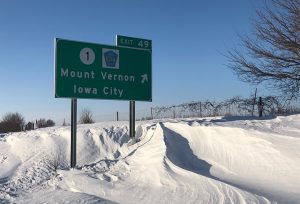
The resort’s general manager says the cold weather is good news for the entire rest of the season, as it helps Sundown to stock up on snow, so they can stay open during warmer spells.


 Facebook
 Twitter
 YouTube
 RSS
RSS