

CLICK HERE for the latest market quotes from the Iowa Agribusiness Network!
CLICK HERE for the latest market quotes from the Brownfield Ag News Network!


CLICK HERE for the latest market quotes from the Iowa Agribusiness Network!
CLICK HERE for the latest market quotes from the Brownfield Ag News Network!
(Radio Iowa) – The first shotgun deer hunting season is underway and the D-N-R wants hunters to help keep chronic wasting disease from spreading. State Wildlife Veterinarian Rachel Ruden says the disease can be spread to deer who come into contact with an infected carcass. “Be aware of how you’re handling your carcass, your deer carcass, especially if you don’t know the test results or that deer hasn’t been tested, we really don’t want those animal parts to end up on the landscape to, you know, cause a new outbreak location,” she says. If you field dress the deer away from where you shot it, she says dispose of the rest of the deer properly.
“We recommend landfill if that’s an option, otherwise, returning to the location of harvest,” she says. Ruden says , there is no evidence that C-W-D has ever transmitted to people, but the current advice from the C-D-C is to not eat venison that has tested positive. “There’s more studies coming online that are looking at which species can actually acquire the disease by consuming infected venison. That’s a much more kind of biologically relevant route, and kind of the route that, of course, we would be concerned about with people and exposure,” she says. Ruden says hogs are the only animals which are confirmed to get C-W-D from eating infected meat.
“Pigs that were fed infected venison were able to develop this disease, so that you know just kind of adds to that air of taking caution and testing your deer before you consume it, and if you know it’s positive to discard it. But of course, that’s up to the consumer at the end of the day,” Ruden says.
The D-N-R recently held an online public meeting about C-W-D. Ruden says the video of that meeting will be posted on the D-N-R website along with other information.
AMES, Iowa (Iowa Capital Dispatch) — National Farmers Union President Rob Larew spoke about the stalled reauthorization of the Farm Bill and strategies to promote agriculture and conservation within the upcoming administration Saturday at the Iowa Farmers Union annual conference. “I am so tired of talking about this farm bill,” Larew said with a laugh to a full conference room at the Quality Inn in Ames.
The Farm Bill is a bipartisan package of legislation, typically reauthorized every five years, regulating and funding food and farm programs from the U.S. Department of Agriculture conservation initiatives to the Supplemental Nutrition Assistance Program. The 2018 Farm Bill, however, was extended in 2023, expired in fall 2024 and awaits an unknown fate in the rapidly approaching close to the congressional lame-duck session. Larew said coming into 2023, the attitude with the Farm Bill was to take what happened in the pandemic and craft better provisions to protect farmers and the U.S. food system.
“And then nothing happened,” Larew said, and detailed how perspectives changed as Farm Bill deadlines came and went. “Now we are where we are, which is very likely another extension, pushing us into a lot of uncertainty for next year,” Larew said. The reelected Farmers Union president said a Farm Bill is hard to pass in a normal year, let alone in a year when the legislation is “low on the list” of a new administration’s priorities. Larew said he hopes the president-elect’s plans to slash government spending does not impact the Farm Bill, and said he will continue to push the message that “you can never balance a budget on the back of a Farm Bill.”
Iowa Capital Dispatch is part of States Newsroom, a nonprofit news network supported by grants and a coalition of donors as a 501c(3) public charity. Iowa Capital Dispatch maintains editorial independence.
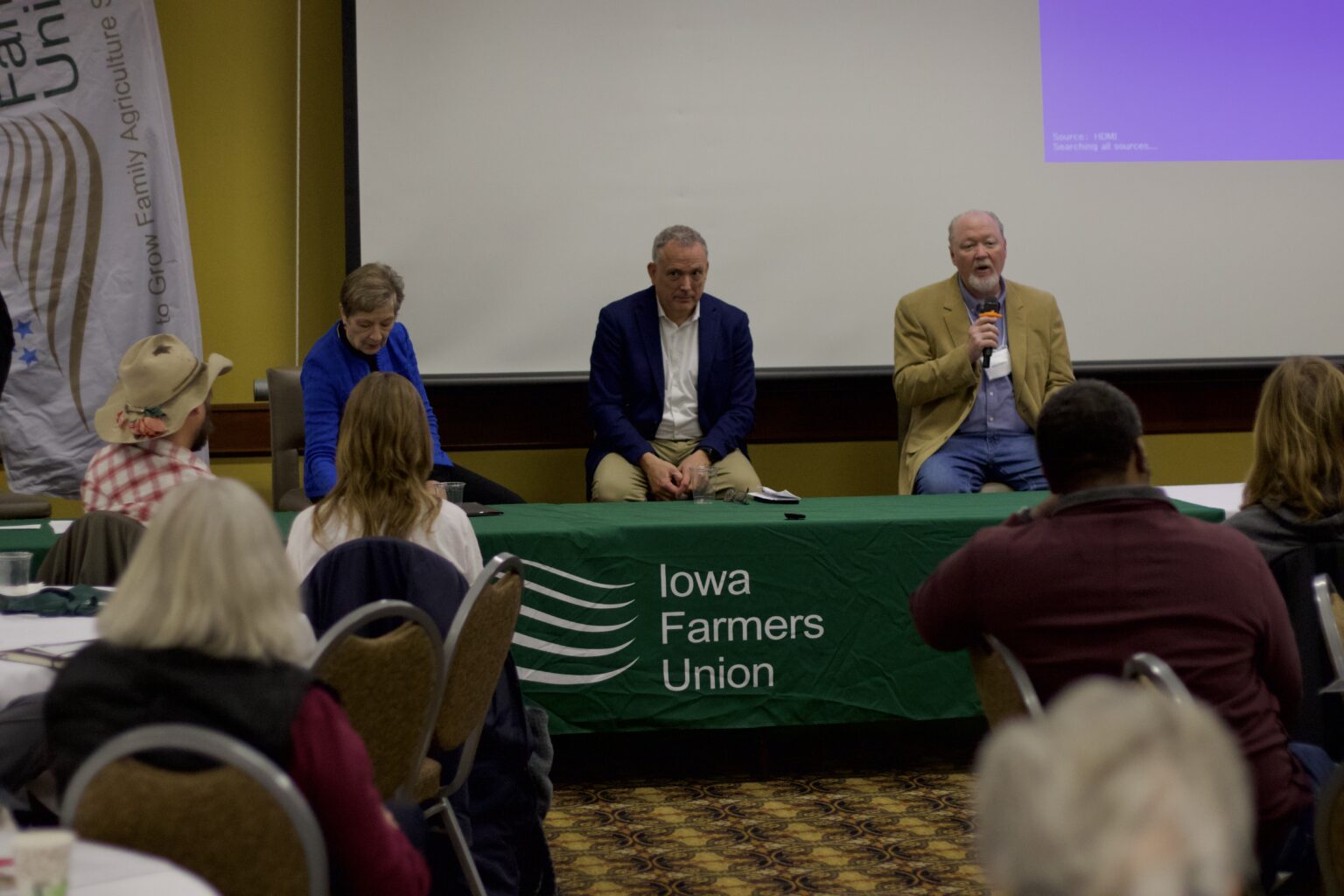
Panelists speak about the Farm Bill at the Iowa Farmers Union annual conference. From left are Cheryl Tevis, Rob Larew, and Chris Clayton. (Photo by Cami Koons/Iowa Capital Dispatch)
Larew spoke as part of the “Farm Bill Limbo” panel at the 2024 convention, titled “Fairness in Farming,” along with DTN Progressive Farmer Ag Policy Editor Chris Clayton and Cheryl Tevis, an ag-focused writer with the Iowa Writers’ Collaborative. The other panelists expressed similar concerns toward changes to agriculture policy that could come from the upcoming administration, including tariffs, mass deportations, decreasing the abilities of USDA, and the conflicting interests of Robert F. Kennedy, Jr., who is slated to run the Department of Health and Human Services and Brooke Rollins,who Trump plans to nominate as secretary of Agriculture. Tevis said she’s “not holding (her) breath” that Congress will agree on the “fragile marriage of convenience” that is the Farm Bill before the end of the year.
Before the panel, Iowa Farmers Union members shared stories of their participation in USDA programs, like cover crops subsidies, conservation easements, energy programs that allowed them to update freezers and install solar panels and local food procurement funding. Iowa Farmers Union President Aaron Lehman opened the Saturday sessions with an overview of the union’s accomplishments in 2024, including another year of membership growth consistent with what the union has seen over the past 12 years. Lehman commended union staff and members for their organized opposition to the sale of a nitrogen fertilizer plant to Koch Industries in the spring, a successful Farmers Union Day at the state fair and continued efforts to promote local food and conservation.
Lehman also highlighted the union’s efforts to oppose a lawsuit aimed at dismantling a federal provision that protects wetlands. Iowa Farmers Union, along with Iowa Environmental Council and several other groups, were approved Tuesday as intervenors in the lawsuit over the swampbuster provision. “We are responsible for those things being put into law,” Lehman said. “The Department of Justice and the USDA should be defending themselves when they are challenged … but it’s important for us to be there at the table too, because we’re not sure where this new administration will defend themselves.” Lehman championed union efforts at the Statehouse to secure “the first ever state-funded procurement of local food” which was accomplished in collaboration with the Iowa Food System Coalition.
Union members were invited to the local food policy summit on Friday to talk about the work of the Iowa Food System Coalition and 2025 plans to grow the Iowa local food economy. Lehman said union members can be “proud” that they were “the only farm group opposed to a pesticide liability shield for pesticide companies.” Lehman said the group plans to oppose the Bayer-led bill about pesticide labeling again in 2025. Lehman said there is much more to be done in the coming year. “We won’t get it just by working at the Statehouse,” Lehman said. “We have to work together in the countryside. We have to work at it around tables in our communities and on our farms in order to make a real difference from the ground up.”
(Radio Iowa) – The southern part of the state took a little longer to finish up the harvest this year compared to the north. Iowa State Extension field agronomist, Aaron Saeugling covers the southwest corner of the state, and says a wet spring is to blame. “Clearly, a lot of that was delayed planting. We had a pretty good stretch of rain in May, and so I had a lot of corn that was planted the last week of May, in the first two weeks of June, and so that delays harvest.” he says. He says a delay in southern counties has less of an impact that in the north. “We have a longer window in the fall than northern Iowa in terms of harvest. And so occasionally, if you have later higher moisture corn, they’ll kind of hold off combining,” Saeugling says. “So it’s not unusual for us to combine corn at Thanksgiving, and in northern Iowa, that’s they don’t like to do that, because Mother Nature can come.”
Saeugling covers Pottawattamie, Cass, Adair, Mills, Montgomery, Adams, Union, Fremont, Page and Ringgold counties. He says the late start and later harvest didn’t seem to impact harvest results. “You know, ironically, they still pulled some pretty good yields. There were isolated pockets, kind of depending on, you know, when the dry spell came through. I mean, we were, we were in the Drought Monitor at certain parts of the summer,” he says. “So depending if that corn was, you know, silken tasseling at the wrong time, those fields were probably impacted a little more than others, but I have other places that corn yields were exceptionally good.” Northeast Iowa saw a relatively wet summer, but I-S-U field agronomist Terry Basol says things dried out to allow for a quick harvest and dry crops.
“The moisture was low enough so that there wasn’t as much drying needed. That helped the economics, especially considering the lower commodity prices over the past few years. Every little bit certainly helps the growers,” Basol says. Basol says dry weather had a secondary impact as lower river levels impacted shipping. “There’s a fair amount of fertilizer that comes up from the Gulf to Iowa, Minnesota, and the other states along the river, so that’s another thing to keep an eye on, as well,” he says.
This marks the third fall in a row the southern Mississippi has been below average levels.
(Grant Winterer, Iowa Public Radio, contributed to this story.)
(Radio Iowa) – Iowa food pantries and food banks could lose a major source of food if the current Farm Bill isn’t extended. Michelle Book is C-E-O of the Food Bank of Iowa, which distributes food to pantries and other feeding organizations in 55 Iowa counties.
“Of 2.5 million pounds that we distributed in November, 1.25 million of that came from USDA,” Book says. “We have 37 trucks that will arrive at the Food Bank of Iowa to unload in December and 24 of those are USDA loads, so it’s critically important that we continue to be supported in that way by the USDA.”
The U-S Department of Agriculture provides about half of the food the Food Bank of Iowa distributes. Book says it’s not only canned fruits and vegetables, but meat, and sometimes fresh produce. “The USDA Commodity Food started in the 1980s with the blocks of orange cheese and today the variety of just astounding,” Book says. “Over the course of my time at the Food Bank of Iowa, we’ve received leg of lamb and white fish, a lot of frozen fruits and vegetables. We get a lot of dairy from the USDA.”
Book, who’s been C-E-O of the Food Bank of Iowa for nearly nine years, says she’s concerned budget-cutting talks in D.C. might lead to a new Farm Bill that provides less emergency food. “That food has proven to be, over the last few years, very healthy, nutritious food. It helps the food banks serve neighbors in need,” Book says. “It also helps our local agricultural producers as well, keeping prices up, but we are concerned that we’ll see a lack of USDA food coming our way in upcoming years.”
Book made her comments during an appearance this weekend on the “Iowa Press” program on Iowa P-B-S.
(Lewis, Iowa) – Cass County Conservation and the Iowa Bluebird Conservationists are once again hosting a Cass County Christmas Bird Count on Sunday, December 22nd. Spokesperson Chris Parks says those who want to participate in the count will meet at Cold Springs State Park in Lewis, beginning at 8-a.m. on Dec. 22nd. Participants will divide into groups that will cover different sections of the count circle.
Birders are encouraged to dress for the conditions and bring along binoculars and bird books if you have them, otherwise they can be provided. It is also suggested to either wear or bring along an article of blaze orange clothing for any birding that may occur in parks that allow public hunting, as it will be the final day of deer season.
The count will run until 3:30pm that day as a 15-mile diameter circle can be covered as thoroughly as possible. The groups will break and meet for lunch at Noon Dec. 22nd, at Pizza Ranch in Atlantic, to compare lists and reboot for counting in the afternoon. You are welcome to join for the whole day or just the morning or afternoon sessions. All abilities are welcome whether you are comfortable just birding from a vehicle and roadside or if you would like to walk through areas as well. Weather backup date will be determined if necessary.
Home birders may also contribute to the Cass County Count by watching their home feeder. Feeder counters will need to keep track of the time spent observing and will count the maximum number of a species seen at one time, not a cumulative for the day. Contact Chris Parks or Lora Kanning at Cass County Conservation if you would like to contribute and we will provide guidelines.
The Christmas Bird Count is a valuable research tool for the Audubon Society and is the nation’s longest running citizen-science bird project. This year is the 125th year of the count and the Cass County area is excited to join in again. Find more information on the Christmas Bird Count at www.christmasbirdcount.org. Parks says they would really love to know you are planning on coming ahead of time, so please reach out.
WASHINGTON — The U.S. Department of Agriculture announced Friday it will require dairy farms to share samples of unpasteurized milk when requested, in an effort to gather more information about the spread of highly pathogenic avian influenza. Public health officials have tracked the spread of bird flu or H5N1 in domestic poultry flocks for years before the virus began showing up in the country’s dairy herds this March, raising concerns. While the risk to the general public remains low and there is no evidence to suggest bird flu can spread from person to person, nearly 60 people, mostly farmworkers, have contracted the virus this year.
The new milk testing requirements from USDA will apply nationally but will begin first in California, Colorado, Michigan, Mississippi, Oregon and Pennsylvania, the week of Dec. 16. In a written statement Agriculture Secretary Tom Vilsack said “Among many outcomes, this will give farmers and farmworkers better confidence in the safety of their animals and ability to protect themselves, and it will put us on a path to quickly controlling and stopping the virus’ spread nationwide.”
Holstein milking cows at an Idaho dairy on July 20, 2012. (Photo by Kirsten Strough/USDA)
The U.S. Food and Drug Administration has repeatedly tested pasteurized milk on store shelves throughout the country to reaffirm it’s safe to drink. Other dairy products, like cheese and ice cream, have also been found safe. But the FDA continues to urge people against consuming unpasteurized milk, since it doesn’t go through the heating process that kills off viruses and bacteria.
(Lewis, Iowa) – The sponsors of the Cass County Conservation Board’s (CCCB) Trumpeter Swan arrival contest have determined the official arrival of the swans at the Schildberg Quarry in Atlantic, was December 1st! On that day 12 Trumpeter Swans were here and stayed more than twenty-four hours. The winner that was the closest to that date was Mary Brasfield! She will receive a Trumpeter Swan prize.
In October, the CCCB invited Cass County residents to predict when the first Trumpeter Swan will arrive at the Schildberg Quarry. Trumpeter Swans have visited the Schildberg Quarry for at least Twenty-five out of the last twenty-six winters. Last year, the swans arrived December 2nd.
Cass County Conservation thanks to all who participated in this year’s contest!
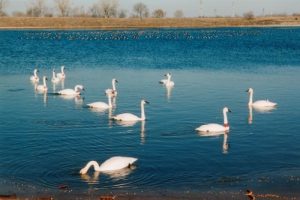
CCCB file photo
(Radio Iowa) – Iowa’s busiest hunting season of the year opens Saturday (Dec. 7), as some 100-thousand shotgun-wielding deer hunters will hit the woods and fields over the next few weeks. Megan Anderson, a trauma injury prevention coordinator at Gundersen Health System, says if it’s been a while since you’ve been hunting, you would likely benefit from brushing up on your safety skills.
All hunters should know rules like: When firearms aren’t in use, be sure they’re stored safely, locked and UN-loaded. Anderson says you should always know where other members of your party are located, and to let someone not with the group know where you are and when you’ll be back.
Especially during December, when the weather can quickly turn very cold and unpleasant, Anderson says proper clothing is vital.
Iowa has two deer shotgun seasons coming up. The first runs tomorrow through December 11th, while the second season runs December 14th through the 22nd. Gundersen Health System has clinics in Calmar, Decorah, Fayette, Lansing, Postville and Waukon, and a hospital in West Union.


 Facebook
 Twitter
 YouTube
 RSS
RSS