

CLICK HERE for the latest market quotes from the Iowa Agribusiness Network!
CLICK HERE for the latest market quotes from the Brownfield Ag News Network!


CLICK HERE for the latest market quotes from the Iowa Agribusiness Network!
CLICK HERE for the latest market quotes from the Brownfield Ag News Network!
ATLANTIC, IA (December 12, 2024) – Produce in the Park’s Christmas Market is being held at the Nishna Valley Family YMCA (1100 Maple St. Atlantic, IA 50022) on Saturday, December 21 from noon to 3:00 PM. There is no cost to enter Christmas Market. During the market, kids can enjoy free bounce houses inside the YMCA, and Zipp’s Pizzaria will be selling pizza in the YMCA’s parking lot.
This holiday farmers market is held just days before Christmas so shoppers can celebrate with local foods, decorations, and gifts. Christmas Market will offer lots of local vegetables including fresh greens, potatoes, squashes, sweet potatoes, carrots, and spinach, as well as honey, beef, pork, lamb, chicken, and farm-fresh eggs. The holiday market will also offer Christmas cookies, gourmet cupcakes, kringle, and other baked goods and desserts.
In addition to local food, Christmas Market offers shoppers an opportunity to purchase local and handmade holiday decor and gifts. Shoppers can expect to find candles, soaps, crocheted toys, earrings, artwork, lavender products, wood crafts, seasonal hand towels, and more.
Vendors at Christmas Market 2024 will include:
● Food Truck: Zipp’s Pizzaria
● Bridgewater Farm – Lots of produce including greens, sweet potatoes, squash, carrots,
kale, mixed greens, and cilantro, farm-fresh eggs, beef, pork, pasta sauce, salsa.
● The Eye of Nebula – Baked goods including cookies and muffins, canned jellies, crochet
toys, candles, soaps, and skincare products
● Wings of Love Sweetly Crafted – Cinnamon rolls and dessert breads, reusable paper
towels, wipes, and burp cloths, and other various crafts
● Frosting Inc. – Gourmet cupcakes, peanut butter balls, and other baked goods
● KookieNow with Mrs. Phippen – Christmas Cookies in Triple Chocolate Mocha
Peppermint and White Chocolate Peppermint
● Paige’s Pieces – Earrings, signs, car hangers, keychains
● Brun Ko Farm – Chicken, lamb, eggs, butternut squash, sweet potatoes, spinach, spring
mix, garlic, honey, Gift Baskets
● Juj’n Juj’n and Mike Souder Original Art – Leather work, artwork
● Ter-Bear Honey – Honey
● The Kringleman Pastries – Danish kringle, Danish letters, eclairs, krispies, cream
horns, and other pastries
● J.W. Lavender Farms at Quakerdale Farms – Lavender plants, bags, and bundles, as
well as pillow sprays, candles, soaps, and more
● Imagine Garden Gift – Holiday decor and gifts
● Dragonfly Creations – Candles, soaps, crafts, and artwork
● RaMakes Home Decor – Seasonal decor, wood products, towels
● She Shed Designs – rustic home decor, purses, signs, dishcloths, repurposed antiques
● A Witch Crafts – artwork and crafts
● Resin for Reason – Resin art, keychains, magnets, jewelry, trays, jars, and more
● Jackalope Custom Design – Car coasters cups pens ornaments
● 6 Sisters Creations – Christmas candy, Christmas crafts, and chalk painting art
As with all Produce in the Park farmers markets, local organizations will be at the farmers market sharing information. Cass County Tourism will have a booth with a “Winter Recreation” theme, and Healthy Cass County will be sharing resources from various community organizations.
All Produce in the Park farmers markets accept SNAP EBT, otherwise known as food stamps, for all qualifying food items.
Christmas Market 2024 is sponsored by Atlantic Area Chamber of Commerce, Cass County Tourism, Cass Health, City of Atlantic, First Whitney Bank & Trust and Nishna Valley Family YMCA.
Produce in the Park continues to accept vendor applications for Christmas Market, and additional holiday markets planned for winter 2024-2025. Vendor applications can be found online at www.ProduceInTheParkAtlanticIowa.com; printed copies of the application are available at the Atlantic Area Chamber of Commerce (102 Chestnut St., Atlantic, IA 50022).
Produce in the Park seeks vendors selling handmade or homegrown products, including local foods, as well as beauty products, candles, crafts, art, and decorations. For the latest information on Christmas Market, and all Produce in the Park markets, follow Produce in the Park on Facebook (www.facebook.com/ProduceInThePark) or Instagram (https://www.instagram.com/produceintheparkatlanticia/.
(Radio Iowa) – The Iowa D-N-R reports the number of deer taken in the early archery and other seasons was down about five percent leading into the first gun season. The D-N-R’s Pete Hildreth says early gun totals are looking good. “During the first four days of the 2024 gun one seasons. So that’d be December 7th through the 10th, we had approximately 24-thousand-600 deer harvested and reported statewide,” Hildreth says. He says that’s a slight increase.
“That is a four percent increase of the season prior, and about two and a half percent higher than the five year average,” he says. Hildreth is the Conservation and Recreation Division administrator, and spoke during the Natural Resources Commission meeting. He says hunters in eastern Iowa have seen the best success.
“Eastern Iowa is showing strong harvest rates relative to past years, whereas much of western Iowa is lagging considerably,” he says. Hildreth says the lower deer totals in western Iowa are due to the impact of Epizootic Hemmorrhagic Disease or E-H-D on deer. Hildreth says they confirmed another disease in three new counties during the first shotgun deer season. Davis, Wapello and Shelby counties all had deer samples that tested positive for chronic wasting disease for the first time.
There are now 26 of the 99 counties with confirmed C-W-D cases, and 14 of those counties have only one confirmed case. “Unfortunately, nine of those counties with one detection have come online just since 2023, meaning that C-W-D is moving across our landscape, but not necessarily taking root,” Hildreth says.
The second gun deer season starts on Saturday.
(Radio Iowa) – Many Iowans already have big plans for New Year’s Eve, so the Iowa Department of Natural Resources is suggesting anyone who loves the outdoors to take part in an event on New Year’s Day. Sherry Arntzen, chief of the D-N-R’s Parks, Forests and Preserves Bureau, says what are known as First Day Hikes are being held on January 1st at dozens of Iowa’s state parks. “It’s just a fantastic way for people to get out and start the year,” Arntzen says. “Everybody makes New Year’s resolutions, and if one of them is to get healthy, why not go out and enjoy getting healthy in our state parks?” The First Day Hikes tradition started in Iowa in 2012 as a way of launching the new year with a new outlook on the outdoors and getting healthy.
Arntzen says participants are surrounded by the quiet beauty of nature in winter, and they experience spectacular views, beautiful settings and the cultural treasures offered by Iowa’s state parks. “A lot of our parks, people don’t realize, are open year-round,” Arntzen says, “weather, obviously dependent for road conditions, but it’s a great way to get out and enjoy the outdoors in the off-season when people don’t typically think of going outside.” First Day Hikes are being offered in 45 of Iowa’s state parks on the first day of 2025, and there are essentially two different types of hikes. “This year, we have 19 parks that are offering hosted guided hikes. They have a meeting area, and you actually tour along with either a park person or a friends group member,” Arntzen says. “A number of them have refreshments available, hot cocoa or snacks, and it starts at a designated time.”
The other 26 hikes are self-guided and while most of them are just one or two miles, some are longer, depending on the location. Find full details here: www.iowadnr.gov/firstdayhikes
(Iowa DNR News) – Iowans can buy 2025 resident hunting, fishing and other licenses on Dec. 15. Licenses purchased for 2024 expire on Jan. 10th. The menu of license options includes the popular Outdoor Combo annual resident hunting/fishing/habitat combo license for $55; the Angler’s Special three-year fishing license for $62; and the Hunter’s Special three-year hunting license with habitat included for $101.
Also available is the Bonus Line option for $14 letting resident and nonresident anglers to fish with one more line in addition to the two lines allowed with the regular fishing license. Upgrade your paper license to a durable hard card with custom art from Iowa artists for only $6.
Download the GoOutdoorsIowa mobile app for iPhone and Android devices to buy and access your license information, no matter where you are. Sync your hunting and fishing licenses on the app to show in the field. You may download multiple customer licenses to offer one secure digital license document location for families, groups, and more.
Licenses are available at 600 locations across the state, and on the DNR website at www.iowadnr.gov/GoOutdoorsIowa.
The Iowa DNR says “Hunting and fishing are often enjoyed with family and friends. A fishing or hunting license makes a great stocking stuffer. “
WASHINGTON – U.S. Senator Joni Ernst (R-Iowa) and U.S. Rep. Randy Feenstra (R-Iowa) today (Wednesday), called for the U.S. Coast Guard (USCG) to support commerce on the Missouri River instead of removing 36 of its Aids to Navigation (ATONs) north of Blencoe, Iowa.
Navigation on the Missouri River is an integral part of moving Iowa’s inputs and goods both domestically and worldwide. In recent years, navigation up to Sioux City, Iowa has increased, and planned development projects are expected to further increase traffic in years to come.
“In Iowa, we are proud to feed, fuel, and supply consumers around the globe with products straight from the heartland. Our beautiful rivers are integral to sharing those products with the rest of the world.” said Senator Ernst. “The removal of this infrastructure on the Missouri River threatens the livelihoods of Iowans in our manufacturing and agricultural communities. I urge the Coast Guard to reconsider this decision.”
Read the full letter here.
(Radio Iowa) – The Washington County Board of Supervisors has unanimously approved the first reading of an ordinance that restricts where wind turbines could be built. The vote came Tuesday following a public hearing on the issue Monday. Washington County farmer Greg Coch told K-C-R-G T-V that he supports the ordinance. ”It gives a lot of different people a voice cause a lot of people don’t want them. They don’t want them in their view-scape. They don’t want them in their environment and it gives those people an opportunity to have more of a setback than you would ordinarily see,” Coch said at the public hearing. Coch urged supervisor to pass the ordinance at their meeting Tuesday. Linda Boston was raised on a farm and told K-C-R-G T-V that she’s against the ordinance.
“It’s really not going to help us here immediately, it just helps in the long run. Our carbon footprint. And shouldn’t we be concerned about having the most healthy environment that we can for our world?” Boston said. The ordinance requires a guarantee that new wind turbines would not impact the value of any property within two miles. It also require turbines to be at least one mile away from most gathering places such as schools, libraries, and churches unless there is a written agreement. Supervisor Jack Seward Junior spoke about the ordinance before the vote. ”In my estimate, the whole basis for the industry as it exists today is a political push adopted by “big government” intending to fight “climate change” by removing carbon fuels from the economy,” Seward said. Supervisor Bob Yoder also expressed doubts about the turbines.
“They talk about green energy and I don’t think it’s as environmentally friendly as what they’re billed to be,” Yoder said. Supervisor Marcus Fedler says ordinance provides a way for both sides to give their input. ”So I’m looking forward to hearing from the people and let the people that want these, they still have to provide a reasonable reason why we should discriminate against other folks that don’t have a seat at the table,” Fedler said.
The Washington County Supervisors need to approve the ordinance two more times before it passes.
(Radio Iowa) – American Farm Bureau president Zippy Duvall is warning there may be collateral damage in rural America if President-elect Trump follows through on mass deportations and increases tariffs. Duvall is in Des Moines for the Iowa Farm Bureau’s annual meeting. “We really need this new administration focused on trade,” Duvall says. “I know that the new administration’s talking about tariffs. We don’t support tariffs. We know that when tariffs are put on that other countries take it out on agriculture and we’re real fearful of what might happen in that area.”
The first Trump Administration paid American farmers 28 BILLION dollars in so-called trade disruption payments to compensate for China’s retaliation to Trump’s tariffs. Duvall says expanding ag exports would help farmers get past the financial strain of inflation. Duvall, who spoke to reporters in Des Moines for nearly half an hour, says the Farm Bureau is very interested in learning the details of Trump’s plan to deport people who entered the country illegally.
“A lot of workers across this country are undocumented that’s working on farms, because there’s no other people who want to do that work,” Duvall says, “and so we’ll be working with the administration to try to make sure that we don’t harm the food system in our country and harm our rural communities and our farmers and ranchers as we move forward.”
A recent U-S Labor Department survey found about 44 percent of American farm workers are undocumented immigrants. Duvall says no one wants criminals from other countries here, harming U-S citizens, but he says the Farm Bureau will argue against deporting migrants who are critical to the ag economy. “What we’re planning on doing is making sure that we take that seat with the president and making sure he understands how valuable this workforce is to our farmers and ranchers,” Duvall says, “and make sure that we try to minimize the collateral damage that might go on in that area.”
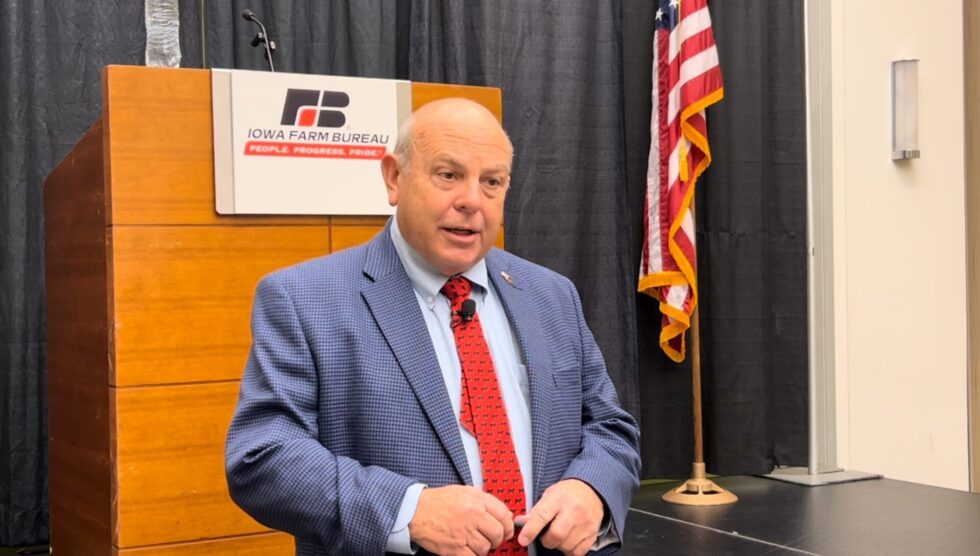
American Farm Bureau president Zippy Duvall spoke to reporters at the Iowa Farm Bureau’s annual convention on Dec. 10, 2024. (Photo by Brent Barnett/Brownfield)
Duvall says there may be an opportunity reduce regulations on farmers once Trump takes office and the Farm Bureau is lobbying for the total elimination of the federal inheritance tax. Duvall says he’s extremely disappointed a new Farm Bill has stalled, again, in congress. “We right now are focused on not just pushing for a modernized Farm Bill, but pushing for disaster and economic payments,” Duvall says, “to try to bind our farmers over until we can get a new Farm Bill passed.”
Duvall is a farmer from northern Georgia. On Monday, he drove through areas of his state that were hit by Hurricane Helene in late September. “It looks like a bomb went off for 100 miles,” Duvall says. “I mean it’s really, really bad and the crops that were destroyed, the barns that were destroyed, homes and lives that were lost — it really was difficult to look at when you ride up through there.”
Duvall says just about every part of the country has seen some form of natural disaster this year and congress needs to provide disaster assistance to farmers A-S-A-P. Duvall has been the American Farm Bureau’s president since 2016. He’s the keynote speaker at this week’s Iowa Farm Bureau convention.
(Iowa News Service) – A small turtle made popular in the “Kung Fu Panda” movies could soon be added to the endangered species list. Iowa wildlife advocates are working to restore it to its native habitat and give the turtle a better chance for survival. The Blanding’s turtle is popularized in the long-running, lighthearted animated movies but its fate is anything but funny. The U.S. Fish and Wildlife Service will decide in coming months whether to list it on the endangered species list. Officially, fewer than 3,000 Blanding’s turtles are left in Iowa.
Karen Kinkead, Wildlife diversity program coordinator for the Iowa Department of Natural Resources, said they are a cryptic species and hard to count but are easy to identify when you spot one. “They’re kind of this drab, olive green-grey color. Their shell is shaped kind of like a helmet. They are sort of nondescript,” Kinkead outlined. “But then you see this bright yellow chin and the way that their lower jaw is formed it makes it look like this is an animal that is always smiling.”
Decades of habitat loss and predation have already put the Blanding’s turtle on the threatened list in Iowa. A partnership between the state DNR, Iowa State University and the Blank Park Zoo in Des Moines just hatched nearly five dozen baby Blanding’s turtles researchers will raise until adulthood, then tag with telemetry gear to track them in the wild.
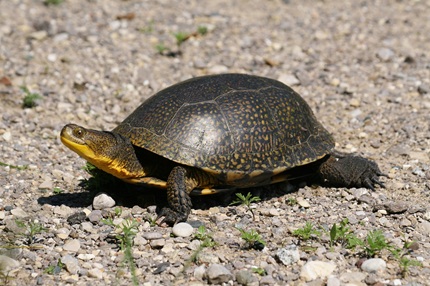
Endangered Blandings Turtle in the wild
Kinkead pointed out the zoo is “head-starting” the turtles by hatching and keeping them in the zoo over the winter, instead of allowing them to hibernate. “They keep them awake and keep feeding them so they grow larger,” Kinkead explained. “Then when they’re released into the wild the next summer, they’re a bigger size.”
Kinkead added being bigger and more mature makes the turtles less vulnerable to predators once they are released.
A new report analyzed nearly 200 manure spills into Iowa waterways from 2013 to 2023 and found the majority occurred in counties with the highest concentrations of animal feeding operations. The Iowa Capital Dispatch says the report, released Monday by Food and Water Watch, builds on an earlier report from the environment-focused nonprofit that found livestock operations in Iowa produce more than 100 billion pounds of manure each year, the most out of any state in the country.
Northwest Iowa had “particular spill concentration” according to the report, which coincides with findings from the Factory Farm Nation report that found the same region was home to “extreme factory farm concentration.” The report analyzes discharge enforcement reports from the Iowa Department of Natural Resources, which over the 10-year period reported 179 instances of manure discharge in amounts ranging from 500 gallons to 1 million gallons, though not all instances listed an amount. The interactive map associated with the report shows 10 “repeat violators” or farming operations that had multiple spills recorded over the period. Four of the repeat violators are in the northwest region. 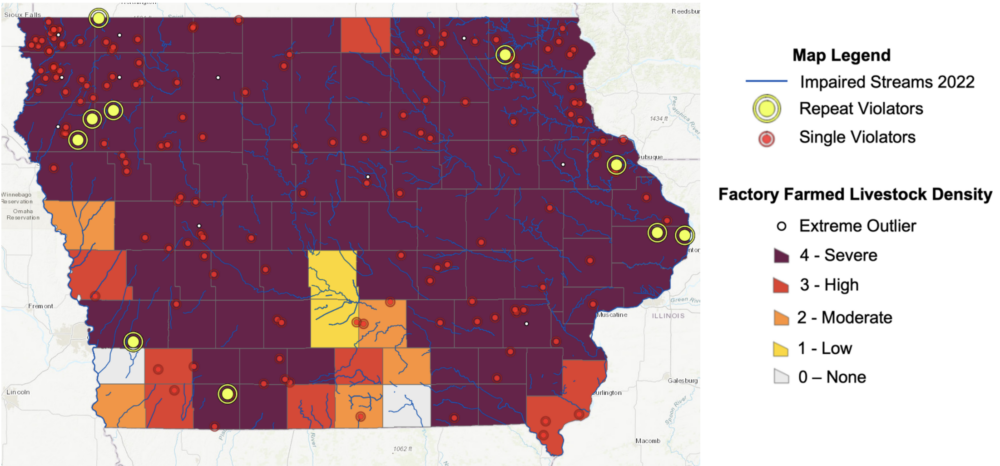
Food and Water Watch estimates the actual number of spills is much higher, since the producers themselves are required to report spills, which the report calls a “clear conflict of interest.”
“This is NOT a comprehensive map of factory farm spills that occurred in Iowa over the study period,” the report said. “For this reason, this map and accompanying report almost certainly undercount the true cost of factory farm spills into Iowa waterways.”
The report also noted more than 4,000 animal feeding operations in Iowa do not have National Pollutant Discharge Elimination System permits. These permits, which regulate entities that discharge pollutants into U.S. waters, are only required on animal feeding operations of a certain size, or with other specific conditions, per the federal Clean Water Act.
Food and Water Watch Iowa Organizer Michaelyn Mankel urged the state to implement more stringent regulations. “Corporate polluters must be held accountable for soiling our water — Iowa legislators must pass the Clean Water for Iowa Act to boost pollution monitoring and ensure accurate fines at factory farms,” Mankel said in a statement.
According to the report, farm operations with recorded spills have been fined less than $730,000 cumulatively, over the 10-year reporting period, despite a reported nearly 2 million fish killed. Mankel called the enforcement penalties “barely a slap on the wrist.”
Eldon McAfee, on behalf of Iowa Cattlemen’s Association and Iowa Pork Producers Association, said the organizations “need more time to review the information used in the analysis,” but plan to review the report.


 Facebook
 Twitter
 YouTube
 RSS
RSS