

CLICK HERE for the latest market quotes from the Iowa Agribusiness Network!
CLICK HERE for the latest market quotes from the Brownfield Ag News Network!


CLICK HERE for the latest market quotes from the Iowa Agribusiness Network!
CLICK HERE for the latest market quotes from the Brownfield Ag News Network!
(Des Moines, Iowa) – Gov. Reynolds today (Monday) authorized a disaster proclamation for O’Brien County, Iowa effective immediately through March 5, 2025. The U.S. Department of Agriculture has confirmed a positive case of highly pathogenic avian influenza (HPAI) in commercial layer chickens.
This proclamation allows state resources from Iowa Homeland Security, the Iowa Department of Agriculture and Land Stewardship, and other agencies to assist with tracking and monitoring, rapid detection, containment, disposal, and disinfection. The proclamation also waives regulatory provisions related to commercial vehicles responding to affected sites. 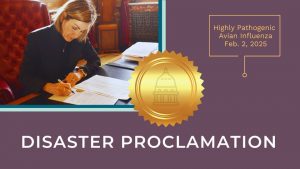
The recent HPAI detections in birds do not present an immediate public health concern, and it remains safe to eat poultry products. If producers suspect signs of HPAI in their flocks, they should contact their veterinarian immediately.
(Atlantic, Iowa) – The Iowa Department of Natural Resources is hosting a series of public meetings to discuss the past hunting and trapping season and possible rule and regulation changes to the sports. The meetings will be in locations across the state from Feb. 17th through the 20th. This past weekend on KJAN’s Conservation Report, Cass-Adair County Conservation Officer Adam Gacke says during the meetings, biologists generally come out to provide an update specific to each area in the state.
In this area, meetings will be held in Mills and Union Counties.
Gacke says they’re hoping to have a good turnout at those and other meetings across the State.
Comments collected from the meetings will be presented to the Natural Resources Commission and will be considered by DNR before it proposes any changes to hunting or trapping regulations.
Again, those area meeting locations and dates are:
In other outdoor news, Gacke says persons wanting to go ice-fishing need to be aware that with the recent heat wave, ice conditions are variable, and can be dangerous.
The Iowa DNR reported nine OHV/ATVs broke through the ice late last month – seven at the Iowa Great Lakes on the Minnesota border, and two at Lake Rathbun, on the Missouri border. Fortunately, no injuries were reported. Gacke says where you start onto a lake or body of water can be completely different from where you intend to set-up your ice-fishing equipment.
Officials with the Iowa DNR announced in January, the agency sold more than 300,000 hunting, fishing or combination annual licenses to Iowa residents in 2024 and nearly 50,000 annual fishing, hunting or combination licenses to nonresidents. The figures do not include shorter time period licenses, lifetime licenses or specific season licenses. Annual licenses for 2024 expired Jan. 10, and Iowa’s final deer seasons wrapped up Jan. 19, which according to DNR’s harvest report, more than 101,000 deer were harvested in 2024. This was close to the totals for 2023, which reached 104,000 deer.
DNR asked the public to help collect samples throughout the hunting season to monitor for chronic wasting disease. The department collected more than 5,000 samples from deer across the state during the 2024-2025 deer seasons and confirmed 51 wild deer were positive for the disease that is fatal to deer. The department increased the number of samples it gathered in 2024 after confirming the disease in 128 wild deer in 2023. The 2024 figures are close to what the state saw in 2021, according to the DNR interactive database.
(Radio Iowa) – A series of workshops will be launched this week that are designed to teach Iowans how to extend the habitat for monarch butterflies and other pollinators. Liz Ripley, an outreach specialist at the Iowa Learning Farms on the campus of Iowa State University, says the four workshops will be held in four different areas of the state during February and March — and they’re all free. “So it’s open to anyone who would like to attend. We’d like to see a good mix of farmers, landowners and urban residents,” Ripley says. “When it comes to creating more habitat, we need everybody at the table. Obviously, the largest portion of our land here in Iowa and across the Corn Belt is in agricultural production, so definitely trying to reach a lot of farmers and landowners.” Like farmers, Ripley says pollinators help ensure the world eats. Studies find about 75% of the world’s flowering plants and about 35% of the world’s food crops depend on pollinators. That’s why the workshops are important, she says, as all Iowans can play a role.
“It’s an opportunity to learn a little bit more specifically what the monarchs as an indicator-pollinator species need and desire for their habitat and survival,” she says, “but also the role they play when it comes to our ability to grow things, not only here in Iowa, but across the Midwest and Corn Belt.” Iowa is in the middle of the annual monarch commute lane as the orange-and-black insects made the incredibly long journey. Experts can establish their population counts by the number of acres occupied when they overwinter in Mexico, and the numbers have fallen drastically in the past 20 years. “They can estimate the number of monarchs based on how much area that they cover each winter, and that does ebb and flow depending on different survival rates from the year prior,” Ripley says. “We have seen that continued steady decline of these monarchs, and a lot of that has been driven by habitat loss along their migratory journey north and south each year.” She says the workshops will provide Iowans with an opportunity to learn more about monarchs and how to integrate additional pollinator habitat into the state’s landscape.
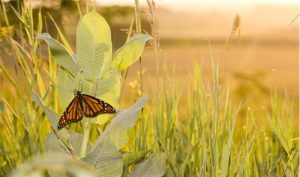
Photo courtesy of the Iowa Monarch Conservation Consortium
“These workshops are going to be held February 6th in Ames, February 11th at Storm Lake, March 11th in Fairfield, and March 18th in Coralville,” she says, “and if you’re interested in joining us, we just ask folks to RSVP to help us make sure that we have enough food on hand for the complimentary meal that’s included with each of these workshops.”
To RSVP, contact Ripley at 515-294-2473 or ilf@iastate.edu.
(Radio Iowa) – State and federal officials announced this weekend that bird flu had been confirmed in a commercial flock of 240-thousand layer hens in northwest Iowa’s O’Brien County. Governor Kim Reynolds has recommended an additional half a MILLION dollars in state spending to support development of vaccines for bird flu and other foreign animal diseases.
The current outbreak of avian influenza began three years ago and the first human case of bird flu in the United States was identified in April of last year. In December, state officials reported the first human case in Iowa, in a person who worked in a commercial poultry operation. In a recent Radio Iowa interview, Reynolds said figuring out how to best mitigate transmission of the virus is key. “Think about it going from birds to hogs,” Reynolds said.”I mean just this past year it went to dairy. It’s scary the impact it could have not only on the food supply chain, but just to people as well.”
Governor Reynolds says the National Veterinary Service Lab in Ames is playing a critical role in confirming cases quickly, so current mitigation strategies can begin. When bird flu is confirmed in poultry, the birds are euthanized. “It’s been devasting what it’s done to our producers here in the state,” Reynolds says. A decade ago, over 30 million birds in Iowa poultry operations were euthanized during the previous outbreak of bird flu. Since March of last year, the virus has been detected in 12 commercial flocks in Iowa.
“I don’t want to see another epidemic like we dealt with before,” Reynolds said. In 2024, state and federal officials confirmed cases of bird flu in 13 Iowa dairy herds. Dairy cattle with signs of bird flu are segregated from the rest of the herd and the majority of the cattle recover from the virus.
(Iowa News Service) – Environmental advocates in Iowa want state lawmakers to tighten regulations on large livestock feeding facilities, which they say will help protect the state’s air and water. They say right now, Iowa is headed in the wrong direction. The group Iowa Food and Water Watch has a list of priorities for the 2025 Legislature – from opposing legislation that could limit pesticide companies’ liability, to protecting ground and surface water from the 4,000 large animal feeding operations in the state.
Food and Water Watch Iowa Organizer Jennifer Breon said cleaning up Iowa’s drinking water is at the top of the list – by requiring those operations to adhere to the U.S. Clean Water Act. “Only 4% of Iowa’s CAFOs or factory farms have Clean Water Act permits,” said Breon, “and Iowa has more factory farms than any other state.” Livestock industry operators say they are always balancing efforts to be more environmental friendly with the need to keep up with consumer demand for meat products.
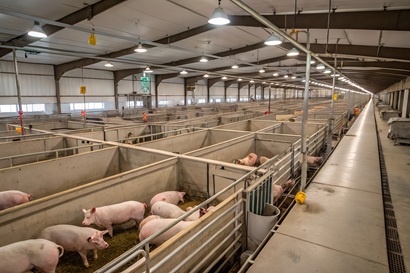
A Confined Animal Feeding Operation (CAFO).
Beyond polluting the air, ground, and surface water near CAFOs, Breon said the 109 billion gallons of manure produced by Iowa’s factory farms every year is threatening the state’s recreational opportunities. “It’s impossible to swim in the lake in Iowa in the summertime frequently, because of E. coli and algae blooms,” said Breon. “Our state is forced to issue warnings about beach closures, pretty much all summer long.”
An analysis by Food and Water Watch found that Iowa’s factory farms have been fined less than $750,000, despite multiple citations for water pollution over a decade.
(Radio Iowa) – Today (Friday) is former Governor Terry Branstad’s last day as president of the World Food Prize. “But I intend to still be involved as a volunteer and I want to do what I can to help,” Branstad says. Branstad says one of his accomplishments has been reconnecting the World Food Prize with the work of Nobel Peace Prize winner Norman Borlaug, the agricultural scientist who founded the World Food Prize in 1986.
“We’ve taken the staff and many other people up to see the Borlaug farm where he grew up in Howard County and we were in Mexico this year, next year we’re going in India and the year after to Africa, tracing where Borlaug did a lot of his research.” Branstad, who turned 78 this past November, grew up on a farm near Leland. He served nearly 22 and a half years as governor — the longest tenure ever for an American governor. He was the nation’s oldest governor in 2017 when he left office to become U-S Ambassador to China. When he was first elected governor, Branstad was just 36 years old — the nation’s youngest governor.
“It was a difficult year, 1982,” Branstad said. “Interest rates nationwide were over 10%. They were 8.3% in Iowa. We were at the onset of the Farm Crisis and it was a very challenging time. I was running against a very capable opponent: Roxanne Conlin.” Branstad left office in 1999 after four terms as governor and became president of Des Moines University in 2003. “The challenge was I was not an academic and I was not a doctor, so I was immediately suspect from the faculty,” Branstad says, “but I won them over.”
Branstad says he had an “open door” policy in his office and started eating lunch in the school’s cafeteria. When he returned to the governor’s office in 2011, Branstad periodically ate in the statehouse cafeteria. Branstad has basic advice for people who want to enter politics. “First of all, you want to treat everyone with respect and dignity, so you want to treat people well,” Branstad says. “You also want to build (friendships.) I found internationally that is very important.” Branstad was U-S Ambassador to China from mid-2017 to the fall of 2020.
“It was a great experience and the Chinese people are nice people,” Branstad says. “Even though we have really big differences with their political system, we also have great respect for their work ethic, their commitment to education, and their friendliness and hospitality.”
Branstad says the contacts he made as a U-S ambassador were an asset in his work at the World Food Prize.
(Radio Iowa) – Two former Iowa governors are meeting for lunch today (Wednesday) to discuss the past and the future of the Des Moines-based World Food Prize. Democrat Tom Vilsack, who served two terms as Iowa’s governor, will become the organization’s C-E-O on March 1st. Republican Terry Branstad, elected to six terms as governor, has been president of the World Food Prize Foundation for the past two years. Branstad also served as U-S Ambassador to China and he says the foundation has made a good choice.
“I’m really excited about another former governor, somebody that understand agriculture,” Branstad said. Vilsack served 12 years as U-S Secretary of Agriculture during the Obama and Biden Administrations. Branstad served as U-S Ambassador to China during the Trump Administration and he says Vilsack’s international connections will be invaluable. Branstad says he and Vilsack have worked together on a number of projects and issues and he’s ready to pass the baton to Vilsack.
“He’s been a great supporter of the World Food Prize,” Branstad says, “and the thing I like about it from the very git go, we’ve had broadbased bipartisan support.” The Iowa legislature annually provides some funding for the World Food Prize, which hosts a symposium each October in Des Moines that draws dignitaries as well as reearchers and ag industry experts from around the globe. The World Food Prize is mainly supported, though, by donations by individuals, corporations and other foundations. Each year a World Food Prize laureate is recognized — and awarded a half a million dollar prize.
(Radio Iowa) – The unseasonably warm weather we’re having is likely going to put an end to the ice fishing season in most of Iowa. D-N-R spokesman Mick Klemesrud says it hasn’t been a great season up to this point either. “We had a lot of places, including on the Iowa Great Lakes, like on Big Spirit Lake, where we had open water. There’s a pocket of open water, it seemed like it would just never freeze over,” Klemesrud says. “And now that we’ve got these warmer temperatures and these high winds, it’s starting to chew up a lot of the existing ice and making some pretty tenuous situations up there.” He says continued days of above freezing temperatures make more and more ice disappear.
“Southern Iowa is going to be, the ice fishing season is probably going to be over by this weekend if the forecast holds. And in places like central Iowa, Big Creek Lake had an open pocket on it that didn’t freeze all winter and so that’s going to expand and chew up some ice and work Twin Lakes, same thing. Three mile and 12 Mile (Lake) had open water on them and it’s just kind of the same scenario,” he says. There are a few areas in north Iowa where the ice is still nice for fishing. “Clear Lake’s get good ice, there’s parts of Spirit Lake that have good ice, you just have to kind of avoid those open water areas,” Klemesrud says. He says you should do a little research on ice conditions before you head out. 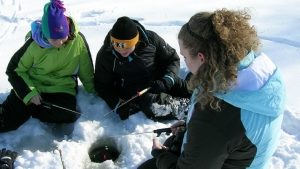
“There’s a lot of good resources online. There’s a lot of good social media networks out there where people post how they did fishing, what they’re catching, where they’re going, that sort of thing,” he says. Klemesrud says remember the safety guidelines wherever you go to ice fish. “Check the ice often, don’t go alone, give yourself a big buffer around any open water. Bring a throwable flotation device and about 50 feet of rope, the worst case should happen,” Kelmesrud says.
Klemesrud says they had reports of nine Off Highway Vehicles or A-T-Vs breaking through the ice. Seven were at the Iowa Great Lakes and two were at Lake Rathbun. He says they were lucky there were no injuries reported.

 Facebook
 Twitter
 YouTube
 RSS
RSS