

CLICK HERE for the latest market quotes from the Iowa Agribusiness Network!
CLICK HERE for the latest market quotes from the Brownfield Ag News Network!


CLICK HERE for the latest market quotes from the Iowa Agribusiness Network!
CLICK HERE for the latest market quotes from the Brownfield Ag News Network!
(Iowa News Service) – Groups working to protect Iowa’s air and water rally at the State Capitol this (Monday) afternoon, against a bill they say would protect pesticide companies from lawsuits if their products make people sick. Iowa Senate Study Bill 1051, the so-called Cancer Gag Act, “provides defense from civil liability tied to the use of pesticides,” as long as their labeling meets Environmental Protection Agency standards – which can be 15 years old.
Iowa Food and Water Watch Central Iowa Organizer Michaelyn Mankel said the measure would essentially change the law to protect pesticide companies from accountability, in a state that’s already seeing a “public health crisis.”
“We have rising cancer rates,” said Mankel. “We’re the only state in the nation where incidents of cancer are increasing, and we rank second in the nation for rates of cancer.” The International Agency for Research on Cancer has said that glyphosate is “probably carcinogenic to humans,” but the EPA says there’s no evidence to supports that. Pesticide makers – including Bayer, which has four lobbyists in Iowa alone – have said they’re following current law and need protection from what they deem frivolous lawsuits, and this bill would provide that.
But Mankel said the measure would further erode Iowans’ ability to take legal action if they think these products caused health problems. “This is not a matter of stopping frivolous lawsuits,” said Mankel. “It’s a matter of not robbing Iowans of the only avenue we have to hold the pesticide industry accountable at a time where we’re really suffering.”
The rally at the Capitol will begin with an altar ceremony to memorialize Iowans who have died from cancer, many of whom advocates say were deaths related to pesticides.
(Radio Iowa) – A new fuel testing laboratory will be dedicated this (Friday) afternoon near the Fort Dodge campus of Iowa Central Community College. Iowa Central President Jesse Ulrich says the work started there 20 years ago when they first began testing biodiesel in truck engines. “What that led to was a smaller lab that was on our campus in our Biohealth and Science Building, and then we’ve really just outgrown that space,” Ulrich says. “We have major contracts with most major gas stations across the country, and specifically here in Iowa.”
The Fort Dodge lab is where fuel from all over the state is put through a battery of tests. “What that means for the average Iowan is, when you pull up to the gas tank and you see ’87’ and then you see some specific numbers underneath of there in the fuel,” Ulrich says, “we’re actually double-checking those numbers to make sure that they’re accurate and make sure that the fuel you’re putting in your tank is the best, highest grade fuel that it can be.”

Radio Iowa file photo
Ulrich says Governor Kim Reynolds and Iowa Ag Secretary Mike Naig plan to attend the dedication at the new facility, which has an additional 10,000 square feet of testing space. “We received a $2-million grant through the Department of Ag to do new tests on engines,” he says, “and part of the testing engine capabilities will allow us to be able to test aviation biofuel, which obviously is the new wave coming across America, and hopefully an up-and-coming fuel source for Americans, and something that will keep biofuel alive and healthy for the state of Iowa and our economy.”
The lab was built on the lot of a former Casey’s store on the west side of Fort Dodge. The ceremony begins at 3:30 p.m.
(Radio Iowa) – A group of Republican lawmakers has introduced six bills that would strengthen landowner rights in response to the potential use of eminent domain for a carbon capture pipeline. The Iowa Utilities Commission has given conditional approval for Summit Carbon Solutions to move forward with pipeline construction in Iowa to capture carbon dioxide from ethanol plants — IF South Dakota regulators approve construction of that segment of the pipeline. Republican Representative Charley Thomson of Charles City says the commission made several errors that must be addressed. “And we’ll continue to work because we have lots of other ideas that we think need to be put into law, to put some guardrails around the IUC’s process,” Thomson says, “and protect the constitutional rights of Iowans.”
Greene County Attorney Thomas Laehn says the pipeline the biggest boondoggle in Iowa history. “These bills will return power to the people, will ensure that our laws are consistent with the values and beliefs of the vast majority of Iowans, and will protect our property from further invasions by private companies.” House Speaker Pat Grassley says the six bills may be combined into one or two packages, but each of the six will get a subcommittee hearing first.
“It shows that we’re continuing to be thoughtful a serious about all of these different proposals, bringing attention to each of them,” Grassley said, “and we’ll make some legislation decisions on the best path forward.” The House has passed several bills about eminent domain and pipelines that carry a hazardous substance like liquid carbon dioxide — but none have passed the Iowa Senate. The Iowa Renewable Fuels Association criticized this latest group of House bills as the wrong policy at the wrong time.
Monte Shaw, the associations executive director, says the bills would prevent Iowa-made ethanol from competing in markets where low-carbon or no-carbon fuels are favored.
(Atlantic, Iowa) – A reminder from KJAN that the Sweetheart Market – another Produce in the Park event – takes place Saturday, February 8 from 10am-1pm at the Nishna Valley Family YMCA in Atlantic. Market Manager Ciara Hoegh says the theme for this year’s Sweetheart Market is appropriately entitled “Bee Mine, Honey!”
Local vegetables, honey, meats, eggs, baked goods, Kringles and desserts, along with home made soups, candles, home decor and gifts will be available, in addition to everything you need to know about honey how it’s made, including products with bees wax.
The vendor with bees wax products is Woodland Wildflower Apiary, whose farm is north of Atlantic. There are more than 30 vendors who will set-up their tables in the YMCA gym. There are some other, first-time vendors at the market, as well.
The Sweetheart Market features face-painting for kids, all-you-can-eat pancakes, sausage and drinks in the rear of the gym by the Pancake Man. The cost for the meal is $8 per adult and $5 per child (Under the age of 18). There is other food available for you to take home, as well.

Homemade loaves of sourdough bread will be available at the Sweetheart Market, but get there early as they are in limited supply!
Produce In the Park markets accept SNAP EBT. Visit www.ProduceInTheParkAtlanticIowa.com for more information. There is NO CHARGE to attend the market. All proceeds will be directed to Cass County Food Pantries. Local organizations, including Cass County Tourism and Healthy Cass County, will be at the market sharing information about community events and opportunities. Sweetheart Market 2025 is sponsored by the Atlantic Area Chamber of Commerce, Cass County Tourism, Cass Health, City of Atlantic, First Whitney Bank & Trust and Nishna Valley Family YMCA.
For the latest information on Sweetheart Market, and all Produce in the Park markets, follow Produce in the Park on Facebook (www.facebook.com/ProduceInThePark) or Instagram (https://www.instagram.com/produceintheparkatlanticia/).
(Atlantic, Iowa) – The City Council in Atlantic, Wednesday evening, passed a couple of resolutions affecting the City’s Parks and Recreation Department policies. The Council first passed a resolution “Adopting a Policy for the Parks and Recreation Department Regarding Donations, Relocations and Removals.” Councilman Mike McDermott is a Council liaison on the Parks Advisory Commission.
For many decades, the Parks and Rec Department has had mainly verbal agreements with donors and those who wish to place, move or remove a memorial – such as a park bench. Any paper documents regarding those donations/memorials have long since been lost, according to City Administrator John Lund.
The Council passed also, a resolution pertaining to the adoption of a “Policy for the Rental of Park Shelters.” Councilpersons Emily Kennedy and Mike McDermott, explained why the Commission wanted to change the policy.
The policy increases the shelter fee to $50. Again, that allows a shelter to be used for a whole day instead of just a few hours. In other business, the Council discussed the merits of a City-Wide Cleanup Day, and associated costs. Having been unable to come to a viable solution Wednesday night, the Council opted to send the matter to the City’s Beautification Committee, who, along with input from the City’s Attorney, will hash-out the details and make a recommendation to the full Council at a later meeting.
(Radio Iowa) – State wildlife officials are asking Iowans not to skip over the Fish and Wildlife Fund this tax season, what’s popularly known as the Chickadee Check-off. Stephanie Shepherd, a state wildlife diversity biologist, says contributions on your state tax form go to the Iowa DNR to help conserve non-game species across the state. “It’s how the DNR is able to have staff dedicated to working on songbirds, raptors, frogs and toads, turtles, bumble bees, butterflies,” Shepherd says, “and so we work on all of those things on a statewide basis.”
Along with habitat restorations, the fund helps DNR staff train volunteers to monitor wildlife populations in the state. For example, volunteers recorded nearly 1,200 bumble bees representing ten species during last year’s inaugural Iowa Bumble Bee Atlas. “Our program works on all the wildlife you can’t hunt, fish and trap out there,” Shepherd says, “so, that’s thousands of species.”

American Tree Sparrow (Photo by Karl Schilling of Des Moines)
Avian ecologist Anna Buckardt Thomas is tracking the migration patterns of the wood thrush, a forest songbird that’s population has declined 50-percent since the 1960s. “They have this really beautiful flute-like sound,” she says. “If you’ve ever heard one, it just stops you in your tracks.”
Iowa taxpayers contributed around $134,000 to the Chickadee Check-off last tax season. It’s roughly half of what Iowans contributed in 1982 when the state legislature created the fund.
DES MOINES, Iowa – The Iowa Department of Natural Resources is reminding anglers, that ice fishing shelters, left unattended, must be removed from state-owned lands and waters, including parking lots and boat ramps by Feb. 20th. Ice fishing shelter owners who camp in a paid campsite within a state park can remain past the February 20 deadline. Ice fishing shelter owners are encouraged not to wait until the last minute to get their shelter off the ice. If a shelter falls through the ice, the owner is responsible for getting it out of the lake.
On a separate note, the DNR says the walleye fishing season on Spirit, East and West Okoboji lakes is open through Feb. 14th. It will close after that date and reopens on May 3. Those are the only Iowa lakes that have a closed season for walleye. For more information on fishing regulations, go to www.iowadnr.gov/fishing.
(Altoona, Iowa) — The executive director of Iowa Renewable Fuels Association, Tuesday, urged industry leaders and farmers at the association’s summit, to pursue expanding markets and to be wary of “looking in the rearview mirror.” The Iowa Capital Dispatch reports leaders in ethanol, biofuels and associated markets from across the country gathered at the Prairie Meadows Event Center in Altoona for the Iowa Renewable Fuels Association annual summit, this year with a theme of “fuels of opportunity.” Monte Shaw, in an opening session shared his observation of a divide he sees in Iowa. “It’s a divide between people who think everything is fine, and people who think that the foundations of our rural economy are a little bit shaky,” Shaw said, admitting he finds himself in the second camp. Shaw pointed to figures from the U.S. Department of Agriculture showing a $90 billion decline in net farm income forecasts from 2023 and 2024.
That’s worse than the declines, by percentage points, in the 1980s, Shaw said. Just as biofuels delivered farmers out of the farm crisis in the 1980s, Shaw said looking ahead to new markets, like sustainable aviation fuel and increased demand for biofuels, can revive rural economies. The most immediate push is for Congress to allow the year-round sale of E15, a blend of ethanol fuel, across the country. Shaw said “It is time to fix E15 now, no more delays, no more Iowa nice, we have been patient for a decade, but quite frankly we are done waiting.” Shaw said this action is the “near term demand driver” that would help farmers, help consumers to save at the pump “and be a vital part of American energy dominance.” To reach the growing markets, Shaw said it might require new practices like conservation farming techniques or implementing carbon sequestration at biofuels facilities, but he added “American agriculture is always changing.”
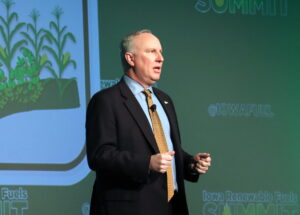
Iowa Renewable Fuels Association Executive Director Monte Shaw speaks at the association’s annual summit, Feb. 4, 2025. (Photo by Cami Koons/Iowa Capital Dispatch)
E15 has been a push from Iowans, including Gov. Kim Reynolds, who was slated to speak at the event but had to cancel to attend the funeral of Rep. Martin Graber, who died Jan. 31st. E15 regulation was part of a proposed spending bill in December 2024 to keep the federal government operating, but the provision was scrapped in the final bill that passed. More recently, one of President Donald Trump’s executive orders from the first week of his term ordered the Environmental Protection Agency to consider emergency waivers for the year-round sale of E15. Iowa’s U.S. senators have also reintroduced a bill, known as the Farm to Fly Act, to clarify program eligibility and definitions of sustainable aviation fuel. Sustainable aviation fuel is one of the “fuels of opportunity” that presenters at the summit said could raise net farm income again. Biofuel producers have been waiting for official guidance on a sustainable aviation fuel tax credit, 45z.
(Des Moines, Iowa) – Iowa Secretary of Agriculture Mike Naig presented reports for the Iowa Department of Agriculture and Land Stewardship to an appropriations subcommittee Monday, highlighting the ongoing struggles with the highly pathogenic avian influenza, as well as successes with the Choose Iowa program and conservation efforts. Naig appeared in front of the Iowa House Agriculture and Natural Resources Appropriations Subcommittee to share information on IDALS’ budget requests for the upcoming fiscal year.
According to the Iowa Capital Dispatch, he began with an update for the subcommittee on the ongoing threat of the highly pathogenic avian influenza which jumped from birds to dairy cattle in 2024 and since 2022 has impacted nearly 30 million commercial and backyard birds in Iowa. “It’s just a reminder that, unfortunately, foreign animal disease is a constant threat, a year-round threat,” Naig said. “We need to be staffed and prepared to respond to it.”
The governor’s recommendations for FY 2026 include a $500,000 appropriation to the department for foreign animal disease vaccine development. Naig highlighted the conservation work of the department in 2024, sharing that Iowa had nearly 4 million acres planted with cover crops and set another “record year” for conservation cost-share programs. “We always say a state dollar doesn’t act alone,” Naig said, noting that “$27.1 million worth of state investment was matched with $41.2 million in private sector dollars.”
Representatives on the subcommittee, and Naig, expressed enthusiasm about the Choose Iowa program, which helps to market and support locally made foods and products. The program has more than 170 members in 72 Iowa Counties and Naig said he hopes to expand to 300 members this year. The Choose Iowa program issued grants for value-added farm products, to dairy innovation and recently the department announced an allocation for butchery innovation. The initiative also had a pilot program aiding local food banks, and beginning this spring, from local schools.
Rep. Sami Scheetz, D-Cedar Rapids, noted recent moves from the Trump administration to put tariffs on products from Mexico and Canada, both of which have been postponed by a month, and asked Naig how this would affect Iowa farmers. Naig said he is “not a fan” of tariffs in general, but said the president is using the tariffs as a “tool” to support his border and immigration policies.

 Facebook
 Twitter
 YouTube
 RSS
RSS