

CLICK HERE for the latest market quotes from the Iowa Agribusiness Network!
CLICK HERE for the latest market quotes from the Brownfield Ag News Network!


CLICK HERE for the latest market quotes from the Iowa Agribusiness Network!
CLICK HERE for the latest market quotes from the Brownfield Ag News Network!
(Radio Iowa) – Some Iowa families have a tradition of taking down the Christmas tree tomorrow (Tuesday), on the last day of the year, in order to start the new year out fresh. Horticulturist and extension educator John Fech says don’t just toss the tree to the curb, but find a way to repurpose it. “Recycling it, reusing it, thinking of it again as a resource or an asset,” Fech says. If you’re crafty, trim the branches to make a fragrant sachet, wreath, or garland to enjoy in the weeks ahead. Laying small limbs over tender perennials provides them with some protection against fluctuating winter temperatures. He says a couple of layers of cut stems, applied in a criss-cross fashion, should offer adequate air penetration, yet keep them cool enough to reduce injury from warm and cold cycles.
Fech says mulching is another option. “Do that yourself with a hatchet or you could have it run through a chipper,” Fech says. “Many of the cities do that for their parks and then they use that for trail cover around city parks and hospitals and places like that.” Another idea is to return the tree to the great outdoors for wildlife to use as shelter. He likes to call it tree-cycling. “Also, it could just be songbird habitat,” Fech says. “Set it near the bird feeder so birds have a place to get out of the wind and have a little bit of refuge from predator birds.”
If mulching the entire tree is too much work, just using the needles can be an effective mulch on perennial plants, in your garden, and to keep weeds in check.
(Radio Iowa) – Former Iowa Governor Tom Vilsack — leaving his role as U-S Agriculture Secretary in three weeks — will have the second-longest tenure as the nation’s top ag official. “It’s been a tremendous honor and privilege to have had nearly 12 years as the secretary of agriculture,” Vilsack said. “It is an extension of work actually that began in a small town in southeast Iowa as a small town lawyer representing farmers during the Farm Crisis. It really sort of gave me a direction to my life which has ultimately ended up with me in this office.” Vilsack grew up on the east coast and, after graduating from law school, Vilsack moved to his wife’s hometown of Mount Pleasant. He was elected as the town’s mayor, then as a state senator before he won two terms as Iowa’s governor. Vilsack was Secretary of Agriculture during the Obama Administration and President Biden asked him to return to the role four years ago.
“As a mayor, as a state senator, as a governor and as secretary I’ve had the opportunity to be involved in, to encourage and support programs that will advance opportunities for farmers, ranchers and producers,” Vilsack says, “because I remember the pain of the Farm Crisis of the ’80s.” Vilsack says one of the highlights of his second run as U-S agriculture secretary has been seeing an uptick in the number of farms in Iowa. “In 1981, during the (Farm) Crisis, we had about 115,000 farms in Iowa,” Vilsack said. “Today we have 86,911 farms according to the census, but that number’s up over a census that was several years ago, so we’re headed in the right direction and I think a lot of it has to policies that we put in place to provide assistance and help, so I feel pretty good about it.” The U-S-D-A conducts a census every five years. The last census in 2022 found the number of farm units in Iowa had increased by about one percent the number of farmers had increased seven percent from 2017.

Ag Secretary Tom Vilsack (photo from Ag Secretary’s office)
Vilsack says the commodity-based system has rewarded size and he’s proud of programs at the U-S-D-A that helped increase the number of Iowa farms operating on fewer than a thousand acres. “I hope that I’m able to continue focusing on ways in which I can showcase the work of American agriculture, that I can showcase opportunities to expand rural economies and the farm economy to give small and mid-sized producers a chance,” Vilsack said. “I also have been working extraordinarily hard on nutrition and food security issues both domestically and globally.”
Vilsack is not planning to retire. “My hope is I get a chance to figure out ways in which I can continue to make a contribution,” Vilsack says. “I don’t think I’m ready for retirement and I don’t think I’d be very good at it.” Vilsack turned 74 on December 13th.
The only other person who has served longer than Vilsack as the nation’s secretary of agriculture is former Iowa Congressman James “Tama Jim” Wilson. He was ag secretary for 16 years and served three presidents.
DUBUQUE, Iowa (KCRG) – An expert with the Iowa Department of Natural Resources believes black bears could call Iowa home within the next five years. DNR furbearer biologist Vince Evelsizer notes black bears are native to Iowa, but were hunted to extinction in the state in the mid-1800s. The bears are moving southward from Wisconsin and Minnesota, close to northeastern Iowa.
The southward expansion is fueled by the Mississippi River, which Evelsizer says offers a stable habitat for bears. The DNR confirms at least three sightings of black bears in Dubuque County this year with a few unconfirmed reports of the animals this month.
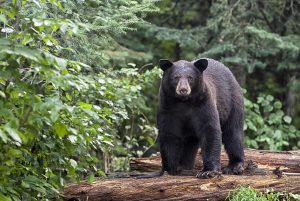
A Black Bear
Iowa State Professor Dr. Mike Rentz, an expert in sustainability and wildlife, says some of the bears will travel long distances to a source of food that they somehow know about at a particular time of the year. He said if black bears do move here permanently, Iowans should take a few precautions, that include not leaving the garbage out., making bird feeders higher, and not leaving dog food outside. Rentz said also, if you see a bear, enjoy the sighting, but use common sense and give it space. Don’t try to get too close.
He notes a good resource on bear safety is bearwise.org.
(Radio Iowa) – The Iowa D-N-R recently awarded 138 Iowa rural fire departments federal grants for specialized equipment to fight wildfires. D-N-R forestry fire supervisor Jason Walker says Iowa fire departments are normally set up to fight structure fires in burning homes or commercial buildings. “And there’s specialized gear that goes along with that, whether it’s a heavy bunker protective equipment they wear, heavy boots, you know things like that, when you are out in the wildland where you may be walking miles at a time, it could become extremely burdensome,” Walker says.
The gear for wildfires is specialized for the challenges they provide. “A wildland fire, we do things a little bit different, where you’ve got a little bit lighter weight, more mobile, personal protective equipment,” he says. “it allows our firemen to be a lot more effective and efficient at moving around. You don’t get so tired so easily. ” Walker says the grants are a good way to help departments be prepared for anything. “Those departments that don’t have a lot of resources or money available to just go out and buy stuff, this helps supplement that, and they’re able to go out and purchase some of that more specialized wildland fire gear, whether it’s pants, shirts, coats, boots or some hand tools, etcetera.” Walker says. “This helps cover half of the cost of some of that stuff .”
Walker says Iowa wildfires are like the ones you might see on T-V in California where they consume, forests, homes and anything in their path. But they are still a concern. “The reality is across the state of Iowa we have a significant amount of opportunity for wildfire, whether it be early season spring grass fires, or, as we’ve seen with more drought conditions, especially this last fall, for a period of time, field fires that may happen with equipment malfunctions, etcetera,” he says. Walker says we saw one of the busier wildfire seasons in Iowa this year. “We had several days with higher temperatures, high winds, low humidities, which combined to be what we would call Red Flag Warning type days,” he says. “Any kind of spark or source of ignition can cause a very significant, catastrophic wildfire across anywhere in rural Iowa.”
The Iowa volunteer fire departments received a total of 416-thousand dollars in grants. In the KJAN listening area, departments receiving the grants include:
Anita, Avoca, Bayard, Clarinda, Creston, De Soto, Dexter, Early, Farragut, Glenwood, Grant, Hamburg, Logan, Oakland, Onawa, Orange City, Quimby, Shelby, Shenandoah, Sidney, Silver City, Stuart, Tabor, Underwood, and Yale.
(Des Moines, Iowa) – Are you ready for a cozy getaway in an Iowa State Park cabin? The Iowa Department of Natural Resources says you can get 20% off your stay with Promo Code Cabin2025 when you book now for the months of January or February 2025. Enjoy the pristine beauty and outdoor fun of winter in an Iowa state park.
This promo applies to the year-round cabins at:

Promo code only can be applied for online reservations for January 1 through February 28, 2025. Note that January 1, 2025 is not an allowed arrival date; reservations may have an arrival date before or after that day. Promo code is good only for the state parks listed. Two-night minimum. Last day to make a reservations is February 20, 2025. Rules and fees apply.
(Des Moines, Iowa) – What are your plans for New Year’s Day 2025? The Iowa Department of Natural Resources says Iowa state parks and forests invite you to enjoy the outdoors and take a hike! More than 40 locations are offering either a guided hike with park staff or a suggested hike to explore on your own. Hikers can expect to be surrounded by the quiet beauty of nature in winter, and experience spectacular views, beautiful settings and the cultural treasures offered by Iowa’s state parks.
Find a First Day Hike near you, here: 2025 First Day Hikes Event List
In southwest Iowa, First Day Hikes are being held at the following locations:
Green Valley State Park
SELF GUIDED HIKE
Parking Location: Southeast parking lot on 140th St for the 5-mile hike on paged trail. OR South Shelter parking lot on 140th Street for 6-mile hike on grass path.
Park Address: 1480 130th St, Creston IA 50801
Description: Enjoy 2.5 miles of paved trail (5 miles round trip) from SE Parking Lot on 140th street to the main boat ramp. Or mowed grass path for three miles (6 miles round trip) from south shelter parking lot on 140th Street to North End of the lake. Dress for the weather.
Contact: (641) 782-5131.
Lake Anita State Park*
10:00 AM
Meeting Location: East side of beach parking lot
Park Address: 55111 750th St, Anita IA 50020
Description: Long Hike, 4 miles – starting at the beach parking lot, we will travel north on the all-weather trail and continue around the lake until we get back to the parking lot. Short Hike, 1.3 miles – starting at the beach parking lot we will travel north until the picnic area and turn back around and head back the way we came until we get back to the parking lot. Both hikes are very scenic and on a paved path through mostly restored prairie. This hike is on a paved trail with some moderate slopes.
Contact: (712) 762-3564
Lake of Three Fires State Park
SELF GUIDED HIKE
Parking Location: When entering the park, turn left. You will find parking available at the boat ramp or at the top of the hill.
Park Address: 2303 Lake Rd, Bedford IA 50833
Description: Start this 1.5-mile hike at the trail head west of the dam. There is a bridge that will cross the spillway. Once across the spillway, keep making left turns and you will find yourself back at on the east side of the dam. Maps at the trail intersections with “you are here” arrows can help you find your current location.
Contact: (712) 523-2700.
Lewis and Clark State Park
SELF GUIDED HIKE
Parking Location: Parking lot for the beach area, which is near the entrance
Park Address: 21914 Park Loop, Onawa IA 51040
Description: Hike 1 mile around the loop along Park Loop Road to get the best the park has to offer, including views of the woods and lake. This trail is flat and paved. Dress for the weather.
Contact: (712) 337-3211.
Prairie Rose State Park*
3:00 PM
Meeting Location: Park Office
Park Address: 680 Road M47, Harlan IA 51537
Description: Join us for a 2-mile hike around the east side of the lake. The Friends of Prairie Rose usually provides hot chocolate and popcorn following the hike. We should see lots of animal signs on this hike. The grass trail is fairly wide and flat, with a few moderate slopes.
Contact: (712) 773-2701.
Springbrook State Park
SELF GUIDED HIKE
Meeting Location: Parking lot above lake OR small parking area near informational kiosk below dam
Park Address: 2437 169th Rd, Guthrie Center IA 50115
Description: This 1.37-mile hike travels around the lake, with optional side trails for those who wish to adventure out. If parking at the dam, walk up the stairs to the boat ramp for the trailhead. If parking above the lake, walk down to the shelter and take the trail to the right. Trail is moderate, but not ADA accessible, and may include stairs and possible areas of ice and snow. Please dress for the weather.
Contact: (641) 747-3591.
Viking Lake State Park
SELF GUIDED HIKE
Parking Location: Go to the extra-vehicle park lot near the campground entrance.
Park Address: 2780 Viking Lake Rd, Stanton IA 51573
Description: Enjoy the 1-mile Burr Oak Trail. This is a grass-mowed path.
Contact: (712) 829-2235.
Waubonsie State Park*
Noon – shelter open for potluck/refreshments. Hike starts at 1:00 PM
Meeting Location: Wa-Shawtee Lodge
Park Address: 2585 Waubonsie Park Rd, Hamburg IA 51640
Description: The 2-mile hike will begin at Wa-Shawtee Lodge and wind off-trail through the woods of Waubonsie State Park and the Militia Hollow Wildlife Management Area. The Friends of Waubonsie will be providing food and beverages before and after the hike. Watch the Friends of Waubonsie Facebook page for cancellation information. The trail is mostly compacted dirt, with some intermittent steep sections and rolling terrain.
Contact: (712) 350-0873.
(Des Moines, Iowa) – The Iowa Department of Natural Resources will release rainbow trout in nine locations across Iowa this winter in areas that would not support them during warmer months. Winter trout stockings are a great place to take kids to catch their first fish. A family-friendly event is paired with some stockings to help anglers have success and fun while fishing. The popular program is supported by the sales of the trout fee. Anglers need a valid fishing license and pay the trout fee to fish for or possess trout. The daily limit is five trout per licensed angler with a possession limit of 10.
Children age 15 or younger can fish for trout with a properly licensed adult, but together, they can only keep one daily limit. Children can pay the trout fee, allowing them to keep their own daily limit.
Winter trout stocking events are dependent on favorable weather and ice conditions. Check the DNR Trout Fishing website at www.iowadnr.gov/trout for possible changes to the schedule.
2025 Winter Community Trout Stocking Schedule
(Ames, Iowa) – Researchers from Iowa State University have partnered with Michigan State University to develop a robot that would detect nitrates and monitor tile health to help farmers keep their land productive. The Iowa Capital Dispatch reports nearly half of Iowa’s harvested cropland has tile drainage, according to ag census data from the U.S. Department of Agriculture. The underground drainage systems help to boost crop productivity, but environmental and water groups have pointed out they can also deliver excessive amounts of nitrate and other nutrients downstream.
Mike Castellano, a professor of soil science at ISU, said the robots and nitrate sensors could help farmers detect where, how and how much nitrate they are losing. Castellano spoke at a virtual field day with Iowa Learning Farms Dec. 19. “That allows farmers to better manage their field at a precision scale, to improve both productivity and environmental performance of our crop production systems,” Castellano said. Castellano said current technologies limit nitrate testing to the end of the tile pipe, but the robot would be able to pinpoint “exactly when and where those nutrients are being lost.”
Liang Dong, the director of the microelectronics research center at ISU has worked with Castellano to develop the nitrate sensor portion of this technology. Dong said the sensor is completed and is being commercialized to be an affordable technology for farmers. “When the sensor is small enough and the price is low enough, farmers can put the sensors into their drainage tile, and then they will know what is the waterflow and what is the nitrate loss from their field,” Dong said.
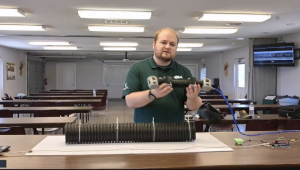
Christian Luedtke, a researcher at Michigan State University, demonstrates a prototype of a tile robot. (Screenshot from Iowa Learning Farms)
The end goal is to put the nitrate sensor, along with a camera and a waterflow sensor, onto a robot that can crawl through an entire tile drainage system and store the information for farmers. The robot, which is being developed by team led by Xiaobo Tan, a professor of electrical engineering at Michigan State University, is still a prototype. Christian Luedtke, a graduate researcher working with Tan on the project, spoke at the virtual field day and demonstrated the current prototype. The nearly two-foot long robot is currently designed to use several fin-like barbs on the front and back to move through corrugated pipes.
Luedtke said he has learned through this project that not all tile is corrugated and it often will change diameters across a field, which present additional challenges to creating the robot. “We do not know that being engineers and not farmers,” Luedtke said. These are things he learned while in Iowa this summer while talking about the project with farmers, many of whom have clay or concrete tiles that were installed many generations prior. Luedtke said the robot also needs to be quicker at moving through the pipes, have a battery life of at least a couple of hours and be waterproofed before the research team can begin practical tests in actual tile.
“The water quality issues here in Iowa, if we can help provide a cheap and easy solution for farmers to make decisions to help that, I think that’d be a great effect for our work to have,” Luedtke said.
(Des Moines, Iowa) – Iowa’s two regular gun deer seasons are done and the late muzzleloader season is underway along with the reopening of the archery season. The D-N-R’s state deer biologist says things are on track to hit the 104-thousand deer taken last year once all the current seasons are completed. Jace Elliott, state deer biologist for the Iowa Department of Natural Resources, said roughly 15-20,000 hunters will participate in the late muzzleloader season and likely harvest about 10,000 deer. “The season is popular with hunters looking to avoid the crowds. It’s the season with the highest percentage of does harvested and is a good opportunity for herd management or to put meat in the freezer,” Elliott said. “This time of year, hunters would be wise to target existing food sources as these resources can be limited.”
While the archery season also re-opens, fewer deer are harvested during this time than during the early portion of the season. The late muzzleloader and late split archery season are Dec. 23 to Jan. 10, 2025. The final deer seasons are the two January antlerless deer only seasons – the Population Management January Antlerless Season and the Excess Tag January Antlerless Season. Both seasons run from Jan. 11-19, but there are differences between the two.
The Population Management January Antlerless Season is available only in Allamakee, Appanoose, Decatur, Lucas, Monroe, Wayne and Winneshiek counties if there are more than 100 antlerless tags available in that county on Dec. 23. Since all seven counties met that requirement, all seven will be open. Hunters participating in the population management January antlerless season may use bows, muzzleloaders, handguns, shotguns, crossbows, or rifles .223 caliber and larger, as a method of take. The Excess Tag January Antlerless Season is available in all counties with unsold county antlerless tags on Jan. 11. Due to the compressed timeline, license sales will only be available over the counter, not online, until the quota is filled. Hunters participating in the excess tag January antlerless season may only use rifles from .223 caliber to .500 caliber as a method of take.
“We began running both seasons concurrently in 2023, and this past January we had just shy of 3,000 hunters participating who harvested about 1,500 deer statewide,” he said. “We will likely have similar counties participating as last year – primarily in northeast Iowa and southern Iowa – that will not fill their antlerless quota by Jan 10.” Hunters can monitor the quotas in real time at iowadnr.gov/Hunting then click on the Antlerless Deer Tag Quotas link under the Helping You Prepare heading. “If hunters are interested in using more than a centerfire rifle, they should consider purchasing the Population Management tags to have larger menu of options for the method of take,” he said.
Hemorrhagic Disease Update
Public reporting data suggests that 2024 was Iowa’s most severe hemorrhagic disease (commonly known as EHD) outbreak in recorded history. While more than 3,000 suspected EHD mortalities have been received this year in 94 counties, research suggests that multiplying that total by 10 would provide a more realistic, yet still conservative, estimate of total EHD-related mortality. “This means that many hunters and landowners throughout the state are noticing fewer deer during the hunting season, specifically in central and northwestern Iowa,” Elliott said. “While there is still plenty of harvest opportunity during our late seasons, it’s important for our hunters to adapt their harvest goals to the current status of their local deer population. Talk with your neighbors to better understand population impacts in your area, and understand that deer tend to congregate in the late seasons, which can lead to false perceptions of abundance on certain properties.”
A new EHD reporting tool and dashboard can be found on the DNR Deer Hunting webpage at https://www.iowadnr.gov/Hunting/Deer-Hunting. “While the majority of Iowa’s counties appear to be spared from severe population impacts from this recent outbreak, hunters should always consider the bigger picture and understand the role they play in managing balanced, healthy deer populations,” he said. “Successful local deer management relies on being informed and working together with neighbors, especially during severe EHD years.”
Chronic Wasting Disease Update
The Iowa DNR has raised its deer sample quota this year due to the sampling increases around the new positive deer from 2023. This year, the DNR has collected more than 5,000 samples from across the state to date and the lab at Iowa State University is working through them. So far, 26 deer have been either confirmed as having chronic wasting disease or are suspected and subject to a follow up test. The 26 positive deer includes three new counties – Davis, Shelby and Wapello – where the disease has been confirmed.
Late Muzzleloader season
Method of Take: Bows, muzzleloaders, handgun, or crossbow
Season is Dec. 23-Jan. 10. 2025
Population Management January Antlerless Season
Method of Take: Bows, muzzleloaders, handguns, shotguns, crossbows, or rifles .223 caliber and larger
Season is Jan. 11-19, 2025 – only in Allamakee, Appanoose, Decatur, Lucas, Monroe, Wayne and Winneshiek counties if there are more than 100 antlerless tags available in that county on Dec. 23.
Excess Tag January Antlerless Season
Method of Take: Rifles .223 caliber to .500 caliber
Season is Jan. 11-19, 2025 – available in all counties with unsold county antlerless tags on Jan. 11, and sales will only be available over the counter, not online, until the quota is filled.
(Radio Iowa) – Egg prices have reached a record high in the U-S and the Iowa Egg Council says bird flu is the biggest reason for the price jump . I-S-U Extension poultry vet Yuko Sato says the market determines the cost of eggs. “One common misconception is people think that the egg prices are driven by what the farmers set the price on. They have no control over any of that, it’s basically what the commodity market is doing,” she says.
Because farmers must destroy flocks if they’ve been infected by bird flu, some farmers are losing money. Wholesale egg prices in the Midwest reached five dollars and 27 cents a dozen last Wednesday. Iowa Egg Council C-E-O Mindy Larsen says the rising cost of labor, packaging, and shipping – affect prices at the grocery store along with the bird flu. “Every single thing in our economy as a whole that impacts anything that you buy at the store is also going to impact eggs,” she says.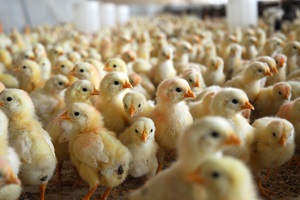
The U.S. Bureau of Labor Statistics estimates that overall grocery costs are roughly 20 percent higher than they were before the pandemic. Egg prices are expected to drop next year when flocks rebuild.


 Facebook
 Twitter
 YouTube
 RSS
RSS