

CLICK HERE for the latest market quotes from the Iowa Agribusiness Network!
CLICK HERE for the latest market quotes from the Brownfield Ag News Network!


CLICK HERE for the latest market quotes from the Iowa Agribusiness Network!
CLICK HERE for the latest market quotes from the Brownfield Ag News Network!
(Des Moines, Iowa/Iowa Capital Dispatch) – Iowa senators advanced a bill Tuesday to implement nutrition guidelines and education in Iowa schools that prioritize the state’s “unique” food sources like corn, pork and dairy. The bill would also update school health class curriculum to include a section on nutrition and include instruction on food production and the benefits of local sourcing in agriculture, as well as natural resources career and technical education instruction.
Senate Study Bill 1158 would instruct the Iowa Department of Education to apply for a waiver for exemption of certain parts of federal nutrition standards for school meals. The bill asks for exemptions from sodium limits, whole grain requirements and stipulations on fruit and vegetable varieties and general permission to substitute federal nutrition guidelines with those that “align with Iowa’s dietary recommendations or cultural food practices.”
The Iowa Department of Education, if the waiver were approved, would then work with the Iowa Department of Agriculture and Land Stewardship, nutrition experts, educators and other stakeholders to develop guidelines for a “nutritionally adequate meal” in Iowa. Per SSB 1158, these guidelines must be as stringent as federal guidelines in promoting health and preventing chronic diseases and must prioritize animal-based protein, dairy, vegetables and fruits, in that order.
Sen. Liz Bennett, D-Cedar Rapids, opposed the bill in the Senate Agriculture Committee hearing because of this section. “You’re basically rewriting the food pyramid by writing into law that certain food groups must be prioritized in the order listed,” Bennett said in the committee hearing. Bennett said she’s not against animal proteins but said she does not see “nutritional research evidence” supporting the prioritization outlined in the bill.

(Photo courtesy of the U.S. Department of Agriculture)
Lobbyists from Iowa commodity groups including the Iowa Cattlemen’s Association and Iowa Corn Growers Association spoke in favor of the bill during its subcommittee hearing Feb. 26. Sen. Mike Zimmer of DeWitt, ranking Democrat for the Senate Ag Committee, echoed Bennett’s sentiment and said students should be taught the harms as well as the benefits of animal proteins and should similarly be exposed to other sources of protein.
Zimmer said the bill attempts to “reinvent the wheel” on nutrition education and school meal programming that are already established by the Department of Education. Sen. Kevin Alons, R-Salix, who chaired the subcommittee on the bill last week, said the proposed legislation does not ignore federal nutrition guidelines; it instead asks for a waiver.
The bill was amended in committee to remove references to “sustainable farming” practices from the section on career education. Sen. Dan Zumbach, R-Ryan, said the language was removed to avoid complication in the curriculum since “the word sustainable is not defined.” According to the U.S. Department of Agriculture, sustainable agriculture is defined in U.S. Code as “an integrated system of plant and animal production practices” that, among other goals, “make the most efficient use of nonrenewable resources and on-farm resources and integrate, where appropriate, natural biological cycles and controls.”
The bill passed with the amendment, 11-4 with Democrat Sens. Zimmer, Bennett, Tony Bisignano of Des Moines and Herman Quirmbach of Ames voting no. A similar bill, House Study Bill 173, has advanced from subcommittee in the House.
(Radio Iowa) – Iowa Democratic Party chair Rita Hart says President Trump’s new import tariffs on goods from Canada, Mexico and China will have a negative impact on Iowa’s economy. “It’s already hit the corn and soybean market and we can see what’s happening to the stock market,” Hart says. In a post on his “Truth Social” platform, President Donald Trump said the tariffs were being imposed on “external product” and the great farmers of the United States should get ready to start making a lot of products to be sold INSIDE the U-S. Trump closed the message by writing “Have fun!” Hart says the price for a bushel of corn fell by 22 cents by midday today (Tuesday).
“That doesn’t seem like fun to me,” Hart says. Hart says after Trump imposed tariffs in 2018 and 2019, other countries which had been buying American farm commodities started buying elsewhere. Trump authorized 61 BILLION dollars in tariff relief payments to American farmers during his first term. “Farmers are a proud bunch. We want trade, not aid,” Hart says. “This president got by with it last time. I don’t know why, but if he thinks he’s going to have the taxpayers bail us out again, that’s just poor leadership.”
Hart farms with her husband in Clinton County, near Wheatland.
(Radio Iowa) – Iowa Ag Secretary Mike Naig is back from a trade trip to Costa Rica and Guatemala. Naig says both countries present a lot of trade opportunities. “To Guatemala being the largest economy in Central America, both very good markets for us, from a soybean meal, from a corn, from a corn, from a pork, beef and turkey standpoint as well, and we think both have a real upside from an ethanol standpoint,” he says.
“We can help Costa Rica and Guatemala on two fronts. One is, you know, to help supply their livestock industries with feed. And so we do that through exporting soybean meal, dry distillers grains and corn, but also the consumer. You know, their rising incomes, they are looking for more protein,” Naig says. He says representatives of Iowa’s beef industry were on the trip. “Iowa corn fed beef is very, very desirable, competes well, dark turkey meat as well. So these, markets, represent multi faceted opportunities for us,” he says. Naig says the accessibility of the two countries is a positive.

Mike Naig (Iowa PBS photo)
“There’s a tremendous logistic advantage, logistical advantage for us to go down the Mississippi, across the Gulf and into ports in Central America,” Naig says. “So we have a logistical advantage, and then you match that up with the quality and the consistency that we can supply. We’ve got some very, very good customers in those two countries.”
The Iowa Economic Development Authority was on the trip with Ag Department as they worked to connect Iowa companies with markets for their products and service.
(Red Oak, Iowa) – The Montgomery County Emergency Management Agency late this (Friday) night, issued a BURN BAN, in effect immediately and until further notice! Emergency Management Coordinator Brian Hamman issued a statement on social media, saying the ban was necessary as a result of “Multiple, large and out of control field fires.”
Hamman said numerous fires were reported Friday (Feb. 28th), “As a direct result of Red Flag Conditions (Temperatures, High Winds & Low Relative Humidity) throughout the entire area. All fires originated from previously burnt brush piles from approximately 1-2 weeks ago, that had rekindled due to the strong sustained winds and eventually spread to dry adjoining grass and fields.”
Hamman said “While conditions two weeks ago were conducive to light and burn brush piles, we have quickly dried out due to the extreme warm up this week. Regardless of issuing an Open Burn Ban yesterday, today or tomorrow, it would not have changed the outcome today due to the extreme weather conditions. This is why we stress the importance of monitoring these piles for several weeks after they have burnt or request that once they are burnt, to please bury them or put soil on top.
“A special thanks,” He said, ” goes out to the US National Weather Service Omaha/Valley Nebraska for monitoring the fire trends today and quickly alerting us of wildfire detections via satellite, they were able to detect (5) fires prior to them being reported to 9-1-1.
“Another special thanks goes out to all the area farmers who quickly responded to all the different fires today with tractors & discs as well as all of our responding fire departments. Most all have fulltime jobs and are volunteers who give up their time to help when called upon.
“Lastly,” Hamman said, “A special thank you to Montgomery County 911 and all the area dispatchers who had a difficult day with all of the fires. At one point, we had (4) active field fires within Montgomery County ongoing. They fielded numerous calls and answered all radio traffic without hesitation and with the upmost professionalism.”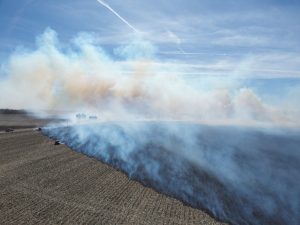
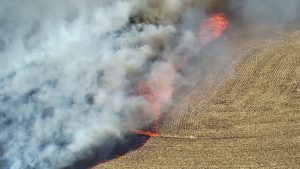

(Images are from the MCEMA Facebook page)
A brief list of each fire is listed below:
(1) At 11:30am, Montgomery Co EMA was notified of a wildfire detection via US National Weather Service Omaha/Valley Nebraska satellite radar in the area of US HWY 71 x US HWY 34. Montgomery County 911 received a 9-1-1 call shortly after reporting a field fire in the area of 220th x T Ave and fire departments were dispatched. The fire quickly grew out of control, jumped the road and was eventually contained with fire suppression units and tractors & discs. Crews were on scene for roughly 2 hours.
1 minor injury reported.
Origin of Cause: Previously lit burn pile. Estimated 45 acres burned.
Responding Agencies:
Villisca FD
Stanton Fire and Rescue Department
Red Oak Fire Department
Corning Iowa Fire Department
Montgomery County Emergency Management Agency
Montgomery County Sheriff’s Office – Red Oak, Iowa
Montgomery County 911
(3) Tractors & Discs
(2) At 1:08pm, Montgomery County 911 received a report of a small field fire in the area of 230th x C Ave southwest of Red Oak. Fire crews from the initial fire were released and responded as well as surrounding county mutual aid partners. The fire was quickly contained by a tractor and disc and with the first arriving fire units.
No injuries reported.
Origin of Cause: Previously lit burn pile.
Responding Agencies:
Red Oak Fire Department
Stanton Fire and Rescue Department
Emerson Volunteer Fire/Rescue Association Inc.
Essex Fire Rescue
Montgomery County Emergency Management Agency
Montgomery County 911
(3) At 2:01pm, Montgomery Co EMA was notified of another wildfire detection via US National Weather Service Omaha/Valley Nebraska satellite radar in the area of US HWY 48 x H Ave. Fire crews from the second fire were released and dispatched to the scene as well as additional mutual aid partners. Once initial crews arrived on scene, a fast-moving field fire was ongoing and additional out of county mutual aid resources were requested along with several area farmers with tractors & discs. Fire crews remained on scene for roughly 6 hours at this incident scene due to numerous piles of debris smoldering.
1 minor injury reported.
Origin of Cause: Previously lit burn piles. Estimated 150 acres burned.
Responding Agencies:
Red Oak Fire Department
Elliott FD
Stanton Fire and Rescue Department
Grant FD
Griswold Fire & Rescue
Carson Fire and Rescue
Macedonia FD
Clarinda FD
Numerous Tractor & Discs
(4) At 2:48pm, Montgomery Co EMA was notified of an additional wildfire detection via US National Weather Service Omaha/Valley Nebraska satellite radar in the area 110th x O Ave. Mutual aid crews responding to the HWY 48 x 110th fire were diverted and found an ongoing field fire in the area of 155th x Pine Ave. A tractor and disc was already deployed in the field assisting to create a fire break and out of county mutual aid partners were requested due to the large ongoing fire west of Elliott. Crews remained on scene for roughly 90 minutes.
No injuries reported.
Origin of Cause: Previously lit burn pile.
Responding Agencies:
Grant FD
Stanton Fire and Rescue Department
Villisca FD
Essex Fire Rescue
Clarinda FD
(1) Tractor and Disc
(5) At 3:18pm, Montgomery Co EMA was notified of an additional wildfire detection via US National Weather Service Omaha/Valley Nebraska satellite radar in the area of 270th and O Ave. Montgomery County 911 also took a call reporting this field fire and fire crews that were enroute to the previous fire were redirected and quickly contained the field fire with additional assistance from tractor & discs that were on scene or arrived shortly after. Crews were on scene for 1 hour.
No injuries reported.
Origin of Cause: Previously lit burn pile.
Responding Agencies:
Stanton Fire and Rescue Department
Villisca FD
Clarinda FD
(3) Tractor and Discs
(6) At 3:38pm, Montgomery Co EMA was notified of an additional wildfire detection via US National Weather Service Omaha/Valley Nebraska via satellite radar in the area of 110th x C Ave. Smoke was quickly visible at the HWY 48 x 110th fire and out of county mutual aid was requested as there were no available fire units within Montgomery County due to numerous ongoing field fires. Some units were able to be released from the HWY 48 x 110th fire to aid the out of county mutual aid resources and additional tractor & discs were called or responded directly to the scene. Crews were on scene for 2 hours.
No injuries reported.
Origin of Cause: Previously lit burn pile.
Responding Agencies:
Red Oak Fire Department
Griswold Fire & Rescue
Carson Fire and Rescue
Macedonia FD
Oakland Fire and Rescue
Henderson FD
Clarinda FD
Numerous Tractor & Discs
Other agencies providing assistance during those incidents:
Mills County Emergency Management Agency
Pottawattamie County Emergency Management
Page County Iowa Emergency Management \ E 911
Cass County Iowa Emergency Management Agency
Cass County 911 Center
AVON LAKE, Iowa [KCCI] — A man and a dog were rescued after falling through the ice on a lake in southeastern Polk County, Thursday. According to the Polk County Sheriff’s Office, deputies and animal control were dispatched to Avon Lake around 4:45 p.m. on Thursday for a report of a dog that had fallen through the ice. While en route, a second 911 call was made, indicating that a man had gone onto the ice to rescue the dog and had also fallen through the ice. Authorities say a nearby neighbor saw the incident and used a small boat from the shoreline to slide across the ice to the man in the water. The man was unable to get into the boat, but was able to hold on until deputies arrived on scene.
With the help of local citizens and a Carlisle police officer, a Polk County Sheriff’s Deputy was able to throw a rope to the man and pull him to the shore. The man was taken to a nearby hospital as a precaution, the PCSO said. The dog that had fallen into the water was also found and is OK. Authorities warned residents against walking onto ice in ponds and lakes as the weather warms up, and encourages precautions for pets for those who live near open water.
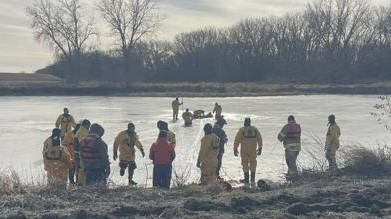
Firefighters practice ice rescue techniques in southwest Iowa (File photo – Courtesy of the Red Oak Fire Department)
In a separate incident, the Linn County Sheriff’s Office has identified the man who died after falling through ice in Linn County Thursday afternoon. KCRG reports 46-year-old Brian Thomas of Marion died after he was taken by ambulance to Mercy Hospital. The Linn County Sheriff’s Office said deputies were called to the 8100 block of Chain Lakes Road, near Palo, at about 2:40 p.m. Thursday. First responders found three men on the bank of the lake near. The sheriff’s office said all three had fallen in, two had pulled the third man to the shoreline, but he was unconscious. First responders initiated CPR on Thomas who was unconscious. He was then taken to the hospital, where he was later pronounced dead.
The other two men were taken to the hospital to be treated for hypothermia.Thomas’ remains were taken to the State Laboratory for an official autopsy.
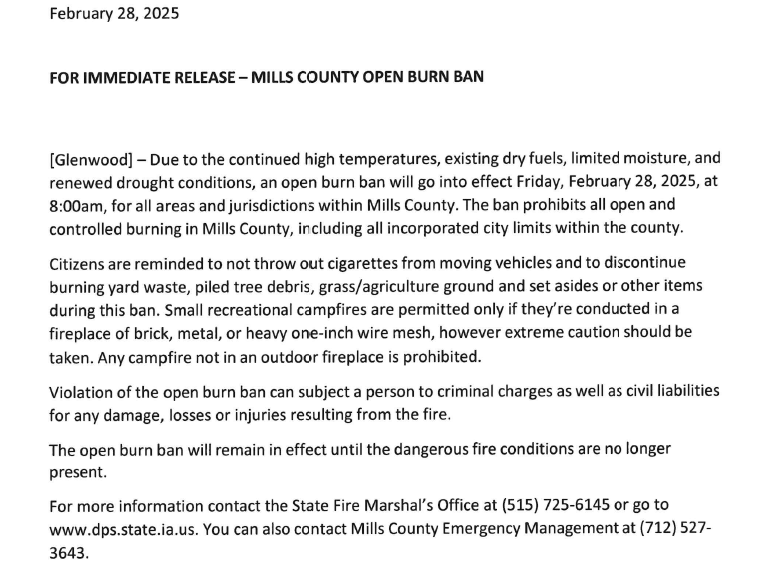
(Glenwood, Iowa) – A ban on open burning is in effect until further notice for Mills County. See the press release below from the Mills County Emergency Management Agency:
(Radio Iowa) – Most of Iowa is under a Red Flag Warning from noon today (Friday) through six o’clock tonight, as open burning is strongly discouraged. National Weather Service meteorologist Brooke Hagenhoff says there’s a critical risk as any fires that develop will likely spread rapidly. “For today, we’ve got warm conditions in the upper 50s to low 60s. We’ve got really dry fuels out there, because it’s so early in the season that nothing’s growing, so all the grasses and things are dry,” Hagenhoff says, “and then on top of that, we’ve got really strong winds gusting 45 to 50-plus miles per hour.” The warning covers 91 of Iowa’s 99 counties, all but the far northeastern corner of the state. Hagenhoff says the warm temperatures, strong winds and dry vegetation will create a serious hazard. 
“That combination is going to make it really dangerous for any kind of burning that goes on,” she says, “so we definitely want to take care and delay any burning until later this weekend or next week.” More big dips are coming in the weather rollercoaster Iowans have been riding lately. The forecast calls for high temperatures across much of Iowa’s southern half to be in the 60s today, while highs tomorrow may only be in the 30s. “Those ruthless winds are ushering in that cooler air with this cold front that’s going to be coming across here later on this evening, so that’s really the big push,” Hagenhoff says. “So, if you want to enjoy some of the warmer weather, get out there today and do that. It’ll be a little cooler on Saturday.”
The state Fire Marshal’s office shows active burn bans in only five counties, Mills County in the southwest, and four in eastern Iowa: Clinton, Linn, Muscatine and Scott.
(Radio Iowa) – Maple syrup season gets underway this weekend at the Indian Creek Nature Center near Cedar Rapids. Center spokesman Eric Hart says they began preparations last month. “We put in over 100 spires on February 15th, and then once the weather warmed up this past week, the sap has started flowing,” Hart says. Volunteers and staff collect the tree sap and to start the process of boiling down into maple syrup. Hart says the weather conditions play a big part in how much sap they can collect. “This time of year is usually really good for it, but it kind of does depend on what kind of weather we get,” he says. “Usually, temperatures during the day that are above freezing, around 40 degrees, and then temperatures at night below freezing, make it ideal for that sap to start flowing.”
Hart says you can come out starting this weekend to learn about the process. “They just have to register for one of our ‘It’s Maple Syruping Programs.’ These are open to the public, they’re five dollars per person, and we host multiple ones throughout the month of March that happened before the maple syrup festival.” This 42nd Maple Syrup Festival wraps up the syrup season on March 29th and 30th. Hart says 2023 was one of their better years for collecting sap and making syrup. “We collected one-thousand-927 gallons of sap, and then we that got boiled down into 46 gallons of maple syrup,” he says. Hart says you can see the process at their events and festival, and also get a taste of the syrup.

Collecting maple syrup. (Indian Creek Nature Center photo)
“It really reveals how nature can provide so many things for us, and opens people’s eyes to how processes in nature can be used to create all kinds of things, including something as sweet as maple syrup,” Hart says. “And that’s one thing we try to bring into all of our events and programs, is that element of nature, and getting people outside to kind of they can get hands on.”
Find out more about the maple syrup events at: indiancreeknaturecenter.org.
(Des Moines, Iowa) – An Iowa House subcommittee advanced a bill Thursday that would require water use permits be evaluated on a case-by-case basis in terms of “beneficial use.” According to the Iowa Capital Dispatch, Representatives and supporters of the bill cited the depletion of the Ogallala Aquifer in Kansas, and the associated hardships, as a reason for the bill.
Rep. Cindy Golding, who helped author the bill and chaired the subcommittee, said the past four years of drought conditions in Iowa and the things she has heard from friends and family in Kansas, showed her that water use in Iowa needed to be addressed. “Water is a real problem,” Golding, a Republican from rural Linn County, said. “And not wanting Iowa to get (like Kansas), I’d like us to have a process in place before we get there.”
House File 480 would remove the definition of beneficial use from current code and redefine it so the Department of Natural Resources would determine beneficial use in a “case-by-case basis” that is not based on the applicant’s category of use. Iowa Code holds that beneficial use includes that “waste or unreasonable use” of water resources be prevented and the “conservation and protection” of water resources is “required.”
The DNR’s interpretation of beneficial use has been central to an ongoing fight between water advocates and landowners in northeast Iowa over a water use permit renewal for a cattle operation near Bloody Run Creek. In November, an administrative law judge remanded the DNR’s decision to renew the permit and said the department needed to evaluate quality, as well as quantity when determining beneficial use.
Wally Taylor, legal chair of the Iowa Chapter of Sierra Club, said Iowa Code as written has “conflicting definitions of beneficial use” but that the bill would clear up the definition to be in the interest of the people. Iowa’s relation to groundwater was an issue at the Statehouse last year as well, when the Legislature voted to allocate $250,000 to research the condition of the state’s aquifers.
The proposal advanced with unanimous support. Other lobbyists registered, including DNR, took an undecided stance.


 Facebook
 Twitter
 YouTube
 RSS
RSS