

CLICK HERE for the latest market quotes from the Iowa Agribusiness Network!
CLICK HERE for the latest market quotes from the Brownfield Ag News Network!


CLICK HERE for the latest market quotes from the Iowa Agribusiness Network!
CLICK HERE for the latest market quotes from the Brownfield Ag News Network!
(Harlan, Iowa) – Fire officials in another southwest Iowa county have requested and were granted a Burn Ban Proclamation. The Shelby County Emergency Management Agency reports a Burn Ban for the County is now in effect until further notice, as a result of abnormally warm and dry conditions, low humidity, strong winds and tinder vegetation. That combination of elements can contribute to extreme fire behavior, which can put property and lives at risk.
As of Friday, March 28th, including Shelby- a total of nine counties in this area are under a ban on open burning. The others include: Audubon; Guthrie; Pottawattamie; Adair; Mills; Montgomery; Union and Page Counties. 
For more information on Burn Bans in Iowa, see the State Fire Marshall’s website .
(Iowa Capital Dispatch) – A St. Louis-based company with an Iowa grain dealer license has filed for Chapter 11 bankruptcy. Iowa farmers with unpaid grain sold to Benson Hill Holdings, Inc. prior to March 20, can file a claim for indemnity, according to the Iowa Department of Agriculture and Land Stewardship. Don McDowell, communications director for IDALS, said the department is not “immediately aware” of any affected farmers.
The grain indemnity fund will pay farmers 90% of their loss, up to $300,000, though claims related to Benson Hill must be mailed or personally delivered to IDALS’s Grain Warehouse Bureau by July 18. The fund was established by the Iowa Legislature in 1986 and accrues via a per-bushel fee on purchased grain and fees on licensed warehouses and grain dealers.
According to minutes from the Iowa Grain Indemnity Fund Board, the balance of the fund as of Feb. 19 was $8.4 million. Benson Hill filed for Chapter 11 bankruptcy March 20 and has up to $11 million in debtor-in-possession financing to continue its day-to-day operations. Christi Dixon, a spokesperson for the seed innovation company, said it is “restructuring” its finances. “We will continue to meet our contractual commitments and support key farmers without interruption,” Dixon said in an email.
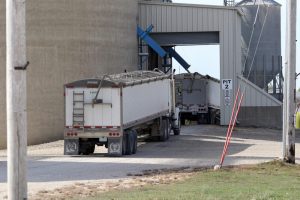
Trucks deliver harvested grain in western Iowa. (Photo by Jared Strong/Iowa Capital Dispatch)
Dixon said the company maintains a seed processing facility in Bondurant and employs seven people in Iowa. Benson Hill previously owned a soy processing facility in Creston, but sold the facility in February 2024 to White River Nutrition.
McDowell said the grain license for Benson Hill included locations in Cherokee and Galva.
(Radio Iowa) – Forecasters say much of Iowa can expect high temperatures in the 60s, 70s and even near 80 today (Thursday) and tomorrow, which will prompt some Iowans to pull out their kayaks and canoes. Sure, it’s spring, but Iowa D-N-R conservation officer Nate Carr says having warm air temperatures doesn’t necessarily mean warm water temperatures, so dress appropriately.
There’s a general rule that if the water and air temperatures combined don’t equal at least 120 degrees, anyone who ends up dumped in the water is at risk for hypothermia, and water temperatures are still quite chilly.
Carr says to pack extra clothes in a dry bag and always wear a life jacket.
(Atlantic, Iowa) – A group of local outdoor enthusiasts aim to restore native prairie grasses and make improvements to various aspects of the Atlantic Parks and Recreation Department sites. Long-time Atlantic Parks Advocate Frank Saddlemire spoke with the Parks and Rec Advisory Commission Wednesday evening. One of the projects he would like to see worked on, is the boat ramp from Lake number 2 at the Schildberg Recreation Area.
That area was included in a controlled burn Wednesday. Saddlemire said the second project he’s interested in seeing improved, is the Butterfly Gardens at the Schildberg Rec Area. The current Butterfly Garden is located in the middle of the park.
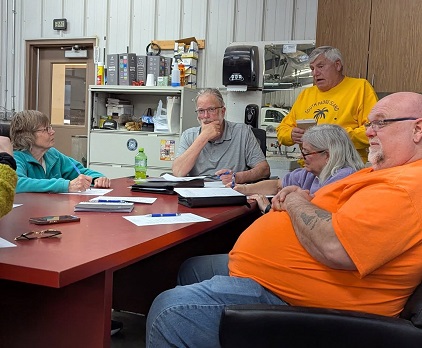
Frank Saddlemire (Yellow shirt) speaks with the Atlantic Parks & Rec Advisory Board (3-26-25; Ric Hanson-photo)
He says the only money involved in the project is re-bar, to secure the railroad ties into the ground. Signage could be included that mentions which group or organizations are responsible for maintaining the gardens. The third project Saddlemire is interested in, is returning Schildberg’s to a wildlife prairie, because “Conservation is education.” Frank said he’s spoken with Cass County Conservation Department Executive Director Micah Lee and Nick Thompson, Iowa Pheasants Forever Farm Bill Wildlife Biologist for Cass County, about wiping out the Brome Grass, burn the weeds off and seed it with native prairie grass.
The benefits include a larger variety of birds and insects.
He says it also saves the taxpayers money by saving time and using manpower for mowing.
He said it also benefits the City in the form of it being a tourism site. The Advisory Committee took the information Saddlemire presented under consideration.
(Atlantic & Southwest Iowa) – Numerous area fire departments were kept busy Wednesday, battling ditch, grass or field fires. Locally, the Atlantic Fire Department responded to two grass fires on Wednesday. Fire Chief Tom Cappel says one of the fires crews from Atlantic fought, occurred early Wednesday afternoon in the area of 644th Street and Jackson Road.The blaze erupted from a brush pile.
A second fire was reported later that afternoon west of the Atlantic Airport, off of Highland Road. That blaze began as a controlled burn of prairie grass, but grew out of control as the result of strong southerly winds that caused flames to jump the road and ignite a nearby farm field.
Chief Cappel issued a reminder to residents who may be planning a controlled burn, to notify their local fire department beforehand.
Earlier in the day, the Atlantic Fire Department conducted its own controlled burn at the Schildberg Recreation Area.
Elsewhere in southwest Iowa, the Creston Fire Department, with mutual aid provided by six other area departments, battled controlled burn that got out of hand at around 2:30-p.m. Wednesday, northwest of Creston. The flames spread to one shed and threatened another. A large junk pile behind that structure was fully engulfed in flames. Altogether, about 400-acres was scorched in the blaze.
Other fires were reported late Wednesday afternoon along the interstate in Cass and Adair Counties. Red Oak Fire were battle two fires when they were called to the scene of a car engulfed in flames at around 4-p.m. Wednesday. There were no injuries, but the car was a total loss.
(Radio Iowa) – The Iowa House has — again — approved legislation that would provide new protections for landowners along the proposed Summit Carbon Solutions pipeline route. Representative Charley Thomson, a Republican from Charles City, says the overwhelming majority of Iowans oppose the project.
“Parts of the government of Iowa seem to refuse to recognize reality and at some point, it starts to look like corruption,” Thomson said. “…I think the right thing will be done. I hope it’s sooner rather than later.” The package includes new restrictions on the use of eminent domain to seize land for an expansion of the pipeline and it calls for Summit to reimburse landowners who cannot get insurance because the pipeline runs through their property.
Representative Steven Holt, a Republican from Denison, says he’s proud the House has been standing up for property owners. “I have to say that the pride has been replaced with disappointment by the fact that members of the senate have not listened to the cries of our citizens to stand up for the Constitution, to tell Summit and Bruce Rastetter and the lobby that the fundamental private property rights of Iowans are not for sale,” he said, “not now and not ever.”
Bruce Rastetter is the founder and owner of Summit Carbon Solutions. One Democrat who voted for the package suggested it will not become law because Republican Governor Kim Reynolds and key Republicans in the Senate support the pipeline project. The head of the Iowa Renewable Fuels Association says he’s confident cooler heads will prevail in the senate, the pipeline will be built and demand for corn will increase by billions of bushels.
(Radio Iowa) – The Iowa Senate has voted to shield farm chemical companies from lawsuits that allege the labels of products lack proper warnings about health risks. Bayer, the company that sells Roundup, faces thousands of lawsuits filed on behalf of farmers and others who’ve been diagnosed with cancer. Senator Mike Bousselot, a Republican from Ankeny, says Roundup’s label meets the legal requirements of the U-S government and other countries where it’s approved for use.
“No scientific agency in the world has concluded that glyphosate poses a carcinogenic risk,” Bousselot says. Senator Adrian Dickey, a Republican from Packwood, says this area of the law has become a playground for attorneys. “It’s about sue-happy attorneys and their latest attempt to make a lottery out of our legal system,” Dickey said. The bill passed on a 26-to-21 vote — the minimum number of yes votes required to clear the Senate.
Senator Molly Donahue, a Democrat from Cedar Rapids, is among the critics who call the bill the cancer gag act. “This bill is a dangerous piece of legislation that places corporate interests above the health and rights of Iowans at a time when our state is grappling with rising cancer rates,” she said.
Similar legislation passed the Iowa Senate last year by a wider margin, but it didn’t come up for a vote in the House.
(Atlantic, Iowa) – The Cass County Conservation Board is holding a Native Landscaping Program next month. The program will be held in the Atlantic Public Library’s Community Room on April 5th, beginning at 11-a.m.
An additional session will be held at the Outdoor Educational Classroom (OEC), south of Massena, on April 5th, beginning at 2-p.m. Both programs are FREE, and all ages are welcome to attend. Conservation staff will be discussing different Native plants and how to incorporate them into your yard. Discover how to use native plants in your yard.
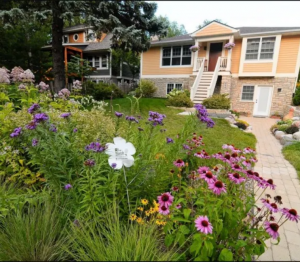
(Photo via raincampaign.org)
The OEC is located south of Massena. To get there, take Highway 148 south of Massena, turn left on Tucson Road and follow it East for about two miles, then turn right hand into the parking lot.
(Ringgold County, Iowa) – The Iowa Department of Natural Resources (DNR) has canceled the upcoming Prairie Chicken Day due to the decline in the local population to the point where staff have only observed sporadic use by a few male prairie chickens of the main Kellerton Lek.
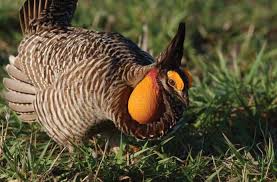
Prairie Chicken
The effort to return the prairie chicken to Ringgold County, Iowa, and Harrison County, Missouri, had begun in 1987, when wild birds captured primarily in Kansas and Nebraska, with a few coming from South Dakota, were released in the area. Ringgold and Decatur counties had been identified as offering the best habitat to support prairie chickens in Iowa.
The last significant translocation effort was in 2017. Since then, the population has shown a steady decline with a few years of stability, but no significant increases to indicate a growing population have been recorded.
(Radio Iowa) – The recent snow and rain could help Iowa improve drought conditions was we move out of March and into April. The Iowa D-N-R’s Jessica McIntyre says she sees changes when looking back at the Drought Monitor for the start of March. “Especially in central Iowa, where there was what was considered D-1 or moderate drought, has now been downgraded to D-zero, which is abnormally dry, so that’s an improvement. And there’s also another section in eastern Iowa that also had that similar trend,” she says. Several areas of the state with drought got snow and rain last week. McIntyre says there will be some help as the snow melts with warmer temperatures.
“Not sure how much impact it will have immediately, just because we’re still kind of in that transition time when the ground is still somewhat frozen,” she says. McIntire says things are looking okay as we head into what are normally wetter spring months. “We get normal or above normal precipitation over the next couple of months, yeah, I think we’ll be in pretty good shape, especially when we compare ourselves to a year or two years ago. We are sitting pretty good right now,” McIntire says.
McIntire says the driest months of the year are behind us and there should be improvement as we move toward spring planting.


 Facebook
 Twitter
 YouTube
 RSS
RSS