

CLICK HERE for the latest market quotes from the Iowa Agribusiness Network!
CLICK HERE for the latest market quotes from the Brownfield Ag News Network!


CLICK HERE for the latest market quotes from the Iowa Agribusiness Network!
CLICK HERE for the latest market quotes from the Brownfield Ag News Network!
Cass County: Corn $4.08 Beans $10.20
Adair County: Corn $4.05 Beans $10.23
Adams County: Corn $4.05 Beans $10.19
Audubon County: Corn $4.07 Beans $10.22
East Pottawattamie County: Corn $4.11 Beans $10.20
Guthrie County: Corn $4.109 Beans $10.24
Montgomery County: Corn $4.10 Beans $10.22
Shelby County: Corn $4.11 Beans $10.20
Oats: $2.64 (same in all counties)
(Prices are per bushel; information is from the area Farm Service Agency [FSA] offices)
(Radio Iowa) – Action this week in the legislature has advanced a plan that would give carbon pipeline companies more flexibility to find a route around landowners who won’t voluntarily agree to let the pipeline on their property. Senate Republican Leader Mike Klimesh says his proposal is an extension of conversations in the capitol over the last four years. “It provides us a solution and a path forward,” Klimesh said.
Carbon pipeline opponents say it does not protect all landowners because if Summit Carbon can’t find alternative properties, it could still use eminent domain to seize land along the current route. Cynthia Hansen’s family farm is in Shelby County. “This bill opens up a larger pool of landowners for the companies to choose from,” she said, “but it does nothing to protect unwilling landowners from the threat of or the use of eminent domain.”
Jake Ketzner, a lobbyist for Summit Carbon, says the company has requested a clean corridor expansion bill. “While the bill does expand the corridor, we oppose the parts that create new processes because this will raise costs and extend timelines,” Ketzner said. The bill would require Summit to show state regulators it tried everything possible to find alternatives before the company could use eminent domain to seize property along the proposed pipeline’s path.
Ketzner says the company currently has signed contracts that give Summit voluntary access to 74 percent of the land along phase one of the project. In late 2023, Summit submitted an application to the Iowa Utilities Commission for phase two of its project, to expand the pipeline to POET and Valero ethanol plants.
The Weston–Underwood segment of the Great American Rail Trail took a significant step forward this month when the Iowa Transportation Commission approved the application to the Statewide Transportation Alternatives Set-Aside Program (TAP).
The approval, issued at the Commission’s January 13, 2026 meeting, includes $1,920,435 in funding through the Transportation Alternatives Program. These federal transportation funds are anticipated to be available beginning October 1, 2026, which marks the start of Federal Fiscal Year 2027.
This milestone advances planning efforts for the Weston–Underwood trail segment. Before eligible reimbursable project expenses may occur, the project must receive authorization from the Federal Highway Administration (FHWA) and be included in the Metropolitan Area Planning Agency’s (MAPA) FFY 2027 Transportation Improvement Program (TIP) as well as the Statewide Transportation Improvement Program (STIP).
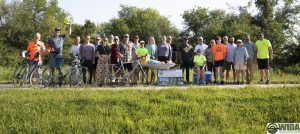
Photos courtesy of Pottawattamie County Trails Association and Western Iowa Development Association. (Via Pottcounty-ia.gov)
In addition to the TAP award, the Weston–Underwood segment has also received $500,000 through the State Recreational Trails Program, approved by the Iowa Transportation Commission in November 2025. This funding is part of a broader, multi-source approach to advancing the project.
These awards do not fully fund the Weston–Underwood segment. Pottawattamie County is awaiting decisions on two additional grant applications, expected in the coming months, that could help close the remaining funding gap.
Additional updates will be shared as the project continues through required planning and authorization steps.
(Radio Iowa)- Iowa Agriculture Secretary Mike Naig is asking lawmakers to boost funding for the state’s “Choose Iowa” program that supports individuals and businesses that produce everything from locally grown food to trees and soy candles. There’s a one-hundred dollar yearly fee for enrolling in the program, which launched in 2023. The number of participating businesses jumped 113 percent last year. “We want to continue to grow that membership — recruit new members, retain existing members (and) increase consumer awareness. The more that consumers know that Choose Iowa’s out there, the more they’ll look for it, the most products will be sold,” Naig said. “And, of course, we also are now really going the next level of how do we help connect our Choose Iowa members with distributors, with retail, you know, try to get to where they can sell some larger quantities on a more predictive basis.”
Naig is asking for a 300-thousand dollar boost in the Choose Iowa program budget. He’d use part of that money to hire someone with experience in getting products placed in retail locations. “Recognizing that we’ve got members that are just getting started. You’ve got members who are in a growth potential,” Naig said. “You’ve got other members where they are at a point where they need to get into distribution now. They are really looking to grow big.”
The program handed out half a million dollars in grants to businesses this past year and Naig says each state tax dollar awarded to a Choose Iowa business led to nearly a dollar of matching local investment.
(Radio Iowa) – President Donald Trump announced work is underway to make E-15 available nationwide during his stop in Iowa Tuesday. Iowa Congresswoman Ashley Hinson, a fellow Republican, says supporters can’t let up until the issue is done. “While our farmers are hurting and our ag economy is on the brink….I’m telling in these conversations with my colleagues, half measures are unacceptable. And so we need to make sure we’re delivering on E-15,” Hinson says. Hinson says she recently had a conversation with a member of the U-S-D-A about the high cost of fertilizer.
“U-S-D-A is very aware, and so is Secretary Rollins, of input costs and what our folks are facing,” she says. President Trump also talked about the payments to farmers to offset loses from tariffs and Hinson says those will help. ” I think it’s a good start, but farmers don’t want checks, they want markets, and that is what we need to be focusing on,” she says.
Hinson is from Marion and currently represents Iowa’s Second Congressional District, but is running for the open U-S Senate seat.
Cass County: Corn $4.07 Beans $10.18
Adair County: Corn $4.04 Beans $10.21
Adams County: Corn $4.04 Beans $10.17
Audubon County: Corn $4.06 Beans $10.20
East Pottawattamie County: Corn $4.10 Beans $10.18
Guthrie County: Corn $4.09 Beans $10.22
Montgomery County: Corn $4.09 Beans $10.20
Shelby County: Corn $4.10 Beans $10.18
Oats: $2.61 (same in all counties)
(Prices are per bushel; information is from the area Farm Service Agency [FSA] offices)
ALGONA, Iowa (IOWA CAPITAL DISPATCH)— The Iowa Department of Agriculture and Land Stewardship has detected a second outbreak of the highly pathogenic avian influenza in a Kossuth County mixed-species flock in a week. A spokesperson with IDALS said the flock had about 25,000 birds. The outbreak occurred at a mixed-species game bird hatchery and included pheasants, quails and chukars, a game bird in the pheasant family. The previous bird flu detection in Kossuth County occurred Thursday in a flock of chickens and game-bird pheasants and affected about 7,120 birds. The spokesperson could not disclose if the outbreaks occurred at the same facilities.
This is the second, 2026 outbreak of the H5N1 strain of the bird flu in Iowa. Since the start of the current outbreak, which began in 2022, more than 186 million domestic birds, nationally, have been affected by the strain of the virus, according to the U.S. Department of Agriculture’s Animal and Plant Health Inspection Service.
The current public health risk of the highly pathogenic avian influenza is low, according to the U.S. Centers for Disease Control and Prevention, as the flu is not currently known to spread between humans.
IDALS urges livestock producers to “continue bolstering” biosecurity measures on their operations to prevent future outbreaks. Additionally, producers who detect symptoms like lethargy, a sudden increase in deaths, swollen heads, or difficulty breathing in their flocks, should contact their veterinarians immediately. The highly pathogenic avian influenza has also been detected in wild birds in Iowa. The Iowa Department of Natural Resources urges Iowans who notice 20 or more sick or dead birds in an area to contact the department.
(Radio Iowa) – D-N-R state deer biologist Jace Elliott says hunters took just shy of 102-thousand deer through the various seasons this year, which is similar to last year. He says the numbers varied quite a bit through each region. “Some places that stand out are the Cedar Valley in east central and northeast Iowa. We continue to see increasing harvest rates there, likely due to increasing deer populations. But then much of the rest of the state, central, southern, and western Iowa, were behind the five-year average,” he says. “It’s safe to say that in most of the state, we’re seeing population declines. Certainly the western third of the state, as well as much of southern Iowa and central Iowa for that matter,” Elliott says.
He says disease is likely the biggest issue with deer populations. “Population declines are likely a combination of multiple factors, but one thing that we can’t rule out is the E-H-D outbreaks that were reported in 2023 and 2024,” he says. “Those certainly played a big role in some of the population impacts that we’re still dealing with today.” Elliott says it will take some more time to recover from the outbreaks. “It really is situational, over the past we’ve seen some counties bounce back in two to three years after a severe outbreak. But that’s kind of the best case scenario,” Elliott says. “Counties with limited habitat and therefore limited deer populations are likely going to take longer to recover.”
Elliott says one thing that hasn’t changed is the number of people who put on some orange and head out to hunt deer here. “We have very stable hunter numbers in Iowa, which is unique because most of the Midwest and Eastern U-S in general is declining. each year. And we have a relatively stable number of deer hunters, I think likely due to the high quality deer population we have throughout much of the state,” he says. Elliott says the D-N-R will continue to analyze the deer numbers and base the various license allocations on the population of deer in each county.
The D-N-R does an annual spotlight survey every spring to get a handle on the number of deer in the state.
(Radio Iowa) – Many Iowa farmers can expect to pay slightly more to plant, maintain and harvest a crop in the year ahead, according to a new report from Iowa State University Extension and Outreach. Ann Johanns, an ag decision maker program specialist with the extension, says producers will face tight margins in the 2026 growing season. “So on corn production, overall, it was about 4% higher than last year, and then the soybean total costs were about 2% higher, and it ranged within the different categories,” Johanns says. “Labor was just a little bit higher at 1%, and then machinery costs were around 3% to 4%, depending on kind of what type it was.”
The extension’s report, called Estimated Costs of Crop Production in Iowa 2026, takes into account that average market prices for corn and soybeans are projected to stay below production costs, making for a challenging situation. On the plus side, Johanns says the projected land costs came down slightly. “We take data from the cash rent survey that Iowa State does every spring and then, we take input from our specialists and people that we survey for the estimated cash crop production and take that all into account,” Johanns says. “They did all project a slight decrease in the land costs that we use, and of course, every farm operation is going to be different.”
Johanns says opportunities for profit are expected to be limited this coming year, underscoring the importance of careful cost tracking and farm-specific planning, which is where the extension can help farmers to plan.”We have corn and soybean budgets, but there’s a low till budget, there’s a strip till budget, and so they can look at multiple types of production,” Johanns says. “There’s also some budgets in there for hay, for alfalfa ground, there’s choices within these budgets, so we have some tools online to help people do the calculations themselves.” Johanns says the report’s figures should be used as planning benchmarks, not exact estimates for individual farms, adding, farm-level cost data is vital information for producers to track.
Cass County: Corn $4.08 Beans $10.17
Adair County: Corn $4.05 Beans $10.20
Adams County: Corn $4.05 Beans $10.16
Audubon County: Corn $4.07 Beans $10.19
East Pottawattamie County: Corn $4.11 Beans $10.17
Guthrie County: Corn $4.10 Beans $10.21
Montgomery County: Corn $4.10 Beans $10.19
Shelby County: Corn $4.11 Beans $10.17
Oats: $2.59 (same in all counties)
(Prices are per bushel; information is from the area Farm Service Agency [FSA] offices)

 Facebook
 Twitter
 YouTube
 RSS
RSS