

CLICK HERE for the latest market quotes from the Iowa Agribusiness Network!
CLICK HERE for the latest market quotes from the Brownfield Ag News Network!


CLICK HERE for the latest market quotes from the Iowa Agribusiness Network!
CLICK HERE for the latest market quotes from the Brownfield Ag News Network!
(Radio Iowa) – A 36-year-old man is charged with causing a diesel fuel spill near Dallas Center, at a site owned by his former employer. Aaron Wayne Peek of Des Moines is charged with theft, criminal mischief and trespassing. The Dallas County Sheriff says video footage from cameras at the site showed Peek, a former employee of the farm company, tampered with an above ground tank early Saturday morning, releasing four-thousand gallons of diesel fuel.
About 10-thousand dollars worth of diesel was spilled and it reached a creek near Waukee.
State officials estimate the environmental cleanup will cost over 100-thousand dollars.
(Radio Iowa) – Governor Reynolds has signed a bill into law to make it a crime for unauthorized drones to be flown over anything on an Iowa farmstead that covers at least 40 acres. A 2024 has already prohibited drones from flying over animal feeding operations and homesteads. The new law will forbid secret surveillance of farm equipment, crops and any farm animal as well as barns, sheds and other structures on the farm. Representative Derek Wulf, a farmer from Hudson, says it’s an important expansion of last year’s law.
Senator Dan Zumbach (ZUM-bah), a farmer from Ryan, says drones scare livestock.*
It will be a simple misdemeanor to fly a drone over a farmstead — and a serious misdemeanor if the drone can capture audio or video. The law will not apply to farm property that is within city limits.
***********
Other bills signed-into law Tuesday by Governor Reynolds include:
Washington, D.C., May 6, 2025 — The U.S. Department of Agriculture’s Food and Nutrition Service (FNS) will require States to make certain all records associated with Supplemental Nutrition Assistance Program (SNAP) benefits and allotments are shared with the federal government. The announcement was made today (Tuesday), but U-S Ag Secretary Brooke Rollins, who said “President Trump is rightfully requiring the federal government to have access to all programs it funds, and SNAP is no exception. “
Rollins said “For years, this program has been on autopilot, with no USDA insight into real-time data. The Department is focused on appropriate and lawful participation in SNAP, and today’s request is one of many steps to ensure SNAP is preserved for only those eligible.”
On March 20, 2025, President Trump signed Executive Order 14243, Stopping Waste, Fraud, and Abuse by Eliminating Information Silos, requiring agency heads to “take all necessary steps, to the maximum extent consistent with law, to ensure the federal government has unfettered access to comprehensive data from all State programs that receive federal funding, including, as appropriate, data generated by those programs but maintained in third-party databases.”
The Supplemental Nutrition Assistance Program is federally funded, administered by States, and includes relationships with processors and retailers, among others, all of which are information siloes. Today’s guidance prioritizes program integrity and will allow FNS, for the first time, transparency into the data long only held by States and Electronic Benefits Transfer (EBT) processors.
(Council Bluffs, Iowa) – Officials with the Connections Area Agency on Aging report Farmers Market vouchers are available for seniors meeting income requirements. Vouchers can be used at participating area Farmers Markets to buy $50.00 worth of fresh, locally grown fruit, vegetables, herbs and honey. The Vouchers are valid June 1st through October 31st. Connections says they regret that not being able to distribute vouchers at the same level as in previous years. The USDA provided Connections with 1900 sets of vouchers in 2024. This year the Agency received 750 sets of vouchers for its 20-county service area.
Applications will automatically be mailed to anyone that received vouchers in 2024. Individuals will be randomly selected to receive Farmers Market vouchers. Only one set of vouchers per household.
2025 Farmers Market Process:
Farmers Market distribution will be done by mail ONLY. 
Connections encourages citizens to voice their support for the program by contacting your US members of Congress and share why the program is important to you:
Joni Ernst DC Office (202) 224-3524 Zach Nunn DC Office (202) 225-5476
Chuck Grassley DC Office (202)224-3744 Randy Feenstra DC Office (202) 225-4426
(Radio Iowa) – The Dubuque City Council passed an ordinance Monday against feeding or harassing bears. During discussion of the ordinance, the D-N-R’s Ross Ellingson said the idea is take away the things that lure the bear in.
Ellingson said bears are becoming more prevalent in Iowa due to the large populations of black bears in neighboring states.
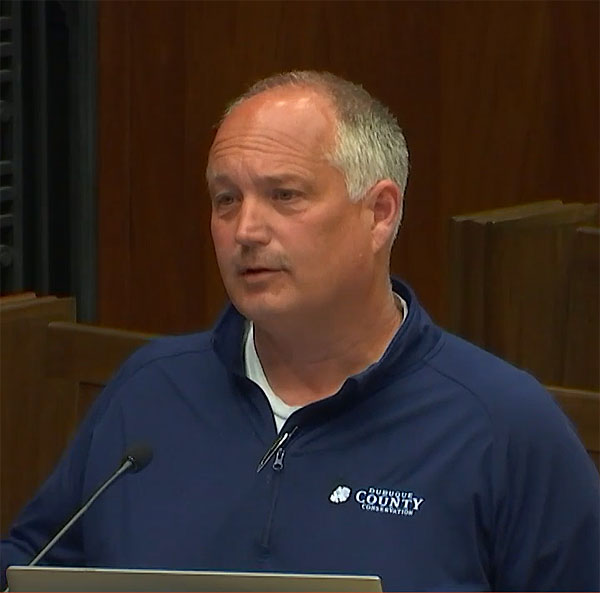
Brian Preston. (photo from Dubuque Council meeting video)
Dubuque County Conservation executive director, Brian Preston, said there is one bear that now lives near the city.
Preston said they are trying to emphasize that feeding the bears is not a good thing.
People who feed the bears could face a fine of up to 750 dollars. The ordinance could also require a resident to take down a bird feeder to deter bears. Residents are advised to stay away from bears and not follow them to try and get a picture or video. Harassing bears to get them to go away is not allowed under the ordinance, as the expert said that could lead to more unwanted interaction with the bears.
Wet conditions kept some farmers out of the fields last week, while others were able to get plenty of planting done. Radio Iowa’s Dar Danielson reports.
Ten percent of the corn has already emerged, and five percent of the soybeans have emerged.
(Radio Iowa) – One month after the Trump administration announced sweeping tariffs on imports to the U-S, the pork and soybean industries are closely watching how countries respond. Weekly export sales for U-S pork recently hit a marketing year low, in part because China cancelled a contract for 12-thousand metric tons. Iowa State Extension economist Chad Hart says agricultural export sales fluctuate, but aggregate data over the last four months shows countries are buying less U-S pork.
Hart says the majority of soybean export sales have already been made and delivered for the current marketing year, which ends in August. He says the U-S/China trade war could have a much greater impact on the soybean industry if retaliatory tariffs are still in place this fall.
Hart says corn exports have been up despite the tariff chatter, but countries have pulled back purchases of U-S pork since January. He says the 10 percent baseline tariffs on almost all imports into the U-S could make it harder to find new trading partners for farm products.
(Radio Iowa) – Iowa State University will begin offering the state’s first four-year degree in digital and precision agriculture this fall. I-S-U associate provost Ann Marie VanDerZanden presented the program during the recent Board of Regents meeting, and says it will train students in technology and data analysis.
VanDerZanden says precision ag has come a long way.
VanDerZanden says surveys and discussions with ag equipment manufacturers shows a need for more people who understand the methods. And she says I-S-U students are anxious to get involved.
VanDerZanden says their projections show the program will take off quickly.
Several Iowa community colleges offer an associate degree or certificate in precision agriculture, and VanDerZanden says I-S-U will work with these colleges to develop articulation agreements. Information shows South Dakota State University is the only one in the Midwest that offers a major in precision agriculture, but it does not require the level of specialization that the I-S-U degree will require.
(Radio Iowa) – The Iowa Department of Natural Resources is using a mix of conventional and modern methods as it tries to figure out why the population of the gray fox has rapidly declined in the state. Wildlife biologist Vince Evelsizer says they started the study by putting tracking devices on a couple of the animals.
They are also reviewing photos from stationary trail cameras set out in areas where the animals live.
Evelsizer says new A-I technology is helping them look for clues in those thousands of photos.
He says D-N-R experts finish off the work after the A-I review.
Evelsizer says they hope the information gained from tracking the gray fox and the photos will help them learn why their populations have dramatically dropped.
(Wiota, Iowa) – Members of the Cass County Cattlemen’s organization have selected 2025 Royalty. Officials report their selection was made April 22nd, at the Wiota Steak House, after a personal and dinner interview was conducted. Royalty for the year are:
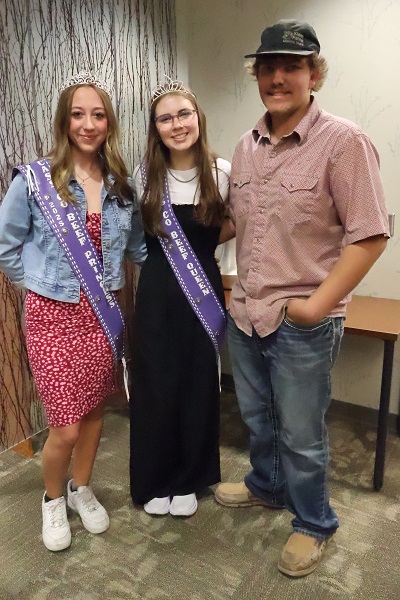
Cass County Cattlemen Royalty for the year are: (from Left) Princess Addi Masker (Atlantic), Queen Jacquie Freund (Lewis), and Ambassador Hayden Kleen (Atlantic).
The group of young people will represent Cass County Cattlemen in parades, promote beef at various speaking events, and help at the Beef Quarters at the Iowa State Fair.
The Princess, Queen and Ambassador presented officials with Cass Health in Atlantic, a “Happy First Baby” May Day Basket. The basket of beef products will be given to the first baby born at Cass Health, in May. Each baby born during the month will receive a bib “When I get teeth, feed me beef”. May is beef month. (Photos & info submitted to KJAN)
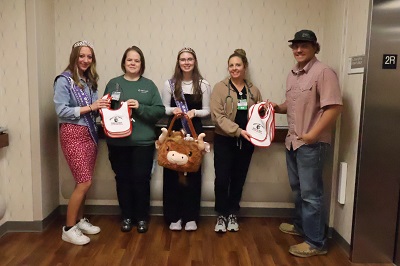
Princess Addi Masker, Nurse Brooke Dreager, Queen Jacquie Freund, Nurse Britini Olson, and Ambassador Hayden Kleen show the basket of beef products given to the first baby born at Cass Health in May.


 Facebook
 Twitter
 YouTube
 RSS
RSS