

CLICK HERE for the latest market quotes from the Iowa Agribusiness Network!
CLICK HERE for the latest market quotes from the Brownfield Ag News Network!


CLICK HERE for the latest market quotes from the Iowa Agribusiness Network!
CLICK HERE for the latest market quotes from the Brownfield Ag News Network!
(Radio Iowa) – A bill that would tax the liquid carbon dioxide flowing through a proposed pipeline has cleared an Iowa Senate committee, although lawmakers who advanced the bill say they’ll work on the mechanics of how the state tax would be assessed. Senator Dan Dawson, a Republican from Council Bluffs, says he’s interested in having the state collect taxes from the project. “The State of Iowa has invested substantially in the ethanol industry,” Dawson said. “…We’ve can’t just exempt things up front, let a bunch of revenue generate and then all the monies that we spent on these things, nothing is ever returned back to the taxpayer.” Jake Ketzner, a lobbyist for Summit Carbon Solutions — the pipeline developer, says the company opposes the bill.
“Just like any other tax, it increases the cost of doing business and it increases the cost of the service we would provide our customers, which in our case is the ethanol plant producers,” Ketzner said. “We’re rather see ethanol producers paying farmers more for their corn instead of paying for a new tax to the government.” Dawson, the chairman of the Senate Ways and Means Committee, questions why Summit should get a special “carve out” after telling the Iowa Utilities Commission its project is a benefit to the public. “You can’t just say it’s a public benefit and then have a declaration made by the IUC for eminent domain and then the public doesn’t benefit,” Dawson said. Pipeline critics urged legislators to focus instead on a different bill focused on eminent domain, to protect the property rights of landowners who don’t want the pipeline on their farms.
Kathy Carter owns land in Floyd County that’s along the proposed pipeline route. “It’s a pat ’em on the head, make ’em feel good gesture,” Carter said. “Throw Iowans a bone and they’ll shut up.” Julie Glade, a Wright County landowner, also testified during the Senate subcommittee hearing. “I guess unless you in the senate know something we don’t, there is no pipeline yet. Why are you looking at a revenue stream from a pipeline project to nowhere right now? It seems like Senate leadership and the governor for some reason want this project to happen so badly, they have to manufacture reasons to push ahead.”
The bill is sponsored by Senate Majority Leader Mike Klimesh. It would set two tax rates, one for carbon that’s eventually used to extract oil from underground reserves and a higher rate for liquid carbon directed to other uses.
(Radio Iowa) – Iowa’s in the midst of a what’s called a snow drought, according to the state climatologist. While we had three weekends in a row of heavy snows starting right after Thanksgiving, Justin Glisan says there’s been very little statewide snowfall since then. While some Iowans may rejoice at having to do less shoveling, Glisan says it may become a problem once spring arrives — especially for farmers — if there’s little snowmelt and runoff in our rivers. “We’re in a snow drought across the upper Midwest,” Glisan says. “We’ve been running, after a fast start at the end of November and into December, we’re about 2.3 inches statewide average, and that’s about 6 inches below average.”
The new year started out warmer than normal in Iowa, which meant winter storms were dropping more rain than snow. “The interesting thing on the precipitation side is the rainfall event we had early in January,” Glisan says. “We had a wide swath of rainfall — in January — that amounted to, through the state, over nine-tenths of an inch for the monthly average, and that’s about 4/100ths below average.” January was something of a roller-coaster month for temperatures, Glisan says, but we ended up with an average statewide temp of 19-point-3 degrees, just two-tenths of a degree below average. “If you look at the first half of the month, we were running six degrees warmer than average, and then the cold snap through the end of the month dropped that average by about six degrees,” Glisan says, “so here we are, just right around average in terms of temperature.”
Long-range forecasts point to that groundhog being correct, he says, with six more weeks of winter ahead. “If you look at the short-term outlooks for the first half of the month, though, they tell a different story on the temperature side,” Glisan says, “higher probabilities of warmer-than-average temperatures, and we’ll see the temperatures rise through this week and into next week.”
Forecasts call for parts of Iowa to see temps climb into the 50s next week. While the calendar shows winter will last through March 19th, meteorological winter ends February 28th.
(Atlantic, IA) – The Board of Supervisors in Cass County, Tuesday morning, discussed the issue of farmland transition within farm families. The discussion was spearheaded by Jim Steffen, President of the Massena Corporation, who Board Chair Steve Baier acknowledged has worked over the years to help shape rural development projects and the future of rural counties. Steffen said his family owns two farms in the area.
Steffen, who is 83-years-old, said those properties will be sold unless they can do something different with them. The solution, he hopes is for he and his business partners with the Massena Corporation, to work with what are called “production units.”
He says the idea is not to “aggregate a whole lot of land and a whole lot of legal and operating responsibility.”
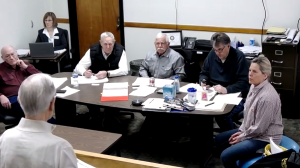
Massena Corp. President Jim Steffen speaks w/the Cass County BOS, 2-3-26
Steffen didn’t ask the Board for any contribution from the County or County services, but he is looking for local investors to help build-out the production units.
He said the only thing he would ask from the Supervisors, is to think about what the Massena Corporation is trying to accomplish, and perhaps help to sponsor or facilitate land owner meetings on the topic.
Board Chair Steve Baier said, “If there’s something we can do from an economic development standpoint,” he’s interested, especially if it gets younger people interested in production agriculture and cattle, including the possibility of working with local lockers, to form some sort of consortium for livestock producers.
Additional information on the Massena Corporation production unit concept is expected to be forthcoming.
Cass County: Corn $4.09 Beans $10.19
Adair County: Corn $4.06 Beans $10.22
Adams County: Corn $4.06 Beans $10.18
Audubon County: Corn $4.08 Beans $10.21
East Pottawattamie County: Corn $4.12 Beans $10.19
Guthrie County: Corn $4.11 Beans $10.23
Montgomery County: Corn $4.11 Beans $10.21
Shelby County: Corn $4.12 Beans $10.19
Oats: $2.76 (same in all counties)
(Prices are per bushel; information is from the area Farm Service Agency [FSA] offices)
(Atlantic, IA [this story & photos submitted by an Atlantic FFA reporter, via FFA Advisor/Ag Instructor Eric Miller]) -The Atlantic FFA Chapter welcomed Iowa FFA State Officer Laura Steinkamp and District Officer Tucker Olsen to a chapter visit on January 29th, 2026. While at the high school, they discussed opportunities in FFA and the students participated in leadership-building activities.
During a year of service to the organization, Iowa FFA officers serve as ambassadors for agriculture and the FFA. They travel to FFA chapters throughout the state to connect with members and talk about the many opportunities available to students enrolled in agricultural education. Atlantic FFA member Tenley Cappel said, “I had a lot of fun. It was neat to see how our class could cooperate to solve a problem.”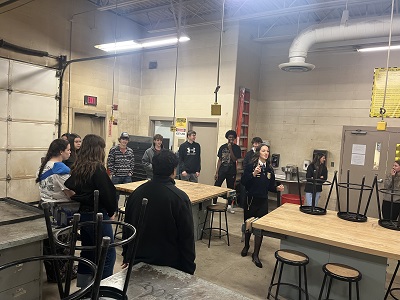
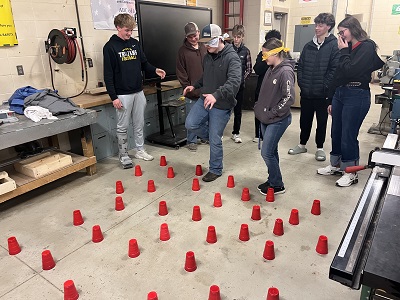
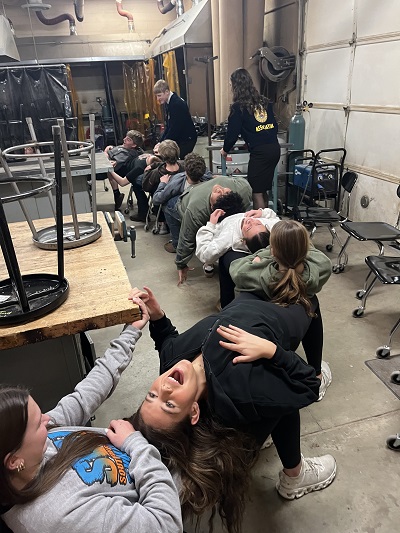
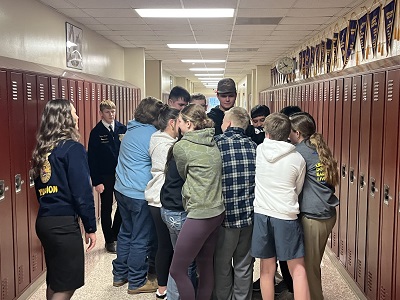
Each Ag Class has a lesson tailored to meet the needs of the individuals in the class. Some workshops are based on Leadership Skills, others on Team Building and finally FFA Chapter Recruitment. Each class begins with an introduction of an ice breaker activity used to get the State Officers and the students in the class introduced to each other. This is followed by a game or activity designed to highlight a specific leadership skill or team building activity. Atlantic FFA member Caden Noelck said “It was a lot of fun playing games and learning about leadership activities in class”.
Agricultural education incorporates three aspects of learning. The classroom provides basic knowledge. FFA develops leadership and personal skills. A Supervised Agricultural Experience (SAE) provides hands-on learning while working or in an agricultural business.
The Iowa FFA Association comprises 270 local chapters preparing over 20,000 students for future career opportunities. FFA activities and award programs complement instruction in agricultural education by giving students practical experience in applying agricultural skills and knowledge gained in classes. Through agricultural education, FFA makes a positive difference in students’ lives by developing their potential for premier leadership, personal growth, and career success.
Cass County: Corn $4.09 Beans $10.20
Adair County: Corn $4.06 Beans $10.23
Adams County: Corn $4.06 Beans $10.19
Audubon County: Corn $4.08 Beans $10.22
East Pottawattamie County: Corn $4.12 Beans $10.20
Guthrie County: Corn $4.11 Beans $10.24
Montgomery County: Corn $4.11 Beans $10.22
Shelby County: Corn $4.12 Beans $10.20
Oats: $2.76 (same in all counties)
(Prices are per bushel; information is from the area Farm Service Agency [FSA] offices)
(Radio Iowa) – Iowa D-N-R state deer biologist Jace Elliott says there were a few more counties added to the list of those with positive Chronic Wasting Disease (CWD) tests in deer following this year’s hunt. There are now 38 of the 99 counties with at least one positive detection “I believe we have around a dozen new counties this year,” he says. Elliott says it is a slow moving disease, but it can sometimes turn up where they don’t expect it. “In a lot of cases, we see kind of a slow creep of the edge of the disease into new counties, but often times we also detect sort of random seeming counties that are not bordering a previously positive detection,” he says. The first positive case of C-W-D was confirmed in deer in northeast Iowa along the Wisconsin board in 2013. Elliott says they started testing way before that to be prepared.
“So each year we test around five-thousand deer for C-W-D across the whole state. We’ve been maintaining those numbers since roughly 2002, the early 2000s,” he says. “Now, where we focus our effort depends a little bit on where we’re detecting the disease. We’re currently in the process of looking at new strategies in order to maximize our resources.” He says the game plan is to try and slow the spread of the disease. “Really, what we’re doing in Iowa is trying to maintain balanced quality deer populations, because we’ve known from past states experiences that this disease can spread in low densities and high densities,” Elliott says. “So we’re just again committed to maintaining that balanced quality deer population as much as we can through regulations.” C-W-D is a disease that is fatal to the animals.
You can find out more about the C-W-D cases in Iowa on the D-N-R’s website at iowadnr.gov, and look for the C-W-D interactive dashboard.
(Radio Iowa) – Iowa’s Secretary of Agriculture visited the new Career Ag Academy on the Hamilton County Fairgrounds in Webster City over the weekend. Mike Naig says high school students there can receive dual-credit courses with Iowa Central Community College and with Iowa State University. “I’ve been able to tour some really good models around the state,” Naig says, “bringing livestock, bringing that opportunity to get our high school students a hands-on opportunity. I know I learned better where you match that in classroom with the experiential learning. Of course, it’s one of the things that we love about ag education and FFA in particular.”
The academy has been active since the start of the current school year, working to educate students about agriculture.”We really need to create these pathways where it’s not just farm kids that are getting a chance to do these types of things and be around livestock and get the experience of doing chore, but any kid, any student, regardless of where you come from, can get to do that,” Naig says. “We need more people working in ag, and if we’re going to get more people working in ag, we need students from all backgrounds to learn about those opportunities.”
Naig says he’d like to see more such career ag academies pop up all over Iowa. “You got to learn to do chore and you got to learn what’s the right feed ration and how do you create the right environment for those animals? But then, of course, you’re going to connect the dots and you’re going to talk about, well, where’s that feed come from? What’s the grain side of it? Oh, also, how about the meat side of it, the nutrition side of it, the culinary arts?” Naig says. “I mean, you really start to string this together and it’s just a farm-to-fork kind of experience.”
Ground was broken on the facility last March. It houses classrooms, a dedicated livestock learning area and meat lab. A date has not yet been announced for its official grand opening and open house for the public.
Cass County: Corn $4.09 Beans $10.22
Adair County: Corn $4.06 Beans $10.25
Adams County: Corn $4.06 Beans $10.21
Audubon County: Corn $4.08 Beans $10.24
East Pottawattamie County: Corn $4.12 Beans $10.22
Guthrie County: Corn $4.11 Beans $10.26
Montgomery County: Corn $4.11 Beans $10.24
Shelby County: Corn $4.12 Beans $10.22
Oats: $2.75 (same in all counties)
(Prices are per bushel; information is from the area Farm Service Agency [FSA] offices)
(Radio Iowa) – Brian Meyer — the leader of DEMOCRATS in the Iowa House — says says a silent majority of Iowans want the carbon pipeline built and he says the Senate’s REPUBLICAN leader has proposed a resolution that will end the stalemate.
“I think it’s probably the most likely to pass, with maybe some tweaking around the edges,” Meyer said. “It’s my personal opinion that actually would be a way forward.” Senate Majority Leader Mike Klimesh is offering a bill that would expand the proposed pipeline corridor, so Summit Carbon Solutions could go around unwilling landowners and find people who’d let the pipeline run through their land. Meyer is one of 21 Democrats in the House who voted against a bill this month that would completely ban the use of eminent domain to seize land along the pipeline route.
“It’s just not a real bill,” Meyer said. “…At some point we need to sit down and have a conversation and negotiate a way forward on this pipeline.” Some Republicans like Adam Steen, who’s running for governor, have suggested the push to protect the property rights of landowners who oppose the pipeline is among the top campaign issues of 2026. Meyer says the Senate G-O-P leader’s bill is the best way to resolve the issue.
“I think there’s a lot of people in rural Iowa that want the pipeline and you have to look at everybody,” Meyer said, “not just 250 people that show up at the Capitol with red shirts on.” That’s a reference to landowners and their supporters who’ve gathered at the Iowa Capitol most Tuesdays during the past few legislative sessions, urging legislators to either block the pipeline or at least give them the right to say it can’t be on their property.”That’s certainly something to take into account and it’s very important that we address those issues with eminent domain and we protect property rights,” Meyer said, “and I think the Senate bill does its best to do that.”
But Meyer says it’s time to get the pipeline started. “There’s a lot of people in rural Iowa who are kind of the silent majority that want this to get done,” Meyer said, “because we need to address the economic realities in rural Iowa with corn and ethanol.”
Meyer made his comments today (Friday) during taping of “Iowa Press” which airs tonight (Friday) on Iowa P-B-S.


 Facebook
 Twitter
 YouTube
 RSS
RSS