

CLICK HERE for the latest market quotes from the Iowa Agribusiness Network!
CLICK HERE for the latest market quotes from the Brownfield Ag News Network!


CLICK HERE for the latest market quotes from the Iowa Agribusiness Network!
CLICK HERE for the latest market quotes from the Brownfield Ag News Network!
(Radio Iowa) – The Iowa D-N-R is moving closing to making some changes in hunting and trapping regulations. The D-N-R’s Chris Ensminger discussed findings from public input meetings during the recent Natural Resources Commission meeting. “For deer, just general comments, we received 427, which is over half of the total comments received for just general comments, 110 for Waterfall, 112 for furbearers. Turkeys received 32 upland 66,” he says. Ensminger says the deer comments focused on some key areas. “Our population is too low, saw too few deer. E-H-D numbers were much higher than reported. People are asking to reduce or eliminate party hunting, reduce or eliminate antlerless tags, limit everyone to one buck, or need a buck only in all gun seasons. And so those six comments, out of 106 unique comments, that represent 42 percent of the total,” Ensminger says.
He also talked about in more detail about the furbearer comments. “Support a bobcat season in additional counties, increase the bag limit for bobcats, increased the otter bag limit, and I would like a bounty program. Those four comments resulted in 60 percent of the program discussions,” he says. Ensminger says the upland comments focused on the population of pheasants and game birds. He says there were also comments about allowing out-of-state hunters. “Eighty percent of the people would like to see us do something different, further regulate non-resident opportunity. Twenty percent would not like to see that. So you can think of that one as about an 80-20 issue,” Ensminger says.
Ensminger says the D-N-R staff will start to look at some rule changes based on the comments. He says they do have some three public meetings scheduled for May 19th through the 21st to get some input on possible changes. “We do have public meetings scheduled for May 19th through the 21st, three meetings, and we will have a kind of more defined proposal that will be taken out to those folks as far as what the core regulations might look like, the core concept would look like, and then we’ll be asking for them, obviously, do they support that still?,” he says. “And what other additional things, you know, do you want to have party hunting as part of those regulations? Do you want to, what do you want to do with the youth season? You know, because we’ve heard people say that, youth should not be impacted by any kind of additional regulations.”
Ensminger says they will be releasing information on antlerless deer licenses in June. He says proposed rule changes would come in July and go into effect in 2026.
(Radio Iowa) – Republican Senators met for hours today (Friday) to privately debate restrictions on the proposed Summit Carbon Solutions Pipeline, then emerged late this (Friday) afternoon and adjourned for the week without taking any public action. Pipeline opponents say it was a stunning development after being told a bill would come up for a vote. Dennis King, a fourth generation farmer from Clay County, says the bill easily passed the House weeks ago with 85 out of 100 possible votes.
A dozen Republican senators have vowed to boycott votes on state spending plans until the senate votes to limit the pipeline company’s authority to seize land for the project.
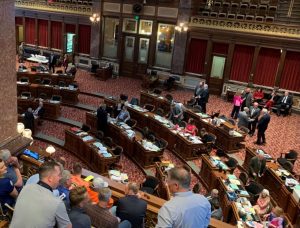
A crowd in Iowa Senate viewing gallery awaited the start of debate on May 9, 2025. (RI photo)
Cindy Hanson and her sister are opposed to having the pipeline on their family’s Century Farm in Shelby County.
Monte Shaw of the Iowa Renewable Fuels Association was at the capitol all day, too, lobbying against any move by legislators that would block the pipeline’s construction.
Having senators shelve the bill is also a win for the ethanol industry.
The senate’s only votes today (Friday) were to confirm three officials to seats on state boards and commissions and made changes in an education related bill.
(Radio Iowa) – Iowa Congresswoman Ashley Hinson says she’s enthusiastic about the trade agreement reached Thursday between the United States and the United Kingdom. Hinson, a Republican from Marion, says there’s promise the new accord will mean Iowa farmers will find more avenues to sell their products in the U-K and elsewhere, though only portions of the deal are being unveiled.
Initial reports of the trade agreement say the U-K will be making the customs process smoother, while buying more American commodities, including beef and ethanol.
As part of the trade deal, reports say President Trump agreed to cut tariffs on U-K-made vehicles, steel and aluminum, but the original ten-percent tariff on British goods is to remain in place. Hinson remains optimistic more trade agreements are pending with other nations.
Reports say the Brits also agreed to reduce tariffs on hundreds of U-S products, everything from sporting goods to olive oil.
Cass County: Corn $4.26 Beans $9.90
Adair County: Corn $4.23 Beans $9.93
Adams County: Corn $4.23 Beans $9.89
Audubon County: Corn $4.25 Beans $9.92
East Pottawattamie County: Corn $4.29 Beans $9.90
Guthrie County: Corn $4.28 Beans $9.94
Montgomery County: Corn $4.28 Beans $9.92
Shelby County: Corn $4.29 Beans $9.90
Oats: $2.84 (same in all counties)
(Des Moines, Iowa/Iowa Capital Dispatch) – Bills updating the grain indemnity program and allowing the Iowa Department of Agriculture and Land Stewardship clean titles on livestock they take over, advanced Thursday from the Iowa House. Lawmakers appear to have resolved differing opinions on grain indemnity limits and including credit-sales, which has been a roadblock for similar bills in the past, though the Senate will have to give final approval to the amended bill. Rep. Norlin Mommsen, R-DeWitt, who managed the bill, said there were a lot of opinions on the policy, which left him feeling “caught between a rock and hard spot.”
“I believe, at the end of the day, we have a better product because of that cooperation between everybody,” Mommsen said. Although the House accepted some of the Senate’s version of the bill, Mommsen proposed an amendment to Senate File 608. Mommsen explained grain indemnity as being “like FDIC insurance on a savings account.” Since the 1980s, when it was created, the grain indemnity fund has helped farmers get paid for sold grain when their buyers go broke.
Farmers pay a per bushel fee into the grain indemnity fund when the fund is below its lower boundary, and they stop paying once it reaches the upper boundary. The fund stayed above the minimum for nearly 30 years until 2023, when the bankruptcy of a soybean dealer triggered more than $3 million in indemnity claims from affected farmers and depleted the funds. Mommsen said the goal was to “upgrade” the rules around the fund to “better respond to today’s market conditions.”
One such upgrade included increasing the fund’s minimum from $3 million to $8 million, and the maximum from $8 million to $16 million to reflect the changes. These figures reflected the original version of the House bill, but were an increase from the $5 million and $12 million figures in the version that passed the Senate. Cash-sale contracts would be reimbursed at 90% under the bill, which is consistent with current law. The bill updates the fund to include some credit-sale contracts and Mommsen’s amendment provided definitions for two different types of credit sales.
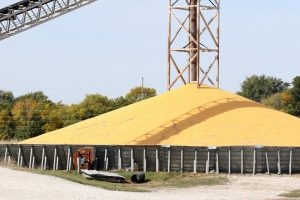
Harvested corn is piled near Lake City in western Iowa. (Photo by Jared Strong/Iowa Capital Dispatch)
Per the amendment, a deferred-payment contract means the dealer and seller agreed on a price for grain but the payment will take place more than 30 days from the date of delivery. These contracts are not eligible for indemnity claims. A deferred-pricing contract means the grain was delivered without an agreed-upon price. Farmers with these contracts can claim indemnity for 75% or up to $400,000 of their losses.
Earlier versions of the bill in the House only covered 70% of these types of sales, and the version of the bill that passed the Senate did not differentiate between the different types of credit sales. Mommsen said it was important to differentiate because deferred payments are like “an unsecured loan.”
Rep. J.D. Scholten, R-Sioux City, said it felt “pretty impactful” to have a bill in the House updating a fund that rose out of the farm crisis of the 1980s. “When we do have an agricultural recession we’re dealing with, when we’re dealing with tariffs that are causing uncertainty, farmers need to make sure they have the protection they (need),” Scholten said. “This may not be the perfect bill, but this is a good enough bill.”
IDALS announced in April the fund would stop collecting the fees in September since the current grain indemnity fund balance sits above $10 million, after collecting the fees since Sept. 2023. Mommsen said because the current balance is within the boundaries set by the bill, “there would be no need to reinstitute” assessment fees for the fund if the bill becomes law.
The amended bill passed 81-3.
(Iowa Capital Dispatch) – A report from a national conservation group says the Mississippi River is the nation’s most endangered river, because of federal plans to cut flood relief programs as severe weather threats grow. American Rivers, a nonprofit environmental advocacy organization, issued its annual list of U.S. rivers it views as most at-risk for the past 40 years. The Mississippi’s place at the top comes as communities along the lower river flooded from torrential rain in early April, and as Trump administration officials consider eliminating the Federal Emergency Management Agency, or FEMA, which helps state and local governments respond to disasters.
The list calls attention to the threats rivers face and prioritizes those for which the public can influence policies that affect their well-being, said Mike Sertle, senior director for American Rivers’ Central Region. For the Mississippi River, he said, the organization’s goal is to press the federal government to maintain a role in disaster relief, which it says is critical to safeguarding people in river communities.
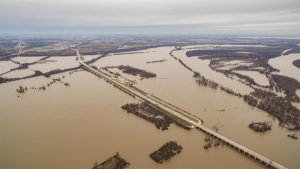
The Mississippi River rises to flood stage surrounding a highway outside Memphis in 2016. Memphis is again flooding this week after heavy rains. (Photo by Andrew Breig / Daily Memphian)
The Mississippi River has always flooded. While flooding threatens human structures, it is an important part of the Mississippi River’s life cycle and actually builds land. But experts say floods are growing more frequent, erratic and severe due to climate change. In 2019, the river’s most recent major flood, water stayed at or above flood stage for months and caused $20 billion in damage.
FEMA assists communities during floods and other types of disasters, provides funds for recovery and oversees preparedness efforts, like its flood maps that predict risks in different areas. And it’s doing so more often today. A January 2025 report to Congress found that the average number of major disaster declarations has increased by 61% from the 1980s and 1990s, partly due to climate change.
But it has faced broad criticism for not moving quickly enough after disasters and not helping disaster survivors equally. President Donald Trump has floated the idea of dismantling the agency and in February the agency fired more than 200 of its staffers as part of Trump’s push to shrink the size and scope of the federal government. The White House did not comment on the American Rivers’ report’s criticism of these actions.
DES MOINES – Drought conditions have improved across the state despite below-normal rainfall in April, according to the latest Water Summary Update. The Iowa Department of Natural Resource’s says after a wetter-than normal March, April saw below-average precipitation across all regions of the state. However, recent spring rains have helped alleviate drought and abnormally dry conditions across Iowa. April’s average statewide precipitation was 3.33 inches, or 0.34 inches below normal.
The state also experienced warmer weather, with statewide temperatures averaging 50 degrees, or 1.4 degrees warmer than normal. At the end of April, Iowa’s Drought Plan dry conditions improved or remained the same in all drought regions except the southeast, which only degraded slightly. A drought watch issued in March for the northeast region has been removed as severe drought has significantly decreased. Conditions remain stable in the other drought regions, with the entire state carrying a normal drought designation.
According to the U.S. Drought Monitor (USDM), just over half of Iowa continues to experience abnormally dry conditions or drought conditions. The May precipitation outlook from the National Weather Service’s Climate Prediction Center indicates a chance of below-average precipitation across the northeast and eastern half of the state, and an equal chance for above, below, or near-average precipitation for the rest of the state. Reduced rainfall in May could raise concerns about deteriorating conditions. 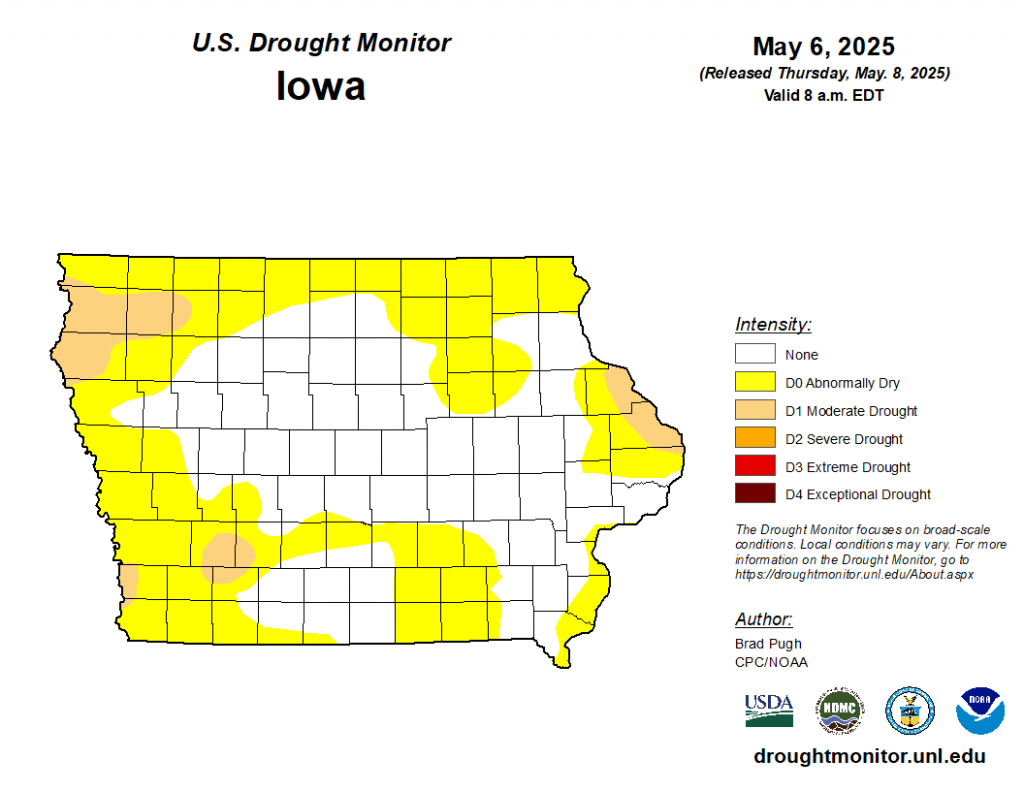
Iowa DNR Environmental Specialist Jessica Reese McIntyre says “Drought and dry conditions improved across the state due to spring rain in March and April, but most notably in northeast, west, and central Iowa. The drought watch issued in March for northeast Iowa has been removed. The National Weather Service precipitation outlooks predict an equal chance for the entire state for above, below, or normal precipitation for much of the state through July.”
(Radio Iowa) – The Iowa Natural Resource Commission today (Thursday) approved the state’s purchase of a former Boy Scout camp that covers nearly 18-hundred acres in the Loess Hills of western Iowa. D-N-Rs Land and Water Bureau Chief Travis Baker, spoke before the vote.
The D-N-R is purchasing the property from the Iowa Natural Heritage Foundation for five-point-one million dollars, three million less than the appraised value.
The D-N-R says the land acquisition will protect one of the largest contiguous regions of forest in western Iowa and result in more than 100 miles of connected public hiking trails. The former Little Sioux Scout Ranch is at the heart of the property with a 20-acre lake. Four Boy Scouts died when a tornado hit the camp in 2003. A memorial to those scouts will remain.
Baker says the D-N-R will close on the property this summer and it will be open to the public this fall. The purchase is funded by a four-point-six-five million dollars U-S-D-A Forest Legacy Grant and 500-thousand from the REAP Open Spaces funding.
(Radio Iowa) – The state budget lawmakers are developing includes five MILLION dollars for construction of an Agricultural Education Center on the Iowa State Fairgrounds. State Fair C-E-O Jeremy Parsons says it will be a key component of what will be called the “My Iowa Ag Learning Campus.”
The plan calls for the center to be built near the Animal Learning Center where fairgoers can see live farm animals, watch the births of baby pigs and chicks, and learn about the different parts of a farmstead. The new building will focus on crop development, Iowa soils, farm equipment and jobs in agriculture.
Parsons says there are other concepts like this at other state fairs.
Parsons says the total construction cost for the new building is projected to be 15 MILLION dollars. In January, Governor Reynolds recommended that the state provide five MILLION dollars over the next two years for the project. Bills that have cleared initial review in the House and Senate would provide similar withdrawals from the state fund where gambling taxes are deposited.
(Radio Iowa) – The U-S Agriculture Secretary says she’s open to federal action in response to a California state law that would restrict the way farmers in Iowa raise pigs. Iowa Congresswoman Ashley Hinson, a Republican from Marion, asked about the issue in a House budget hearing. Supporters say California’s Proposition 12 improves animal welfare, but Hinson and many in the pork industry say it imposes a financial burden on producers.
The California law requires certain cuts of pork sold in the state to come from breeding pigs with at least 24 square feet of space. U-S Ag Secretary Brooke Rollins said state laws that have a significant impact outside their borders are not sustainable.
Hinson has introduced legislation in the past to prevent states from enacting stricter regulations on animal agriculture than federal law requires.


 Facebook
 Twitter
 YouTube
 RSS
RSS