

CLICK HERE for the latest market quotes from the Iowa Agribusiness Network!
CLICK HERE for the latest market quotes from the Brownfield Ag News Network!


CLICK HERE for the latest market quotes from the Iowa Agribusiness Network!
CLICK HERE for the latest market quotes from the Brownfield Ag News Network!
Cass County: Corn $4.04 Beans $10.17
Adair County: Corn $4.01 Beans $10.20
Adams County: Corn $4.01 Beans $10.16
Audubon County: Corn $4.03 Beans $10.19
East Pottawattamie County: Corn $4.07 Beans $10.17
Guthrie County: Corn $4.06 Beans $10.21
Montgomery County: Corn $4.06 Beans $10.19
Shelby County: Corn $4.07 Beans $10.17
Oats: $3.10 (same in all counties)
Cass County: Corn $4.07 Beans $10.20
Adair County: Corn $4.04 Beans $10.23
Adams County: Corn $4.04 Beans $10.19
Audubon County: Corn $4.06 Beans $10.22
East Pottawattamie County: Corn $4.10 Beans $10.20
Guthrie County: Corn $4.09 Beans $10.24
Montgomery County: Corn $4.09 Beans $10.22
Shelby County: Corn $4.10 Beans $10.20
Oats: $3.08 (same in all counties)
(Des Moines, Iowa) [KCCI – On the first weekend of summer, which will also be the hottest stretch of the year so far, the Iowa DNR suggests avoiding nine beaches where E. coli levels are too high. Swimming is not recommended at the following beach/lakes:
The DNR conducts weekly tests at more than three dozen state-owned swimming beaches between the week before Memorial Day through Labor Day. You can find more on the DNR’s website.
(Anita, Iowa) – The Cass County Master Gardener group is excited to host a walking tour of 3 private gardens in and around Anita this Sunday afternoon June 22. The garden walk will feature three unique garden spaces for participants to explore at their leisure and gain inspiration for their own gardens, while enjoying a variety of garden styles and designs. Gardens will be open for touring and ticket purchases between 2-6 PM on Sunday and may be visited in any order. Water will be available at each location, and many have shaded seating areas as well. Please pace yourself and take precautions with the heat forecast for this weekend.
The walk is coordinated by the Cass County Master Gardeners but is open to anyone interested in gaining some gardening inspiration. Educational materials will also be available at each stop for those wanting to grow their own gardening knowledge. Tickets for the walk are $10 each, with all proceeds going to support local Master Gardener projects and activities. Tickets may be purchased at any of the three locations on the day of the event and should be presented at each location for admission. Locations include 694 Main Street in Anita, 801 Walnut Street in Anita, and 68948 Troublesome Creek Road, Atlantic (just north of Wiota). A map of the tour locations and description of each garden is also on each ticket purchased.
Plan to join the Cass County Master Gardeners this Sunday afternoon, June 22, for a memorable walk in the garden(s)! Two gardens are located in Anita, while one is out in the country north of Wiota. Highlights from featured gardens included sun and shade gardens, container gardens, custom garden art, functional fruit and vegetable gardens, houseplants galore, annual plantings, perennial beds and more! Follow the Cass County Master Gardeners on Facebook at http://www.facebook.com/CassCoMG for sneak peeks of featured garden spaces leading up to the day of the tour.
For information about other upcoming Master Gardener activities in Cass County, or to learn about becoming a Master Gardener, visit https://www.extension.iastate.edu/cass/master-gardener-program, call the Cass County Extension Office at 712-243-1132, or email Cass County Extension Director and Master Gardener Coordinator Kate Olson at keolson@iastate.edu. In addition, you are invited to follow the Cass County Master Gardeners at their Facebook page at www.facebook.com/CassCoMG to keep up with local events, garden previews, and tips for gardening throughout the year!
(Atlantic, Iowa) – The theme for the next “Produce in Park,” in Atlantic on June 26th, is golf-related. “Puttin’ in the Park” will feature mini-golf and disc golf activities, along with a kids’ craft station, and live music by Jenna Now. Produce in the Park is held in the downtown Atlantic City Park. Stop by and purchase fresh produce, baked goods and more, from any one of 20 or more vendors. Food trucks June 26th will include Zipp’s Pizzeria, and Lucky Wife Slushies. 
Guest Chef Sarah Anderson will share free samples of Feta and Dill Salad. Be sure and look for free produce taste tests, information from visiting organizations, and much more!
Follow Produce in the Park on Facebook: https://www.facebook.com/share/15kWPCE78J/
And, to register as a vendor for the event or learn more, visit www.produceintheparkatlanticiowa.com
June 20, 2025 (DES MOINES, IA) – Governor Kim Reynolds today welcomed the announcement that JBS USA will make a significant new investment in Perry, Iowa, a move that will bring renewed economic vitality to the community. JBS is one of the world’s leading food companies, providing protein and food solutions to customers and consumers across the globe. The company processes, prepares, and packages fresh, further-processed and value-added premium protein products under a variety of highly recognized brands.
JBS USA, headquartered in Greeley, Colorado, plans to invest $135 million in a new state-of-the-art 150,000 square foot facility to produce fresh sausage. The company plans to create 250 jobs within the first three years of operations and eventually employ 500 in subsequent years. The Iowa Economic Development Authority board approved $12 million in tax benefits for this project through the High Quality Jobs program at its meeting earlier today.
“Today’s announcement is tremendous news for Perry and the entire state of Iowa,” said Governor Reynolds. “This investment by JBS reflects confidence in Iowa’s workforce, our strong agricultural economy, and our commitment to growing vibrant communities. At a time when Perry has faced real challenges, this investment brings renewed hope and opportunity for the hardworking families who call this community home.” 
JBS currently has operations in Council Bluffs, Marshalltown and Ottumwa, employing more than 5,300 Iowans. The new Perry facility, which is expected to be fully operational in late 2026, will serve as one of the company’s key prepared foods operations and play a vital role in Iowa’s globally recognized food processing industry.
“This investment aligns with our ongoing commitment to Iowa, our producer partners, team members and the U.S. market as we look to build a best-in-class sausage production facility,” said Wesley Batista Filho, JBS USA CEO. “We are grateful to the state of Iowa for their continued support, and we look forward to being part of the Perry community — creating quality jobs and economic opportunity in the region.”
Cass County: Corn $4.12 Beans $10.24
Adair County: Corn $4.09 Beans $10.27
Adams County: Corn $4.09 Beans $10.23
Audubon County: Corn $4.11 Beans $10.26
East Pottawattamie County: Corn $4.15 Beans $10.24
Guthrie County: Corn $4.14 Beans $10.28
Montgomery County: Corn $4.14 Beans $10.26
Shelby County: Corn $4.15 Beans $10.24
Oats: $3.10 (same in all counties)
(Radio Iowa) – Recent rainstorms are helping to improve Iowa’s soil conditions, though only about a third of the state is completely drought-free. The new map from the U-S Drought Monitor shows the amount of the state in abnormally dry or drought conditions has fallen in the past week from around 80 to just under 70 percent. State climatologist Justin Glisan says southwest Iowa remains a “problem child” with above average temperatures and below average rainfall.
“One of the driest parts of the state has been that southwest corner of Iowa,” Glisan says. “As we shifted into May, we did see a slightly more active weather pattern, but actually it was the first May since 2010 without a tornado reported. So, the lack of severe weather — that’s where we see drought and dryness across the state.” While spring officially ends later today (Friday), Glisan says meteorological summer started June 1st. Over the course of March, April and May, he says Iowa was two-and-a-half degrees warmer than normal, and two inches below normal for precipitation. Though Iowa broke a four-year drought in May of last year, Glisan says dry conditions are still impacting water levels. 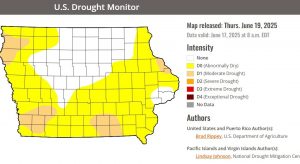
“If you go back four to five years, most stations across the state are still missing out on about a year’s worth of precipitation,” he says. “So, this has impacts on aquifers, which we pull water out of, but also well fields and other water supply sources.” The new drought monitor map shows pockets of “moderate” drought in all four corners of the state. As corn pollination and detassling season approaches, Glisan says Iowa’s crops may become stressed.
“With those windy conditions and high temperatures, that’s where we can exacerbate dryness across the surface,” Glisan says. “So, we’re extracting soil moisture — that topsoil moisture — first. Plus, vegetative demand is increasing with corn and beans, as well. So, this is where we can get into a period of time of rapid drying at the surface.”
Glisan says that could cause stress in corn and soybean fields. On the positive side, he says most of the state remains in a lull in terms of severe weather.
(Radio Iowa) – Iowa is the nation’s top corn-producing state and Iowa farmers harvested over two-point-six BILLION bushels of corn last year — the second largest crop ever. Iowa State University ag economist Chad Hart says despite tariff challenges, U-S corn exports for the first five months of the year hit a three year high.
“The only big market where U.S. corn really isn’t moving is the Chinese market,” Hart says. “Almost everywhere else we’ve seen fairly sizable gains in sales and that holds when we look at soybeans as well.” The U-S-D-A has predicted a slight drop in soybean sales this year, but not as much as feared due to the lack of sales to China. Reports indicate corn exports remained well above average through early June.
“When you talk to farmers, there is some cautious optimism out there because they are seeing these additional sales,” Hart says. Hart says in June, it’s typically Brazil and Argentina that dominate global sales of feed grains. Iowa typically accounts for about eight to nine percent of all U-S agricultural exports. California’s the only state that exports more agricultural products.
(Iowa Capital Dispatch) – The Iowa Farm Bureau’s latest food and farm index found that among concerns of the high cost of groceries, the overwhelming majority of Iowa grocery shoppers surveyed are concerned about increases to food prices caused by government regulations. The Iowa Capital Dispatch says the annual survey, conducted by the Harris Poll, also found that more consumers are seeking locally grown and produced products. Latoya Guishard Welch, vice president of research for public release at the Harris Poll, said “At a time when trust in national institutions—from government to media—is at historic lows, the sustained confidence in local farmers speaks volumes about their authenticity and transparency, underscoring the strong bond and mutual respect between Iowa’s farmers and the communities they serve.”
According to the food and farm index, 80% of shoppers are concerned, and 47% are very concerned, about government regulations that increase consumer food prices. The percentage of people very concerned has more than doubled since 2021, when just 21% were more than just concerned about the role of government in increased food costs. U.S. Department of Agriculture statistics show direct imports, or finished products ready for sale, accounted for 15% of U.S. spending on food and beverages. Foreign ingredients and supplies comprised 4% of domestic food production. Forbes reported tariffs could have a significant impact on the cost of food and beverages at the grocery store, if imposed at their highest proposed levels.
A recent study from Farmers for Free Trade, a non-profit advocacy group, found that tariff costs for Iowa importers increased by $68 million, or 304% from April 2024 to April 2025. According to the study, imports from China had the highest tariffs, but imports from Mexico, Canada and South Korea faced dramatic increases in tariffs. Goods imported from Mexico to Iowa in April 2024 had tariffs of 0.2%, compared to a 4.4% tariff in April 2025. Reciprocal tariffs between the U.S. and China, which are currently on a 90-day reduction agreement, would put Iowa industries at a “significant” risk. In particular, Chinese tariffs on U.S. exports would hurt Iowa pork and soybean producers especially hard. The Farmers for Free Trade study concluded the presidential tariffs, if they took effect and stayed in place, would “have major consequences” on Iowa.
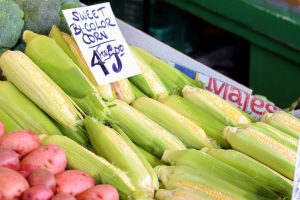
Fresh vegetables at a farmers market. (Photo by Cami Koons/Iowa Capital Dispatch)
Recent consumer price index data from U.S. Department of Agriculture shows a 23.6% increase in grocery prices from 2020 to 2024, which likely explains why price continues to be the most important factor for Iowa grocery shoppers when making decisions on which types of food to buy. Three-fourths of Iowans said meat, poultry or dairy products are part of their daily diets, and a higher proportion of Iowans say they prefer “real” meat and dairy over plant-based alternatives.
More and more, consumers are choosing to purchase these items directly from the farm. Sixty-nine percent said they have purchased groceries directly from farmers, through their online websites, farm stores or at farmers markets, and 40% of Iowa consumers look for locally made or grown labels when buying at the store. This is an increase from 2024 survey results which found around 30% of consumers sought local labels. The survey results also show that more than 90% of shoppers said they trust farmers and 49% said they place a “great deal of trust” in Iowa farmers in general. The survey also asked consumers if they felt confident farmers were caring for animals and the environment, which the vast majority, around 80% for each category, did.


 Facebook
 Twitter
 YouTube
 RSS
RSS