

CLICK HERE for the latest market quotes from the Iowa Agribusiness Network!
CLICK HERE for the latest market quotes from the Brownfield Ag News Network!


CLICK HERE for the latest market quotes from the Iowa Agribusiness Network!
CLICK HERE for the latest market quotes from the Brownfield Ag News Network!
(Radio Iowa) – D-N-R wildlife biologist Todd Bogenschutz says pheasants weren’t the only game bird that saw a drop in harvest numbers last year. “Twenty-seven-thousand-500 quail reported harvested, which is about three-thousand less than the year before, so down a little bit,” Bogenschutz says. The drop in pheasants was attributed to a wet spring, but Bogenschutz says other weather impacted quail. “The quail are native to Iowa, so not an introduced species like pheasants, so they’re a little bit more tolerant to the rain and than pheasants are,” he says. “And so probably the bigger thing for quail would be the winter.”
Bogenschutz says this was a mild winter and that will help the quail population.”So I’m expecting to see our growth counts go up just because I think we probably had better survival of the birds we had this past winter because it was so mild. It’s not the rainfall can’t impact quail too, but we’ve got to get into that like nine and ten inch rain,” he says. Bogenschutz says the morning dove harvest was down a little bit too.
He says the counts were up for cottontail rabbits and that led to their harvest being up, with some 77-thousand cottontails taken statewide. The squirrel harvest was up 124-thousand squirrels statewide last year.
(Iowa Capital Dispatch) – Eighteen percent of soybeans are setting pods across the state, which is several days ahead of the 5-year average. Other crops across Iowa continue to progress close to the normal schedule amid another week of above-average precipitation, according to the crop progress and condition report from the U.S. Department of Agriculture. Corn and soybeans both rated well for the July 7-13 reporting period, respectively at 85% and 79% good to excellent. Corn silking reached 36% on average across the state, and 5% of corn entered the dough stage. The central regions of the state and southeastern Iowa continue to lead the state in terms of acres reaching various development stages.
On average, more than half of soybean acres across the state are blooming, according to the report. The second cutting of alfalfa hay is 66% complete across the state and 7% of hay acres have undergone their third cutting already. Hay rated 83% good to excellent for the week. Oats rated 86% good to excellent and nearly all, 96%, of the crop has headed and 71% has colored.
Farmers had fewer than four days suitable for field work during the reporting period due to what State Climatologist Justin Glisan referred to as an “anomalously wet and active” weather week. On average, the state received 2.37 inches of precipitation during the period, which is more than an inch above the normal. Precipitation accumulation maps for the period show a band of heavy rain from river to river across the central portion of the state. These areas received 2-4 inches more than the normal for the reporting period. Asbury in Dubuque County clocked the most precipitation for the period with 6.77 inches. Several towns in eastern Iowa had flash flooding warnings and there were tornadoes in Canton, Clarinda and in Scott County.
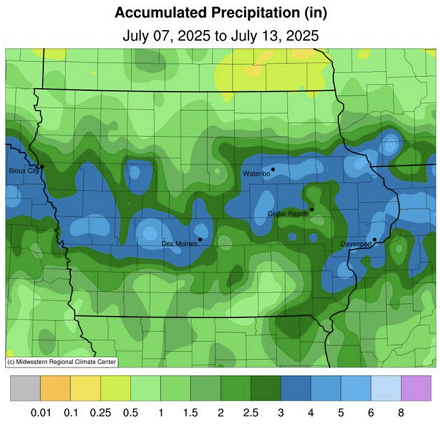
Accumulated precipitation from July 7-13. (Map courtesy of Midwestern Regional Climate Center)
Gov. Kim Reynolds issued a disaster proclamation Monday for Scott County, due to damages from the storm. The disaster proclamation opens up state funds to help with repairs to an area and allows affected residents to apply for grants to help pay for repairs and other expenses caused by the storm. Iowa Secretary of Agriculture Mike Naig said it was a “wild weather week” for the state. “Though the rainfall is improving drought conditions and helping the corn during tasseling and pollination, there are now parts of the state that could use a break from the rain,” Naig said in a statement.
According to the report, north central Iowa has the wettest soil, with 37% of topsoil and 38% of subsoil moisture conditions rated as surplus for the period. On average, topsoil moisture conditions for the state rated 71% adequate and 23% surplus. Subsoil moisture conditions for the state were 74% adequate and 16% surplus. Southwestern Iowa continued to have the driest soil conditions as 31% of topsoil and 35% of subsoil rated short.
Cass County: Corn $3.85 Beans $9.78
Adair County: Corn $3.82 Beans $9.81
Adams County: Corn $3.82 Beans $9.77
Audubon County: Corn $3.84 Beans $9.80
East Pottawattamie County: Corn $3.88 Beans $9.78
Guthrie County: Corn $3.87 Beans $9.82
Montgomery County: Corn $3.87 Beans $9.80
Shelby County: Corn $3.88 Beans $9.78
Oats: $3.00 (same in all counties)
(Prices are per bushel; information is from the area Farm Service Agency [FSA] offices)
Cass County: Corn $3.85 Beans $9.77
Adair County: Corn $3.82 Beans $9.80
Adams County: Corn $3.82 Beans $9.76
Audubon County: Corn $3.84 Beans $9.79
East Pottawattamie County: Corn $3.88 Beans $9.77
Guthrie County: Corn $3.87 Beans $9.81
Montgomery County: Corn $3.87 Beans $9.79
Shelby County: Corn $3.88 Beans $9.77
Oats: $3.00 (same in all counties)
(Prices are per bushel; information is from the area Farm Service Agency [FSA] offices)
(Atlantic, Iowa) – The start of the Cass County (Iowa) Fair is just a little more than a week and a-half away, and the static building will be bustling with activity throughout the fair. Along with being open to see all the great static exhibits members have been working on throughout the year, the building is also host to many competitions. During the week static exhibits will be on display along with Bucket of Junk exhibits.
The building will open for the first time from 5:00pm to 7:00pm on Thursday, July 24th. When the building opens you will be able to see the static exhibits for the first time including which exhibits were chosen for State Fair. Also during this time is the 4-H Food Sale, which will be taking place in the lobby of the Community Center and is free will donation for food made by 4-Hers that will be judged Wednesday, July 23rd. Building hours can be found below along with a schedule of events that are being held each day. 
You’re invited to come out and support the fair exhibitors as they showcase the skills and exhibits they have been practicing and building all year. Static Exhibits are projects youth have created this past year as an active growth of their areas of interest. These are a sample of learning youth have achieved. They talk to a judge about what their goal was before they started, the process they went through, and what they learned working towards their goals.
The exhibits may include food, photos, creative signs, posters, or displays and much more. Come see the variety of learning 4-H can offer for young people.
For more information on how to enroll in 4-H, contact Katie at 712-243-1132 or https://www.extension.iastate.edu/cass/join-4-h.
DES MOINES, Iowa — Swimming is not recommended at over a dozen Iowa beaches. The Iowa Department of Natural Resources report suggests avoiding these 14 beaches, all of which have E. coli levels that are too high and indicate other bacteria. They are as follows:
Last week, swimming was not recommended at 12 Iowa beaches. The DNR conducts weekly tests at more than three dozen public swimming beaches between the week before Memorial Day through Labor Day.
(Radio Iowa) – Governor Kim Reynolds says the state and federal government should stick with the voluntary approach to reducing farm chemical runoff into Iowa waterways. A report commissioned by Iowa’s largest county has found nitrate levels in the rivers used to provide drinking water in the Des Moines metro are among the highest in the United States. “You know regulation is hardly ever the answer. That’s a killer in most instances,” Reynolds said. “It takes out innovation. It takes out you know just the ability to be nimble.” Reynolds says since she took over as governor eight years ago, the state has spent hundreds of millions of dollars to help farmers install conservation practices that improve water quality.

Gov. Reynolds spoke with reporters after an event in Des Moines on July 10, 2025. (governor’s office photo)
“That’s, I think, where we need to continue to put our efforts,” Reynolds says. “I can’t control Mother Nature. They can’t control Mother Nature, so that’s just a component that they have to work with, but mark my word, they are working every single day to implement conservation practices because they know it benefits everybody.” Former Iowa Governor Tom Vilsack served 12 years as the nation’s secretary of agriculture. He says there is a definitely a role for the federal government in cleaning up waterways, but Vilsack suggests it’s supporting new ways to use manure from Iowa livestock operations.
“One of the reasons we have the nitrate problem is because there is an over application of manure on ground around the state…There’s only so much nutrients that land needs. It gets rid of the excess. It goes into the rivers and streams. We’ve got the problems,” Vilsack said. “What if you diverted that manure? What if you created opportunities to basically take that manure and create something more valuable from it?” Vilsack says manure is generating energy and fuel in other parts of the country and the federal government should support research and projects that turn manure into a commodity that’s sold like corn and beans. “You’ve reduced the level that’s applied to land, which reduces nitrates — which deals with the water issue, you’ve created an opportunity for that farmer to have additional income…and you also create jobs in rural places,” Vilsack said. “What’s not to like about that opportunity?”
Vilsack says there are other creative solutions like sensor technology that determines how much farm chemicals are needed on crop land. “In some cases it’s been suggested by folks at Iowa State that maybe 30% of our corn acres don’t necessarily need fertilizer at all,” Vilsack said. “Well, if that’s the case, that’s a savings for farmers.” Vilsack made his comments during taping of the “Iowa Press” program which airs tonight (Friday) on Iowa P-B-S.
(Atlantic, Iowa) – The downtown Atlantic City Park is a magical place to celebrate Christmas…in July! Event organizers invite your join them at the farmers market for Christmas in July, featuring festive fun for all ages: Christmas face painting, holiday-themed art with Your Forte, a special visit from Santa, and a performance of Christmas carols by the Cass County Choral Society. Don’t miss this jolly good time at the park! 
25+ vendors with fresh produce like tomatoes, cucumbers, and fresh onions, local meats (chicken, beef, and lamb), farm-fresh eggs, honey, and freeze-dried snack. Baked goods such as breads, cupcakes, brownies, and gluten-free desserts, as well as Christmas Cookies including sugar, ginger bread, peanut butter kiss, and hot chocolate cookies. Craft and art products including wood items such as charcuterie boards and cutting boards, upcycled clothing, rocks and crystals, paintings, leatherwork, soaps and other bath and body products, garden decorations, and compost.
Food Trucks: Noble Provisions Grilling Burgers, Zemog’s Mexican Kitchen, Louie’s Shaved Ice, Squeezing Lemons fresh-squeezed lemonade.
Details:
Event: Christmas in July Produce in the Park
Date: Thursday, July 17, 2025
Time: 4:30 PM – 6:30 PM
Location: Atlantic City Park, 10 W 7th St, Atlantic, IA 50022
Cost to enter: Free
Facebook event link: https://www.facebook.com/share/1VZGKY5Nip/
(Radio Iowa) – The executive director of the Iowa Renewable Fuels Association is thrilled over the Trump Administration’s plans for increased renewable fuel blending levels. Monte Shaw says the EPA released its proposed changes on Tuesday for the Renewable Fuel Standard for the coming years, and he says they’re very robust compared to previous years.
“The last rule was definitely below what it should have been,” said Shaw. “It’s kind of left the industry a little stagnant. And, these would be very robust levels — the largest we’ve seen. Fifteen billion gallons for conventional biofuels like ethanol, 24 billion gallons overall, so, a significant step up for the levels that biodiesel operates in, and things like that.”
Shaw says the standards set during President Biden’s administration hurt the renewable fuel industry. “The last rules under the Biden Administration woefully missed — I mean, they just missed,” he said. “It set the levels way too low for what was going on in the biodiesel and renewable diesel industries by billions of gallons. So, it really hurt the industry. Quite frankly, what the industry said was going to happen, happened. They (the Biden Administration) said, ‘Nah, you guys are too optimistic’ and low-balled it, and it hurt. We had biodiesel plants shut down.”
Radio Iowa file photo
Shaw hopes the improved RFS levels ease any discomfort President Trump’s proposed trade tariffs caused farmers. “We know farmers have faced a pretty rough two years,” said Shaw. “We know there’s going to be some disruptions to the markets based on how Trump wants to pursue his trade and tariff agenda. So, I think they looked at the RFS as something they could do for agriculture to provide some growth and stability while they pursue some other policies that can be a little tricky for agriculture.”
While calling the proposed levels “a great first step,” he urged the EPA to provide greater access to E-15 fuels by eliminating outdated regulations.
(Radio Iowa) – Drought conditions continue to improve in the state. The latest U-S Drought Monitor shows most of the middle of the state has no drought conditions, which is about 64 percent — and is up from 57 percent last week. Less than four percent of the state has areas of moderate drought, including one county in northwest Iowa, six in the southeast, four in south-central, and two in eastern Iowa.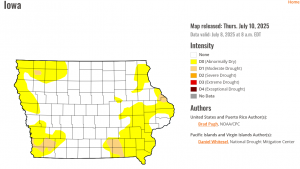
Around 36 percent of the state is abnormally dry, in sections along the eastern and western edges. Just 20 percent of the state had no drought conditions at the start of the year.


 Facebook
 Twitter
 YouTube
 RSS
RSS