

CLICK HERE for the latest market quotes from the Iowa Agribusiness Network!
CLICK HERE for the latest market quotes from the Brownfield Ag News Network!


CLICK HERE for the latest market quotes from the Iowa Agribusiness Network!
CLICK HERE for the latest market quotes from the Brownfield Ag News Network!
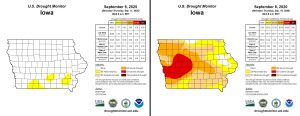
DES MOINES, Iowa — After very soggy weather across the state earlier this summer, including the wettest July on record in Des Moines, abnormally dry conditions have returned to Iowa for September. With the lack of rain, especially over central and southern Iowa, the national drought monitor now shows portions of southern Iowa in the abnormally dry category. With limited rainfall expected over the next week, those dry regions are likely to expand.
Cass County: Corn $3.77 Beans $9.50
Adair County: Corn $3.74 Beans $9.53
Adams County: Corn $3.74 Beans $9.49
Audubon County: Corn $3.76 Beans $9.52
East Pottawattamie County: Corn $3.80 Beans $9.50
Guthrie County: Corn $3.79 Beans $9.54
Montgomery County: Corn $3.79 Beans $9.52
Shelby County: Corn $3.80 Beans $9.50
Oats: $2.71 (same in all counties)
(Prices are per bushel; information is from the area Farm Service Agency [FSA] offices)
(Des Moines, Iowa) – Officials with Cass County ISU Extension and Outreach in Atlantic, report Jacque Wickey was inducted into the 2025 Iowa 4-H Hall of Fame during a ceremony at the 4-H Exhibits Building at the Iowa State Fair on Sunday, Aug. 17. Ninety-two Iowa counties participated this year and selected 122 inductees for their outstanding service and dedication to 4-H. Inductees or their surviving family members were presented a certificate by the Iowa 4‑H Foundation President, Don Timmins, and State 4-H Program Leader, Mitchell Hoyer, as they were introduced on stage.
Wickey participated in 4-H from 1964-1972 and belonged to the Massena Champions, Massena Merry Maids, and the Massena Merry Maids/Victoria Volunteers. She also was a member of the “Boys” Club so she could show livestock where she showed cattle and horse. Other memories include building a Cass County team and attending the State Fair and AKSARBEN livestock shows. She always enjoyed dressing in the calves for shows. She even got her start as a beautician at the rear end of a steer. She could make the tails bigger and fluffier than anyone else. Skills learned there have yielded her career as a licensed Cosmetologist for 50 years now. Other 4-H member activities include a Jr Leader, Jr Superintendent, and holding all offices in her club.
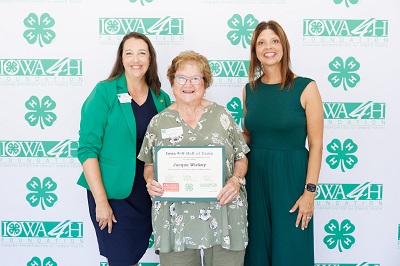
Jacque Wickey (Photo submitted)
She attended the State Conference and Camps at the Iowa 4-H Camp, in addition to State Fair and AKSARBEN. After graduation, Jacque Wickey volunteered to chaperone at the Girls Dormitory at the State Fair. This allowed her to help out and stay connected with the people from Cass Co. Upon moving back to Cass County, she served as Secretary of the YAC committee in the early 2000’s in addition to helping Great Nieces learn to sew or simply sat in the stand cheering them on. She is deeply involved in her community and church and is always willing to plan and volunteer for events. She is a pretty amazing aunt, and a friend to everyone.
Many inductees serve as club leaders, youth mentors, fair superintendents or fair board members, County council members, county youth council members, fair judges, financial supporters, chaperones or ISU Extension and Outreach staff members. The inductees have demonstrated dedication, encouragement, commitment and guidance to Iowa’s 4-H’ers through the years. “We are honored to recognize these special individuals, for their advocacy and dedication to the Iowa 4-H program,” shared Iowa 4-H Foundation Executive Director, Emily Saveraid. “This is a great way to honor the volunteers and staff across the state of Iowa that generously give their time and talents to foster positive partnerships with our 4-H youth,” said Tillie Good, Iowa 4-H staff and volunteer development manager.
Information about previous inductees to the Iowa 4-H Hall of Fame also is available on the Iowa 4-H Foundation website, organized by year and by county. Go to www.iowa4hfoundation.org/ and under the heading “What We Do” select “Recognizing Service” then “Iowa 4-H Hall of Fame.” Cass County 4-H Hall of Fame past recipient list can be found at https://www.iowa4hfoundation.org/what-we-do/recognizing-service/iowa-4-h-hall-of-fame/iowa-4-h-hall-of-fame-inductees/categories/cass
Cass County: Corn $3.77 Beans $9.48
Adair County: Corn $3.74 Beans $9.51
Adams County: Corn $3.74 Beans $9.47
Audubon County: Corn $3.76 Beans $9.50
East Pottawattamie County: Corn $3.80 Beans $9.48
Guthrie County: Corn $3.79 Beans $9.52
Montgomery County: Corn $3.79 Beans $9.50
Shelby County: Corn $3.80 Beans $9.48
Oats: $2.69 (same in all counties)
(Prices are per bushel; information is from the area Farm Service Agency [FSA] offices)
(Iowa DNR News; Des Moines, IA) – Iowa state parks have set Saturday, Sept. 27 as annual Volunteer Day, when Iowans are invited to lend a hand at several state parks and forests hosting volunteer events. Join park staff to help care for Iowa’s natural areas, freshen up campgrounds and facilities, and spend time outdoors.
Clean-up efforts will be unique for each park depending on needs, and may include litter pick-up, staining or painting buildings, removing invasive species, rebuilding picnic tables, harvesting prairie seeds and more. The state parks and forests participating include:
Citizens interested in volunteering can find complete details on times, meeting locations and activities at https://www.iowadnr.gov/places-go/state-parks/statewide-volunteer-day
Cass County: Corn $3.77 Beans $9.48
Adair County: Corn $3.74 Beans $9.51
Adams County: Corn $3.74 Beans $9.47
Audubon County: Corn $3.76 Beans $9.50
East Pottawattamie County: Corn $3.80 Beans $9.48
Guthrie County: Corn $3.79 Beans $9.52
Montgomery County: Corn $3.79 Beans $9.50
Shelby County: Corn $3.80 Beans $9.48
Oats: $2.68 (same in all counties)
(Prices are per bushel; information is from the area Farm Service Agency [FSA] offices)
(Radio Iowa) – A D-N-R forester says the cooler temperatures are setting things up for a good fall color show in the coming weeks. Joe Herring is from Iowa Falls, and says the colors should start showing up soon. “I think it’s going to be good if if this weather is any indication of where we’re going, it’s perfect. We think the best fall colors come from clear bluebird sky days, warm days, cool nights, not freezing,” he says. Herring says freezing temperatures can kill off the color show.
“If it dips down into hard frost, that can actually kill those leaves and end the fall color early. But you know, we want to avoid the real strong, windy days and we’d like to avoid, you know, tons of rain in the fall,” Herring says. He says the tree canopies are strong heading into the fall color season. “It’s been a really good year for foliage, just for vegetative growth in general, just because of all the rain we’ve had,” he says.
Herring says he starting to see some early color in some trees, but there’s not been a full scale breakout just yet.
(Radio Iowa) – Lawmakers on a panel that reviews state regulations have temporarily blocked a proposed change in state guidelines for a specific type of septic system, a change that would make it cheaper to install. Republican Representative Mike Sexton, a farmer from Rockwell City, proposed the delay. “If these were livestock farms we were talking about instead of homeowner’s septic tanks, the [expletive] would hit the fan,” Sexton said.
There are tens of thousands of homes and businesses in Iowa that are not connected to a public sewer system and use a septic system to trap and filter toilet waste. The Iowa Department of Natural Resources has proposed ending the requirement that aerobic treatment units which circulate air to treat sewage have a final step that sends discharged water through soil or sand filters. Sexton says blocking that change from going into effect until at least the middle of next year will hopefully pressure lawmakers to crack down on a related issue.
“Folks, raw sewage is coming from these septic tanks that aren’t maintained,” Sexton says. “There’s not a reporting mechanism on failed systems. We have homes that aren’t being inspected. You know that’s right.” The legislature’s Administrative Rules Review Committee voted eight-to-two to block the rule from taking effect now — a delay that will last until the 2026 legislature ends. The vote came after more than 40 minutes of public testimony from people who strongly supported or opposed changing state guidelines for aerobic treatment units.
Nick Laning is a lobbyist for Infiltrator Water Technologies — a company that makes these type of septic units. Laning told legislators very few aerobic treatment units are being installed in Iowa today because state regulations are outdated and unnecessary.”Delaying these rules only prevents Iowans from accessing ATUs which are already available in every other state,”Laning said, “and they can be more affordable, better suited to local geography and capable of treating nitrates other water quality issues.”
The DNR and EPC identified an outdated, unnecessary regulation,” Laning said. Jim Carroll, a licensed engineer who designs and maintains wastewater systems in Iowa, opposed getting rid of the filtering requirement for aerobic treatment units. “Environmental protection is really our primary concern, not whether that product is affordable or not,” Carroll said. “If it’s going to pollute the environment, it doesn’t matter what it costs.”
The water quality bureau chief in the Iowa Department of Natural Resources told legislators the proposed change creates a level playing field for all types of septic systems and it fulfills the governor’s executive order that requires agencies to reduce regulatory burdens.
(An Iowa Capital Dispatch report) – Three wind turbine blades sit ground up inside the concrete blocks of a new retaining wall at Premier Credit Union in downtown Des Moines. It’s the latest project from Renewablade, a company in Bondurant that has found a way to use the materials and, in turn, alleviate the issue of what to do with the massive hunks of fiberglass and resin. Brian Meng with Renewablade said the company is finally in production after several years of research and development to figure out the best way to grind up the blades and incorporate them into the concrete. Right now, Renewablade makes three main products: the retaining wall blocks, like those used at the Premier Credit Union project, commercial highway barriers, and larger barriers used to bunker agricultural materials.
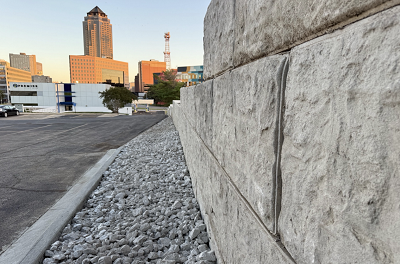
A retaining wall at Premier Credit Union in downtown Des Moines is made from concrete mixed with fiber from decommissioned wind turbine blades. (Photo courtesy of Renewablade)
Meng has spent his career in the recycling industry and several years ago started to notice the need for recycling the blades, which by nature must be replaced about every 20 years. One study estimated by 2050 there would be more than 2 million tons of retired wind turbine blades in the U.S. Lawsuits cropped up in Iowa and other states as officials took notice of areas where the blades were being dumped and abandoned. It turned out the parties dumping the blades had been paid to recycle them but weren’t doing so.
Another Iowa-based company, REGEN Fiber, processes the blades into a grind that can be added to various types of concrete. A company in Boone has focused on the turbine generators and recycles rare earth materials from decommissioned wind turbines. Meng said Renewablade collects the blades from Iowa turbines, which are easier to transport to the company’s processing facility in Earlham, and from as far as Seattle and Maine. Meng said it “works well” when the decommissioned blades are close to home. For example, Renewablade recycled some of the blades that were damaged in a tornado near Greenfield in 2024. The blades can be around 200 feet long, or about the wingspan of a Boeing 747 jet, which makes transportation difficult and expensive.
The scale also means these blades take up a lot of space in a landfill. And yet, once ground up into concrete blocks, Renewablade was able to repurpose the blades from one whole turbine in just one small parking lot wall. Despite early pushback in Earlham towards the business, Meng said the company is fully operational this year with big plans to expand. Meng said the company is eying expansions into the UK and Texas.
Cass County: Corn $3.76 Beans $9.47
Adair County: Corn $3.73 Beans $9.50
Adams County: Corn $3.73 Beans $9.46
Audubon County: Corn $3.75 Beans $9.49
East Pottawattamie County: Corn $3.79 Beans $9.47
Guthrie County: Corn $3.78 Beans $9.51
Montgomery County: Corn $3.78 Beans $9.49
Shelby County: Corn $3.79 Beans $9.47
Oats: $2.67 (same in all counties)
(Prices are per bushel; information is from the area Farm Service Agency [FSA] offices)


 Facebook
 Twitter
 YouTube
 RSS
RSS