

CLICK HERE for the latest market quotes from the Iowa Agribusiness Network!
CLICK HERE for the latest market quotes from the Brownfield Ag News Network!


CLICK HERE for the latest market quotes from the Iowa Agribusiness Network!
CLICK HERE for the latest market quotes from the Brownfield Ag News Network!
(Atlantic, Iowa) – Organizers with Atlantic’s Produce in the Park have announced the first of five Holiday Market events takes place October 18th at the Nishna Valley YMCA in Atlantic. The “Boo-tique” Market by Produce in the Park will be held from 10-a.m. until Noon on the 18th, at the NV YMCA (1100 Maple St.), in Atlantic. There is no admission fee.
The BOO-tique market is a Produce in the Park farmers market with a LOT of extra fun–trick-or-treating, hand-led horse rides, face painting, bounce houses, balloon animals, and more. Costumes are welcome!
Food Trucks:

Vendors will be selling: fresh produce including sweet potatoes, butternut squash, onions, garlic, spinach, and more; local meats (chicken, pork, and beef); farm-fresh eggs; local honey; breads including sourdough; baked goods and desserts; freeze-dried snacks; arts and craft vendors; garden decorations and potted plants (like spider plants!).
Thanks to Sponsors: Gregg Young Chevrolet of Atlantic, City of Atlantic, 1st Whitney Bank, Cass Health, Cass County Tourism, Atlantic Area Chamber of Commerce, and Nishna Valley Family YMCA
Event Facebook link: https://www.facebook.com/share/1BFKuLqswo/
(Area News) – Multiple area fire departments in southwest/western Iowa were kept busy battling both combine and field fires, Saturday. At least two combines caught fire in Cass County. One was in the area of 740th and Boston Road, and was contained by crews from Anita, Wiota, Adair and Exira.
Emergency personnel responded to a field/ crop fire north of Clarinda on M-63.
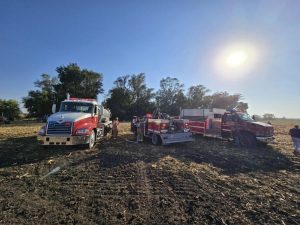
Photo via Red Oak Fire Chief John Bruce
At around 4-p.m., Saturday, firefighters from New Market, Clarinda, Bedford and Villisca worked a large field fire north of New Market, in Taylor County, near 200th/ Badger Avenue. Local farmers also provided their tractors and disk implements to help stop the spread of the fire.
Another fire was reported in Mills County. No one was said to have been injured during any of those and other incidents in southwest Iowa.
Dry field conditions (low humidity and high winds) again today (Sunday) prompted the National Weather Service to issue an ELEVATED FIRE DANGER Special Weather Statement through at least 4-p.m.
**Due to the Federal Government shut-down, there are currently no daily (M-F) Posted County grain Prices to report. **
(Des Moines, Iowa) – As the fall harvest starts across Iowa, the risk of wildfires in crop fields increases. The Iowa Department of Natural Resources (DNR) says parts of Iowa are seeing dry conditions with the risk of the relative humidity dropping to dangerous levels for wildfires and ignition sources in the fields. Ready to harvest standing crops contain very low moisture, a condition which can create fuels that are receptive to ignition and at risk of rapid rates of fire spread. The DNR encourages farmers to get reacquainted with fire prevention practices to keep your farm ‘firewise.’
The following simple steps for a safer harvest can save time and money.
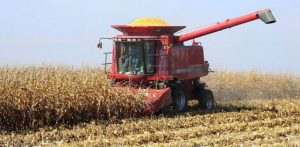
Combine harvesting corn. (ISU Extension photo)
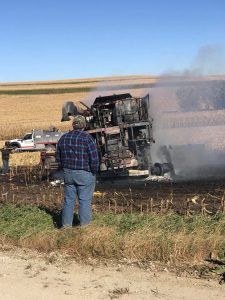
Combine/Field fire east of Earling. File photo)
To help control field fires until firefighters arrive, remain calm and act swiftly. Quickly disk a fire break approximately 15 feet wide around the fire. Be cautious when doing this as smoke will starve and stall a motor and will make hazards and bystanders difficult to see. To assist with a structural fire, make sure there are no flammable objects nearby and if the circuit panel is safely accessible, turn off the building’s electricity. If time allows, evacuate any livestock to a distant pasture. If possible, spray high-pressure water on any surrounding vegetation or structures, discouraging spreading embers. Do not take risks.
After using any equipment to fight a fire, check air filters, ledges, nooks and crannies for burning debris. For more detailed information, visit www.iowadnr.gov/fire.
Remember, in a fire emergency, call 911 immediately. Do not wait until all your means of fighting the fire are exhausted. Every minute impacts your losses.
DES MOINES— Today, Governor Kim Reynolds authorized a disaster proclamation for Calhoun County, Iowa effective immediately through November 1, 2025. The USDA has confirmed a positive case of highly pathogenic avian influenza (HPAI) in a commercial turkey flock.
This proclamation allows state resources from Iowa Homeland Security, the Iowa Department of Agriculture and Land Stewardship, and other agencies to assist with tracking and monitoring, rapid detection, containment, disposal, and disinfection. The proclamation also waives regulatory provisions related to commercial vehicles responding to affected sites.
The recent HPAI detections in birds do not present an immediate public health concern, and it remains safe to eat poultry products. If producers suspect signs of HPAI in their flocks, they should contact their veterinarian immediately.
(Radio Iowa) – Governor Kim Reynolds and Iowa’s congressional delegation are calling on U-S Ag Secretary Brooke Rollins to relocate U-S-D-A research projects to central Iowa. Iowa was not included in the plan released in July that would shift most U-S-D-A employees out of the Washington, D.C. metro to cities in five other states. Senator Chuck Grassley says Ames is a prime location. “Ames has the means and the USDA relationship needed to provide a very smooth transition since it’s already got a large concentration of USDA facilities and employees,” Grassley said. Secretary Rollins plans to start shifting functions at the Agricultural Research Center in Beltsville, Maryland, to other sites and permanently close the facility in a few years.
“The current facility in Maryland is named after a native Iowan and former Secretary of Agriculture Henry Wallace,” Grassley said. “Seems very fitting, because of Henry Wallace, locate some of that facility’s ag research to its namesake’s home.” Four units of the Agricultural Research Center are already located in Ames, including its National Animal Disease Center. Grassley says Iowa State University works closely with those facilities and U-S-D-A researchers use I-S-U’s high-performance computing services. “Ongoing projects at the Beltsville Research Facility in Maryland, right outside of Washington, align with the efforts that have been happening at Iowa State University for decades,” Grassley said.
Grassley, the governor, Senator Ernst and all four Iowans who serve in the U-S House signed onto a letter to the ag secretary. It cites Iowa’s low cost of living for employees who might move from the nation’s capitol to Iowa as well as the real-world experience U-S-D-A research would find in Iowa’s fields.
(Des Moines, Iowa) – The Iowa Department of Natural Resources’ weekly Fall Colors report, says Cottonwood and black walnut tress are starting to change color in north central and northwest Iowa. Red maples in town are starting to change colors. Early fall colors have started in central Iowa, but are still very spotty with only about 10-15 percent of the foliage showing color. Reds are beginning to appear on some maple trees, especially in towns. Maroon colors are appearing on sumac, dogwood, and Virginia creeper vines. Walnut, cottonwood, basswood, elm, and hackberry trees are turning yellow. 
It’s early in the season in southeast Iowa. Mostly bottomland species are starting to change colors and lose leaves. Cottonwood, walnut, and elm trees are showing a little yellow and brown. Some dogwoods and roadside shrubs are starting to show fall colors. Walnut and cottonwood trees are starting to show a little yellow in south central Iowa. Shrubs and vines are showing some purples and reds.
Cottonwood, white ash and red maple trees are starting to change color in southwest Iowa. Upland shrubs (sumac.dogwood, plum) on south/west slopes are starting to turn red and purple.
Read more and sign-up for the weekly e-mail update, HERE.
(Radio Iowa) – A state legislator from north-central Iowa is being named the new executive director of the Iowa F-F-A Foundation. Shannon Latham of Sheffield says she brings 30 years of experience spanning business, government and communications to her F-F-A responsibilities. Latham says she’s thrilled to be giving back to an organization that had a profound impact on her life. “In fact, my FFA advisor is the one who led me toward an agricultural career path,” she says. “He took me to my college visit at Iowa State. He introduced me to the major of agricultural journalism just because he knew all of the things that I was interested in when I was in high school.” 
While some people may not be familiar with the foundation itself, Latham says many people in central Iowa will recognize the F-F-A Enrichment Center on the DMACC campus in Ankeny. “A lot of groups come here, have conferences all throughout the year, and the foundation helps raise money actually for Team Ag Ed,” Latham says, “and Team Ag Ed is a bunch of partners that include the Iowa FFA Association. That is what our chapters across the state belong to.”
In addition to her F-F-A duties, Latham says she will continue in her role as a state representative. There are 20-thousand-500 members in the Iowa F-F-A program in some 270 chapters statewide.
(Radio Iowa) – President Trump says the federal government will make payments to soybean farmers who are taking a financial hit due to China’s stance in the trade war. China — the world’s largest buyer of soybeans — has turned to other countries for its soybean supply.
“We’re going to take some of that tariff money that’s we’ve made, we’re going to give it to our farmers who are for a little while going to be hurt until…the tariffs kick in to their benefit,” Trump said recently, “so we’re going to make sure that our farmers are in great shape because we’re taking in a lot of money.” Trump has not indicated when the payments will start or how big they’ll be.
“We’re going to be taking some money from all of the tariff money that we’ve taking and we’re going to be distributing it to our farmers until the tariffs kick in to their benefit, which ultimately the farmers are going to be making a fortune,” Trump said, “but it’s a process.”
Trump — in a post on social media yesterday (Wednesday) — said he will be meeting with China’s president in four weeks and soybeans will be a major topic of discussion. Last year, a little over half U.S. soybean exports went to China, but China hasn’t purchased U.S. soybeans for the past four months.
(Radio Iowa) – The latest survey of supply managers in Iowa and eight other Midwestern states shows the economy sagging under the weight of retaliatory tariffs, as the region’s manufacturing sector sheds jobs for the sixth straight month. Creighton University economist Ernie Goss says the September survey indicates many farmers are in for a difficult harvest season as the Trump administration tariffs are backfiring with one of the biggest trading partners.
“China just purchased soybeans from Brazil,” Goss says. “Now, they have not bought U.S. soybeans since May. That’s very unusual. They’re retaliating against our agricultural sector and they’re retaliating against other sectors. And they’re not the only one.” A year ago, China bought about 60-percent of all U-S soybean exports, and is now buying none. As a result, soybean prices are plummeting as Iowa growers are seeing per-bushel prices at one-third of what they were last fall.
Goss says the Creighton survey shows both imports and exports weakened during September, while wholesale prices rose from August and stayed at elevated levels.”Four out of five of our supply managers indicated that tariffs were pushing up prices,” Goss says. “Obviously, that’s not good. Inflation’s above the fed’s target.” Hiring is down significantly and the survey shows the Midwest region lost 38-hundred manufacturing jobs in the past month, while Goss says the U-S lost 78-thousand manufacturing jobs.
“We’re losing jobs, losing manufacturing jobs,” Goss says, “and I know I’ve raised my voice there, but we need to raise our voice about what’s going on in manufacturing because manufacturing and agriculture depend heavily on trade, and trade is not good right now.”
According to the U.S. International Trade Administration, Iowa’s manufacturing sector exported $8.4 billion in goods for the first seven months of this year, compared to $9.3 billion for the same period last year. That’s a drop of more than nine-percent.


 Facebook
 Twitter
 YouTube
 RSS
RSS