

CLICK HERE for the latest market quotes from the Iowa Agribusiness Network!
CLICK HERE for the latest market quotes from the Brownfield Ag News Network!


CLICK HERE for the latest market quotes from the Iowa Agribusiness Network!
CLICK HERE for the latest market quotes from the Brownfield Ag News Network!
(Iowa Capital Dispatch) – Forty-five percent of Iowa corn acres have reached the dent stage and soybeans are just beginning to color, with nearly all, or 90%, of the crop already setting pods, according to the latest crop progress and condition report from the U.S. Department of Agriculture. Corn and soybean crops are a day or two behind the five year average schedule on several progression stages. Corn in the dough stage reached 88% which is three days behind the average for the Aug. 18 through Aug. 24 reporting period. Corn acres rated 84% good to excellent and soybean acres rated 79% good to excellent, a slight drop from the previous reporting period for both crops.
The report also noted disease pressure continued to rise in Iowa crops. Field agronomists with Iowa State University Extension and Outreach noted continued presence of southern corn rust and sudden death syndrome, along with a slew of other diseases and pests have been present across the state. Oat harvest is nearly finished in the state at 97% completion, and nearly 80% of alfalfa hay acres have had a third cutting.
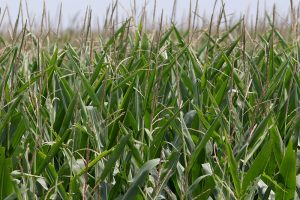
Corn growing in a western Iowa field in August 2023. (Photo by Jared Strong/Iowa Capital Dispatch)
Farmers had nearly 6 days suitable for field work this week and enjoyed high temperatures in the upper 70s and low 80s later in the week due to a cold front that pushed in. “Farmers across Iowa enjoyed a welcome break from the rain last week along with cooler temperatures and less humidity,” Iowa Secretary of Agriculture Mike Naig said in a statement. Naig said the cooler temperatures are forecast to hang around for the remainder of the month.
Despite the cool temperatures through the weekend, the average temperature for the reporting period was still 1.3 degrees above normal, according to State Climatologist Justin Glisan, who said temperatures were “unseasonably warm” for most of the period. Ames logged the highest temperature for the week, which at 97 degrees Fahrenheit was 16 degrees above the normal. Northeastern parts of the state had “unseasonably” high precipitation totals early in the week, with some areas logging as much as 6 inches of rain.
The average precipitation across the state was 0.87 inch, just slightly below the normal of 0.93 inch.
Cass County: Corn $3.72 Beans $9.79
Adair County: Corn $3.69 Beans $9.82
Adams County: Corn $3.69 Beans $9.78
Audubon County: Corn $3.71 Beans $9.81
East Pottawattamie County: Corn $3.75 Beans $9.79
Guthrie County: Corn $3.74 Beans $9.83
Montgomery County: Corn $3.74 Beans $9.81
Shelby County: Corn $3.75 Beans $9.79
Oats: $2.83 (same in all counties)
(Prices are per bushel; information is from the area Farm Service Agency [FSA] offices)
(Radio Iowa) – A soybean disease called sudden death syndrome – or S-D-S — is showing up in more fields this year due to a wet growing season. Iowa State University Extension plant pathologist Daren Mueller says a soil fungus causes S-D-S, largely by producing a toxin that’s absorbed into the soybean’s leaves, which turn yellow and die. “The more rain we get, the more toxin that’s going to be there and sort of hastens the death of the plant. But you still, it is a patchy disease and sometimes the fields are not 100 percent infected. So, it’s still good to have a few rains to finish out the crop that isn’t infected,” he says.
Mueller says treatment is not an option once S-D-S is detected, but farmers can consider different soybean varieties and seed treatments next year. He says planting later in affected acres can also decrease risks of the disease.“As farmers are planting earlier and earlier, that actually increases the risk of S-D-S, so maybe identify the fields that are worst, and try to put those toward the end of your list that you’re going to plant,” Mueller says.
Mueller made his comments on the Iowa Public Radio show “River to River.”
(Radio Iowa) – Bankers in Iowa and nine other states who responded to the latest “Rural Mainstreet” survey predict many Midwest grain farmers will have more expenses than profits this year. Creighton University economist Ernie Goss conducts the monthly survey. “It’s all about those two words that we always use: supply and demand. And I think in this case it’s too much supply for most of the grain products out there,” Goss says. “The bankers expect one-fifth of the grain farmers to experience negative cash flow — of course that’s not good, negative income.”
The U-S-D-A predicts Iowa farmers will harvest the largest ever corn crop this fall and that bumper crop means lower prices — projected to be around three-dollars-and-60 cents per bushel. Goss says there are other troublesome economic signals in the farm economy. “Farmland prices are down for the month and farm equipment sales down for the 24th straight month,” Goss said. “…Iowa and Nebraska had the worst economic performance from the fourth quarter of 2024 to the first quarter of 2025 — the worst in the nation — and that’s all about agriculture.”
Goss says urban areas are doing much better, but Midwest economies rely heavily on the performance of the ag sector. A weaker U.S. dollar may eventually boost overseas grain sales, according to Goss, and he says there may at least be a short term break for borrowers if the Federal Reserve cuts interest rates in September.
(Radio Iowa) – The first human case of a dangerous, flesh-eating parasite has been confirmed in the United States, in someone who recently traveled to El Salvador, and U.S. Agriculture Secretary Brooke Rollins warns the “New World Screwworm” could devastate cattle herds if it reaches the U.S. “The New World Screwworm is a real threat to America…The last time it really hit our shores was in the ’50s and ’60s. It took 30 years for our cattle industry to recover,” Rollins said at a press conference during the Iowa State Fair. The U.S. Department of Agriculture is building a facility in Texas, near the southern border, to produce and release hundreds of millions of sterile flies in hopes of eradicating the pest in Mexico before it reaches the U.S. “The last case of the screwworm that was an isolated case, but nevertheless a case, was found about 370 miles south of the Texas border,” Rollins said.
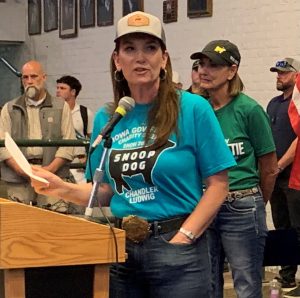
U.S. Agriculture Secretary Brooke Rollins spoke at a news conference before participating in the Governor’s Charity Steer Show at the 2025 Iowa State Fair. (RI photo)
In July, the Mexican government announced it was building a $51 million facility that will also produce and release sterile flies in hopes of pushing the screwworm population further south to the border between Panama and Colombia. Rollins said teams of USDA employees will be dispatched to Mexico, too. “We are staffing up in the hundreds to get down into Mexico so we can trust, but verify the data they’re giving us,” Rollins said. “That’s part of the problem. We’re relying on Mexico which has some significant cartel issues, significant funding issues, so we’re really grateful for their partnership, but we’re going to trust, but verify with our own teams down there.”
The U.S. government has stopped imports of live cattle from Mexico and the USDA is training dogs that will be able to detect screwworm infestations in animals at U.S. border crossings.
(Radio Iowa) – Even the recent chilly morning lows in the 40s weren’t cold enough to kill mosquitoes, so Iowans are being warning to take more precautions after the state’s first reported case of West Nile virus this year. State medical director Robert Kruse says as Iowa enters peak mosquito season, people should watch for the symptoms and seek immediate medical attention if they’re showing signs. “Stiff neck or weakness beyond what they may typically experience,” Kruse says, “confusion, any sort of severe headache or high fevers or any kind of new neurological symptoms.”
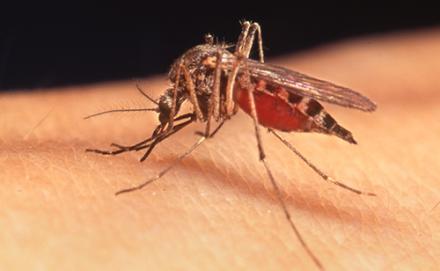
Mosquito-USDA-photo
Kruse says just about one in five people will experience symptoms, but certain groups are more likely to have severe complications. “For those individuals that are older age, or certainly have immunocompromised systems where their immunity is not as great,” he says, “they’re more likely they have complications related to the infection.” Speaking on the Iowa Public Radio show, “River to River,” Kruse says Iowans should use mosquito repellent with DEET and avoid standing water to lower their risk of getting the virus.
The state confirmed its first West Nile case of the year in northern Iowa last week. There were 21 cases confirmed statewide in 2024, with one death.
Cass County: Corn $3.70 Beans $9.75
Adair County: Corn $3.67 Beans $9.78
Adams County: Corn $3.67 Beans $9.74
Audubon County: Corn $3.69 Beans $9.77
East Pottawattamie County: Corn $3.73 Beans $9.75
Guthrie County: Corn $3.72 Beans $9.79
Montgomery County: Corn $3.72 Beans $9.77
Shelby County: Corn $3.73 Beans $9.75
Oats: $2.87 (same in all counties)
(Prices are per bushel; information is from the area Farm Service Agency [FSA] offices)
(Atlantic, Iowa) – Another Produce In the Park event in Atlantic heads your way this Thursday, August 28th. Get ready for some spicy fun, as the theme this week is “Salsa Night at Produce in the Park!” Watch guest chefs in a Chopped-style salsa showdown, then taste their creations. Bring your dancing shoes for salsa-style Jazzercise (all welcome!), plus a salsa-themed kids scavenger hunt and “Blind Date with a Book” with the Atlantic Public Library Friends & Trustees. 
Live music will be provided by Jenna Nevins. Vendors this week will be offering fresh produce (peppers, tomatoes, onions, zucchini, and more), local meats, farm-fresh eggs, honey, baked goods, arts and crafts, fresh flower bouquets, handmade soaps, and more. Zipp’s Pizzaria is bringing their food truck to the downtown Atlantic City Park, for Produce In the Park, and visiting community organizations will have booths set up, including: Zion Integrated Behavioral Health Services, Cass Health, Atlantic Public Library, and others.
Thanks to August Sponsors: Zion, Cass Health, Gregg Young Chevrolet of Atlantic, City of Atlantic, 1st Whitney Bank, Cass County Tourism, Atlantic Area Chamber of Commerce, and Nishna Valley Family YMCA.
For more information and to apply to be a vendor at our farmers markets visit https://www.produceintheparkatlanticiowa.com. Facebook event link: https://www.facebook.com/share/1Ark9pVsyG/

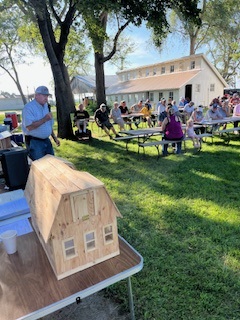
(Radio Iowa) – Harvest projections for corn and soybeans are up while the prices for those commodities are remaining low. Iowa Congresswoman Ashley Hinson says continuing to expand markets is one way to deal with that situation. The Republican from Marion says she recently talked with commodity groups at the Iowa State Fair.
(as said)”I sat down with the folks from Iowa Corn, they definitely want to see these trade deals come to fruition. So they were thankful for the provisions, we were able to get in the one Big Beautiful Bill act that are are now law. Obviously to help expand market access, making sure those resources are there for foreign market development,” Hinson says.
She says the U-S needs to keep working on deals like the ones secured with Great Britain, Vietnam, Japan, and South Korea that provide opportunities for our farmers
(as said)“Ultimately that’s what they want. They don’t want another handout or or another check, they want to be able to sell their products and make sure that demand is there,” she says.
Hinson says it will help Iowa tremendously if more markets can be opened up.*
(as said)”There’s amazing potential there if we can continue to advance these trade deals and continue to provide our farmers access to new markets,” she says.
Hinson says another example is a soybean crush plant she recently visited in her district that is supplying the South Pacific with fish food.


 Facebook
 Twitter
 YouTube
 RSS
RSS