

CLICK HERE for the latest market quotes from the Iowa Agribusiness Network!
CLICK HERE for the latest market quotes from the Brownfield Ag News Network!


CLICK HERE for the latest market quotes from the Iowa Agribusiness Network!
CLICK HERE for the latest market quotes from the Brownfield Ag News Network!
(Radio Iowa) – The 100th pheasant season in Iowa opens Saturday and D-N-R wildlife biologist Todd Bogenshutz says it is setting up to be a good one. “This past year was the fourth mildest winter in state history, like 150 years of record. So, we probably had virtually all of our hens survive from last fall,” he says. Bogenshutz says having that type of survival rate is fantastic, and those numbers make up for some loss of young birds in wet weather after the hatch. “The roadside survey showed that our chick survival wasn’t as good as last year, but it was only down a little bit, so the number of hens that were nesting more than made up for not quite as many chicks surviving. And so our counts still were up 40 percent statewide,” Bogenschutz says.
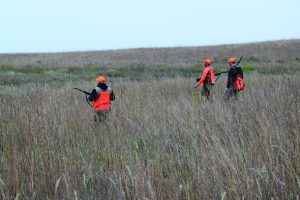
Photo courtesy of the Iowa DNR.
Some 77-thousand hunters head out to chase the ringnecks last year, and he says that number is likely to grow this season. “This year with the counts being so good, you know, Mother Nature smiled on us with good weather and we grew a lot of birds for the for the habitat we have, I would not be surprised at all if we’re over 80-thousand hunters,” he says. Bogenschutz says Iowa should stay at the top of the best states for pheasant hunting. “We’ve been the number two state in harvest for the last four years running at least, probably this will be the fifth year with this fall, only South Dakota can boast more pheasants harvested than us,” Bogenschutz says.
Bogenschutz the pheasant harvest could be in the 600 to 700-thousand range. The season runs through January 10th.
POTTAWATTAMIE COUNTY, Iowa — A fisherman in Pottawattamie County now holds the state record for reeling in the biggest catfish. George Thompson was fishing along the Missouri River earlier this month when he reeled in a catfish measuring 60 inches long and weighing 105 pounds, according to the Iowa Department of Natural Resources. It’s the same stretch of river where the previous record of 53 inches and 101 pounds was set back in 2004. The Iowa DNR says it took Thompson 35 minutes to battle the beast out of the water.
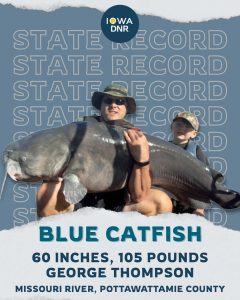
The DNR confirmed the measurements and the successful release.
(Radio Iowa) – Leaders in Iowa’s most populous county say they’ll funnel 200-thousand dollars to the Iowa Water Quality Information System to help keep a network of river and stream sensors operating next year. The University of Iowa program lost state funding in 2023, and supplemental dollars from the Walton Family Foundation and I-S-U Nutrient Research Center are expected to run out next year. Matt McCoy is chair of the Polk County Board of Supervisors.
“While I personally would like to see the state and federal government play a big role in helping us fund these data sets,” McCoy says, “unfortunately, they’ve made decisions at the legislative and at the federal level to not do that.” McCoy says the county has an obligation to ensure the water its residents rely on is protected. The funding from Polk County represents one-third of the annual budget for the water monitoring network. McCoy says the hope is that other counties will contribute funding to operate dozens of sensors across the state.
Rich Leopold, director of Polk County Conservation, says long periods of data are key for tracking trends and knowing whether certain water quality practices, like adding wetlands, are effective. Leopold says, “We’re investing time, energy and money into all these practices, and if we want to make sure that we’re doing something to make things improve, are things improving?”
The sensors collect real-time data for things like nitrate, flow and temperature. The Iowa division of the Izaak Walton League recently launched a GoFundMe page for the program.
(Radio Iowa) – In an update to an earlier report, a spokesman for the trade group called Fur Commission U-S-A now says around two-thousand mink were released into the wild after fences were cut down cut down and pens damaged at a mink farm near Woodbine Monday night. The spokesman says about 60 percent of the animals were recovered by the farmer.
The farmer is also involved in conservation programs that support national wildlife repopulation efforts and suffered additional losses when starving mink preyed on those animals in his care.
(Radio Iowa) – Iowa Senator Chuck Grassley is adding his voice to the bipartisan chorus of lawmakers who are questioning President Trump’s suggestion to import more beef from Argentina to bring down prices. Reports show U-S consumers are paying more than 50-percent higher prices for beef over the past five years, but Grassley says we need to look within, not outside our nation’s borders, for the solution. “I don’t think we ought to be taking more beef from Argentina and I think the president recognizes that he has a problem doing that,” Grassley says, “and that’s why he had the secretary of agriculture make changes in policy that will increase the production of beef in the United States.” Grassley says he and a half dozen other members of Congress met with Ag Secretary Brooke Rollins on Tuesday, and after that meeting, Grassley says he’s convinced the president has the best interests of beef producers in mind.
“He’s opened up more federal land for grazing, help for setting up smaller meat packing plants so that the four big packers that have 85% of the slaughter, we got more competition,” Grassley says. “We’ll help cattle feeders as well as helping consumers.” The Iowa Cattlemen’s Association issued a statement Wednesday saying Trump’s comments about importing more Argentine beef are “disconcerting,” adding, the president “continues to create undue harm to U.S. cattle producers, inhibiting their ability to make smart marketing decisions that directly impact their long-term profitability.” Grassley says cattle numbers in the U-S are the lowest they’ve been in 75 years and he believes Trump’s long-range plan will “reinvigorate” the cattle industry.
“So instead of eating grass-fed beef from Argentina, which is as tough as leather,” Grassley says, “and we’re going to eat corn-fed beef from the United States of America.” Trump posted Wednesday on social media: “The Cattle Ranchers, who I love, don’t understand that the only reason they are doing so well, for the first time in decades, is because I put Tariffs on cattle coming into the United States, including a 50% Tariff on Brazil. If it weren’t for me, they would be doing just as they’ve done for the past 20 years — Terrible! It would be nice if they would understand that, but they also have to get their prices down, because the consumer is a very big factor in my thinking, also!”
(Radio Iowa) – The number of state beach advisories for E. coli hit a record this year as the D-N-R continues a project to learn more about it. Dan Kendall manages the D-N-R’s summer beach monitoring program. “I have crews out, usually about 15 weeks out of the year, sampling beaches in an effort to be protective of public health.” Those samples include testing for E. coli, a large family of bacteria. Most strains are harmless. They live in the guts of warm-blooded animals, including people, geese and cattle. But some escape into the environment through feces and make people sick with stomach cramps and diarrhea. Kendall says high concentrations of E. coli in water also indicate other harmful microbes may be present. “So, as the numbers go up, the risk of getting a gastrointestinal-type illness at the beach goes up,” Kendall says.
The D-N-R issued 151 “Swimming Not Recommended” advisories this for state beaches because of E. coli. D-N-R natural resource biologist Jason Palmer was out recently trying to find out why long-term data shows some state beaches test high for E. coli time and time again. “We’re doing some sand sampling and some water sampling, kind of at the same time so that we can see what’s happening both in the terrestrial portion of the beach, as well as what’s occurring in the swimming water where people often times are recreating,” he says. Data at lakes around Iowa show beaches tend to be E. coli hot spots – specifically within five to six feet from the water’s edge. Farther out, E. coli levels drop off. New research also shows some E. coli strains can do pretty well outside an animal gut.
“E. coli bacteria can actually persist in the environment for very long periods of time, and in some cases, have been shown to replicate in the right conditions,” he says. Palmer says E. coli can thrive in wet sand right below the surface. It gives the bacteria a moist structure to grow on and a stable temperature with protection from direct sunlight. Another piece of this project uses pumps that put lake water through a series of medical-grade filters trying to figure out if there are viruses and other pathogens at the beach. Palmer’s team will ship these filters and some sand samples to a federal lab in Wisconsin. There, scientists will look for the genetic material of harmful microbes and clues to where they came from. “Canadian geese, dog, tracers to look for human waste and also tracers to look for things that might occur in the agricultural environment, like swine or cattle or poultry,” Palmer says.
Palmer and field technicians have collected data from Big Creek, Backbone, Clear Lake and MacBride since 2023. And he’s hoping that results will be available to share next year. By understanding the dynamics of E. coli at state beaches, Palmer says the D-N-R can better communicate risks to the public and find solutions.
(Radio Iowa) – A monthly survey of bank C-E-Os in rural areas of Iowa and other Midwest states indicates the region’s economy has dipped to its lowest level since May of 2020. Creighton University economist Ernie Goss conducts the survey and issues a Mid-America Mainstreet Index each month. “It was not good news for the month of October and certainly looking ahead, the outlook is also negative for these bank CEOs in looking at the farm economy,” Goss said. Goss says a firm majority of the bankers indicated President Trump’s approach to trade with China is about right, but nearly 85 percent of the bankers surveyed support emergency federal payments to farmers due to the financial hit of trade losses.
“Some of the bankers said, ‘Well, we’d like to see higher grain prices, for example, than getting that support,’ but nonetheless there was support for that, but again that’s not going to make up for the downturn in what we’re seeing in lower grain prices througout the region,” Goss said. “…We’re seeing below break even income, cash flow for farmers that depend heavily on grain, that is.” Goss says there may be one bright spot in the survey, about farm loans.
“Delinquency rates are very low right now especially given the weakness in farm income. In other words, the farmers have been judicious about borrowing and the lenders have been judicious about lending,” Goss said, “…On the flip side of that farm equipment sales have really been suffering in the region.” Goss says farm equipment sales have dropped for 26 straight months. That’s a hit to Iowa where Deere and Company has been laying off workers and scaling back production. Goss says due to rising costs for fertilizer and other expenses, there’s been an increase in the amount farmers are borrowing. “I expect that to continue to move higher and, of course raising the risk out there,” Goss said, “and we’ve seen a lot of volatility in the farm outlook and obviously that’s a real issue going forward.”
Goss says the value of farmland is holding up much better than farm income. The rural bankers surveyed expect farmland prices to decline by three to four percent in the next 12 months, according to Goss.
(Radio Iowa) – A spokesman for the trade group called Fur Commission U-S-A reports someone illegally entered a mink farm in southwest Iowa near Woodbine Monday night. Spokesman Challis Hobbs says a farmer, his son and grandson raise more than one-thousand mink and found the perimeter fence torn down. )”That’s what they woke up to, and they woke up to a lot of the pens had been opened and like the housing, so like the nest box like where it’s warm and stuff where the mink stay, the people who came in, they destroyed those,” he says. Hobbs says around half of the mink stayed around and they’ve been working to find the others as they are domesticated and don’t do well in the wild.
“What we see time and time again is like within 24 to 48 hours, if the farmer can’t recover them, the majority of them die. The ones that don’t, they kind of get loose and they’re desperate and they’re carnivorous. So they’re killing anything and everything they can to eat,” he says. Hobbs says they might survive for awhile eating any birds or chickens they can find, but they often die or are hit on the roadway and killed. Hobbs says there have been some recent attacks on fur farms in Ohio and Pennsylvania, and they are not just vandals. “Everyone who’s been caught doing this has been activists. It’s very organized, it’s organized crime really is,” Hobbs says. “Like for example the ones in Pennsylvania, they showed up and they had. They had a whole a whole pamphlet of like what to do, not to get caught. Like turn off your cell phone and what to do if you get caught. What to say and don’t turn on your other basically activist friends, extremist activist friends who are doing the same thing.”
He says local law enforcement and the F-B-I are investigating the Woodbine case. “These crimes do fall under the Animal Enterprise Terrorism Act. Because the government does see this as domestic terrorism because they’re intentionally going on these farms and trying to basically shut them down and put these put these farming families out of business,” Hobbs says.
Hobbs says two people were caught in the Pennsylvania and they face multiple charges. Hobbs says the animals cost around 45 dollars each, but it can cost the farmer much more in losing animals for breeding.
(Red Oak, Iowa) – Officials with the Red Oak Fire Department report a little before 1-p.m., today (Tuesday), the Montgomery County 911 center was notified by Pottawattamie County 911, about a combine fire in the area of 490th x Pioneer Trail in rural southeast Pott County, within the Elliott Fire District.
Red Oak FD and Elliott FD were paged and while enroute, Griswold Fire & Rescue was requested for mutual aid due to smoke being visible from Red Oak of the fire. Additional support was requested from area farmers with tractors and discs due to high winds and an apparent ongoing fast-moving fire. (Red Oak FD Facebook photos)
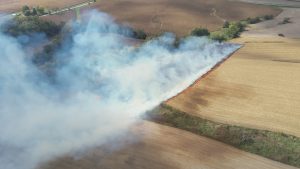
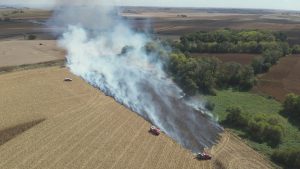
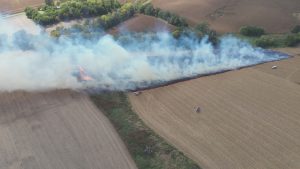
Fire crews arrived on scene and found approximately 4-5 acres on fire, spreading moderately to the east with the wind into a waterway containing two large brush piles that were now on fire. Additional mutual aid was requested from Macedonia Volunteer Fire Department and Carson Fire and Rescue for water tankers due to the size of brush piles actively on fire. The field fire was quickly contained with on scene units as well as the use of tractors and discs who helped contain the fire as well as contain spot fires that flared up due to the wind. Stanton Fire and Rescue Department was requested for tanker support but cancelled as additional units arrived on scene.
The landowner was working with a contractor to bury and place soil on top of the brush piles and will continue to monitor the area until complete. No injuries reported. It is believed that a hot ember or spark ignited dry vegetation while the combine was in operation. Crews were on scene for roughly 2 hours.
MCEMA Drone Video: https://www.youtube.com/watch?v=j0kTe2kzOBc&feature=youtu.be
Assisting agencies:
Montgomery County 911
Montgomery County Sheriff’s Office – Red Oak, Iowa
Montgomery County Emergency Management Agency
Elliott Volunteer Fire Department
Griswold Fire & Rescue
Macedonia Volunteer Fire Department
Carson Fire and Rescue
Stanton Fire and Rescue Department
(Radio Iowa) – The archery season for deer continues and will run right up to the first shotgun season on December 6th. Iowa D-N-R deer biologist, Jace Elliott says western Iowa’s deer populations continues to struggle. “We’re still going through a sustained population decline as far as harvest and population trends show, and that’s been going on for 10 or 15 years. We’re working proactively with regulations to try to reverse that trend,” he says. Elliott says central Iowa is trying to rebound from recent hemorrhagic disease outbreaks.
“In some cases, very severe impact on local deer numbers in the 2023 and 2024 season, so it’s possible that numbers are going to be a bit lower this year than they were over the last decade or so in central Iowa,” Elliott says. “But then in eastern Iowa, in many cases we have very strong deer numbers… in some cases we have the strongest deer harvest that we’ve had in in 20 years.” Elliott says the hemorrhagic disease outbreaks have eased off. “This year shows to be exceptionally mild. We’ve only just had one off cases reported across the state, very few of them compared to the last couple of years, so that should offer some relief in populations that were impacted recently,” Elliott says. Elliott says the wet weather before things started getting dry in September has given deer plenty to eat.
“During the growing season, that’s a really nutrient expensive time for deer, whether we’re talking about bucks that are growing antlers, that takes a tremendous amount of resources and minerals and nutrients in order to grow antlers,” he says. “And whether we’re talking about does, they’re lactating, and that’s also. Its own nutrient demand, so it’s important to have a lot of vegetation on the landscape.” Hunters have taken around eight thousand deer in the ongoing bow season and the now completed early muzzleloader season.


 Facebook
 Twitter
 YouTube
 RSS
RSS