

CLICK HERE for the latest market quotes from the Iowa Agribusiness Network!
CLICK HERE for the latest market quotes from the Brownfield Ag News Network!


CLICK HERE for the latest market quotes from the Iowa Agribusiness Network!
CLICK HERE for the latest market quotes from the Brownfield Ag News Network!
(Radio Iowa) – President Trump met with China’s president earlier today (Thursday) and Trump says China has agreed to start buying massive amounts of U.S. soybeans. U-S Ag Secretary Brooke Rollins says China purchased “multiple” shiploads of soybeans just before the meeting. Iowa Secretary of Agriculture Mike Naig says it’s all great news that will have a meaningful impact at a tough time for the farm economy. China has historically been the largest overseas market for U.S. soybeans, but stopped buying this spring in response to U.S. tariffs. American Soybean Association President Caleb Ragland says that made financial problems even worse for soybean farmers.
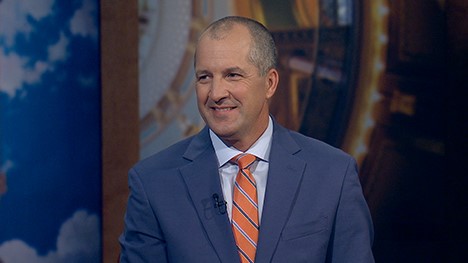
Iowa Secretary of Agriculture Mike Naig on the “Iowa Press” set at Iowa PBS (Iowa PBS photo)
“We are hopeful that this market will be restored following the meeting between Presidents Trump and Xi,” Ragland said. “Still, high production costs and market losses mean soybean farmers are expected to face losses of $109 per acre for this year’s crop.” Ragland says the financial situation for row crop farmers remains dire, though, due to escalating costs for things like seeds, fertilizer and farm equipment. “As congress and the administration continue to address the overall cost of farm production, targeted farm assistance is desperately needed,” Ragland said.
President Trump suggested weeks ago that up to 10 BILLION dollars of emergency payments to farmers could be made using tariff revenue, but the plan was put on hold during the government shutdown.
(Atlantic, Iowa) – Farmers are pondering the question of whether or not this is a good time to apply anhydrous ammonia to their fields after the harvest. Aaron Saeugling ISU Extension/Outreach Field Agronomist for Cass County says it’s a “difficult question to answer, with several variables,” but Saeugling says “I will say NO it is still too warm we need soils to cool a bit further to reduce the conversion to nitrate. We want spoils that are trending downward in temperature the 4-inch soil temp fluctuates more in dry soils and with sunny days. Some folks will justify this by that timing to get it all applied is challenging, while I do agree that getting it applied is a challenge just prepare your self to lose more nitrate than if you are to wait.” He urges crop producers to “Be safe!”
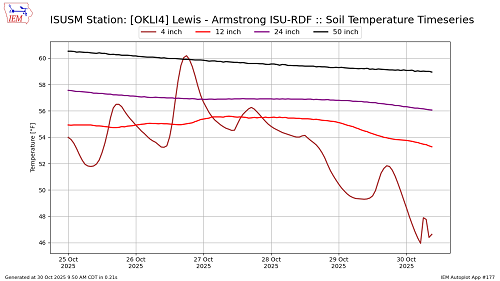
More information is available HERE.
(Red Oak, Iowa) – The Board of Supervisors in Montgomery County are being asked to contribute to a case involving local control of carbon pipeline projects. During the Board’s meeting Tuesday morning in Red Oak, West Township resident Jan Norris asked them to approve the Iowa State Association of Counties (ISAC) request for funding for an Amicus brief in an upcoming U.S. Supreme Court case.
Each of the Montgomery County Board of Supervisors received a letter from ISAC asking for a donation. An amicus brief is a legal document submitted by a third party who is not directly involved in a lawsuit but has a strong interest in the outcome. Related legal terminology, “amicus curiae” translates to “friend of the court,” and the brief’s purpose is to provide the court with additional information, expertise, or arguments that can help inform its decision. Those briefs are often filed in cases of public importance and can support or oppose a party’s position by offering unique perspectives or legal analysis
Earlier this month, Shelby and Story County officials filed a petition in their case against Summit Carbon Solutions. Both counties seek to appeal the Eighth Circuit Court of Appeals’ ruling in June that upheld a lower court’s ruling barring counties from implementing ordinances regulating carbon sequestration projects–such as the proposed Midwest Express CO2 pipeline.
Norris says ISAC is asking each county to consider a $500 contribution or more, to cover the total cost of $25,000 to file the amicus brief and represent counties during the legal proceedings.
The Board acknowledged the matter is worthy of consideration and discussion, and it will be placed on their agenda for Wednesday, Nov. 5th.
(Radio Iowa) – The Iowa furbearer season opens Saturday, and the D-N-R furbearer biologist Vince Evelsizer says the trapping prospects look good. “Overall the furbearer populations around the state are in great condition. The only two species that are of concern would be muskrats and gray fox. Both have a declining population, or with muskrats, somewhat stable,” he says. Evelsizer says the wet start to the year helped fill up waterways, which benefits furbearers, especially beaver and muskrats. “Having some water out there on the landscape helps them all with litter rearing,” he says, “and then also gives them a place for the winter that doesn’t dry up. And so it just helps with them to do have a better year population wise.” Evelsizer says the fur prices are still in the low category for those who do take part.
“The species that are most popular these days in the current world typically are still raccoons, and to some extent otters, and bobcats have become fairly popular as well,” he says. Evelsizer says we’ve been holding around 15-thousand licensed trappers over the last several years. He says efforts to introduce young people to the sport have been successful. “We’ve partnered with the Iowa Trappers Association and the D-N-R’s Hunter Ed program and the D-N-R’s conservation officers. All have been great to work with and getting more beginner trapper events going, with the Iowa Trappers Association leading several of those beginner trapper events. And what’s neat with that is that we’re seeing quite a few youth and females and males attending those events.” 
Evelsizer says the young trappers are getting into it for a lot of reasons. “It’s not just fur market driven, they’re doing it to learn the outdoor skills. They’re doing it to get a few nice tanned pelt, that sort of thing, so neat to see,” Evelsizer says.
You can check the Iowa D-N-R’s website to find out all the rules and regulations for the trapping season.
(Radio Iowa) – President Trump’s approach to trade is being debated on the Iowa campaign trail. Republican Congresswoman Ashley Hinson points to a potential deal with China later this week and Josh Turek — a Democrat running for the U.S. Senate — says Trump’s tariffs and the decision to import Argentine beef are causing a “farmageddon” in rural Iowa. “Our farmers are the very best in the world here in Iowa,” Turek said. “We’ve got a long history of feeding the world, doing it better than anybody else and it is due to these chaotic tariffs that we’re seeing our farmers having an inability to make a living for themselves. They want markets, not handouts.”
Congressman Zach Nunn and U.S. Senator Joni Ernst — both Republicans — have sent a letter to Trump Administration officials, calling for swift, coordinated action to restore access to foreign soybean markets. Congresswoman Hinson — who’s running for the U-S Senate — did not sign the letter. Hinson says Trump’s trip to China this week shows his commitment to American farmers. “It’s great to see things moving in the right direction for our soybean farmers, promising news when China’s potentially agreeing to buy substantial amounts of our soybeans,” Hinson said. “And as we wait for more details on that deal, I will continue working with the administration to expand market access for our Iowa farmers and secure new trade deals.”
Republican Congresswoman Mariannette Miller-Meeks sent a letter to President Trump and the U-S ag secretary, warning any trade deal with China must have strong enforcement mechanisms to sanction bad actors. During Trump’s first term, he negotiated a deal in which China promised to buy 200 billion dollars worth of U-S exports. While the deal ended trade tensions between the two countries, China only bought 58 percent of the U-S goods and commodities it had promised to buy.
(Radio Iowa) – Senators from Iowa and Wisconsin recently re-introduced a bill that would require the U-S-D-A to study competition in the fertilizer market and its impact on prices paid by farmers. Three companies dominate fertilizer production in North America, according to Farm Action. Noah Coppess farms and runs an agri-business in eastern Iowa. and told Senators during a Judiciary Committee hearing that farmers right now are price takers, not price makers – especially when consolidation limits their options.
“Fertilizer pricing has become very volatile with at times, wild swings and costs varying as much as 25 to 50 percent from year to year,” he says. Coppess says they have to pay up front. “We are asked to pre-pay for fertilizer three-to-six months prior to it being applied to the soil, and up to 14 months before the crop will be harvested,” Coppess says.
The C-E-O of the Fertilizer Institute said during the hearing that geopolitics and demand from U-S corn growers have contributed to higher fertilizer prices. He said streamlining environmental permitting for mines and production plants would help the sector boost the domestic supply. The U-S imports the vast majority of the potash used in fertilizer, with most of it coming from Canada.
Iowa Senator Chuck Grassley is a co-sponsor of the Fertilizer Research Act, which would require the U-S-D-A to conduct a study on competition in the fertilizer market and its impact on price.
(Radio Iowa) – Iowa Senator Chuck Grassley says he’s encouraged by the trade deals President Trump is making during his Asian tour, but it’s still unclear if there will be an agreement reached with China to buy American products, especially agricultural products like soybeans. China had been the biggest customer of that crop, but halted all purchases earlier this year in retaliation for Trump’s tariffs. “It would still give a great morale boost to farmers if they knew that China is going to be back in the market for our soybeans,” Grassley says. “Now, exactly when those first soybeans start flowing to China, I can’t give you a date on that.”
Grassley also couldn’t say if a deal with the Chinese this late in the year would be too little, too late for Iowa soybean growers, as China’s been buying beans from Brazil for many months. Grassley says the president’s making significant progress elsewhere. “I think the trip is already producing results,” Grassley says. “You heard announcement of trade deals with Malaysia, Cambodia and signed reciprocal trade framework for Thailand and Vietnam.” A few weeks ago, the president talked about offering farmers who’ve been impacted by retaliatory tariffs several billion dollars in relief, but that potential aid package is on hold due to the federal government shutdown.
Trump’s in the midst of a five-day trade trip in Asia and he’s scheduled to meet with China’s president in South Korea on Wednesday. Grassley couldn’t say what Iowa farmers should hope for from those talks. “That’s new negotiations,” Grassley says. “Don’t forget that China only fulfilled about two-thirds of their obligation to buy American products, including agricultural products, from the January 2020 agreement that we had, called the First Phase of the China agreement.”
Trump met today (Tuesday) with Japan’s prime minister, signing a wide-ranging deal on several fronts, including missiles and rare earth elements.
(Radio Iowa) – An invasive insect that gobbles a wide host of plants, trees and crops is now confirmed in Iowa and it’s feared there’s scarcely anything that can stop it from spreading. The state ag department says the spotted lanternfly was found in southeast Iowa’s Des Moines County in September in an industrial area with significant truck traffic from outside Iowa. Boone entomologist Ginny Mitchell says it’s already established in 15 other states and is proving to be very harmful. “The spotted lanternfly feeds on over 100 different species of plants,” Mitchell says, “and where it really comes into play are a lot of fruit-bearing trees, grapes, different berries, and there is the potential of it feeding on crops like soybeans and corn.”
Though many parts of Iowa have seen frost this month, there hasn’t been a hard freeze statewide yet to kill most insects, and even then, the spotted lanternfly could be back in greater numbers next spring. “The females lay a cluster of eggs and then it’s kind of like a coating that almost looks like dried mud on whatever, a tree or a piece of stone or a building,” Mitchell says, “and it really protects those eggs from any of the elements, so these eggs will survive the winter.” Before it grows wings, the young spotted lanternfly is all black with white spots, and as it ages, it will develop red patches. The mature insect has light brown main wings with black spots, while the rear wings are bright orange with black spots, along with black and white bars. Mitchell says it’s going to be extremely difficult to control the spread of these pests. 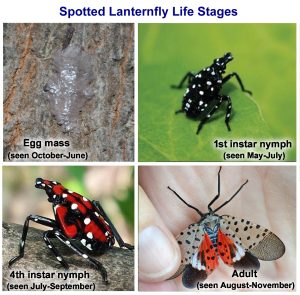
“They were introduced to the United States in Pennsylvania in 2014 and they think they came on a shipment of stones,” Mitchell says. “It’s really hard to distinguish between the eggs and the stones themselves because they’re practically the same color, so these can move anywhere and eggs can be laid on literally anything.” In recent years, Iowans learned a hard lesson about invasive insects like the emerald ash borer, and no one wants a repeat of that. “We tried to stop the spread by convincing people to not move wood from one area to another and it has decimated the ash trees,” Mitchell says. “It’s all over the place now, so we don’t want something similar happening with the spotted lanternfly. We really need to be diligent in keeping an eye out for this pest so it does not continue to spread.”
Iowans who spot the spotted lanternfly should report it to the Iowa Ag Department’s Entomology and Plant Science Bureau at 515-725-1470 or e-mail Entomology@IowaAgriculture.gov.
(Radio Iowa) – The 100th pheasant season opened Saturday in Iowa for a sport that Iowa D-N-R wildlife biologist Todd Bogenshutz says had a humble start. The first pheasants were released from William Benton’s wild game farm near Cedar Falls in 1901 when a storm wrecked their pen. The bird population continued to grow to a point where the State Conservation Commission got complaints of crops being damaged and started to take action.”Game wardens at the time we’re asking land owners to pick up wild eggs in the field or trap wild pheasants in1925, with 60-thousand eggs and like seven-thousand wild birds that were picked up and delivered to other areas of the state without pheasants,” he says. The state also started the first pheasant hunt.
“Maybe 75-thousand people participated in that first season in 1925. It was 13 counties in north-central Iowa,” Bogenschutz says. “It was a three-day season, you could only hunt from 8:00 a-m to noon, and that was a three rooster bag limit.” Bogenschutz says they didn’t have any survey back then but he guesses around 250-thousand birds were taken. Bogenschutz says there weren’t large mechanized farms with fence row to fence row planting back then, and the landscape was perfect for pheasants to thrive. “Half the ag landscape either being small grains or hay or pasture, and then corn was the major crop,” he says. “The other crops besides the small grains were, you know, people were growing beets and sweet clover for seed, and a lot of things that you don’t see anymore today. But yeah, that combination of small fields and that much grassy cover. obviously grew a lot of pheasants.”
Surveys found hunters taking one million or more birds. Bogenschutz says soybeans started becoming really popular in the 60s and more so in the 70s and that led to a big decline in small grains and hay. “Like from the mid 1950s to about 1980. And so now we’re kind of a corn soybean rotation instead of a corn old hay rotation, so that has impacts on the number of birds that we could grow,” he says. The farm crisis of the 1980s led to the creation of the Conservation Reserve Program that paid farmers to take less desirable land out of production, creating more grassland. “That was a big boon for pheasants and I on our harvest again approached. You know one-point-two to one and a half million birds,” he says.
Weather has been the other factor that has impacted the pheasant season. Bogenschutz bad winters and springs from. 2007 to about 2011 sent bird numbers way down. “That was a very unique time frame for us there and it really drove our populations down. We’ve kind of been on an upward trend since then and Mother Nature has been relatively cooperative to us,” Bogenschutz says.
The 100th season started Saturday and will run through January.
(Radio Iowa) – Tom Harkin — the Iowa Democrat who served in 40 years in the U.S. House and Senate — has had a change of heart about the ethanol industry. “For most of my time in the Senate, I was one of ethanol’s biggest supporters,” Harkin said. “…I was wrong, at least in the magnitude.” As a senator, Harin pushed for federal policies to expand the use of ethanol and in 2010 Harkin blasted the E-P-A for delaying regulations to let gasoline with higher amounts of ethanol be sold. Harkin now says while ethanol has its place in the marketplace, it will not solve all the problems in the ag sector.
“The push to make ethanol sort of the end all and be all of agriculture production — that’s just not going to happen,” Harkin said. “…We’re going to have to start thinking of doing other things, encouraging other forms of agriculture, other forms of enterprises, things that will help us get through this mess that we’re in right now. I don’t want to lose another generation of farmers.” Harkin, who is 85, served in congress during the Farm Crisis. By the end of the 1980s, 300-thousand U-S farms had defaulted on loans.

Former U.S. Senator Tom Harkin (Photo courtesy of the Harkin Institute)
“The ’80s happened because a secretary of agriculture in the early ’70s basically said plant fence-row-to-fence-row, go big or get out,” Harkin said. “…I remember sheep raising and cattle operations all over southern Iowa. Well, in the ’70s, they plowed it all up and started planting corn and beans.” Harkin says farmers got overextended with high interest rate loans for combines and other farm equipment — and that led to farm foreclosures in the 1980s. An I-S-U economics professor estimated that in every year during the Farm Crisis, nearly two-and-a-half percent of farmers left the business.
Harkin made his comments during a “Chautauqua Talk” in Algona hosted by Kossuth County Democrats.


 Facebook
 Twitter
 YouTube
 RSS
RSS