

CLICK HERE for the latest market quotes from the Iowa Agribusiness Network!
CLICK HERE for the latest market quotes from the Brownfield Ag News Network!


CLICK HERE for the latest market quotes from the Iowa Agribusiness Network!
CLICK HERE for the latest market quotes from the Brownfield Ag News Network!
(Atlantic, IA) – Cass County 4-H’ers and their families, volunteers and supporters gathered on Sunday, November 9th to celebrate the 2024-2025 4-H year at the County 4-H Awards Convention. Cass County Youth Coordinator Katelyn Bateman says the 4-H Alumni Award, given to 4-H alumni that have stayed active in supporting the local 4-H program, was presented to Curt Behrends. Curt was recognized by 4-H club members as someone who has supported 4-H in multiple ways. He currently serves as President of Grounds Committee, previously on the Fairboard and is always advocating for the program and allowing clubs to use the facilities free of charge all year round. He has been instrumental in ground improvements to the Fair Food stand and Beef Barn construction. Curt is a servant leader and truly a positive role model for our members to look up to.
Michelle Behrends was recognized as Cass County’s newest Honorary 4-H Member. That’s awarded to a member of the community who was not a Cass County 4-H member but supports and assists the local 4-H program. She has given countless hours to the program not only as a parent, Youth Action Committee member and chairperson, but today serves as co-president of Cass County Master Gardeners and takes immense pride in the garden spaces around the Community Building. Michelle is a huge advocate of 4-H and a leader in the community.
The Distinguished Service Award was presented to Weirich Welding. Duane, Logan, and the team are incredibly supportive of the Cass County 4-H program and the welding project area specifically. Duane started the Bucket of Junk contest, challenging young people to develop new skills more than 10 years ago. Since then, the business has opened its doors to 4-H and FFA members wanting to learn more about welding. Duane has served on the Cass County Fairboard and knows the demanding work that goes into youth getting exhibits ready for fair. Logan’s family continues to be actively involved in 4-H continuing the family tradition.
The 4-H Clubs stay active in the community completing service projects, recruiting new members, and documenting their year in multiple ways. Youth hold office roles which can complete books throughout the year and turn in for awards. This year nearly all clubs turned in officer books and participated in recruiting and service activities. Top Secretary and Historian Books went to Grant Guys & Gals; Top Treasurer Book and National 4-H Week Display went to Bear Grove Blazers. Top Community Service Award in 2024 went to Grove H.O.T. to complete multiple service projects during the year. The award for encouraging club participation in multiple program areas within 4-H went to Bear Grove Blazers, they received our Banner Club.
4-H leaders reaching milestones were recognized for their service. Receiving five-year recognition was Molly Wise with Pleasant Noble United. Club leaders that completed their first-year volunteering include: Amanda Will with Benton Franklin, Jenae Waters with Washington GEM, Brittney Weirich with Washington GEM, Carolyn Bruck with Washington GEM, Hillary Zellmer with Washington GEM, Darrin Petty as an Independent Member Mentor, Holly Oathoudt as an Independent Member Mentor, Jessica DeLage with Griswold Clubsters Clover Kids, and Kristin Alexander with Griswold Clubsters Clover Kids.
There were nineteen third graders that were Clover Kids and graduated into the 4-H. Youth who graduated from Cass County Clover Kids included: Cooper Amdor of Cumberland Clover Kids, Ellie Amos of Griswold Clubsters Clover Kids, Joslynn Baier of Griswold Clubsters Clover Kids, Avery Becker of Cumberland Clover Kids, Nora Brahms of Cumberland Clover Kids, Cassidy Buffington of Griswold Clubsters Clover Kids, Sawyer Chambers of Griswold Clubsters Clover Kids, Evan Euken of Grant Guys & Gals Clover Kids, Owen Honeck of Grant Guys & Gals Clover Kids, Isabelle Kardell of Bear Grove Blazers Clover Kids, Owen Niemann of Cass County Creators, Jericho Petersen of Bear Grove Blazers Clover Kids, Quade Robinson of Cass County Creators, Milo Sager of Cass County Creators, Molly Schuler of Cumberland Clover Kids, Reece Wheatley of Cumberland Clover Kids, Riley Wheatley of Cumberland Clover Kids, Baylor Wollum of Cumberland Clover Kids, Decker Wyman of Griswold Clubsters Clover Kids.
The event concluded with the installation of sixteen senior level 4-H’ers onto the 2025-2026 County 4-H Youth Council. Members are:
Oliver Becker of Union Leaders, Hudson Brock of Grove H.O.T., Karly Byers of Griswold Clubsters, Alyson Dreager of Bear Grove Blazers, Jacquelyn Freund of Washington GEM, Walker Gary of Bear Grove Blazers, Ada Hansen of Grant Guys & Gals, Ryanna Harrison of Griswold Clubsters, Lily Johnson of Grove H.O.T., Josephine Millikan of Griswold Clubsters, Leah Ohms of Union Leaders, Olivia Olson of Pymosa, Callie Rudy of Cowpokes, Colin Rudy of Cowpokes, Miraylie Stuart of Pymosa, and Kayedance Sturm of Cowpokes.
Members and leaders of all 4-H clubs in Cass County were recognized for club activities, and project awards completed throughout the year. Intermediate and Junior 4-H members who completed a record book received project awards based on leaders’ recommendation. Record books are rated on organization, appearance, goals and learning, spelling, and grammar. These project records should be well organized, neat, and show evidence of solid Citizenship, Communication, and Leadership activities to receive awards. High School record books are reviewed again for platinum, gold, silver, or bronze level awards.
 Bear Grove Blazers members and awards include:
Abel Brockman: First Year 4-H Member
Brayden Carlson:
Catherine DeBord: Star Intermediate Record Book, Clothing, Food & Nutrition, Home Improvement, Music, Rabbit, Swine
Alyson Dreager: Overall Senior Record Book (Gold), Dog (Silver), Food & Nutrition (Silver), Photography (Silver), Sewing & Needle Art (Silver), Sheep, (Silver), Swine (Gold)
Dylen Dreager: Overall Senior Record Book (Gold), Home Improvement (Platinum), Poultry (Platinum)
Keagen Dreager: Swine, Woodworking
Walker Gary: Overall Senior Record Book (Platinum), Poultry (Platinum), Visual Art (Gold), County Level Award – Citizenship
Michael Hocamp: Overall Senior Record Book (Platinum)
Mya Hocamp: Food & Nutrition, Visual Art
Jamie Jacobsen: Completed a Record Book
Maggie Jacobsen: Completed a Record Book
Hunter Kardell: Star Junior Record Book, Mechanics
Lynsie Kardell: Star Intermediate Record Book, Goat, Photography, Sewing & Needle Art, Swine
Macie Kloewer: Rabbit
Maggie Kloewer: Food & Nutrition
Conner Mumm:
David Retallic: Overall Senior Record Book (Platinum), Food & Nutrition (Silver), Rabbit (Silver), Swine (Bronze), 4-H Graduate, Fairboard Record Book Completion Gift
Ethan Retallic: Star Junior Record Book, Beef, Food & Nutrition, Photography, Rabbit, Sewing & Needle Art, Swine, Visual Art, First Year 4-H Member
Sophia Retallic: Sewing & Needle Art, Visual Art
Nolan Sunderman:
Parker Walter: First Year 4-H Member
Carter Witzman: Overall Senior Record Book (Gold), 4-H Graduate, Fairboard Record Book Completion Gift
Benton Franklin members and awards include:
Ada Nichols: 4-H Graduate
Jett Nichols:
Braxton Scholl:
Faithlynn Scholl:
Madeline Schuler:
Blayre Steffen:
Brookelyn Steffen:
Brylee Steffen:
Brielle Wessling: First Year 4-H Member
Kylee Wessling:
Brant Will: 4-H Graduate
Caden Will:
Kyser Will:
Landrie Will:
Morgan Will:
Cowpokes members and awards include:
AJ Barber:
Micayla Betts:
Gavin Dougherty:
Jase Frederiksen:
Hayden Hansen: Star Junior Record Book, Horse & Pony, First Year 4-H Member
Shelby Hansen: Star Junior Record Book, Horse & Pony
Alex Jespersen:
Cadence Kennedy:
Cassidy Kennedy:
Clara Kennedy:
Kenadie Krause:
Gage Richter: First Year 4-H Member
Jenner Richter: First Year 4-H Member
Jovie Richter: First Year 4-H Member
Callie Rudy: Overall Senior Record Book (Gold), Horse & Pony (Gold)
Colin Rudy: Overall Senior Record Book (Gold), Swine (Bronze)
Julienne Schutt:
Garret Stetzel:
Kaylee Stetzel: 4-H Graduate
Kayedance Sturm: Overall Senior Record Book (Silver), Horse & Pony (Bronze)
Grant Guys & Gals members and awards include:
Ethan Akers: First Year 4-H Member
Avery Bower: First Year 4-H Member
Macy Burg: Overall Senior Record Book (Platinum), Home Improvement (Platinum), Photography (Platinum), Sewing & Needle Art (Platinum)
Brayden Dawson: Beef, Swine
Hayden Dennis:
Colby Euken: Star Junior Record Book, Beef, Clothing, Communication, Photography, Swine, Vet Science, Woodworking
George Fountas:
Ashton Hagen:
Graham Hagen:
Tiana Hagen:
Ada Hansen: Overall Senior Record Book (Platinum), Food & Nutrition (Platinum), County Level Award – Achievement
Isaac Hansen: Star Intermediate Record Book, Beef, Clothing, Communication, Food & Nutrition
Mack Hansen: Star Junior Record Book, Beef, Clothing, Photography, Self-Determined, Sewing & Needle Art, Vet Science
Myah Honeck:
Marcus Jarosik:
Jenna Jensen:
Kace Kinney:
Keeley Kinney:
Kambry Langfelt: Beef
Cooper Metheny:
Emma Meyer:
Gavin Meyer:
Kennedy Meyer:
Remington Stokley:
Haidyn Suhr:
Landon Tibken:
Logan Tibken:
Dexten Westfall Thomas:
Ayden Yeager:
Griswold Clubsters members and awards include:
Breken Amos: Meat Goat, First Year 4-H Member
Laena Amos: Star Junior Record Book, Meat Goat, First Year 4-H Member
Raylea Amos: Star Intermediate Record Book, Beef
Adalyn Buffington: First Year 4-H Member
Blaine Buffington:
Karly Byers: Overall Senior Record Book (Platinum), Horse & Pony (Gold), Meat Goat (Gold)
Bristol Chambers: Star Junior Record Book, Visual Art
Adaline Gade:
Ella Gade:
Rayla Harrison:
Ryanna Harrison: Overall Senior Record Book (Platinum), Meat Goat (Platinum)
Ryleigh Harrison: 4-H Graduate
Josephine Millikan: Overall Senior Record Book (Gold), Civic Engagement (Silver), Clothing (Platinum), Food & Nutrition (Platinum), Home Improvement (Gold), Sewing & Needle Art (Platinum), Visual Art (Gold)
Easton Orstad:
Emily Orstad:
Logan Orstad:
BrookLynne Peterson: 4-H Graduate
Cooper Scholl:
Tanner Scholl:
Mark Shaw:
Grayson Smith:
Natalyn Smith: First Year 4-H Member
Nollan Smith:
Grove H.O.T. members and awards include:
Hudson Brock: Overall Senior Record Book (Gold), Civic Engagement (Gold), Communications (Platinum), Leadership (Silver), Music (Platinum), Poultry (Silver)
D’artagnan Hansen: Overall Senior Record Book (Silver), Poultry (Gold), First Year 4-H Member
Conner Johnson: Overall Senior Record Book (Gold), Civic Engagement (Silver), Food & Nutrition (Gold), Poultry (Gold), 4-H Graduate, Fairboard Record Book Completion Gift
Lily Johnson: Overall Senior Record Book (Platinum), Civic Engagement (Gold), Clothing (Gold), Diary Goat (Gold), Food & Nutrition (Gold), Meat Goat (Gold), Poultry (Gold), Woodworking (Gold), County Level Award – Learning through Livestock
Paislee Klever: Overall Senior Record Book (Bronze),
Zander Pieken: 4-H Graduate
Madeline Richter: 4-H Graduate
Claire Schroder:
Pleasant Noble United members and awards include:
Conlan Amos: Star Intermediate Record Book, Poultry
Gunner Amos:
Zoey Amos: Overall Senior Record Book (Silver)
Alayna Preston:
Emma Ritter:
Gage Ritter:
Kailey Swain: Overall Senior Record Book (Gold), 4-H Graduate, Fairboard Record Book Completion Gift
Hunter Wise:
Pymosa members and awards include:
Lilly Casey:
Jersey Green: First Year 4-H Member
Kord Gross: First Year 4-H Member
Adelyn Hansen: Completed a Record Book, First Year 4-H Member
Gavin Hansen: Completed a Record Book, First Year 4-H Member
Kenadie Krause:
Ma’lia Krause: First Year 4-H Member
John McCurdy:
Lucy McCurdy:
Margaret McCurdy:
Amelia Olsen:
Jack Olsen: First Year 4-H Member
Norah Olsen: First Year 4-H Member
Olivia Olson: Overall Senior Record Book (Platinum), Leadership (Gold), Photography (Gold), County Level Award – Leadership
Oakley Skow: Star Junior Record Book, Dog, Food & Nutrition, Photography, Poultry
Miraylie Stuart: Overall Senior Record Book (Platinum), Beef (Platinum)
Teague Stuart: Completed a Record Book
Adalynn Williams: Completed a Record Book, First Year 4-H Member
Brynlee Williams: Completed a Record Book
Union Leaders members and awards include:
Oliver Becker: Star Intermediate Record Book, Clothing, Food & Nutrition, Health, Meat Goat
Reilly Becker: Overall Senior Record Book (Bronze)
Sadie Becker:
Sawyer Becker:
Bay Erickson: Star Intermediate Record Book, Clothing, Food & Nutrition, Photography, Rabbit, Visual Art
Gage Erickson: Star Junior Record Book, Clothing, Food & Nutrition, Outdoor Adventures, Photography
Kohen Erickson: First Year 4-H Member
Clay Feese:
Joshua Feese:
Logan Frederiksen: First Year 4-H Member
Avery Lee: Star Junior Record Book, Food & Nutrition, Visual Art
Bryson Lee: Food & Nutrition, Woodworking
Hunter Miller:
Eden Ohms: Poultry
Jase Ohms: Poultry, Sewing & Needle Art, Sheep, Vet Science, First Year 4-H Member
Leah Ohms: Overall Senior Record Book (Platinum), Beef (Gold), Photography (Gold), Poultry (Platinum), Sewing & Needle Art (Gold), Sheep (Platinum), Vet Science (Gold)
Washington GEM members and awards include:
Colton Anderson:
Maddy Anderson: Overall Senior Record Book (Gold), Swine (Silver), County Level Award – Danforth I Dare You
Natalie Boose: Rabbits, Visual Art
Bentley Bruck:
Tate Cappel:
Tenley Cappel:
Landrey DeVore:
Jacquelyn Freund: Overall Senior Record Book (Platinum), Home Improvement (Gold), Beef (Gold), Clothing (Gold),
Macy Freund: Star Junior Record Book, Clothing, Food & Nutrition
Annette Hoffmann: Completed a Record Book, First Year 4-H Member
Calon Huddleson: Completed a Record Book, First Year 4-H Member
Emma Kay: First Year 4-H Member
Madison Kay:
Morgan Kirchner: Star Junior Record Book, Poultry, Self-Determined, Sewing & Needle Art
Brinley Knudsen:
Faith Larsen:
Gracelyn Larsen: Completed Record Book
Lana Leyh: First Year 4-H Member
Lexi Leyh:
Paige Marnin: First Year 4-H Member
Lane Robinson:
Quincy Robinson:
Mckinley Sandbothe: First Year 4-H Member
Callen Waters: Swine, Woodworking, First Year 4-H Member
Gentry Waters: Star Junior Record Book, Clothing, Swine, Visual Art
Olivia Weirich: Pets, Visual Art, First Year 4-H Member
Cade Wickard: First Year 4-H Member
Paxton Wickard:
Zach Zellmer: Overall Senior Record Book (Gold)
Independent 4-H Members
Grant Petty: Overall Senior Record Book (Silver)
Jake Wailes: Completed Record Book
Joaquin Wailes: Completed Record Book, 4-H Graduate
Leighton Wailes: Completed Record Book
Ashley Skow, Certified Professional Photographer and owner of Ashley Skow Photography in Atlantic, Iowa, generously volunteered her time and professional services to photograph the 4-H County Convention. The portraits capture highlight the dedication, leadership, and achievements of local 4-H members and volunteers within our community. We extend our sincere thanks to Ashley Skow Photography for donating her time and talent to help showcase the achievements of our 4-H youth and volunteers.
For more information about joining the Cass County 4-H program any time of the year as a 4-H member or adult volunteer, visit www.extension.iastate.edu/cass, call 712-243-1132, or email kbateman@iastate.edu to contact the Cass County Extension office.
(Atlantic, IA) – Officials with the Cass County Extension office are once again hosting continuing instructional courses (CICs) for local commercial pesticide applicators, but they want to remind anyone who has yet to attend the training, that all CIC training must be completed by the end of December to keep a license current. To avoid conflicts with year-end scheduling, Cass County Extension is requiring that all training dates be scheduled by Wednesday, December 17th.
Cass County Extension Director Kate Olson says ‘Year end is a busy time for all, but we don’t want anyone to miss the opportunity to attend their annual required training, as time to meet those annual requirements is getting short. We do offer trainings on a first-come, first-serve basis, and our hours will be slightly different during the holidays, so we’d like to remind folks to call and get their classes scheduled before our year-end calendar fills up.”
According to Olson, reshow dates can occur after December 17th, as scheduling allows, but they must be on the calendar before then to be honored. To ensure a spot on the training schedule, applicators needing to complete CIC for the year are asked to call as soon as possible if they have a preferred training date, but no later than Wednesday, December 17th at 4:30 PM. Applicators calling after this date will NOT be placed on the training schedule.
Training dates can be scheduled locally by calling the Cass County Extension office at 712-243-1132 or by emailing Olson at keolson@iastate.edu. For more information on the Commercial Pesticide Applicator program or the CIC classes, please visit www.extension.iastate.edu/psep/.
(Radio Iowa) – Renewable Fuels Association C-E-O Geoff Cooper says the E-P-A in the past week has given more small oil refineries a pass when it comes to adding ethanol to gasoline. “Adding another 14 small refinery exemptions to what is already a massive pile of exemptions that have been granted in the last couple of months,” Cooper says. The Trump Administration has reviewed a backlog of requests dating back to the Biden Administration and so far this year has granted exemptions to 160 small refineries.
“Essentially what this decision does is it just adds more uncertainty, more confusion in the renewable fuel and agricultural and agricultural markets,” Cooper said, “and that’s certainly not something we need to see today.” The Renewable Fuel Standard requires that billions of gallons of ethanol and other biofuels be blended into fuel each year. Small refiners may seek exemptions, however, if they show the blending requirement would be a big financial hit the operation.
The E-P-A has another 15 requests under review. Iowa is the nation’s top ethanol-producing state, with 42 plants that use corn to make ethanol and two that use plant material to make ethanol.
AMES, Iowa – Nov. 12, 2025 – Today, the Iowa Transportation Commission approved $3,127,377 for nine State Recreational Trails Program projects. Among the projects and approved funding, was $285,000 for the Wabash Trace/Rapp Park Connector Trail (in Page County), and $500,000 for the Great American Rail Trail: Weston to Underwood (Pottawattamie County Conservation Board).
The State Recreational Trails Program was created in 1988 with the purpose of developing and maintaining recreational trails and trail-related facilities for both motorized and non-motorized trail users. This funding is available to cities, counties, state agencies, local governments, and nonprofit organizations through an annual application-based program.
The other projects and approved funding amounts are listed below.
(Ames, Iowa) – The Ames, Iowa-based Iowa Farmers Union (IFU) is hosting an upcoming community event in Clarinda next week. The IFU will hold a Farmers Union Community Happy Hour in Clarinda. The event takes place at The Ice House (1515 S 16th St.) on Tuesday, November 18th, from 6-until 7:30-p.m. Officials say “This is a relaxed gathering open to all Southwest Iowa residents – not just farmers or Clarinda residents. We are there to listen to local residents and there will be a short program (15 minutes or so) for folks to learn about IFU’s work across Iowa supporting family farms, local food systems, and rural communities.”
Enjoy drinks and appetizers – the first round is on the Iowa Farmers Union! More information is available at info@iowafarmersunion.org
Make your reservation to attend here: bit.ly/ClarindaHappyHour
ATLANTIC, IA – Produce in the Park in Atlantic is hosting Harvest Market November 24th, from 3-until 6-p.m., at the Cass County Community Center (805 W. 10th Street, Atlantic, IA 50022). Harvest Market is held just three days before Thanksgiving so shoppers can stock up on local foods, decorations, and gifts to enjoy at holiday celebrations. This year, Harvest Market is placing a special emphasis on ensuring everyone can enjoy good food this holiday season. Market visitors who show proof of SNAP or WIC participation will receive food coupons to spend at the Harvest Market. $25 in coupons will be distributed per qualifying individual (max $50 per family). Coupons can be spent on all food items (excluding food trucks) and will be distributed on a first-come, first-served basis while supplies last.
As of November 11th, Produce in the Park had received $1500 in funding for the Harvest Market food coupons initiative, with $500 contributions from three local organizations: Cass County Local Food Policy Council, Corn 4 a Cause, and Produce in the Park itself. Produce in the Park continues to welcome additional coupon sponsors. Organizations or individuals interested in sponsoring can contact Market Manager Ciara Hoegh at produceintheparkatlanticiowa@gmail.com.
In addition to distributing food coupons, Produce in the Park has invited various local organizations addressing food insecurity to join the market to share information about their programs and how community members can access and support them. As of November 11, participants include Cass County Grow Another Row, the Cass County Local Food Policy Council, Atlantic’s Free Community Thanksgiving, Atlantic’s new Gathering community dinner series, and Atlantic Food Pantry’s “Scrooge” contestants BJ Hart and Dave York.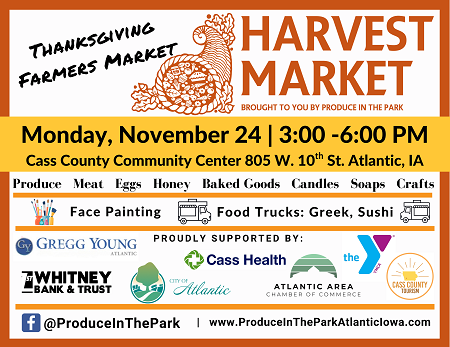
Harvest Market vendors will be selling a wide selection of local foods and handmade craft products. Fresh fall produce will include fresh greens (spinach, lettuce, kale, arugula), potatoes, sweet potatoes, butternut squash, onions, garlic, carrots, and bok choi. Other food offerings include local meats (chicken, pork, beef), farm-fresh eggs, honey, jellies, jams, salad and BBQ sauces, salsa, freeze-dried snacks, and baked goods like rolls, sourdough bread, cookies, cupcakes, kringle, and pies.
Craft vendors will be selling a variety of handmade goods such as candles and wax melts, holiday decorations, potted plants, jewelry, crocheted stuffed animals, and bath and body products such as soaps, sugar scrubs, and beard oils. Harvest Market will offer two food trucks: Karam’s Grill and Pho Wheels & Sushi. Karam’s Grill will serve Mediterranean food such as gyros, falafel, chicken shawarma, and baklava. Pho Wheels & Sushi will offer fresh sushi–preoders are highly recommended, and a link to preorder sushi is available in the Harvest Market Facebook event. And, kids can enjoy face painting and glitter tattoos.
All are welcome at Produce in the Park farmers markets, and admission is free. The market accepts SNAP/EBT and Double Up Food Bucks for all qualifying food items. Harvest Market is the second of five markets in Produce in the Park’s Holiday Market Series. Additional farmers markets in the 2025-2026 series include Christmas Market (December 20), Sweetheart Market (February 14, 2026), and Spring Celebration Market (April 4, 2026).
Produce in the Park farmers markets are made possible by support from the City of Atlantic, First Whitney Bank & Trust, Gregg Young Chevrolet of Atlantic, Cass Health, Cass County Tourism, Atlantic Area Chamber of Commerce, and Nishna Valley Family YMCA. Produce in the Park continues to accept applications for vendors and sponsors for their 2025-2026 Holiday Market Series. For details and applications, see www.produceintheparkatlanticiowa.com.
For the latest market updates, follow Produce in the Park on Facebook at www.facebook.com/ProduceInThePark or Instagram at www.instagram.com/produceintheparkatlanticia/, or sign up for the Produce in the Park email newsletter at www.produceintheparkatlanticiowa.com.
(An Iowa Capital Dispatch story) – A new report from the Iowa Food System Coalition shows that Iowa has 1,461 local food businesses spread across the state. Coalition staff said the report shows the economic viability of local food businesses across the levels of the food system. Bob Ferguson, who serves on the Farm and Food Business priority team with the coalition, said the report showed an increase in the number of on-farm stores, farm stands and local food businesses from previous estimations. “There’s more there than one would suspect,” he said. “There needs to be a lot more, but there’s already robust local infrastructure that interacts with itself to provide local goods and services.”
The businesses, which include food farmers, processors, food hubs and more, are spread across the state, with greater concentration around Iowa’s largest cities. The majority, or 1,074, of the businesses are farmers and food producers. Meat and food processors make up the next highest category, with 189 meat processors and 47 food processors in the state. The report identified between 10 and 26, per category, of local wineries, restaurants, retail stores, groceries and dairy manufacturers in Iowa. The remaining categories had fewer than 10 businesses each identified in the state: grade A dairies, breweries, coffee, food hubs, raw milk, uncategorized, grain mills, caterers, distributors and private chef services.
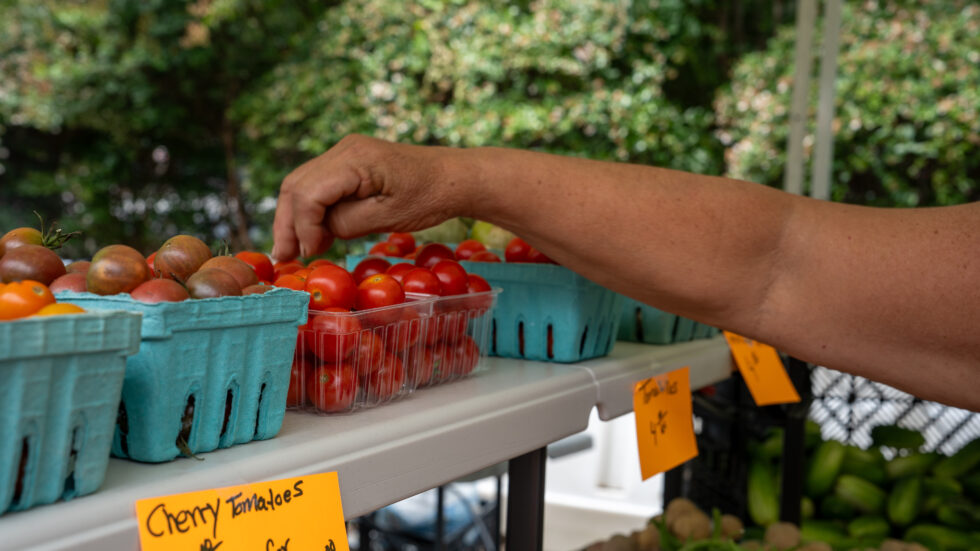
Farmers Market (USDA photo)
The report defined local food businesses as producers that sell direct to consumer, strategic supply chain partners and some large volume distribution services that make “substantial and effective efforts to produce or market source-identified local foods.” Ferguson said the food system has become heavy at the top level and at at the small-scale level, but has been “hollowed” in the middle. The report that shows the number and spread of local food businesses, he said, shows that “infrastructure at the middle is still there.” Ferguson predicts the number of businesses will only continue to grow in the state.
In addition to providing local food infrastructure and economic impact, Ferguson said these local business also provide a “powerful sense of placemaking” or the “coolness factor” that helps people “feel great about being where they are,” which he said is important for rural development. The report analyzed online directories, like the state’s Choose Iowa network, various food hubs, farmers market databases and registries for licensed dairy and meat processing plants. Because the report only makes use of regularly updated online lists, the coalition notes it is “likely an under-count” of local food businesses.
The coalition hopes future iterations of the report will also include business that don’t have an online presence.
(Radio Iowa) – There’s no U-S-D-A weekly crop report due to the government shutdown, but the state’s top ag official says the end of the harvest close. Iowa Ag Secretary Mike Naig says his travels around the state and conversations with farmers indicates the corn and bean harvest is nearly complete. That would fit with the five-year average that shows 98 percent of soybeans and 91 of the corn is usually harvest by mid-November. Naig says the weekend drop of temperatures into the teens and low 20s marked the official end of the growing season.
State Climatologist Justin Glisan wrote in his weekly weather summary that temperatures took a “nose-dive” late into the Nov. 3 through Nov. 9 reporting period. Several towns in northwest Iowa reported the weekly low temperature of 13 degrees Fahrenheit, which Glisan said was 14 degrees below normal. Despite the drop in temperatures toward the end of the week, the overall average temperature for the period was 47.2 degrees. The statewide average was 3.4 degrees above the climatological normal.
According to Glisan, more than 50 weather stations reported measurable snowfall during the reporting period. Pocahontas reported just slightly more than 5 inches of snow. The weekly precipitation average across the state was slightly under three-tenths of an inch, while the normal is 0.52 inch. The latest report from the U.S. Drought Monitor showed 81% of Iowa was in abnormally dry or drought conditions. About 15% of the state, mostly on the eastern edge, was in moderate drought conditions.
(Radio Iowa) – A Department of Natural Resources expert says they’re getting more data on a study of the decline of gray fox numbers. Furbearer biologist Vince Evelsizer says they’ve been putting collars on the elusive animals when they are found in live traps. “We’re up to three collared gray foxes since the start of this project two years ago. So, it’s a low and slow burn with this project, we knew it would be,” he says. “That’s why it started off as a pilot project.” He says it is encouraging that trappers and others have stepped up to help them collect data. “We’re getting more and more folks engaged with giving us reports of sightings. And so we’re going to continue trying to collar more gray foxes here this fall and winter,” he says.
Evelsizer says the tracking data and sightings are helping them track habitat and habits so they can get a picture of what is happening to the animals. “We have some pretty strong hypotheses or ideas about what may be leading to their decline, but we need to know what those are better. We need to , you know, have a better understanding of that,” Evelsizer says. He says they’ve enjoyed working with the animals. “The gray fox has been a really interesting animal to work with. They’re fairly small — adults weigh ten to12 pounds — so they generally are very easy to work with compared to some other species of wildlife,” he says.
Evelsizer says the public, trappers and partner groups such as the Iowa Wildlife Federation have also become really interested in finding out what is happening with the animals.
(Radio Iowa) – Mother Nature’s thrown Iowa a few curve balls this fall, making it difficult for people who love looking at the oranges, yellows and reds of autumn to know when and where to go. Chip Murrow, an urban forestry program specialist with the Iowa Department of Natural Resources, says some parts of Iowa have trees that are already bare, while others are still fully leafed out and mostly green. The wide weather swings share part of the blame.
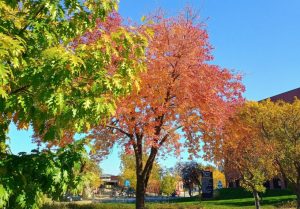
Radio Iowa photo
The amount of daylight may also play a role in the color show, plus, species like black walnuts might drop their leaves early, while oaks typically keep them well into winter. So, where can Iowans still go for the best fall color show?
While the recent weather has been unseasonably warm, the forecast calls for very cold temperatures and snow likely for this weekend. Murrow says that could spell the end of the fall color. Or not.
Typically, northern Iowa sees the leaves change color first, followed by central Iowa, then the south, although this year, parts of eastern Iowa have seen cold snaps that missed the rest of the state, prompting an earlier, faster fall in the east.

 Facebook
 Twitter
 YouTube
 RSS
RSS