

CLICK HERE for the latest market quotes from the Iowa Agribusiness Network!
CLICK HERE for the latest market quotes from the Brownfield Ag News Network!


CLICK HERE for the latest market quotes from the Iowa Agribusiness Network!
CLICK HERE for the latest market quotes from the Brownfield Ag News Network!
Cass County: Corn $4.00 Beans $10.70
Adair County: Corn $3.97 Beans $10.73
Adams County: Corn $3.97 Beans $10.69
Audubon County: Corn $3.99 Beans $10.72
East Pottawattamie County: Corn $4.03 Beans $10.70
Guthrie County: Corn $4.02 Beans $10.74
Montgomery County: Corn $4.02 Beans $10.72
Shelby County: Corn $4.03 Beans $10.70
Oats: $2.63 (same in all counties)
(Prices are per bushel; information is from the area Farm Service Agency [FSA] offices)
(An Iowa News Service report) – Concerned Iowans gathered in Des Moines recently to call for safer drinking water. The state is home to as many as 4,000 concentrated animal feeding operations. Iowa’s rivers and lakes are routinely closed to recreation as a result of high nitrate and phosphorous levels.
Food & Water Watch Iowa Senior Organizer Michaelyn Mankel said residents gathered at a recent Town Hall to ask state lawmakers to continue funding for the state’s water quality monitoring network of 500 sensors that report waterway pollution in real time. “There has been a move by the legislature to defund this program and push us back into the dark,” said Mankel, “at a time where the crisis has never been more severe and rates of pollution are skyrocketing.”
Researchers are investigating the link between water pollution and Iowa’s cancer rate, which has the second-highest occurrence of new cases in the nation. Environmental officials are pushing for lower levels of nitrates, phosphorous and other dangerous chemicals in Iowa’s drinking water – contaminants, Mankel said, are tied to factory farm manure runoff.
“Corporate agriculture operates heavily across Iowa and has effectively been given a free pass to pollute,” said Mankel. “They are laying waste that is ending up in our waterways in addition to having massive spill events on a regular basis.”
Mankel said polluted waterways are driving down the quality of life in Iowa. Corporate ag producers say they are looking for more environmentally friendly ways to operate, and claim that pollutants in their runoff are within legal limits.
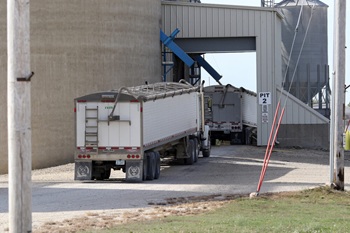
(IOWA CAPITAL DISPATCH) – A Nebraska-based grain dealer with elevators in western Iowa has filed for Chapter 11 bankruptcy. The Iowa Department of Agriculture and Land Stewardship said farmers have 120 days to file for indemnity if they had unpaid grain sold before Nov. 17 to Hansen-Mueller Co. The Iowa Grain Indemnity Fund will pay farmers up to 90%, with a $400,000 maximum, for their sold grain in the event a state-licensed grain dealer goes broke before it can pay the farmer.
The Iowa Grain Indemnity Fund is supported by farmers who pay a per-bushel fee into the fund when it is below its lower boundary, which the Legislature raised this year to $8 million. The fund was depleted in 2023 due to the bankruptcy of a large dealer, but the Grain Indemnity Fund Board stopped collecting the fees in September this year.
(Photo by Jared Strong/Iowa Capital Dispatch)
A spokesperson with IDALS said the fund is currently at $12.6 million and the department does not anticipate that indemnity payments resulting from the Hansen-Mueller bankruptcy will result in the board reinstating grain indemnity fees. According to Chapter 11 bankruptcy filings for Hansen-Mueller, none of its 20 largest unsecured claims were with Iowa companies. Some of the top claims include one for more than $4.6 million with Viterra Canada Inc., a more than $2.5 million claim with Cargill in Minnesota and just over $2 million to Beloit, Kansas-based Agmark LLC.
Hansen-Mueller had its grain dealer license revoked in Nebraska earlier this year, according to reporting from Nebraska Public Radio, when the company failed to make payments to producers. The company later made the payments and its license was reinstated by the state licensing agency in early November. According to a press release from the company, it intends to continue operations under the supervision of the bankruptcy court and “meet obligations” to employees and suppliers while the sale of its assets is finalized.
Hansen-Mueller, according to its website, had locations in 10 states, including Iowa. The company had elevators in Sioux City and Council Bluffs. Iowa farmers with unpaid grain sold to Hansen-Mueller before Nov. 17, 2025, have until March 17, 2026 to file a claim with the state grain indemnity board.
Claims must be made in writing and mailed to IDALS Grain Warehouse Bureau. More instructions are available online.
Cass County: Corn $4.00 Beans $10.81
Adair County: Corn $3.97 Beans $10.84
Adams County: Corn $3.97 Beans $10.80
Audubon County: Corn $3.99 Beans $10.83
East Pottawattamie County: Corn $4.03 Beans $10.81
Guthrie County: Corn $4.02 Beans $10.85
Montgomery County: Corn $4.02 Beans $10.83
Shelby County: Corn $4.03 Beans $10.81
Oats: $2.63 (same in all counties)
(Prices are per bushel; information is from the area Farm Service Agency [FSA] offices)
ORANGE CITY, Iowa (IOWA CAPITAL DISPATCH) – The U.S. Environmental Protection Agency and Wynja Feedlot in Orange City have reached a settlement of $20,000 for the feedlot’s unpermitted wastewater discharges. The EPA can charge up to $68,445 per day of Clean Water Act violations, but the agency lowered the charge on the basis that the feedlot had “a limited ability to pay a civil penalty.”
In addition to the fee, Wynja Feedlot Inc., a 999-head capacity cattle feedlot, is required to apply for an National Pollutant Discharge Elimination System, or NPDES, permit, construct a lined containment basin and sample discharges from the surrounding tile for possible pollutants.
The EPA discovered in March 2021 that the confined animal feeding operation had been discharging wastewater through a drainage pipe that led to a “relatively permanent” tributary of the West Branch of the Floyd River. According to EPA, the wastewater contained high levels of bacteria, ammonia, chlorides, and unprocessed organic matter, all of which can contribute to impaired water quality. The feedlot did not have an NPDES permit for the drainage pipe, and according to EPA, the facility admitted the observed discharge had occurred for three consecutive days. 
(Radio Iowa) – A ribbon cutting Wednesday celebrated the new facility in Scott County that converts landfill waste gas into usable natural gas. The facility was built by Waga Energy and Bryce Stalcup, the executive director of the Scott County Waste Commission says the gas generated will help power around four-thousand homes each year. “Unfortunately, there’s waste that you just can’t recycle or divert, and it has to go somewhere,” he says. “Well, when we can then capture the gas as that waste breaks down and then get that use of it, that’s the best thing that we can think possible for our community.”
The process at the Davenport plant takes the gas produced by decomposing garbage and filters it to extract carbon dioxide and other pollutants, and then sends it straight into the MidAmerican energy pipeline. “For Scott County, what this means is cleaner air, better use of our natural resources, and proof that sustainability and economic responsibility can go hand in hand,” Stalcup says.
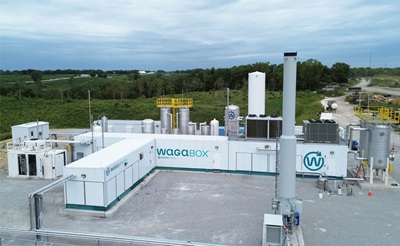
A new facility in Scott County recovers gas from the landfill. (Waga Energy photo)
The facility is expected to help prevent the landfill site from producing nearly 16-thousand tons of C-O-2 equivalent emissions each year. The facility has been operating for more than a month. It’s the eighth landfill gas capturing facility in Iowa, and the second that Waga Energy has built in the United States.
(Radio Iowa) – The Emmet County Board of Supervisors is seeking a second legal opinion on a proposed settlement with the company that has planned to build the Red Rock Energy Center wind farm. Last December, the Emmet County Board of Adjustment rejected a permit for the project and the company sued. Doug Hanson, chairman of Emmet County’s Planning and Zoning Commission, says the county would sign away a lot if it agrees to settle the lawsuit. “The citizens of Emmet County, you really owe it to them to fight,” Hanson said during the supervisor’s meeting this week.
Emmet County Attorney Melanie Summers Bauler is warning that seeking a second legal opinion would likely be a lengthy process. “Unless you can tell that attorney we’re talking about 7000 pages of discovery, then they don’t have any idea how long it would take them to review,” she said. She says a lengthy delay could derail the negotiated settlement. Supervisor Tim Schumacher says that’s not a comfortable spot for the board, but county officials have heard from a lot of people during public hearings who oppose the settlement, and they’re getting a lot of letters from residents who’re urging the board to sign the agreement and let the wind farm’s construction begin.
“I think it makes sense to get another opinion,” Schumacher said. Schumacher volunteered to reach out to a Des Moines law firm the county has previously used and see how quickly an attorney could review the settlement. The agenda for the Emmet County Board Supervisors meeting on November 25th also indicates the board will again discuss the issues surrounding the settlement.
Invenergy is the Chicago company that has proposed building a wind farm in Emmet and Dickinson Counties. In May, the Dickinson County Board of Adjustment unanimously approved the company’s permit to erect 67 wind turbines in their county. Invenergy is the largest private developer of wind energy projects in North America.
Cass County: Corn $4.00 Beans $10.81
Adair County: Corn $3.97 Beans $10.84
Adams County: Corn $3.97 Beans $10.80
Audubon County: Corn $3.99 Beans $10.83
East Pottawattamie County: Corn $4.03 Beans $10.81
Guthrie County: Corn $4.02 Beans $10.85
Montgomery County: Corn $4.02 Beans $10.83
Shelby County: Corn $4.03 Beans $10.81
Oats: $2.63 (same in all counties)
(Prices are per bushel; information is from the area Farm Service Agency [FSA] offices)
DES MOINES— Iowa Governor Kim Reynolds, today (Wednesday), signed a proclamation related to the weight limits and transportation of grain, fertilizer, and manure. The proclamation is effective immediately and continues through December 19, 2025. The proclamation allows vehicles transporting corn, soybeans, soybean meal, hay, straw, silage, stover, fertilizer (dry, liquid, and gas), and manure (dry and liquid) to be overweight (not exceeding 90,000 pounds gross weight) without a permit for the duration of this proclamation.
The proclamation applies to loads transported on all highways within Iowa (excluding the interstate system) and those which do not exceed a maximum of 90,000 pounds gross weight, do not exceed the maximum axle weight limit determined under the non-primary highway maximum gross weight table in Iowa Code § 321.463 (6) (b), by more than 12.5 percent, do not exceed the legal maximum axle weight limit of 20,000 pounds, and comply with posted limits on roads and bridges.
(Radio Iowa) – A new study suggests year-round activities on the Iowa State fairgrounds in 2024 had a 629 MILLION dollar statewide economic impact. Iowa State Fair C-E-O Jeremy Parsons released the study’s results this (Wednesday) morning. “Iowans should be proud of their Fair, not only for what we do for the state socially, culturally, and in the news, but also economically,” Parsons said. A large part of the overall tally is the nearly 480 MILLION dollar impact of just the 11 day run of the 2024 state fair itself.
“In 2024, that number compared to the economic impact of the Kentucky Derby? $405 million. The economic impact of the men’s NCAA final four in San Antonio? $440 million,” Parsons said. That tally for the 2024 fair does not include how much vendors made selling food, drinks and other items during the Fair, which would significantly boost the overall figure. This is the first-ever study of the financial ripples the state fair’s year-round operations create. Nearly 700-thousand out of town visitors came through the gates for the 2024 Iowa State Fair, creating demand for tens of thousands of hotel rooms, plus there were more than 200 events on the fairgrounds throughout the rest year. “We want to be more than a big neighbor on the east side of Des Moines,” Parsons said. “We want to be a good neighbor.”
Parsons says the information will help officials plan for the future — and the 175th Iowa State Fair in 2029.


 Facebook
 Twitter
 YouTube
 RSS
RSS