

CLICK HERE for the latest market quotes from the Iowa Agribusiness Network!
CLICK HERE for the latest market quotes from the Brownfield Ag News Network!


CLICK HERE for the latest market quotes from the Iowa Agribusiness Network!
CLICK HERE for the latest market quotes from the Brownfield Ag News Network!
Cass County: Corn $4.08 Beans $10.82
Adair County: Corn $4.05 Beans $10.85
Adams County: Corn $4.05 Beans $10.81
Audubon County: Corn $4.07 Beans $10.84
East Pottawattamie County: Corn $4.11 Beans $10.82
Guthrie County: Corn $4.10 Beans $10.86
Montgomery County: Corn $4.10 Beans $10.84
Shelby County: Corn $4.11 Beans $10.82
Oats: $2.63 (same in all counties)
(Prices are per bushel; information is from the area Farm Service Agency [FSA] offices)
Cass County: Corn $4.08 Beans $10.82
Adair County: Corn $4.05 Beans $10.85
Adams County: Corn $4.05 Beans $10.81
Audubon County: Corn $4.07 Beans $10.84
East Pottawattamie County: Corn $4.11 Beans $10.82
Guthrie County: Corn $4.10 Beans $10.86
Montgomery County: Corn $4.10 Beans $10.84
Shelby County: Corn $4.11 Beans $10.82
Oats: $2.67 (same in all counties)
(Prices are per bushel; information is from the area Farm Service Agency [FSA] offices)
(Radio Iowa) – Iowa is in the middle of its 100th pheasant season this year. Iowa D-N-R wildlife biologist Todd Bogenschutz says the sport took off quickly and was very popular in the early decades.
Bogenschutz says the season used to open in November, and that led to some scheduling conflicts. It was set to open on Veteran’s Day one year and that raised a concern.
Football had become popular as well, and that created another scheduling concern during the era where coach Forest Evashevski had taken the Hawkeyes to two Rose Bowls.
He says that the school was worried some fans would be chasing birds in the cornfields instead of watching the battle for Floyd of Rosedale.
Iowa won that game 33 to nothing over Minnesota and the Floyd trophy. Hunter numbers dropped off in the 70’s and 80’s as farming changes led to drops in bird numbers. Numbers have been rebounding and Bogenschutz expects this 100th pheasant season will see a lot of success once it is complete in January.
(Radio Iowa) – A few iconic Iowa State Fair items in a Washington, D.C. museum are giving state fair officials some ideas. Iowa State Fair C-E-O Jeremy Parsons says it’s fascinating to see a replica of the Butter Cow inside the Smithsonian Museum, “but professionally displayed in a museum setting. We definitely need to up the bar on how we display things.” Parsons, though, isn’t ready to say what display changes may be in store on the fairgrounds in Des Moines.
The Smithsonian’s year-long exhibit features what are described by the museum’s curator as works of art from state fairs around the country, including some quilts entered in Iowa State Fair competitions. Forbes magazine includes the life-sized butter cow as one of the exhibit’s show-stopping spectacles. Parsons agrees.
By comparison, the Iowa State Fair’s refrigerated display case for the butter cow is along the east wall of the Agriculture Building. People wait in line to look through windows at the butter sculpture of a life-sized dairy cow.
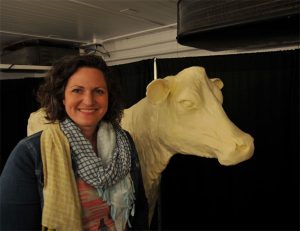
Sculptor Sarah Pratt and one of the butter cows she has created at the Iowa State Fair. (Iowa State Fair photo)
The Smithsonian’s exhibit of State Fair folk art runs through next September and is one of many events to mark America’s 250th anniversary. Parsons says the 2026 State Fair will mark the occasion, too.
And Parsons and his team are making big plans for the 2029 Iowa State Fair.
The center will be built near the north entrance to the fairgrounds and will explain crop development, Iowa soils and farm equipment as well as jobs in agriculture. Parsons says it’s about thinking strategically about the Iowa State Fair’s role in the future, since data suggests the number of Americans who have NO connection to agriculture will continue to grow.
Parsons recently released a study suggesting year-round activities on the Iowa State fairgrounds in 2024 had a 629 MILLION dollar statewide economic impact. Parsons says while the economic impact is massive, the State Fair is still about the people.
Parsons grew up in Leon and was a high school English teacher before he was hired to direct the Missouri State Fair Foundation. Parsons was director of the the Clay County Fair in Spencer for 12 years before he took on the role of Iowa State Fair C-E-O in 2023.
(Radio Iowa) – John Deere’s sales slump continues. John Deere’s fourth quarter profits fell seven percent and the company’s C-E-O is warning 2026 may be another tough year for the world’s leading farm equipment manufacturer. John Deere closed the books on its fiscal year November 2nd and the company reports worldwide net sales and revenue dropped 12 percent during that 12-month period. There was an even bigger 17 percent drop in sales of John Deere combines, tractors and other large farm equipment from the company’s Production and Precision Agriculture division.
John May, the president and C-E-O of John Deere, says the company has taken steps to manage inventory and production to weather uncertainty in the ag sector, but the pressure from tariffs will remain in 2026.
(Iowa DNR News Release) – Pheasant hunting has been as much a part of the Thanksgiving holiday for generations of Iowans, as cranberries and stuffing. And with a seasonable weather forecast that will likely put birds in cover, this would be a good year to continue that tradition and get back to the fields. Iowa Department of Natural Resources Upland Wildlife Biologist Todd Bogenschutz says “It’s a good opportunity for hunters to get out with less competition. Would also be a good time to invite someone new along and pass along that tradition.”
The Iowa DNR offers an apprentice license that allows someone to give hunting a try under the supervision of an adult mentor without completing hunter education. This license may be purchased twice in a lifetime before the individual is required to complete a hunter education course. Iowa’s pheasant population is at a 20-year high, with state wildlife experts forecasting hunters to potentially harvest the highest number of roosters since 2007. Bogenschultz says “The harvest is following what the roadside counts showed – better hunting in northern Iowa with lots of young birds out there.”
Last year, more than 77,400 hunters harvested over 460,000 roosters, providing an estimated economic impact of nearly $170 million in Iowa. The Iowa DNR and Pheasants Forever are celebrating 100 years of pheasant hunting in the Hawkeye State. The first season was held Oct. 20-22, 1925, when 13 counties in north central Iowa were opened to pheasant hunting. Hunters were allowed a three-rooster limit, for a half-day of hunting. An estimated 75,000 hunters participated.
Information on places to hunt, the August roadside survey results and more is available online by clicking the 100 Years of Pheasant Hunting graphic at www.iowadnr.gov/pheasantsurvey.
(Radio Iowa) – Iowa Secretary of Agriculture Mike Naig is back in Iowa after a nine-day trade mission to Vietnam and Indonesia. He says there are exciting prospects in Southeast Asia. “Between the Phillippines, Vietnam and Indonesia, you’ve got some of the fastest growing economies in the world,” Naig said, “and lots of opportunity for even a lot more business there.”
A dozen representatives of Iowa commodity groups were part of the delegation and Naig says there’s a significant opportunity to boost pork exports to Vietnam. “Vietnam is very pork friendly. They want a lot of pork in their diet,” Naig said. “In Indonesia — the fourth largest country by population in the world, the largest Muslim population, what you’re talking about there is, yes, some pork will make it in there. It’s a small percent of their population, but really beef is the significant opportunity in Indonesia.”
Vietnam is among the world’s top 10 importers of U-S agricultural goods. Naig led a previous trade mission to Vietnam in 2023 and a large delegation of Vietnamese officials were in Iowa this past June. “The Minister of Agriculture came and signed, in total, $1.4 billion worth of purchase agreements in the U.S.,” Naig said. “$800 million of that was in Iowa, so this was kind of a follow on to that.” Naig says the last Iowa-led trade mission to Indonesia was quite some time ago.
“Indonesia was new and we learned a lot. There are some challenges there. It’s a good soybean market. It’s a strong (dried distillers grain) market, but, you know, there are some barriers to doing business there and we have strong competitors in that market, so it was interesting to learn those things, which is always good,” Naig said. “You’ve got to be on the ground sometimes to figure those things out.”
Brazil, China and Australia are currently Indonesia’s leading suppliers of agricultural goods, with the U.S. accounting for about 10 percent of Indonesia’s ag imports last year.
Cass County: Corn $4.00 Beans $10.67
Adair County: Corn $3.97 Beans $10.70
Adams County: Corn $3.97 Beans $10.66
Audubon County: Corn $3.99 Beans $10.69
East Pottawattamie County: Corn $4.03 Beans $10.67
Guthrie County: Corn $4.02 Beans $10.71
Montgomery County: Corn $4.02 Beans $10.69
Shelby County: Corn $4.03 Beans $10.67
Oats: $2.62 (same in all counties)
(Prices are per bushel; information is from the area Farm Service Agency [FSA] offices)
(Radio Iowa [w/additional info. from the Iowa Capital Dispatch]) – The U-S-D-A crop report is back after the government shutdown ended. The report shows 99 percent of Iowa’s corn crop is out of the fields making the harvest virtually complete. The southwest and south-central areas of Iowa lagged behind the rest of the state by a small percentage heading into last week. The bean harvest was at 99 percent complete in most of the state two weeks ago. The crop report says the weather has been mostly dry the last couple of weeks, allowing farmers to complete the harvest.
The national report shows the other top corn-producing states have on average just 4% left to harvest. The latest crop production report from USDA estimated corn yields were at 186 bushels per acre nationally, though the report does not include October yields due to the shutdown. Iowa Secretary of Agriculture Mike Naig said farmers delivered a “significant crop” in 2025 despite “variable” weather conditions, disease and a challenging agricultural economy. “Strong production requires strong markets, and we will continue working to build and diversify demand at home, across the country and around the world,” Naig said in a statement.

(Photo by Preston Keres/USDA)
According to the report, 67% of topsoil moisture and 66% of subsoil moisture across Iowa is adequate. South central Iowa has the driest soil conditions with about 60% of topsoil and subsoil short of moisture. State Climatologist Justin Glisan said the statewide average precipitation for the Nov. 17 through Nov. 23 reporting period was 0.20 inch. That means precipitation was about half of the normal of 0.43 inch. Glisan said the statewide average temperature for the period at 43.8 degrees Fahrenheit was 6.1 degrees above the normal.


 Facebook
 Twitter
 YouTube
 RSS
RSS