

CLICK HERE for the latest market quotes from the Iowa Agribusiness Network!
CLICK HERE for the latest market quotes from the Brownfield Ag News Network!


CLICK HERE for the latest market quotes from the Iowa Agribusiness Network!
CLICK HERE for the latest market quotes from the Brownfield Ag News Network!
(Radio Iowa) – The Iowa Waste Reduction Center in Cedar Falls is launching a program to help smaller communities in the Midwest use composting to improve water quality. The Center’s Jennifer Trent says they will work with seven communities across four states to help build small compost facilities. “We’re going to be training them how to take the compost that they manufacture and how to use that to protect local water sources,” she says. They can use the compost they get from those facilities. “Compost has the ability to filter out pollutants and to also break down pollutants,” Trent says. The towns in Iowa, Minnesota, Wisconsin and Illinois with populations of fewer than 25-hundred people sit on E-P-A designated impaired waterways. Trent says the goal is to get those waters off the impaired list.
“So when water enters into a river, if you have strategically placed compost, you can eliminate pollution from entering the water source,” she says. She says another benefit could be reducing the amount of food waste sent to community landfills. Education workshops will start in May and run through August.
(Iowa News Service report) The Iowa Department of Natural Resources is training operators of Concentrated Animal Feeding Operations on the safest ways to apply manure to their fields and what to do if a spill happens. It is part of the state’s effort to help reduce accidents and protect the environment. Iowa produces about 50 million tons of manure every year or enough to fertilize roughly 17% of the state’s cropland.
Jeff Prier, senior environmental specialist for the Iowa DNR, said the state is teaching commercial and smaller operators how to apply it safely by following a required manure management plan. “When they go out to do their application, they need to comply with any separation distances to residence, church, business, school, public use area, water sources,” Prier outlined. “Dependent on their application method.”
Manure from Concentrated Animal Feeding Operations is known to pollute air and groundwater when it is not properly applied. Commercial operators said they are looking for more environmentally friendly ways to operate while trying to meet consumer demand for high quality meat. The deadline to apply for the DNR training is next week.

organic piggery pig farm illustration fertilizer recycling, waste environmental, impact responsible organic piggery pig farm
The DNR charges commercial operators $225 for a manure application permit and $175 for smaller operators. Prier noted it is a small price to avoid fines of between $3,000 and $5,000 for applying fertilizer without state certification. “When they hear the numbers, they tend to open their eyes pretty big and think that’s a pretty big number,” Prier observed. “But the best reason is being in compliance with the rules and regulations and knowing what to do if there is a spill.”
Prier, who has been overseeing training for 26 years, added given the amount of manure spread on Iowa farms every year, the number of spills is relatively small.

(Radio Iowa) – The Iowa State University farmland survey shows the upward run of land prices stalled out this year. I-S-U extension economist Rabail Chandio revealed the 2024 survey results today (Tuesday). “This year we have ended a streak of five consecutive years of increases in land values in Iowa with a decline of three-point-one percent,” she says. “This brings us to 11-thousand-467 dollars an acre.” That is a drop of 369 dollars an acre from last year’s record high. “The nominal value of farmland fell from our record high from last year, but it is still higher than the nominal value in 2020-2022. And if we adjust for inflation, our inflation-adjusted average value for 2024 is only two-point-five percent lower than the 2013 peak, which was the previous peak before the pandemic highs that we just saw,” Chandio says.

Radail Chandio conducts the ISU farmland survey. (ISU photo)
Chandio says the south-central land district was the only one to see an increase in land values, while the west-central district saw the largest decline in prices. “Seventy-five of the 99 counties reported decreases in their nominal values, and 88 counties reported a decrease in inflation-adjusted values. Despite that, 20 counties still report their highest nominal values since 1950,” she says. Chandio says this year appears to be a correction after land values had gone up 29 percent in 2021 and 17 percent in 2022 coming out of the pandemic. “That naturally leads to somewhat of a resetting or balancing in the market, and sort of the similar trend we saw for after the previous peak in 2013,” she says. Chandio says the drop in farm income was the top issue for lower land values.
“The most commonly cited negative factor by our respondents this year was lowering commodity prices, 34 percent of the responses mentioned this,” she says. High interest rates were a close second to the commodity prices in responses about the impact on land values.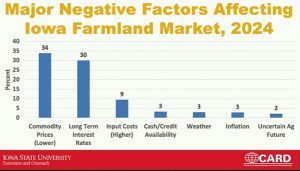
(Radio Iowa) – Paddlefish licenses are now on sale for the Missouri and Big Sioux River season which starts in February. Iowa D-N-R Western Iowa Regional Fisheries Supervisor, Chris Larson, says they have 950 resident licenses that will be sold in the first round through December 31st. “And then at that time, if not, all the licenses have sold, which for the last, well ever since we started it almost ten years ago, we’ve never sold out of licenses. So from January 1st to January 7th, anglers can purchase a second license if they would choose to do so,” he says. Larson says they also have 50 non resident licenses.
“We’ve almost come close or have sold out non-residents almost every year, but resident licenses would sell on average since we started this around 300,” he says. Paddlefish are not caught through the traditional fishing method of casting out bait on a hook. “Paddlefish are filter feeders, and so you really can’t catch them on a typical hook and line with a lure. You got to use a weighted treble hook, and you lower it down to the deeper water areas, and then you jerk it up and hope to snag one,” Larson says. Some areas of the state have been impacted by the drought and then a wet spring, but Larson says not the Missouri River.
“You know, there’s just such a gigantic watershed that water levels south of Gavins Point (Dam) are mostly regulated by the core for navigation during the navigation season, which is usually March 15th through about the first of December,” Larson says. “And then they do have winter flows that go from this time of year until that March date.” Larson says the paddlefish tend to hang out in deeper water in the winter around the wing dikes from Sioux City all the way to the Iowa border. He says they don’t move much in the winter, but do a lot of traveling when things warm up.
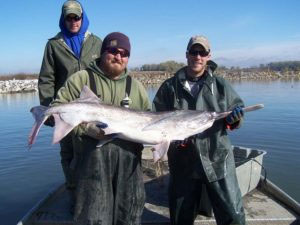
Paddlefish catch(DNR-photo)
“We did about a five-year tagging study, and we’ve had those fish caught down by Tennessee in the Mississippi River and clear up to the Quad Cities on the Mississippi River, and then all the way up to Gavins Point Dam,” he says. The fish have a big paddle that sticks out in front of their face called a rostrum that they use to help navigate through the water. Larson says it’s a sensory organ to figure out where the little zooplankton they eat might be.
You can find out how to get a paddlefish license on the D-N-R website.
(Iowa News Service story) – Livestock being raised with antibiotics is on the rise in Iowa, the nation’s number one hog producer. Doctors say the trend increases the risk of antibiotic-resistant infections for people who consume drug-treated meat. Scientists have described drug-resistant infections as a growing crisis. The National Institutes of Health say the drugs are overused. The Food Animal Concerns Trust’s Safe and Healthy Food Program Director and Senior Analyst, Steven Roach, said federal data show sales for antibiotics used in cattle and other animals is as high as it’s been in nearly a decade.
That’s especially important in Iowa. “In pigs in the U.S. – it’s up by 24%, and in cattle it’s up by 10%,” said Roach. “The chicken industry has continued to reduce their use, so it’s possible for the animal ag industry to make changes – but we haven’t seen that happen in cattle and pigs.” Data for 2024 show the use of antibiotics in chickens dropped by 50% over the last 7 years.
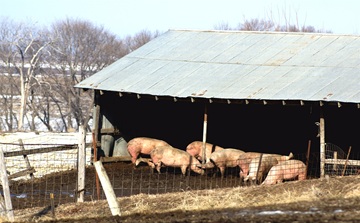
hog farming in iowa
In Iowa, livestock, including hogs, are mostly raised in large corporate confinements – which are known to pollute the air and nearby ground and surface water. Confinement operators say they are trying to keep up with consumer demand for a high-quality, consistent source of meat. Roach said most of the meat available at grocery stores has been raised in confinements and treated with antibiotics.
The Centers for Disease Control and Prevention estimates antibiotic-resistant infections kill at least 35,000 Americans every year. Roach said large-scale ag producers could help reduce that number by changing their philosophy of routinely using drugs in their operations. “We know we’re raising animals in unhealthy conditions,” said Roach, “so then we’re going to give them antibiotics independent of whether they’ve been diagnosed with an illness.”
Roach said meat in the grocery store that has been raised without antibiotics is identified as such on the packaging.
(Des Moines, Iowa) – The Iowa Department of Natural Resources announced Friday it has seen a “sharp jump” in cases of the highly pathogenic avian flu in wild birds this month after “nearly a year” with no detections of the virus.
The news release from DNR follows a week of outbreaks of the bird flu in commercial turkey and layer chicken flocks in Sioux, Palo Alto and Sac counties. According to a spokesperson with the Iowa Department of Agriculture and Land Stewardship, the affected flocks that will have to be depopulated amount to about 76,000 turkeys and nearly 6 million egg-laying chickens.
Rachel Ruden, state wildlife veterinarian with the Iowa DNR, said at this time, a link between the wild bird detections and those in commercial flocks cannot be proven, though additional analysis of the genetic material could show a link.
The department saw an “uptick” in HPAI detections in mid-November from routine swabbing of healthy ducks collected by hunters, and just recently began to respond to calls of sick or dead geese. The cases have primarily been detected north of Interstate 80, according to the news release.
“We are encouraging the public to stay away from sick birds, especially waterfowl,” Ruden said in the release. Classic signs of the virus include birds that are twisting their heads and necks or swimming in tight circles, but Ruden said some are presenting differently now and act quiet or won’t fly away when approached. Iowans who find five or more dead or sick birds within a week should notify the department or their local wildlife biologist. A list of contact information can be found on the department’s website.
Hunters are also advised to exercise caution around waterfowl, and prevent their dogs from interacting with unknown carcasses or eating raw poultry from harvested birds.
A hunting guide from the U.S. Department of Agriculture’s Animal and Plant Health Inspection Service said hunters should not harvest birds that appear sick or are already dead and should properly clean bird dressing sites to avoid spreading the disease. Cooking poultry to an internal temperature of 165 degrees Fahrenheit can kill the virus.
The press release said those with backyard or commercial flocks should monitor poultry for signs of the disease and contact their veterinarian if they suspect an outbreak.
(Radio Iowa) – U-S Agriculture Secretary Tom Vilsack says it appears Farm Bill negotiations have gotten more complex. House Speaker Mike Johnson says a majority of House Republicans oppose a Senate plan to take nearly 10 BILLION in unspent funds from the so-called Inflation Reduction Act and use it on conservation programs. “It would have actually provided additional resources for congress to increase the level of disaster assistance and emergency assistance that could have been provided to producers in Iowa and across the country,” Vilsack says. Vilsack says current budget rules would allow that 10 BILLION dollar transfer. “The sad reality is, by not protecting those resources, potentially congress could redirect them from farmers and ranches towards some other priority,” Vilsack says.
Funding for federal conservation assistance was increased dramatically by the Inflation Reduction Act. “This is a historic opportunity for us to significantly reduce the backlog of farmers who have been waiting for a while for resources to be able to do on their land what they know needs to be done,” Vilsack says, “to protect it and to enhance it.” Neither the House nor the Senate brought a new Farm Bill up for a vote this year. If congress fails to reauthorize the 2018 Farm Bill this month, federal farm policies revert to laws passed eight decades ago. Vilsack says that would create chaos in the markets. “I’m sure that something is going to get done, the question is whether it will get done in a way that provides the best benefit and the most opportunity for farmers and ranchers and producers who work so hard for the rest of us,” Vilsack says.
Lawmakers from states hit by Hurricane Helene in late September are seeking federal disaster aid for farmers who lost crops, livestock and farm buildings.


 Facebook
 Twitter
 YouTube
 RSS
RSS