


Preservation Iowa announces the 2026 Most Endangered Properties
March 4th, 2026 by Ric Hanson
(Des Moines, IA) – Officials with the non-profit Preservation Iowa organization, say they have designated 6 properties in Iowa for 2026 Most Endangered Designations. Among them is the Holliwell Covered Bridge in Madison County, and the Riverton Chautauqua Pavilion, in Fremont County. The other properties are:
- Meyers Farmstead District within Pleasant Grove Heritage Park, Lisbon, Linn County
- White Springs Supper Club, McGregor, Clayton County
- Trinity Church, Forest City, Winnebago County, and
- 100-102 N. Main Street, Conrad, Grundy County
Preservation Iowa’s Most Endangered Property program began in 1995 and was implemented to educate Iowans about the special buildings and historic sites that are slowly and that are “gradually slipping away from us,” according to a news release from the organization. Over the past 30 years, Preservation Iowa has designated over 200 archaeological sites, commercial buildings, homes, churches, landscapes and a variety of other properties in over 70 Iowa counties.
The Most Endangered Properties program helps to bring to the public’s attention the risks to a designated historic property and introduces owners of an endangered property to preservation advocacy and resources that can help preserve their historic property. Additionally, there have been interest groups who have been able to use the designation as a mechanism to leverage other financial resources to restore and preserve properties. For more information about the Most Endangered Program, check out Preservation Iowa’s website at www.preservationiowa.org or contact Preservation Iowa at info@preservationiowa.org.
#1 Holliwell Covered Bridge, Madison County
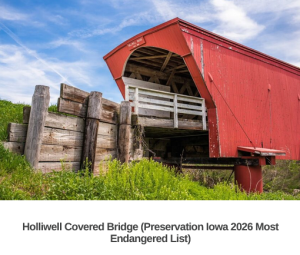 Spanning the Middle River near Winterset, the Holliwell Covered Bridge is one of five remaining original covered bridges in Madison County. The bridge was completed in 1880 by Harvey P. Jones and George K. Foster at a time when timber truss bridges were practical and economical in areas where wood was plentiful. Having a roof and sides slowed the deterioration of the timber framework extending its lifetime. At 110 feet, the Holliwell Bridge is the longest of the extant Madison County covered bridges. It remains in its original location and carried vehicular traffic until the mid-1980s. The bridge was placed on the National Register of Historic Places in 1976. Today, the Holliwell Bridge is a reminder of an era of wooden bridges before the widespread use of iron. Madison County’s famous covered bridges, including the Holliwell, draw thousands of tourists each year. The Holliwell Bridge was also a filming location for the 1995 film The Bridges of Madison County.
Lacking substantial maintenance since the mid-1990s, the bridge’s structural integrity has become compromised. Preservation Iowa says the deteriorating truss members are causing the bridge to lean, and decay and erosion are taking its toll on the bridge’s roof, floor beam supports and abutments. Without repair, the bridge will likely have to be closed to the public within the next 10 years. The covered bridges are owned by Madison County and maintained by the Secondary Roads Department which is responsible for the upkeep of over 220 bridges leaving limited resources for the maintenance of a non-vehicular bridge. Over the past few years, the County has sought to find alternative funding for repairs to the bridge but has not yet been successful.
#4 Riverton Chautauqua Pavilion, Fremont County
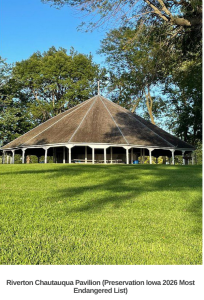 The 12 sided pavilion sits atop a hill in the City Park at Riverton. The open air structure was completed in 1897 and intended to provide a stage for encampments of the newly founded Patriots of America. William Harvey founded the populist organization to advocate for returning to the free coining of silver and support political candidates favorable to that cause. Harvey is said to have put up $500 toward the Riverton pavilion’s construction. He reportedly chose Riverton because Fremont County had the greatest number of Patriots of America lodges of any county in the U.S. Yearly encampments of the fraternal organization were held in Riverton between 1897-1901. The order died out shortly thereafter.
Since then, the pavilion has hosted Chautauqua shows, Sunday School and church services, school graduations, May Day services and other community events. The pavilion was placed on the National Register of Historic Places in 1976.The Riverton Hometown Pride group has lately taken an active role in preserving the pavilion. They received a Paint Iowa Beautiful grant in 2024 and a State Historical Society of Iowa Field Services grant to hire a consultant to evaluate the needs of the structure. That evaluation showed that there is much more that needs to be done to preserve this piece of local and U.S. history.
Significant repairs to the pavilion were done as a community bicentennial project in 1976. In more recent years, moisture and lack of regular maintenance has led to deterioration of the roof and supporting cedar posts


 Facebook
 Twitter
 YouTube
 RSS
RSS