


One Iowan’s quest for darker skies might benefit rural Iowa
January 1st, 2026 by Ric Hanson
DES MOINES, Iowa (IOWA CAPITAL DISPATCH) – James Bruton grew up in rural Texas where the night skies were full of constellations. As he moved to larger cities, before ultimately settling in Des Moines, evening star gazing faded away for Bruton and could only be found with intentional trips away from the light-polluted metropolitans. Bruton hopes rural Iowa can keep that sense of wilderness, lower its electricity costs, help out local wildlife and even benefit from the growing astrotourism market, by enacting “dark sky” ordinances that limit light pollution.
While the effort in Iowa is just getting off the ground, across the globe, nearly 200,000 square kilometers, or more than 77,000 square miles, are recognized as dark sky places by the international, volunteer organization, Dark Sky International. The open spaces of the west and national parks are the spots most people think of for prime stargazing, but Bruton said Iowa can develop its own dark sky areas and give people that same sense of wonder, but without a 10-hour drive.
Bruton told the Iowa Capital Dispatch, “Most of our days are spent looking at screens … being able to step away from that and truly just take in something as magnificent as a clear, dark night sky and everything that it beholds, it just creates (a) perspective that we don’t get when we live in so much light pollution. “It’s not about turning off the lights, It’s just about using light wisely so that communities can thrive.”
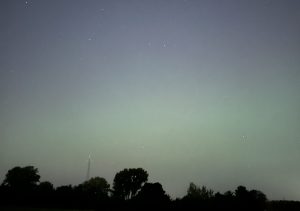
A night sky outside of Johnston, Iowa on Oct. 10, 2024. (Photo by Cami Koons/Iowa Capital Dispatch)
A 2023 published study, analyzing citizen science observations, found that on average the night sky got brighter by 9.6% annually, from 2011 to 2022. According to the National Park Service the light pollution increase “exceed(s) the population growth rate” and has been caused by more light emitted per capita and more “uplight” or light that is directed or reflected upwards, emitted from fixtures. Dark Sky International recommends communities be more intentional with their outdoor lighting, in terms of brightness, direction, purpose and warmth.
The organization has five principles for “responsible” lighting, which Bruton said would inform dark sky ordinances in a community. Dark Sky calls for lights that have a “clear purpose” and are only used when needed. It says light should also be “targeted” so that it doesn’t spill beyond where it is needed. Targeted lights could be something like street or parking lot lights that have a cover over the top to direct light down on the street and not up into the sky. The third principle is that lights should be “no brighter than necessary” with the idea that when something is excessively lit, it causes glare on surrounding surfaces and can be less effective than a dimmer light.
An ordinance could specify, for example, that outdoor light fixtures not exceed 25% of guidelines set by the Illuminating Engineering Society, a technical and educational authority on lighting. The fourth principle asks for controlled lights, those on a motion censor, timer or dimmer so that light is only used when it’s needed. Those principles help to reduce energy costs by eliminating unnecessary lights. The final principle calls for warm colored lights – below 3000 Kelvin – because they are less disruptive to wildlife and don’t travel as far into the sky, according to Dark Sky International.
A city could add an ordinance with guidelines on where cool colored lights are allowed, like in a public safety setting or a sports arena, to adhere to this principle. He said dark sky ordinances shouldn’t be prohibitive to new businesses or economic development and can actually make a community appear “more forward thinking.”
Astrotourism, or the cross of astronomy and tourism, relies on dark sky places. Bruton said this could make a small rural town a destination during an astrological event like an aurora borealis, meteor shower or eclipse. Beyond a potential camera and telescope-wielding tourist market, Bruton said a dark sky can help to protect the “rural heritage” of a community and sense of community pride. Learn more about Bruton’s initiative at the Dark Sky Iowa page on Facebook.


 Facebook
 Twitter
 YouTube
 RSS
RSS